


Ten thousand steps a day is the most successful piece of health marketing ever written, and it was written by a pedometer company. The number did not come from a study. It came from a Japanese device called the manpo-kei, literally "10,000 steps meter," launched in 1965 after the Tokyo Olympics [1] [2]. Sixty years later the research has caught up, and the honest answers to "how many steps a day?" are more useful than the slogan: fewer than you think for health, more than you think for weight loss, and in both cases what matters is the gap between where you are now and where you end up.
This guide covers what the step studies actually found, how to convert steps into calories for your body weight, why your watch's calorie number is the least reliable thing it shows you, and how steps feed into a net calorie target.
Quick Answer
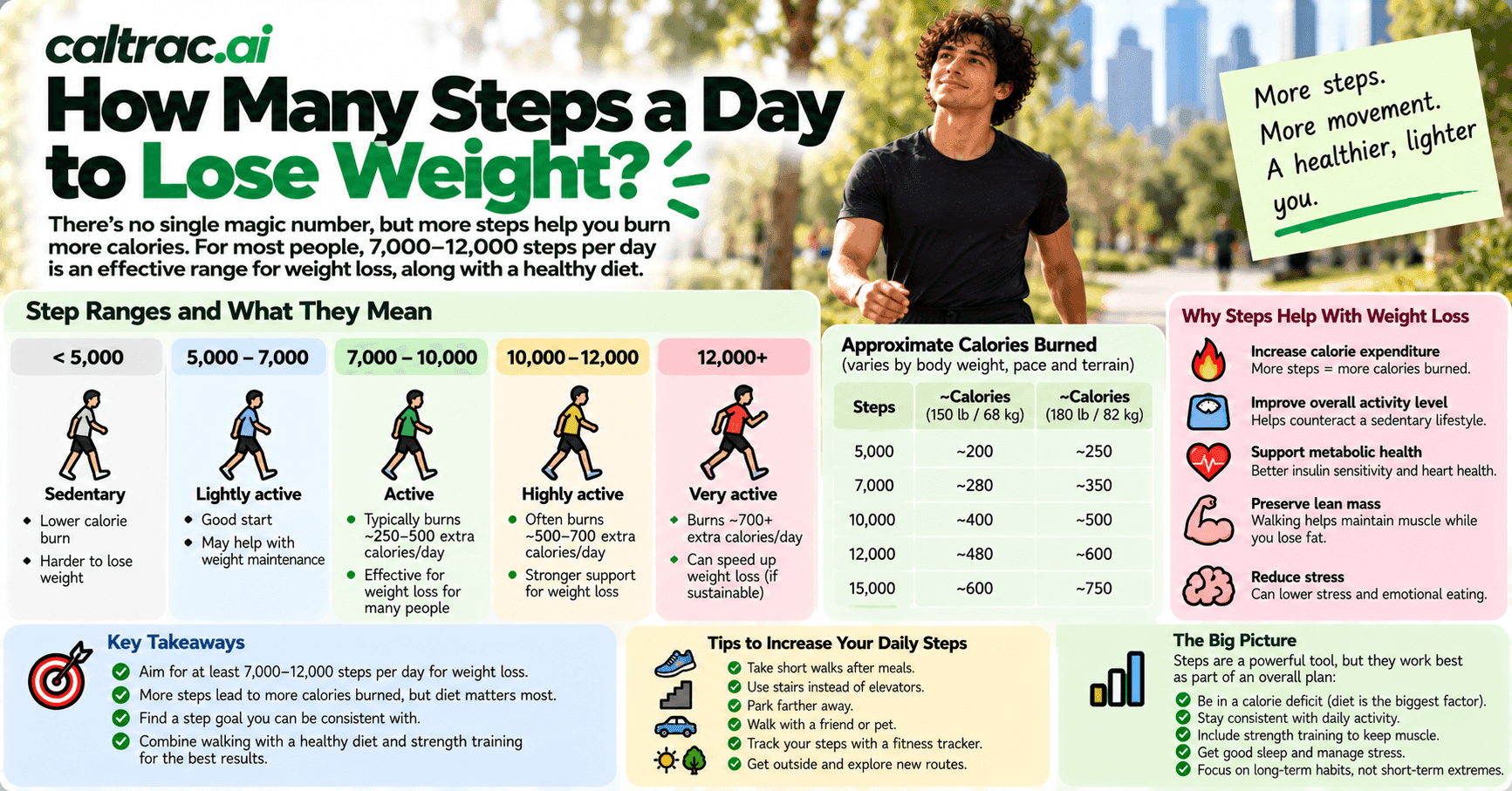
- For living longer: the benefit climbs steeply from about 4,000 steps a day and levels off around 6,000 to 8,000 for adults over 60 and 8,000 to 10,000 for younger adults [3] [4].
- For losing weight: people who lost 10% or more of their body weight in an 18-month trial averaged about 9,800 steps a day, including about 3,500 at a brisk pace [5].
- In calories: 1,000 steps at a normal walking pace burns roughly 35 to 50 kcal gross for a 60 to 90 kg adult, of which about 25 to 36 kcal is above what you would have burned sitting; 10,000 steps is about 250 to 300 kcal net for most adults [6] [7]. The steps to calories calculator gives your own figure.
- The catch: walking alone produces modest weight loss, around 1.3 kg in typical 16-week programmes [8] [9]. Steps work best as the movement side of a calorie deficit, not instead of one.
What the Research Says About Steps and Health
The best evidence on steps is about mortality, not weight, and it is strong. A 2022 meta-analysis of 15 cohorts and 47,471 adults found that compared with the least active quarter (a median of 3,553 steps a day), the risk of death was 40% lower in the next quarter (5,801 steps), 45% lower in the third (7,842) and 53% lower in the most active (10,901). The curve flattened at 6,000 to 8,000 steps for adults aged 60 and over, and at 8,000 to 10,000 for those under 60 [3]. Walking speed added nothing once total steps were accounted for.
A US national sample told the same story: compared with 4,000 steps a day, 8,000 steps was associated with about half the death rate and 12,000 with about a third [10]. The largest analysis to date, with 226,889 people, found each additional 1,000 steps a day associated with 15% lower all-cause mortality, with benefits beginning above about 3,900 steps [4]. In older women, even 4,400 steps a day was associated with substantially lower mortality than 2,700, with the benefit levelling off near 7,500 [11].
The headline: moving from very few steps to a moderate number is where most of the health benefit lives. Going from 8,000 to 12,000 helps less than going from 3,000 to 6,000.
What the Research Says About Steps and Weight Loss
Here the evidence is more modest, and worth being honest about.
A meta-analysis of pedometer programmes without any dietary change found an average weight loss of 1.27 kg over a median of 16 weeks, about 0.05 kg a week [8]. A review of 32 randomised walking trials in inactive adults found walking alone produced 1.37 kg of weight loss, a 1.5 cm smaller waist and lower blood pressure [9]. Useful, not transformative.
Steps matter much more when combined with a diet. In an 18-month trial of diet plus activity in 260 adults, those who lost 10% or more of their body weight were averaging 9,822 steps a day by the end, with about 3,500 of them in brisk bouts, compared with about 7,800 steps for those who lost little or gained [5]. The difference between the two groups, roughly 2,000 extra steps a day, is 15 to 20 minutes of walking.
Why does walking alone do so little on the scale? Partly because the calories are smaller than people assume, and partly because the body compensates. Across 1,754 adults measured with the gold-standard doubly labelled water method, about 28% of the energy spent on activity was offset by reductions elsewhere, so only 72% of your walking calories count toward the deficit [12].
How Many Calories Do Steps Burn?
The honest answer depends on body weight and pace. The standard reference is the Compendium of Physical Activities, which assigns walking at a normal 3 mph pace 3.3 METs, brisk walking at 3.5 mph 3.8 METs, and very brisk walking at 4 mph 5.0 METs [7] [6]. One MET is resting energy expenditure, roughly 1 kcal per kilogram per hour. Calories per minute is METs × 3.5 × body weight in kg ÷ 200.
At a normal pace most adults take about 100 steps a minute, which is the cadence that counts as moderate activity [13], so 1,000 steps is about 10 minutes. Here is what that produces. "Gross" is the total burned while walking; "net" subtracts the 1 MET you would have burned sitting still, which is the figure that counts toward a deficit.
| Body weight | 1,000 steps, gross | 1,000 steps, net | 10,000 steps, gross | 10,000 steps, net |
|---|---|---|---|---|
| 60 kg | 35 kcal | 24 kcal | 350 kcal | 240 kcal |
| 75 kg | 43 kcal | 30 kcal | 430 kcal | 300 kcal |
| 90 kg | 52 kcal | 36 kcal | 520 kcal | 360 kcal |
Harvard Health's tables land in the same place: a 70 kg person burns about 133 kcal per 30 minutes at 3.5 mph and 175 at 4 mph [14]. The widely repeated "100 calories per mile" is a rule of thumb rather than a measured figure; for a 70 kg adult the compendium-based estimate is closer to 75 to 90 kcal per mile gross.
So the often-quoted idea that 10,000 steps burns 500 calories is true only for a heavier person counting gross calories. For most adults, 10,000 steps is worth about 250 to 300 kcal net; for a 75 kg adult at an average pace it is roughly 280 to 300 kcal, and burning 500 kcal net takes 16,000 to 20,000 steps. Caltrac's steps to calories calculator does this for your own weight, height and pace, showing both the net and gross figures. After the body's 28% compensation [12], the real contribution of a 10,000-step day for that 75 kg adult is closer to 200 kcal. That is still worth having. It is roughly a 500 kcal deficit's worth every two to three days, or about 10 kg a year if everything else held constant, which it never quite does because the body adapts as it shrinks [15].
Your Watch Counts Steps Well and Calories Badly
Two separate things happen when you look at your tracker. A systematic review of 158 studies found that Fitbit, Apple Watch and Samsung devices measure steps accurately in laboratory conditions, but concluded that "for energy expenditure, no brand was accurate" [16]. In a head-to-head test of seven wrist devices against laboratory measurement, none estimated energy expenditure within 20% of the true value, and the errors were worst for walking [17].
The practical rule: trust the step count, distrust the calorie count. If you are going to add exercise calories back to your food budget, use the net figures from the table above and halve them for safety, rather than the number your watch displays.
Steps and Net Calories
This is where steps connect to a diet. Your net calories for the day are what you ate minus what you burned, and steps are the most reliable, most measurable part of the "burned" side that you actually control. Someone who adds 5,000 steps to a sedentary day adds roughly 150 kcal of genuine extra expenditure, which is the difference between a 500 kcal deficit and a 350 kcal one.
Caltrac reads your step and activity data from Apple Health on iPhone or Health Connect on Android and shows a net calorie figure alongside what you logged. Setup guides are here for Apple Health and Health Connect. For the "activity level" question in the calorie calculator, a good rule from the step indices is: under 5,000 steps a day is sedentary, 5,000 to 7,500 lightly active, 7,500 to 10,000 moderately active, and over 10,000 active [2].
The Case for Steps Beyond the Calories
The strongest argument for walking is not the 300 calories. It is that walking is the one form of activity almost everyone keeps doing. Lean and obese adults differ remarkably little in deliberate exercise; the difference is in daily movement. In a study that measured posture every half second for ten days, obese participants sat about two hours a day longer than lean ones, a gap worth roughly 350 kcal a day if closed [18]. Steps are the simplest way to close it.
Walking also protects the thing diets put at risk. Weight loss from calorie restriction alone takes muscle with it; adding activity preserves more of it, and a deficit built on a higher protein intake preserves still more [19].
A Four-Week Step Plan
Measure your current average for a week first; the typical office worker lands at 4,000 to 6,000 steps.
- Week 1: add 1,000 steps a day to your baseline. A 10-minute walk after one meal does it.
- Week 2: add another 1,000. Two post-meal walks, or one 20-minute walk.
- Week 3: add 1,000 more and make one 30-minute walk brisk, at 100 or more steps a minute. Thirty minutes at that cadence is 3,000 to 4,000 steps and counts as the moderate activity most guidelines ask for [13].
- Week 4: hold at baseline plus 3,000 to 4,000. For most people that lands between 8,000 and 10,000, which is where the health curve flattens [3] and where the weight-loss trial winners were [5].
Do not chase 15,000. The marginal health gain above 10,000 is small, the calorie gain is modest, and the extra hour is better spent sleeping or cooking.
That is where tracking earns its keep. Snap a photo of your lunch or type what you ate and track it automatically with Caltrac. Your steps flow in from Apple Health or Health Connect, and your net calorie count shows what today's walking actually bought you. Walk the steps; let the app do the arithmetic.
Frequently Asked Questions
How many steps a day to lose weight? Diet-plus-activity trial participants who lost 10% or more of their weight averaged about 9,800 steps a day, including about 3,500 brisk ones [5]. Walking alone, without a calorie deficit, produces about 1.3 kg of loss over four months [8].
How many calories does 10,000 steps burn? About 250 to 300 kcal net above sitting for most adults, or 350 to 520 kcal gross across 60 to 90 kg body weights at a normal pace, based on Compendium MET values [6] [7]. Burning 500 kcal net takes roughly 16,000 to 20,000 steps; the steps to calories calculator gives your figure.
Is 10,000 steps a day necessary? No. The number originated as a 1965 pedometer slogan [1]. Mortality benefits level off around 6,000 to 8,000 steps for older adults and 8,000 to 10,000 for younger adults [3].
How many steps in a mile? About 2,000 for most adults, a figure that dates back to the Roman mile of a thousand paces [1].
Are fitness tracker calories accurate? Step counts generally are; calorie estimates are not. No wrist device tested achieved energy-expenditure error below 20% [17] [16].
Does walking speed matter? For longevity, total steps matter more than pace once steps are counted [3]. For weight loss, brisk bouts of about 100 steps a minute helped in the trial data [5] [13].
References
- Bassett DR Jr, Toth LP, LaMunion SR, Crouter SE. Step Counting: A Review of Measurement Considerations and Health-Related Applications. Sports Medicine. 2017;47(7):1303-1315. pubmed.ncbi.nlm.nih.gov
- Tudor-Locke C, Bassett DR Jr. How many steps/day are enough? Preliminary pedometer indices for public health. Sports Medicine. 2004;34(1):1-8. pubmed.ncbi.nlm.nih.gov
- Paluch AE, et al. Daily steps and all-cause mortality: a meta-analysis of 15 international cohorts. Lancet Public Health. 2022;7(3):e219-e228. pubmed.ncbi.nlm.nih.gov
- Banach M, et al. The association between daily step count and all-cause and cardiovascular mortality: a meta-analysis. European Journal of Preventive Cardiology. 2023;30(18):1975-1985. pubmed.ncbi.nlm.nih.gov
- Creasy SA, et al. Pattern of Daily Steps is Associated with Weight Loss: Secondary Analysis from the Step-Up Randomized Trial. Obesity. 2018;26(6):977-984. pubmed.ncbi.nlm.nih.gov
- Compendium of Physical Activities, 2011 walking category table (walking 2.8 to 3.2 mph, level, moderate pace: 3.3 METs; 3.5 mph brisk: 3.8 METs; 4.0 mph very brisk: 5.0 METs). sites.google.com
- Ainsworth BE, et al. 2011 Compendium of Physical Activities: a second update of codes and MET values. Medicine & Science in Sports & Exercise. 2011;43(8):1575-1581. pubmed.ncbi.nlm.nih.gov
- Richardson CR, et al. A meta-analysis of pedometer-based walking interventions and weight loss. Annals of Family Medicine. 2008;6(1):69-77. pubmed.ncbi.nlm.nih.gov
- Murtagh EM, et al. The effect of walking on risk factors for cardiovascular disease: an updated systematic review and meta-analysis of randomised control trials. Preventive Medicine. 2015;72:34-43. pubmed.ncbi.nlm.nih.gov
- Saint-Maurice PF, et al. Association of Daily Step Count and Step Intensity With Mortality Among US Adults. JAMA. 2020;323(12):1151-1160. pubmed.ncbi.nlm.nih.gov
- Lee IM, et al. Association of Step Volume and Intensity With All-Cause Mortality in Older Women. JAMA Internal Medicine. 2019;179(8):1105-1112. pubmed.ncbi.nlm.nih.gov
- Careau V, et al. Energy compensation and adiposity in humans. Current Biology. 2021;31(20):4659-4666. pubmed.ncbi.nlm.nih.gov
- Tudor-Locke C, Hatano Y, Pangrazi RP, Kang M. Revisiting "how many steps are enough?" Medicine & Science in Sports & Exercise. 2008;40(7 Suppl):S537-S543. pubmed.ncbi.nlm.nih.gov
- Harvard Health Publishing. Calories burned in 30 minutes for people of three different weights. health.harvard.edu
- Hall KD, et al. Quantification of the effect of energy imbalance on bodyweight. Lancet. 2011;378(9793):826-837. pubmed.ncbi.nlm.nih.gov
- Fuller D, et al. Reliability and Validity of Commercially Available Wearable Devices for Measuring Steps, Energy Expenditure, and Heart Rate: Systematic Review. JMIR mHealth and uHealth. 2020;8(9):e18694. pubmed.ncbi.nlm.nih.gov
- Shcherbina A, et al. Accuracy in Wrist-Worn, Sensor-Based Measurements of Heart Rate and Energy Expenditure in a Diverse Cohort. Journal of Personalized Medicine. 2017;7(2):3. pubmed.ncbi.nlm.nih.gov
- Levine JA, et al. Interindividual variation in posture allocation: possible role in human obesity. Science. 2005;307(5709):584-586. pubmed.ncbi.nlm.nih.gov
- Leidy HJ, et al. The role of protein in weight loss and maintenance. American Journal of Clinical Nutrition. 2015;101(6):1320S-1329S. pubmed.ncbi.nlm.nih.gov