


Intermittent fasting is the rare diet trend that has been tested properly, repeatedly, against the thing it claims to beat. The verdict from those trials is consistent and more useful than either the hype or the backlash: fasting works about as well as ordinary calorie restriction, for the same reason, and it suits some people far better than others. Fifteen percent of Americans follow it [1]. This guide explains the main methods, what each trial found, who should not fast, and how to decide whether it is the right tool for you.
The Methods
Intermittent fasting is a family of patterns that restrict when you eat rather than what [2]:
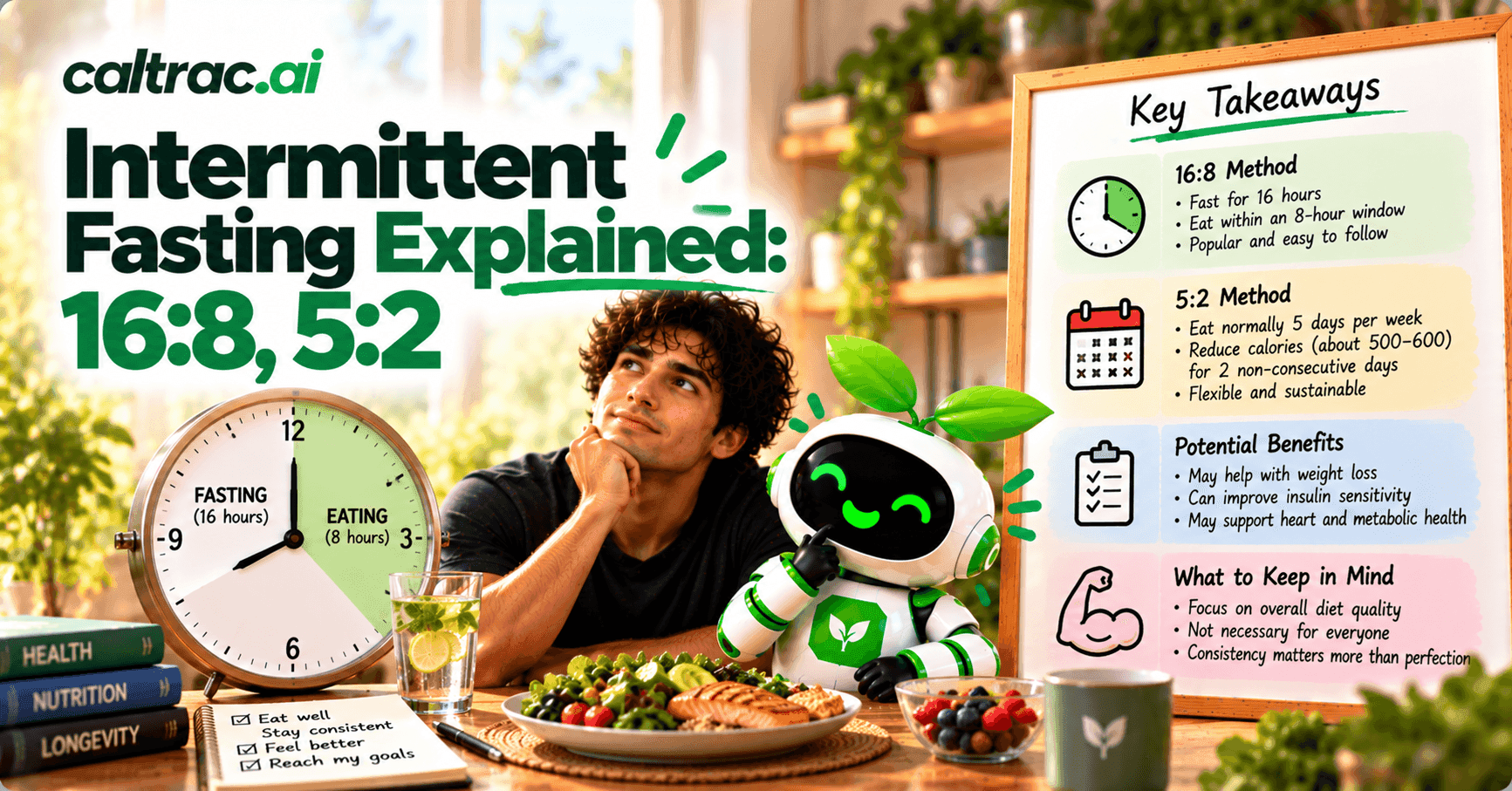
- Time-restricted eating (TRE): all food inside a daily window, most commonly 16:8 (eat for eight hours, fast for sixteen), sometimes 18:6 or shorter.
- 5:2: eat normally five days a week; on two non-consecutive days eat about 500 to 600 kcal.
- Alternate-day fasting (ADF): alternate normal days with fast days of 0 to 500 kcal.
- Early TRE: a TRE window that ends in the afternoon, typically 7 a.m. to 3 p.m.
A 2019 review in the New England Journal of Medicine set out the biological rationale, "metabolic switching" from glucose to ketones during the fast, with most of the evidence for health benefits coming from animal studies and short human trials [3].
What the Trials Found
5:2 versus daily restriction
In the first rigorous test, 107 overweight women followed either 5:2 (two days at about 650 kcal) or continuous 25% restriction for six months. Weight loss was 6.4 kg versus 5.6 kg, not significantly different, with slightly better insulin sensitivity on the intermittent arm [4].
Alternate-day fasting versus daily restriction
One hundred obese adults were randomised to alternate-day fasting, daily calorie restriction or control for a year. Weight loss at twelve months was 6.0% versus 5.3%, not significantly different, and the fasting group had the highest dropout rate at 38% against 29%. The authors concluded ADF "did not produce superior adherence, weight loss, weight maintenance, or cardioprotection" [5].
16:8 on its own
The TREAT trial gave 116 adults either a 16:8 window (noon to 8 p.m.) or three structured meals a day for twelve weeks, with no calorie instruction. The TRE group lost 0.94 kg, the control group 0.68 kg, a difference of 0.26 kg that was indistinguishable from zero, and the TRE group lost slightly more lean mass [6]. Without a calorie target, a late eating window did essentially nothing.
Shorter windows
When the window shrinks, intake does fall. Adults with obesity given a 4-hour (3 to 7 p.m.) or 6-hour (1 to 7 p.m.) window for eight weeks ate about 550 fewer calories a day without counting and lost about 3% of body weight in both groups [7]. The mechanism is not metabolic: a four-hour window simply makes it hard to eat enough.
Fasting added to a calorie target
The cleanest test asked whether timing adds anything once calories are controlled. In a one-year trial, 139 adults with obesity followed a calorie-restricted diet with or without an 8 a.m. to 4 p.m. eating window. The fasting group lost 8.0 kg and the non-fasting group 6.3 kg, a difference that did not reach significance [8]. Timing added nothing beyond the calorie cut.
Early windows
One exception favours fasting, provided the window is early. Ninety adults with obesity were given calorie restriction with either a 7 a.m. to 3 p.m. window or a window of twelve hours or more. The early group lost 2.3 kg more over fourteen weeks, equivalent to a further 214 kcal a day, though fat loss was not significantly different [9]. This fits the finding that eating the same calories later in the day raises hunger and lowers energy expenditure [10]. If you fast, fast in the evening, not the morning.
The overview
A systematic review of 27 trials found intermittent fasting produced 0.8 to 13% weight loss over 2 to 26 weeks, with no serious adverse events, and the twelve trials that compared it with calorie restriction found the two equivalent [11]. An umbrella review of 130 randomised trials found only one association backed by high-quality evidence, a moderate BMI reduction from modified alternate-day fasting over one to two months, and noted that fasting was associated with reduced fat-free mass [12].
What That Adds Up To
Intermittent fasting works when, and because, it reduces calories. It is not a metabolic trick, and it does not outperform eating the same calories across the day [8] [5] [4]. What it offers is a rule. For people who find "eat 500 fewer calories" vague and "eat nothing after 7 p.m." clear, that rule is worth a great deal. For people who get hungry, irritable or prone to evening overeating when they skip breakfast, it is worth nothing, and the TREAT trial's lean-mass finding is a reminder that an unmanaged fast can cost muscle [6].
Who Should Not Fast
Intermittent fasting is not appropriate for everyone, and the exclusions are consistent across clinical sources [13] [14]:
- People with type 1 diabetes, or type 2 diabetes on insulin or sulphonylureas, because of hypoglycaemia risk.
- Anyone with a history of an eating disorder; fasting can reactivate restrictive patterns.
- Pregnant or breastfeeding women.
- Children and adolescents.
- People who are underweight or malnourished, and those who must take medication with food.
If you are on prescription medication of any kind, ask your prescriber before changing when you eat.
If You Fast, Do It Well
Four rules from the evidence.
1. Keep a calorie target anyway. Fasting without one produced a quarter of a kilo in twelve weeks [6]. Set maintenance and a deficit with the calorie calculator; the fasting window is how you hit it, not a replacement for it.
2. Protect protein. Fasting compresses eating time, and protein is the nutrient that suffers. The umbrella review's finding of reduced fat-free mass [12] is the predictable result of 1.6 g/kg of protein being squeezed into two meals. Aim for 1.2 to 1.6 g per kilogram [15], in servings of about 0.4 g/kg [16], which usually means three protein-anchored meals inside the window rather than two. Set the figure in the macro calculator. In trained women, an eight-hour window with protein held at 1.6 g/kg produced the same muscle gains as unrestricted eating [17].
3. Fast in the evening. An early window beat a late one by 2.3 kg over fourteen weeks at the same calories [9]; a noon-to-8 p.m. window beat nothing [6]. If 7 a.m. to 3 p.m. is impractical, 9 a.m. to 5 p.m. keeps the principle.
4. Choose the mildest version that works. Alternate-day fasting had the highest dropout in its trial [5]. A 12-hour window closed after dinner is an intermittent fast that most people can keep for years, and keeping it is the only thing that matters.
How to Decide
Ask two questions. Do you overeat in the evening? If yes, an early eating window attacks the problem directly. Do you get hungry and over-eat when you skip meals? If yes, fasting will fight you, and a steady 500 to 750 kcal deficit [18] spread across the day will serve you better. The trials say either path reaches the same place; your temperament decides which one you will still be on in six months.
That is where tracking earns its keep. Fasting hides the calorie question behind a clock, and the trials show the calories are what matter. Snap a photo of each meal inside your window or type what you ate and track it automatically with Caltrac. You will see whether the window actually produced a deficit and whether protein made it in, and your Apple Health-powered net calorie count shows the day as a whole. Set the window; let the app check the calories.
Frequently Asked Questions
Does intermittent fasting work for weight loss? Yes, about as well as ordinary calorie restriction and no better. Trials of 5:2, alternate-day fasting and time-restricted eating found weight loss equivalent to daily restriction [4] [5] [8].
Is 16:8 effective? Only if it reduces calories. A noon-to-8 p.m. window with no calorie target produced 0.26 kg more loss than control over twelve weeks [6]. Shorter or earlier windows cut intake more [7] [9].
What is the best intermittent fasting schedule? An early window, such as 7 a.m. to 3 p.m., outperformed a late or long window by 2.3 kg over fourteen weeks at matched calories [9]. Beyond that, the best schedule is the one you keep.
Does intermittent fasting cause muscle loss? It can. An umbrella review found fasting associated with reduced fat-free mass [12]. Keeping protein at 1.2 to 1.6 g/kg and training prevented it in a trial of active women [17] [15].
Who should not do intermittent fasting? People with diabetes on insulin or sulphonylureas, anyone with a history of eating disorders, pregnant or breastfeeding women, children, and those who must take medication with food [13] [14].
Can I drink coffee while fasting? Black coffee, tea and water contain negligible calories and are standard in fasting trials. Milk and sugar add calories and technically end the fast; whether that matters depends on whether your goal is the calorie deficit or the fasting state.
References
- International Food Information Council. 2026 Food & Health Survey (intermittent fasting followed by 15% of Americans). ific.org
- Varady KA, Cienfuegos S, Ezpeleta M, Gabel K. Clinical application of intermittent fasting for weight loss: progress and future directions. Nature Reviews Endocrinology. 2022;18(5):309-321. pubmed.ncbi.nlm.nih.gov
- de Cabo R, Mattson MP. Effects of Intermittent Fasting on Health, Aging, and Disease. New England Journal of Medicine. 2019;381(26):2541-2551. pubmed.ncbi.nlm.nih.gov
- Harvie MN, et al. The effects of intermittent or continuous energy restriction on weight loss and metabolic disease risk markers: a randomized trial in young overweight women. International Journal of Obesity. 2011;35(5):714-727. pubmed.ncbi.nlm.nih.gov
- Trepanowski JF, et al. Effect of Alternate-Day Fasting on Weight Loss, Weight Maintenance, and Cardioprotection Among Metabolically Healthy Obese Adults: A Randomized Clinical Trial. JAMA Internal Medicine. 2017;177(7):930-938. pubmed.ncbi.nlm.nih.gov
- Lowe DA, et al. Effects of Time-Restricted Eating on Weight Loss and Other Metabolic Parameters in Women and Men With Overweight and Obesity: The TREAT Randomized Clinical Trial. JAMA Internal Medicine. 2020;180(11):1491-1499. pubmed.ncbi.nlm.nih.gov
- Cienfuegos S, et al. Effects of 4- and 6-h Time-Restricted Feeding on Weight and Cardiometabolic Health: A Randomized Controlled Trial in Adults with Obesity. Cell Metabolism. 2020;32(3):366-378. pubmed.ncbi.nlm.nih.gov
- Liu D, et al. Calorie Restriction with or without Time-Restricted Eating in Weight Loss. New England Journal of Medicine. 2022;386(16):1495-1504. pubmed.ncbi.nlm.nih.gov
- Jamshed H, et al. Effectiveness of Early Time-Restricted Eating for Weight Loss, Fat Loss, and Cardiometabolic Health in Adults With Obesity: A Randomized Clinical Trial. JAMA Internal Medicine. 2022;182(9):953-962. pubmed.ncbi.nlm.nih.gov
- Vujović N, et al. Late isocaloric eating increases hunger, decreases energy expenditure, and modifies metabolic pathways in adults with overweight and obesity. Cell Metabolism. 2022;34(10):1486-1498. pubmed.ncbi.nlm.nih.gov
- Welton S, et al. Intermittent fasting and weight loss: Systematic review. Canadian Family Physician. 2020;66(2):117-125. pubmed.ncbi.nlm.nih.gov
- Patikorn C, et al. Intermittent Fasting and Obesity-Related Health Outcomes: An Umbrella Review of Meta-analyses of Randomized Clinical Trials. JAMA Network Open. 2021;4(12):e2139558. pubmed.ncbi.nlm.nih.gov
- Harvard Health Publishing. Should you try intermittent fasting for weight loss? 28 July 2022. health.harvard.edu
- Cleveland Clinic. Intermittent Fasting: What It Is, Benefits and Schedules. 26 January 2026. health.clevelandclinic.org
- Leidy HJ, et al. The role of protein in weight loss and maintenance. American Journal of Clinical Nutrition. 2015;101(6):1320S-1329S. pubmed.ncbi.nlm.nih.gov
- Schoenfeld BJ, Aragon AA. How much protein can the body use in a single meal for muscle-building? Implications for daily protein distribution. Journal of the International Society of Sports Nutrition. 2018;15:10. pubmed.ncbi.nlm.nih.gov
- Tinsley GM, et al. Time-restricted feeding plus resistance training in active females: a randomized trial. American Journal of Clinical Nutrition. 2019;110(3):628-640. pubmed.ncbi.nlm.nih.gov
- Jensen MD, et al. 2013 AHA/ACC/TOS guideline for the management of overweight and obesity in adults. Circulation. 2014;129(25 Suppl 2):S102-S138. pubmed.ncbi.nlm.nih.gov