


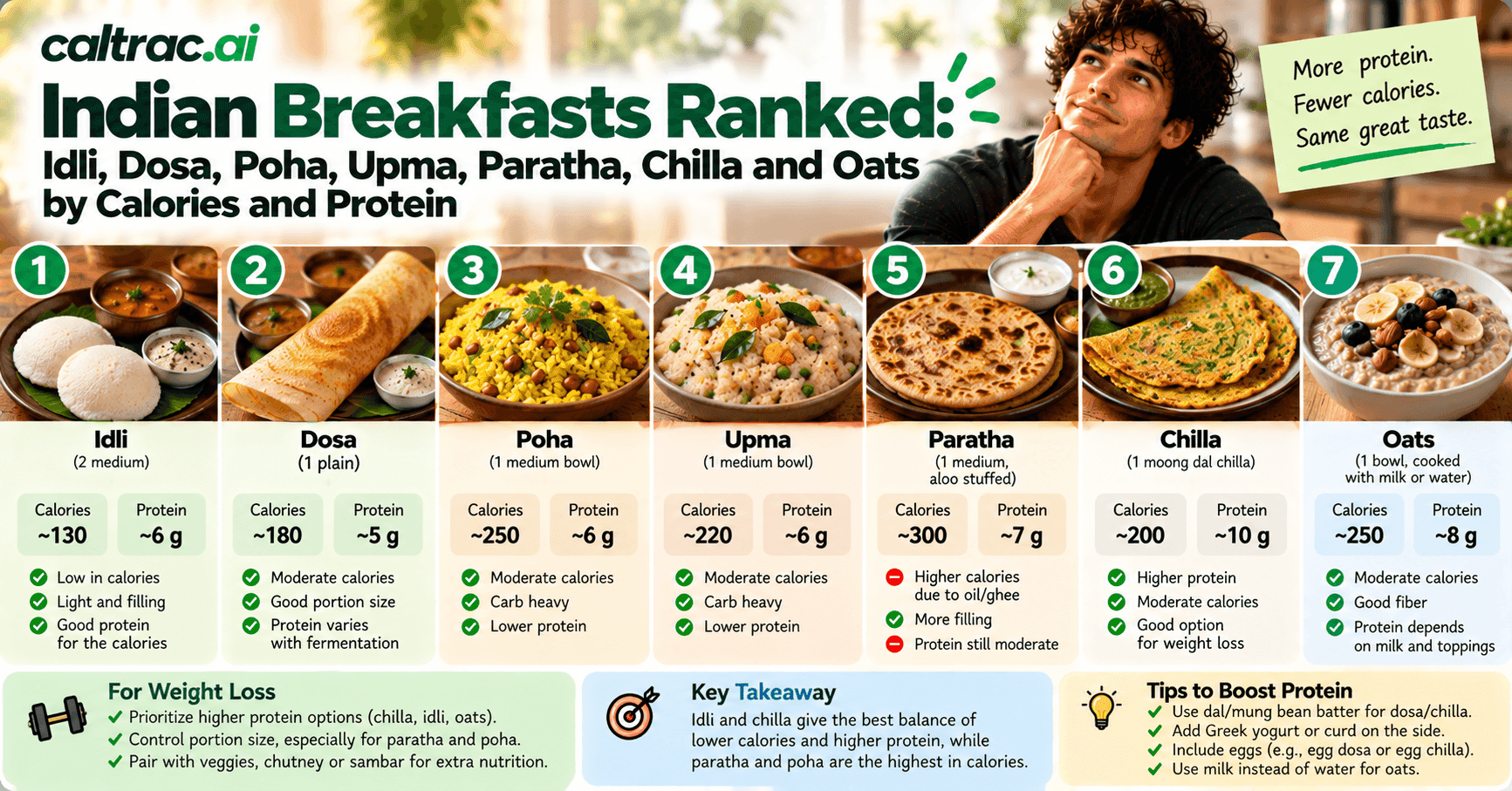
The Indian breakfast is a carbohydrate with a side of carbohydrate. Idli with sambar, poha, upma, paratha, dosa with chutney: almost every traditional option is grain or rice flour cooked in a little oil, and almost none of them delivers meaningful protein. That is not a criticism of the food, which is often low in fat and high in fibre. It is the reason so many people who eat a "healthy" Indian breakfast are hungry by eleven and short of protein by dinner.
This article ranks the common Indian breakfasts using USDA data, by calories and by protein, and then shows how to turn each one into a meal that holds you until lunch.
Why Breakfast Protein Matters
The breakfast-skipping debate is settled, and the answer is that it does not much matter: a meta-analysis of 13 trials found breakfast eaters consumed about 260 more calories a day and weighed slightly more than skippers [1]. What matters is what the breakfast is made of. When young women ate a 350 kcal breakfast with 35 g of protein rather than 13 g, they reported more fullness, had lower ghrelin and higher PYY, and snacked less on high-fat food in the evening [2]. When teenagers ate identical-calorie breakfasts of high, medium and low glycaemic index, they ate 53% more after the high-GI meal than the medium and 81% more than the low over the following five hours [3]. A refined-carbohydrate breakfast does not just lack protein; it schedules hunger.
For India specifically, the problem is structural. Indian diets draw almost 60% of their protein from cereals, which have lower digestibility and quality, and about a third of a sedentary rural population is at risk of not meeting protein requirements once quality is accounted for [4]. In Chennai, refined grains supplied 47% of calories and the highest consumers had nearly eight times the odds of metabolic syndrome [5]. The 2024 national dietary guidelines now ask that cereals and millets supply no more than 45% of calories, with pulses, beans and meat up to 15% [6]. Breakfast is where the ratio is usually worst.
Indian Breakfasts Ranked by Protein per 100 Calories
USDA FoodData Central values, as prepared, per typical serving. The last column is the one that decides how long the meal lasts.
| Rank | Breakfast | Serving | Calories | Protein | Fibre | Protein per 100 kcal |
|---|---|---|---|---|---|---|
| 1 | Eggs, 2 boiled, with 1 slice whole-wheat bread [7] [8] | 100 g + 30 g | 231 | 16.3 g | 1.8 g | 7.1 g |
| 2 | Idli, 3, with 1 cup sambar [9] [10] | 114 g + 248 g | 359 | 18 g | 16.5 g | 5.0 g |
| 3 | Idli, 3, plain [9] | 114 g | 146 | 7.3 g | 6.6 g | 5.0 g |
| 4 | Besan chilla, 2 (60 g besan, 1 tsp oil) [11] [12] | 2 chillas | 272 | 13.4 g | 6.5 g | 4.9 g |
| 5 | Oats, 40 g, cooked in water [13] | 40 g dry | 152 | 5.3 g | 4 g | 3.5 g |
| 6 | Roti, 2, with 100 g curd [14] [15] | 80 g + 100 g | 300 | 9.8 g | 7.8 g | 3.3 g |
| 7 | Masala dosa, 1 medium [16] | 267 g | 491 | 14.6 g | 5.9 g | 3.0 g |
| 8 | Plain dosa, 1 large [17] | 155 g | 326 | 8.8 g | 2.8 g | 2.7 g |
| 9 | Upma, 1 cup [18] | 170 g | 148 | 3.4 g | 2.2 g | 2.3 g |
| 10 | Aloo paratha, 2, with 1 tsp ghee [19] [12] | 140 g | 496 | 9 g | 13.4 g | 1.8 g |
| 11 | Poha, 50 g dry, with 1 tsp oil [20] [12] | 50 g dry | 207 | 3.4 g | 3.4 g | 1.6 g |
Add the usual accompaniments and the picture shifts further: a tablespoon of sweet chutney is 39 kcal and 7 g of sugar [21], and a cup of chai with milk and sugar is 122 kcal and 21 g of sugar [22]. Two chais with breakfast add 244 calories and no protein.
What the ranking shows:
- Eggs on toast tops the table at 7.1 g of protein per 100 kcal, and it is the fastest breakfast to make.
- Idli is the best traditional choice, and sambar is why. Three plain idlis are a light 146 kcal; with a cup of dal-based sambar the meal reaches 18 g of protein and 16 g of fibre for 359 kcal, the best protein and fibre total on the list [9] [10]. Idli is steamed, so it carries almost no fat.
- Besan chilla is the hidden winner. Chickpea flour is 22 g of protein per 100 g [11], so two chillas deliver 13 g for 272 kcal, with fibre. It is the only traditional breakfast that is a pulse rather than a grain.
- Poha and upma are the weakest. Both are refined grain in oil: 2 to 3 g of protein per serving and the lowest protein density on the table [20] [18]. They are light, which is their virtue, and empty, which is their problem.
- Paratha is the calorie trap. Two aloo parathas with ghee are nearly 500 kcal, a third of a weight-loss day, for 9 g of protein [19]. The fibre from whole wheat is genuine; the fat is the cost.
- Masala dosa is a full meal. At 491 kcal it outweighs most lunches, and the protein, 14.6 g, is respectable only because the serving is large [16].
Making Each Breakfast Hold Until Lunch
Research puts a useful breakfast at 25 to 35 g of protein, roughly 0.4 g per kilogram of body weight for a 70 kg adult, as part of a daily 1.2 to 1.6 g/kg [23] [24]. Here is the cheapest way to get each traditional breakfast there.
Idli sambar (18 g): add 100 g of nonfat Greek yogurt or hung curd on the side (54 kcal, 9.5 g protein) [25], or two egg whites. Total 27 g for about 410 kcal.
Besan chilla (13 g): make three instead of two, or stuff them with 50 g of paneer or crumbled tofu. Three chillas with 50 g paneer is about 540 kcal and 26 g of protein; two with 100 g of Greek yogurt is 326 kcal and 23 g.
Poha (3 g): the fix is peanuts and sprouts. Add 30 g of peanuts (170 kcal, 7.7 g protein) [26] and 100 g of boiled moong sprouts (105 kcal, 7 g) [27]: 482 kcal, 18 g protein. Better still, halve the poha and double the sprouts.
Upma (3 g): stir in 100 g of cooked moong dal or add two boiled eggs on the side. Upma with two eggs is 303 kcal and 16 g of protein [7].
Oats (5 g): cook in milk rather than water and add 150 g of Greek yogurt or a scoop of whey. Forty grams of oats with 150 g of nonfat Greek yogurt and 100 g of banana is 322 kcal and 20 g of protein [13] [25] [28]. Savoury oats with an egg stirred in works equally well.
Roti with curd (10 g): swap the whole-milk curd for 150 g of hung curd or Greek yogurt (81 kcal, 14 g), or add a two-egg bhurji. Two rotis with egg bhurji is about 480 kcal and 22 g.
Paratha (9 g): make it a paneer paratha rather than aloo, and eat one with 100 g of curd rather than two with ghee. One paneer paratha with curd lands near 350 kcal and 16 g.
Dosa (9 g): order the plain dosa, not the masala, and the sambar, not the chutney. One plain dosa with a cup of sambar is 539 kcal and 19 g; add a boiled egg for 23 g. The coconut chutney is fat, the sweet chutney is sugar, and the sambar is the protein [10] [21].
The Chai Question
Chai is not a breakfast problem. Two cups of it are. At 122 kcal and 21 g of sugar per cup [22], two with breakfast and two through the morning are 488 calories, more than the idli sambar they accompany, and 84 g of sugar, well above any daily recommendation. Make it with less sugar, or less milk, or fewer cups. One a day at breakfast is a pleasure worth 122 calories; four is a meal.
A Rule of Thumb
Every traditional Indian breakfast can be made to work with one addition: a pulse, an egg, a dairy protein or a handful of nuts. The grain is the base; the protein has to be added on purpose, because the recipes do not include it. Aim for 20 g or more at breakfast, set your daily protein figure in the macro calculator, and your calorie target in the calorie calculator, and the poha-and-chai morning that left you hungry at eleven becomes a meal that carries you to lunch.
That is where tracking earns its keep. Snap a photo of the plate or type "3 idli, 1 cup sambar, 1 chai" and track it automatically with Caltrac. You will see the protein number that explains the eleven o'clock hunger, and your Apple Health-powered net calorie count shows how breakfast fits the day. Eat the idli; let the app count the protein.
Frequently Asked Questions
What is the healthiest Indian breakfast for weight loss? Idli with sambar, for protein and fibre at low fat, and besan chilla, the only common breakfast built on a pulse rather than a grain [9] [10] [11].
How many calories are in idli? About 49 kcal per 38 g idli, or 146 for three, with 7.3 g of protein and almost no fat [9]. A cup of sambar adds 213 kcal and 10.7 g of protein [10].
Is poha good for weight loss? It is light, about 207 kcal for a 50 g dry serving with oil, but carries only 3 g of protein [20]. Adding peanuts and sprouts turns it into a meal.
How many calories in a masala dosa? About 491 kcal for a medium 267 g dosa with filling, with 14.6 g of protein [16]. A plain dosa is about 326 kcal [17].
How many calories in aloo paratha? About 228 kcal per 70 g paratha, or 496 for two with a teaspoon of ghee, with 9 g of protein [19] [12].
How much protein should an Indian breakfast have? Aim for 20 to 30 g, roughly 0.4 g per kilogram of body weight [24], as part of 1.2 to 1.6 g/kg a day [23]. Most traditional breakfasts deliver 3 to 10 g without additions.
References
- Sievert K, et al. Effect of breakfast on weight and energy intake: systematic review and meta-analysis of randomised controlled trials. BMJ. 2019;364:l42. pubmed.ncbi.nlm.nih.gov
- Leidy HJ, Ortinau LC, Douglas SM, Hoertel HA. Beneficial effects of a higher-protein breakfast on the appetitive, hormonal, and neural signals controlling energy intake regulation in overweight/obese, "breakfast-skipping," late-adolescent girls. American Journal of Clinical Nutrition. 2013;97(4):677-688. pubmed.ncbi.nlm.nih.gov
- Ludwig DS, et al. High glycemic index foods, overeating, and obesity. Pediatrics. 1999;103(3):E26. pubmed.ncbi.nlm.nih.gov
- Swaminathan S, Vaz M, Kurpad AV. Protein intakes in India. British Journal of Nutrition. 2012;108 Suppl 2:S50-S58. pubmed.ncbi.nlm.nih.gov
- Radhika G, Van Dam RM, Sudha V, Ganesan A, Mohan V. Refined grain consumption and the metabolic syndrome in urban Asian Indians (Chennai Urban Rural Epidemiology Study 57). Metabolism. 2009;58(5):675-681. pubmed.ncbi.nlm.nih.gov
- ICMR-National Institute of Nutrition. Dietary Guidelines for Indians, Revised Edition 2024 (cereals and millets not more than 45% of calories; pulses, beans and meat up to 15%). nin.res.in
- USDA FoodData Central. Egg, whole, hard-boiled: 155 kcal, 12.6 g protein per 100 g. SR Legacy 173424. fdc.nal.usda.gov
- USDA FoodData Central. Bread, whole-wheat: 252 kcal, 12.4 g protein, 6.0 g fibre per 100 g. SR Legacy 172688. fdc.nal.usda.gov
- USDA FoodData Central, FNDDS. Idli: 128 kcal, 6.4 g protein, 0.4 g fat, 5.8 g fibre per 100 g; 1 idli 38 g. FDC ID 2708346. fdc.nal.usda.gov
- USDA FoodData Central, FNDDS. Sambar, vegetable stew: 86 kcal, 4.3 g protein, 4.0 g fibre per 100 g; 1 cup 248 g. FDC ID 2707430. fdc.nal.usda.gov
- USDA FoodData Central. Chickpea flour (besan): 387 kcal, 22.4 g protein, 10.8 g fibre per 100 g. SR Legacy 174288. fdc.nal.usda.gov
- USDA FoodData Central. Oil, olive, salad or cooking: 884 kcal per 100 g (1 tsp about 4.5 g, 40 kcal). SR Legacy 171413. fdc.nal.usda.gov
- USDA FoodData Central. Cereals, oats, regular and quick, dry: 379 kcal, 13.2 g protein, 10.1 g fibre per 100 g. SR Legacy 173904. fdc.nal.usda.gov
- USDA FoodData Central, FNDDS. Bread, chapatti or roti: 299 kcal, 7.9 g protein, 9.7 g fibre per 100 g; 1 medium 40 g. FDC ID 2707713. fdc.nal.usda.gov
- USDA FoodData Central. Yogurt, plain, whole milk: 61 kcal, 3.5 g protein per 100 g. SR Legacy 171284. fdc.nal.usda.gov
- USDA FoodData Central, FNDDS. Dosa, with filling: 184 kcal, 5.5 g protein, 4.3 g fat per 100 g; 1 medium 267 g. FDC ID 2709129. fdc.nal.usda.gov
- USDA FoodData Central, FNDDS. Dosa, plain: 210 kcal, 5.7 g protein, 4.1 g fat per 100 g; 1 large 155 g. FDC ID 2708347. fdc.nal.usda.gov
- USDA FoodData Central, FNDDS. Upma: 87 kcal, 2.0 g protein, 2.6 g fat per 100 g; 1 cup 170 g. FDC ID 2709128. fdc.nal.usda.gov
- USDA FoodData Central, FNDDS. Bread, paratha: 326 kcal, 6.4 g protein, 13.2 g fat, 9.6 g fibre per 100 g; 1 paratha 70 g. FDC ID 2707715. fdc.nal.usda.gov
- USDA FoodData Central, Branded. Deep Thick Poha (flattened rice), dry: 333 kcal, 6.7 g protein, 0 g fat, 6.7 g fibre per 100 g. FDC ID 2265565. fdc.nal.usda.gov
- USDA FoodData Central, FNDDS. Chutney: 246 kcal, 42.7 g sugar per 100 g; 1 tbsp 16 g. FDC ID 2709309. fdc.nal.usda.gov
- USDA FoodData Central, FNDDS. Tea, hot, with milk: 51 kcal, 8.7 g sugar per 100 g; 1 cup 240 g. FDC ID 2710506. fdc.nal.usda.gov
- Leidy HJ, et al. The role of protein in weight loss and maintenance. American Journal of Clinical Nutrition. 2015;101(6):1320S-1329S. pubmed.ncbi.nlm.nih.gov
- Schoenfeld BJ, Aragon AA. How much protein can the body use in a single meal for muscle-building? Implications for daily protein distribution. Journal of the International Society of Sports Nutrition. 2018;15:10. pubmed.ncbi.nlm.nih.gov
- USDA FoodData Central. Yogurt, Greek, nonfat, plain: 54 kcal, 9.5 g protein per 100 g. SR Legacy 171312. fdc.nal.usda.gov
- USDA FoodData Central. Peanuts, raw: 567 kcal, 25.8 g protein per 100 g. SR Legacy 172430. fdc.nal.usda.gov
- USDA FoodData Central. Mung beans, cooked: 105 kcal, 7 g protein, 7.6 g fibre per 100 g. SR Legacy 174257. fdc.nal.usda.gov
- USDA FoodData Central. Bananas, raw: 89 kcal per 100 g. SR Legacy 173944. fdc.nal.usda.gov