

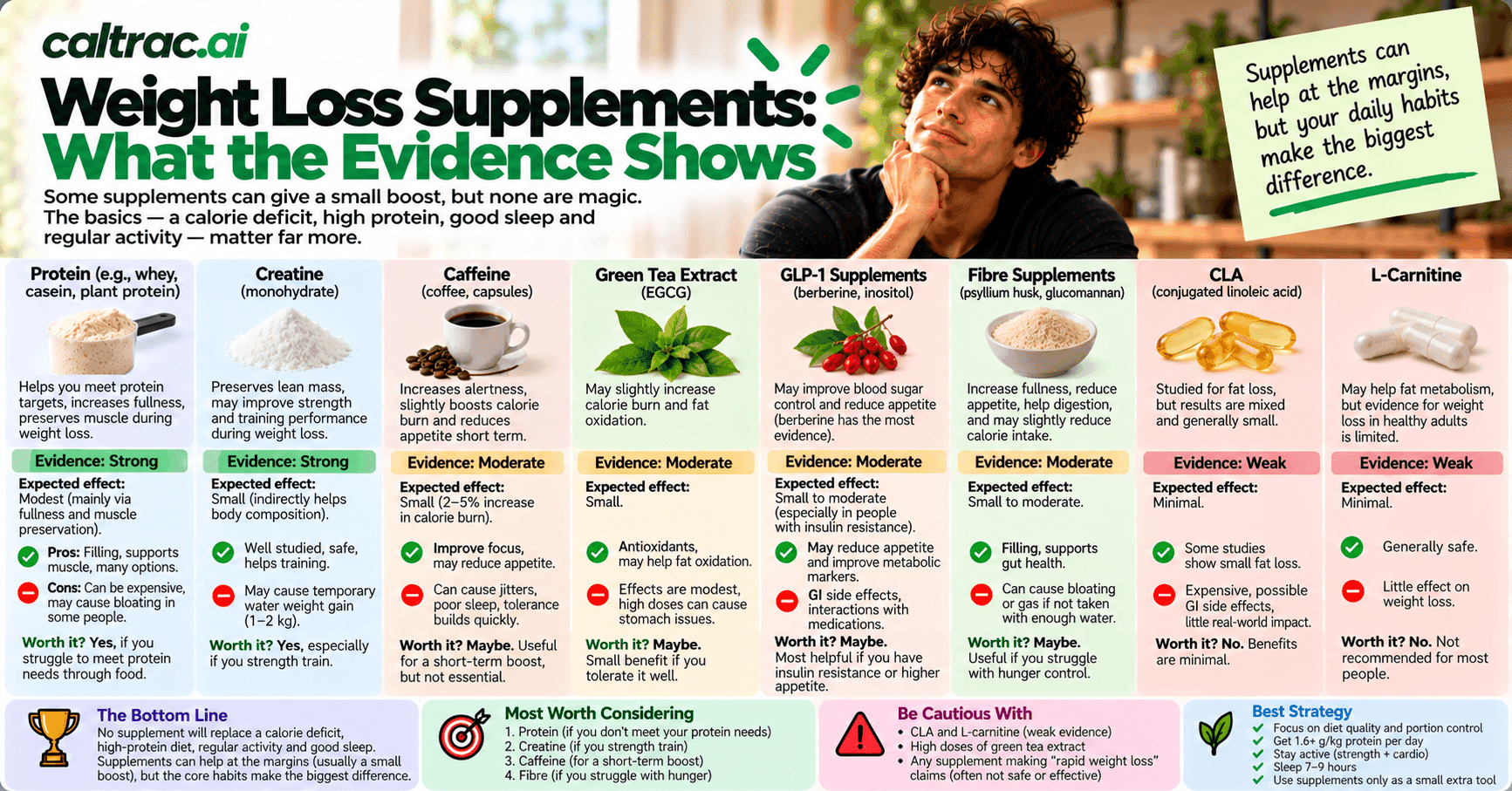
The weight-loss supplement aisle runs on a simple arithmetic: the products cost a lot, the effects are small, and the trials are mostly bad. A 2021 systematic review of 315 randomised trials covering 14 supplements and therapies found that only 52, about one in six, were both low-risk and large enough to judge efficacy, and of those only 16 showed any weight difference at all, ranging from 0.3 to 4.9 kg [1]. That is the whole field in one sentence. What follows sorts the common products into what the evidence supports, what it does not, and what is actively dangerous, with the effect sizes so you can compare them with the 4 to 8 kg a modest calorie deficit delivers in three months.
This is general nutrition information, not medical advice. Supplements can interact with medicines; check with a pharmacist or doctor before starting one.
The Scorecard
| Supplement | Best evidence | Effect on weight or fat | Verdict |
|---|---|---|---|
| Caffeine | 13 RCTs, 606 people [2] | Doubling intake gave 22% greater weight reduction and 28% greater fat loss, with high heterogeneity | Small, real, cheap |
| Green tea catechins | Meta-analysis of 11 studies [3]; Cochrane review of 14 trials [4] | −1.31 kg in one meta-analysis; −0.04 kg, not significant, outside Japan in Cochrane | Small to nil |
| Viscous fibre (psyllium, glucomannan, beta-glucan) | 62 trials, 3,877 people [5] | −0.33 kg weight, −0.63 cm waist, on an unrestricted diet | Small, real, useful for fullness |
| Glucomannan alone | 8 RCTs [6] | −0.22 kg, not significant | Nil |
| Garcinia cambogia (HCA) | 9 RCTs [7] | −0.88 kg, small and significant, short trials | Marginal |
| CLA | 18 studies [8] | 0.09 kg of fat per week at 3.2 g a day, about 1 kg in three months | Modest, declining after six months |
| Chromium picolinate | Cochrane, 9 RCTs [9] | −1.1 kg, low-quality evidence | Marginal, uncertain |
| Apple cider vinegar | Systematic review, 13 human studies [10] | Evidence insufficient to conclude | Unproven |
| Creatine (with resistance training) | Meta-analysis, adults 50 and over [11] | Body fat −0.55 percentage points versus placebo, plus lean mass | Useful for composition, not for weight |
| Whey protein | Meta-analysis in postmenopausal women [12] | Improved lean mass and strength with training; no effect alone | Food, not a fat burner |
| "Fat burner" blends | FDA notifications [13] | Repeatedly found to contain hidden prescription drugs | Avoid |
What the Numbers Mean
Caffeine is the only stimulant with decent evidence. The dose-response meta-analysis found that doubling caffeine intake was associated with 22% greater reductions in weight, 17% in BMI and 28% in fat mass across the included trials, though the trials varied widely [2]. In practice the mechanism is a small rise in energy expenditure and some appetite suppression, worth perhaps 50 to 100 kcal a day in regular users, and it fades with tolerance. Black coffee delivers it for pennies; the FDA's 400 mg daily ceiling for healthy adults is about four cups [14]. Our coffee article covers the detail.
Green tea depends on which review you read. The 2009 meta-analysis found catechin-caffeine mixtures reduced weight by 1.31 kg and helped maintain loss, with a smaller effect in people already consuming over 300 mg of caffeine a day [3]. The Cochrane review three years later split the trials by country: outside Japan, six trials with 532 people showed a 0.04 kg difference, which is nothing, while the Japanese trials could not be pooled and ranged from 0.2 to 3.5 kg [4]. Cochrane's conclusion was that any loss is small and unlikely to be clinically important [4]. Drink green tea if you like it.
Viscous fibre works, a little, and glucomannan alone does not. Pooled across 62 trials, soluble fibres taken with an unrestricted diet reduced weight by 0.33 kg and waist by 0.63 cm, with moderate certainty, and more in people who were overweight or had metabolic syndrome [5]. Glucomannan, the fibre most often sold for weight loss, did not reach significance on its own at 0.22 kg [6]. The honest use of fibre supplements is fullness: psyllium before a meal is a cheap, safe appetite tool, and fibre from food does the same job with vitamins attached.
Garcinia and chromium are marginal at best. Garcinia cambogia's active ingredient produced a 0.88 kg advantage over placebo in nine short trials, with the authors noting the effect was small and the trials of mixed quality [7]. Chromium picolinate's Cochrane review found 1.1 kg over placebo but graded the evidence low quality [9]. Neither is worth the money.
CLA produces measurable fat loss and then stops. Conjugated linoleic acid at 3.2 g a day reduced fat mass by 0.09 kg a week compared with placebo, linear for six months and then flattening [8]. About a kilo of fat in three months is real, but it is also what one fewer biscuit a day achieves.
Apple cider vinegar is unproven. The 2020 systematic review found 13 human studies, judged side effects at normal doses negligible, and concluded the evidence for health effects was insufficient [10]. Two tablespoons in water before a meal will not harm you; it also has not been shown to help.
The Two Supplements Worth Buying
They are not fat burners, and they work only with training.
Creatine monohydrate. In adults aged 50 and over, creatine combined with resistance training reduced body fat percentage by about half a point more than placebo with the same training, while adding lean mass [11]. The evidence in women is less developed but points the same way, with the review noting potential benefits across the lifespan, including around menopause [15]. The scale may go up slightly from water in muscle; the composition improves. Three to five grams a day, no loading needed.
Protein powder, when food falls short. Whey is not a supplement in the sense this article means; it is a concentrated food. In postmenopausal women, whey with resistance training improved lower-limb lean mass and strength, and whey without training did nothing [12]. Higher protein in the 1.2 to 1.6 g/kg range preserves muscle in a deficit and improves fullness [16]. If your meals already deliver that, the powder adds calories; if they do not, it is the cheapest way to close the gap.
What to Avoid
The products that do produce dramatic weight loss do so because they contain drugs. The FDA maintains a running list of weight-loss supplements found to contain hidden prescription ingredients, and the most common is sibutramine, an appetite suppressant withdrawn from the US market in 2010 for cardiovascular risk [13]. A 2022 notice on one product sold online is typical: marketed as a herbal slimming capsule, found to contain sibutramine [17]. The warning signs are a product sold mainly through social media, claims of rapid loss without diet change, a proprietary blend with no quantities, and a price far above any ingredient on this page. If it works like a drug, it probably is one.
The Comparison That Matters
Put the best-case numbers side by side. Green tea, 1.3 kg at most [3]. CLA, 1 kg of fat in three months [8]. Garcinia, 0.9 kg [7]. Fibre, 0.3 kg [5]. A 500 kcal daily deficit, the guideline starting point for weight loss, is about 0.5 kg a week, or 6 kg in the same three months [18]. The entire supplement aisle, taken together at its most optimistic, does not match one month of a moderate deficit. The money is better spent on protein, vegetables and a gym membership.
Find your deficit with the calorie calculator and your protein target with the macro calculator. If the protein figure is one your meals cannot reach, that is the one case where a tub of whey is the right purchase.
That is where tracking earns its keep. The deficit a supplement promises is one you can see for yourself. Snap a photo of the plate or type "chicken salad, 1 tbsp olive oil" and track it automatically with Caltrac; your Apple Health-powered net calorie count shows the real gap between eaten and burned, which is the number every pill on the shelf is pretending to change. Skip the fat burner; let the app show you the deficit.
Frequently Asked Questions
Do any weight loss supplements actually work? A few produce small, measurable effects: caffeine, green tea catechins, viscous fibre and CLA, each in the range of 0.3 to 1.3 kg [2] [3] [5] [8]. None approaches what a 500 kcal daily deficit delivers [18].
Does green tea help you lose weight? Slightly, at best. One meta-analysis found 1.31 kg [3]; the Cochrane review found 0.04 kg outside Japan and called the effect not clinically important [4].
Does apple cider vinegar help with weight loss? The evidence is insufficient to say, according to a 2020 systematic review of 13 human studies [10]. Side effects at normal doses appear negligible.
Is garcinia cambogia effective? Marginally: 0.88 kg more than placebo in nine short trials of mixed quality [7].
Does creatine help with fat loss? Combined with resistance training in adults over 50, it reduced body fat percentage by about 0.55 points more than placebo while adding lean mass [11]. It does not reduce scale weight.
Which weight loss supplements are dangerous? Those found by the FDA to contain hidden drugs, most often sibutramine, a withdrawn appetite suppressant [13] [17]. Products promising rapid loss without diet change are the usual culprits.
References
- Batsis JA, et al. A Systematic Review of Dietary Supplements and Alternative Therapies for Weight Loss. Obesity. 2021;29(7):1102-1113. pubmed.ncbi.nlm.nih.gov
- Tabrizi R, et al. The effects of caffeine intake on weight loss: a systematic review and dose-response meta-analysis of randomized controlled trials. Critical Reviews in Food Science and Nutrition. 2019;59(16):2688-2696. pubmed.ncbi.nlm.nih.gov
- Hursel R, Viechtbauer W, Westerterp-Plantenga MS. The effects of green tea on weight loss and weight maintenance: a meta-analysis. International Journal of Obesity. 2009;33(9):956-961. pubmed.ncbi.nlm.nih.gov
- Jurgens TM, et al. Green tea for weight loss and weight maintenance in overweight or obese adults. Cochrane Database of Systematic Reviews. 2012;12:CD008650. pubmed.ncbi.nlm.nih.gov
- Jovanovski E, et al. Can dietary viscous fiber affect body weight independently of an energy-restrictive diet? A systematic review and meta-analysis of randomized controlled trials. American Journal of Clinical Nutrition. 2020;111(2):471-485. pubmed.ncbi.nlm.nih.gov
- Onakpoya I, Posadzki P, Ernst E. The efficacy of glucomannan supplementation in overweight and obesity: a systematic review and meta-analysis of randomized clinical trials. Journal of the American College of Nutrition. 2014;33(1):70-78. pubmed.ncbi.nlm.nih.gov
- Onakpoya I, Hung SK, Perry R, Wider B, Ernst E. The Use of Garcinia Extract (Hydroxycitric Acid) as a Weight loss Supplement: A Systematic Review and Meta-Analysis of Randomised Clinical Trials. Journal of Obesity. 2011;2011:509038. pubmed.ncbi.nlm.nih.gov
- Whigham LD, Watras AC, Schoeller DA. Efficacy of conjugated linoleic acid for reducing fat mass: a meta-analysis in humans. American Journal of Clinical Nutrition. 2007;85(5):1203-1211. pubmed.ncbi.nlm.nih.gov
- Tian H, et al. Chromium picolinate supplementation for overweight or obese adults. Cochrane Database of Systematic Reviews. 2013;11:CD010063. pubmed.ncbi.nlm.nih.gov
- Launholt TL, Kristiansen CB, Hjorth P. Safety and side effects of apple vinegar intake and its effect on metabolic parameters and body weight: a systematic review. European Journal of Nutrition. 2020;59(6):2273-2289. pubmed.ncbi.nlm.nih.gov
- Forbes SC, Candow DG, Krentz JR, Roberts MD, Young KC. Changes in Fat Mass Following Creatine Supplementation and Resistance Training in Adults ≥50 Years of Age: A Meta-Analysis. Journal of Functional Morphology and Kinesiology. 2019;4(3):62. pubmed.ncbi.nlm.nih.gov
- Kuo YY, Chang HY, Huang YC, Liu CW. Effect of Whey Protein Supplementation in Postmenopausal Women: A Systematic Review and Meta-Analysis. Nutrients. 2022;14(19):4210. pubmed.ncbi.nlm.nih.gov
- US Food and Drug Administration. Tainted Weight Loss Products: public notifications of products found to contain hidden drug ingredients. fda.gov
- US Food and Drug Administration. Spilling the Beans: How Much Caffeine is Too Much? (400 mg a day for healthy adults). fda.gov
- Smith-Ryan AE, Cabre HE, Eckerson JM, Candow DG. Creatine Supplementation in Women's Health: A Lifespan Perspective. Nutrients. 2021;13(3):877. pubmed.ncbi.nlm.nih.gov
- Leidy HJ, et al. The role of protein in weight loss and maintenance. American Journal of Clinical Nutrition. 2015;101(6):1320S-1329S. pubmed.ncbi.nlm.nih.gov
- US Food and Drug Administration. Public Notification: Lipopastilla Gold Max contains hidden drug ingredients (sibutramine). 2022. fda.gov
- Jensen MD, et al. 2013 AHA/ACC/TOS guideline for the management of overweight and obesity in adults. Circulation. 2014;129(25 Suppl 2):S102-S138. pubmed.ncbi.nlm.nih.gov