


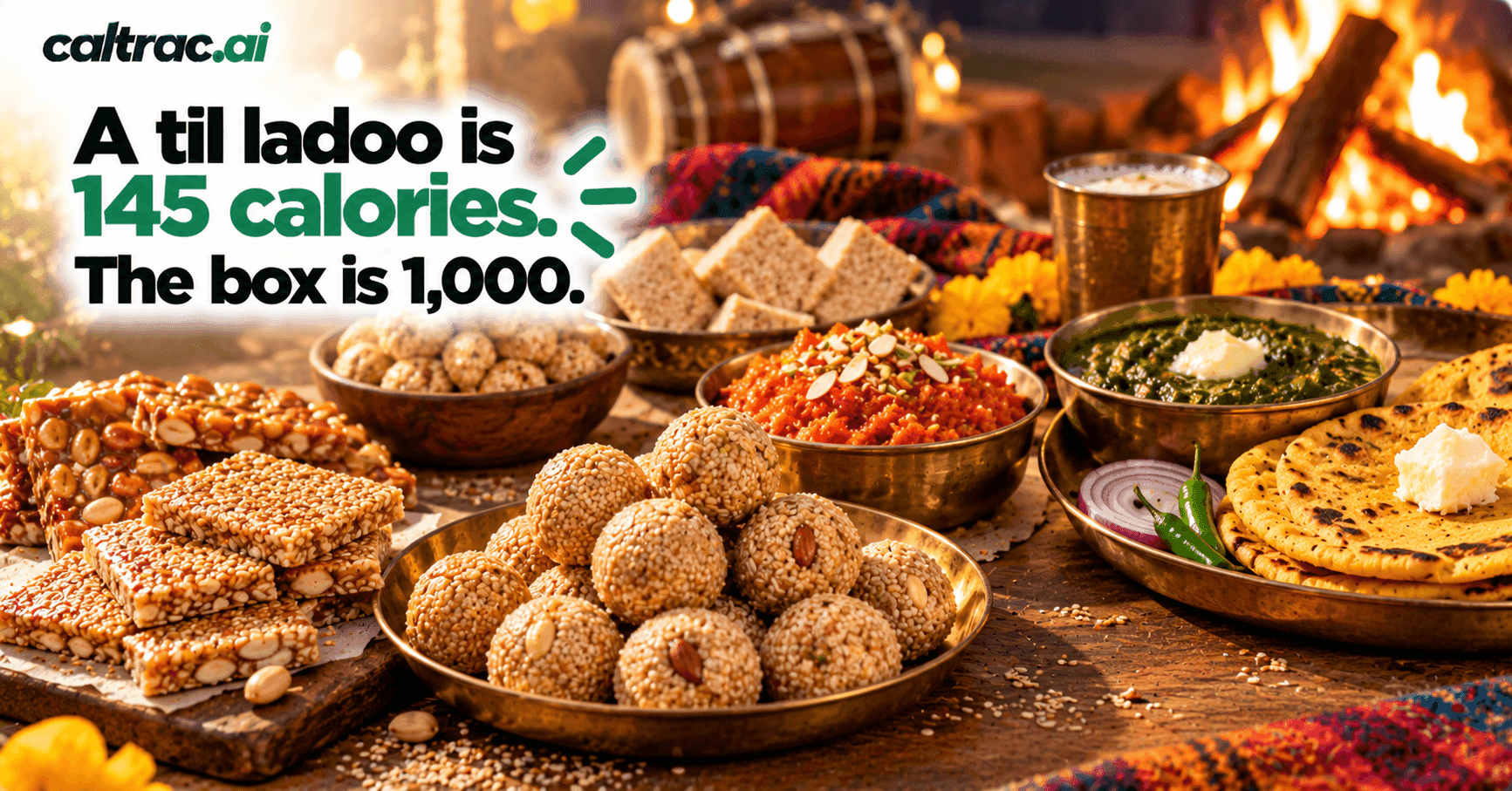
Indian winter food is built around two ingredients, sesame and jaggery, and one cooking fat, ghee, and all three are among the most calorie-dense foods in any kitchen. Gajak, til ladoo, peanut chikki, gajar halwa, moong dal halwa, sarson ka saag with makki roti: these are the foods of Lohri and Makar Sankranti, of December weddings and January evenings, and they are also the reason the season adds weight. This article prices each one from USDA and Indian Food Composition Table data, separates the genuinely nutritious winter foods from the ones that are sugar in a festive shape, and gives a way to eat the season without carrying it into February.
Lohri falls on Thursday 14 January 2027 and Makar Sankranti on Friday 15 January, by the Drik Panchang calendar for Delhi; some calendars list Sankranti on the 14th, so check locally [1].
The Season Adds Weight, Everywhere It Has Been Measured
There is no Indian study of winter weight gain, but the pattern is consistent wherever scales have been put under people. Across 2,924 adults in the United States, Germany and Japan, weight rose within ten days of each country's main holiday, by 0.4 to 0.6% at Christmas and 0.3% during Japan's Golden Week, and about half the gain remained until summer [2]. A review of Western studies put the typical holiday gain at about half a kilo and concluded it was the main contributor to annual weight gain in adults [3]. The Indian winter, with Diwali at one end and Sankranti at the other, is a longer season than any of those.
The Winter Sweets, Priced
USDA and Indian Food Composition Table values, with the composite sweets estimated from their ingredients.
| Food | Typical serving | Calories | Sugar | What it is made of |
|---|---|---|---|---|
| Gajak (til and jaggery) | 2 pieces, 40 g | About 190 | About 18 g | Roughly half sesame, half jaggery: estimated from [4] [5] |
| Til ladoo | 1 ladoo, 30 g | About 145 | About 11 g | About 60% sesame, 40% jaggery: estimated from [4] [5] |
| Peanut chikki [6] | 2 pieces, 40 g | 214 | 18 g | Peanut 53%, jaggery 25%, sugar 15%, glucose 7% (brand label) |
| Besan or boondi ladoo [7] | 1 piece, 60 g | 247 | 18 g | Flour, sugar, ghee |
| Gajar halwa | 1 katori, 100 g | About 190 | About 15 g | Carrots, khoa, sugar, ghee, nuts: estimated from [8] [9] [10] [11] [12] |
| Moong dal halwa | 1 katori, 75 g | About 315 | About 17 g | Moong dal, ghee, sugar: estimated from [13] [11] [10] |
| Roasted peanuts [14] | A handful, 30 g | 180 | 1 g | Peanuts |
| Jaggery, plain [5] | 1 piece, 20 g | 73 | 18 g | Cane juice |
| Chai with milk and sugar [15] | 1 cup, 240 ml | 122 | 21 g | Tea, milk, sugar |
How the estimates were built: a til ladoo is about 60% roasted sesame at 573 kcal per 100 g and 40% jaggery at 367 [4] [5], giving about 490 kcal per 100 g, or 145 for a 30 g ladoo; gajak is closer to half and half, about 470 per 100 g. Gajar halwa made from 500 g of carrots, 100 g of khoa, 60 g of sugar, 30 g of ghee and 20 g of nuts comes to roughly 1,130 kcal for about 600 g cooked, or 190 per 100 g katori [8] [9] [10] [11] [12]. Moong dal halwa, 100 g of dal to 80 g of ghee and 80 g of sugar, is about 1,470 kcal for 350 g, or 420 per 100 g [13] [11] [10]. Recipes vary, and a halwai's version usually carries more ghee than a home one.
Three Things Worth Knowing
Sesame is the genuinely nutritious part. Whole sesame is 18 g of protein and 12 g of fibre per 100 g [4], and the Indian Food Composition Tables put white sesame at 1,283 mg of calcium per 100 g, among the highest of any food [9]. A til ladoo delivers about 3 g of protein and 230 mg of calcium along with its 145 calories. That does not make it a health food, but it makes it a better 145 calories than a boondi ladoo.
Jaggery is sugar. The IFCT lists jaggery at 354 kcal per 100 g with 4.6 mg of iron and 107 mg of calcium [9]; the USDA branded record shows 88 g of sugar per 100 g [5]. White sugar is 387 kcal and no minerals [10]. The 20 g piece of jaggery that follows a winter meal is 73 calories and 18 g of sugar, with just under 1 mg of iron, about 5% of a woman's daily need. Jaggery is a marginally better sweetener than sugar and a sweetener nonetheless; the WHO's free-sugar ceiling of 10% of calories, about 50 g on a 2,000 kcal day, applies to it in full [16].
Ghee is the calorie multiplier. Ghee is 876 kcal per 100 g and 62% saturated fat [11]. The difference between home gajar halwa and the halwai's is largely ghee: each extra tablespoon adds 123 calories to the pan. Replacing saturated with unsaturated fat cut cardiovascular events by 17% in trials [17], and ghee is the most concentrated saturated fat in the Indian kitchen.
The Savoury Winter Plate
Sarson ka saag with makki roti is the other face of the season, and it is a different kind of food.
| Food | Typical serving | Calories | Protein | Fibre |
|---|---|---|---|---|
| Sarson ka saag | 200 g | About 235 | About 11 g | About 9 g |
| Makki roti | 1 roti, 60 g flour, with 1 tsp ghee | About 260 | 4 g | 4.4 g |
| Plain roti [18] | 1 medium, 40 g | 120 | 3.2 g | 3.9 g |
| Dal [19] | 1 cup, 240 g | 348 | 21 g | 18 g |
The saag is estimated from 300 g of mustard greens at 29 kcal per 100 g [20], 50 g of maize flour as thickener [21], 20 g of ghee [11] and onion, garlic and ginger, giving about 470 kcal for a 400 g pot. Mustard greens are 3 g of protein and 3.4 g of fibre per 100 g [20], with 191 mg of calcium [9]; the saag is one of the best vegetable dishes of the year. The makki roti is the heavy part: whole-grain corn flour is 361 kcal per 100 g [21], so a 60 g roti is 217 before the ghee and 260 after, double a wheat roti [18]. One makki roti with a generous plate of saag is a 500 kcal meal with 15 g of protein and 13 g of fibre; three rotis with white butter is 1,000.
How to Eat the Season
- Pick the sesame sweets over the flour sweets. Til ladoo and gajak carry protein, fibre and calcium; boondi ladoo carries flour, sugar and ghee [4] [7].
- One piece, not the box. A single til ladoo is 145 calories; the plate on the table is 1,000. Decide the number before the box opens.
- Count jaggery as sugar. Because it is [5] [16].
- Make the halwa at home and halve the ghee. Gajar halwa at 190 kcal a katori is a reasonable dessert; at a halwai's it may be 300.
- Eat the saag, limit the makki roti. One corn roti and more saag is a better plate than two rotis and less [21] [20].
- Protein at the other meals. The sweets displace protein; keep breakfast and lunch at 25 to 30 g from dal, eggs, paneer or curd [22] [19] [23] so the evening ladoo is a dessert and not a meal.
- Chai is the daily leak. Four cups is 490 calories and 84 g of sugar [15], more than any sweet on the list.
- Aim for maintenance, not loss, through the season. The guideline deficit of 500 to 750 kcal is for ordinary weeks [24]; from mid-December to mid-January, holding weight is the win. The calorie calculator gives the maintenance figure to hold.
That is where tracking earns its keep. Winter sweets are eaten standing up, from a box, in pieces, and nobody counts pieces. Snap a photo of the plate or type "1 til ladoo, 1 cup chai" and track it automatically with Caltrac. You will see the season's sugar and calories accumulate against your maintenance in real time, and your Apple Health-powered net calorie count shows whether the evening walk balanced the gajak. Eat the til; let the app count the jaggery.
Frequently Asked Questions
How many calories in a til ladoo? About 145 for a 30 g ladoo made from roughly 60% sesame and 40% jaggery, with 3 g of protein and about 230 mg of calcium [4] [5] [9].
How many calories in gajar halwa? About 190 per 100 g katori for a home recipe with 500 g carrots, 100 g khoa, 60 g sugar and 30 g ghee; shop versions with more ghee run higher [8] [9] [11].
Is jaggery healthier than sugar? Marginally. Jaggery is 354 kcal per 100 g with 4.6 mg of iron and 107 mg of calcium; sugar is 387 kcal with none [9] [10]. Both are 88 to 100% sugar and count toward the WHO free-sugar limit [5] [16].
Is sarson ka saag good for weight loss? Yes. Mustard greens are 29 kcal, 3 g of protein and 3.4 g of fibre per 100 g [20], and a 200 g serving of saag is about 235 kcal. The makki roti at about 260 kcal each is the part to limit [21].
How many calories in peanut chikki? About 107 per 20 g piece, with 9 g of sugar, from a brand label listing peanuts 53%, jaggery 25% and sugar 15% [6].
When is Lohri and Makar Sankranti in 2027? Lohri on Thursday 14 January 2027 and Makar Sankranti on Friday 15 January, per Drik Panchang for Delhi; some calendars list Sankranti on 14 January [1].
References
- Drik Panchang. Lohri 2027 date and time, New Delhi (Lohri Thursday 14 January 2027; Makar Sankranti Friday 15 January 2027; Sankranti moment 9:14 PM on 14 January). drikpanchang.com
- Helander EE, Wansink B, Chieh A. Weight Gain over the Holidays in Three Countries. New England Journal of Medicine. 2016;375(12):1200-1202. pubmed.ncbi.nlm.nih.gov
- Schoeller DA. The effect of holiday weight gain on body weight. Physiology & Behavior. 2014;134:66-69. pubmed.ncbi.nlm.nih.gov
- USDA FoodData Central. Seeds, sesame seeds, whole, dried: 573 kcal, 17.7 g protein, 49.7 g fat, 11.8 g fibre per 100 g. SR Legacy 170150. fdc.nal.usda.gov
- USDA FoodData Central, Branded. Swad Jaggery Gur (sugarcane juice): 367 kcal, 88 g sugar per 100 g. FDC ID 2164542. fdc.nal.usda.gov
- USDA FoodData Central, Branded. Khazana Peanut Chikki Bites (peanut 53%, jaggery 25%, sugar 15%, glucose 7%): 535 kcal, 15 g protein, 45 g sugar per 100 g; serving 20 g. FDC ID 2624425. fdc.nal.usda.gov
- USDA FoodData Central, FNDDS. Ladoo, round ball: 411 kcal, 6.9 g protein, 22.3 g fat, 29.8 g sugar per 100 g; 1 piece 60 g. FDC ID 2710351. fdc.nal.usda.gov
- USDA FoodData Central. Carrots, raw: 41 kcal, 2.8 g fibre per 100 g. SR Legacy 170393. fdc.nal.usda.gov
- Longvah T, Ananthan R, Bhaskarachary K, Venkaiah K. Indian Food Composition Tables 2017. Hyderabad: ICMR-National Institute of Nutrition; 2017 (jaggery: 354 kcal, 4.6 mg iron, 107 mg calcium per 100 g; white sesame: 520 kcal, 21.7 g protein, 1,283 mg calcium; mustard leaves: 30 kcal, 191 mg calcium; khoa: 316 kcal, 16.3 g protein; moong dal: 326 kcal, 23.9 g protein per 100 g). nin.res.in
- USDA FoodData Central. Sugars, granulated: 387 kcal per 100 g (one teaspoon, 4 g, 16 kcal). SR Legacy 169655. fdc.nal.usda.gov
- USDA FoodData Central, FNDDS. Ghee, clarified butter: 876 kcal, 61.9 g saturated fat per 100 g; 1 tablespoon 14 g. FDC ID 2710168. fdc.nal.usda.gov
- USDA FoodData Central. Nuts, almonds: 579 kcal, 21.2 g protein per 100 g. SR Legacy 170567. fdc.nal.usda.gov
- USDA FoodData Central, Branded. Deep Moong Dal, dry: 343 kcal, 22.9 g protein, 17.1 g fibre per 100 g. FDC ID 2443194. fdc.nal.usda.gov
- USDA FoodData Central, FNDDS. Peanuts, roasted, unsalted: 599 kcal, 28 g protein, 9.4 g fibre per 100 g; 1 oz 28 g. FDC ID 2707516. fdc.nal.usda.gov
- USDA FoodData Central, FNDDS. Tea, hot, with milk: 51 kcal, 8.7 g sugar per 100 g; 1 cup 240 g. FDC ID 2710506. fdc.nal.usda.gov
- World Health Organization. WHO calls on countries to reduce sugars intake among adults and children (2015 sugars guideline). who.int
- Hooper L, et al. Reduction in saturated fat intake for cardiovascular disease. Cochrane Database of Systematic Reviews. 2020;5:CD011737. pubmed.ncbi.nlm.nih.gov
- USDA FoodData Central, FNDDS. Bread, chapatti or roti: 299 kcal, 7.9 g protein, 9.7 g fibre per 100 g; 1 medium 40 g. FDC ID 2707713. fdc.nal.usda.gov
- USDA FoodData Central, FNDDS. Dal (as prepared): 145 kcal, 8.6 g protein, 7.5 g fibre per 100 g; 1 cup 240 g. FDC ID 2707427. fdc.nal.usda.gov
- USDA FoodData Central, FNDDS. Mustard greens, fresh, cooked, no added fat: 29 kcal, 3.1 g protein, 3.4 g fibre per 100 g; 1 cup 140 g. FDC ID 2709607. fdc.nal.usda.gov
- USDA FoodData Central. Corn flour, whole-grain: 361 kcal, 6.9 g protein, 7.3 g fibre per 100 g. SR Legacy 169748. fdc.nal.usda.gov
- Leidy HJ, et al. The role of protein in weight loss and maintenance. American Journal of Clinical Nutrition. 2015;101(6):1320S-1329S. pubmed.ncbi.nlm.nih.gov
- USDA FoodData Central. Yogurt, Greek, nonfat, plain: 54 kcal, 9.5 g protein per 100 g. SR Legacy 171312. fdc.nal.usda.gov
- Jensen MD, et al. 2013 AHA/ACC/TOS guideline for the management of overweight and obesity in adults. Circulation. 2014;129(25 Suppl 2):S102-S138. pubmed.ncbi.nlm.nih.gov