


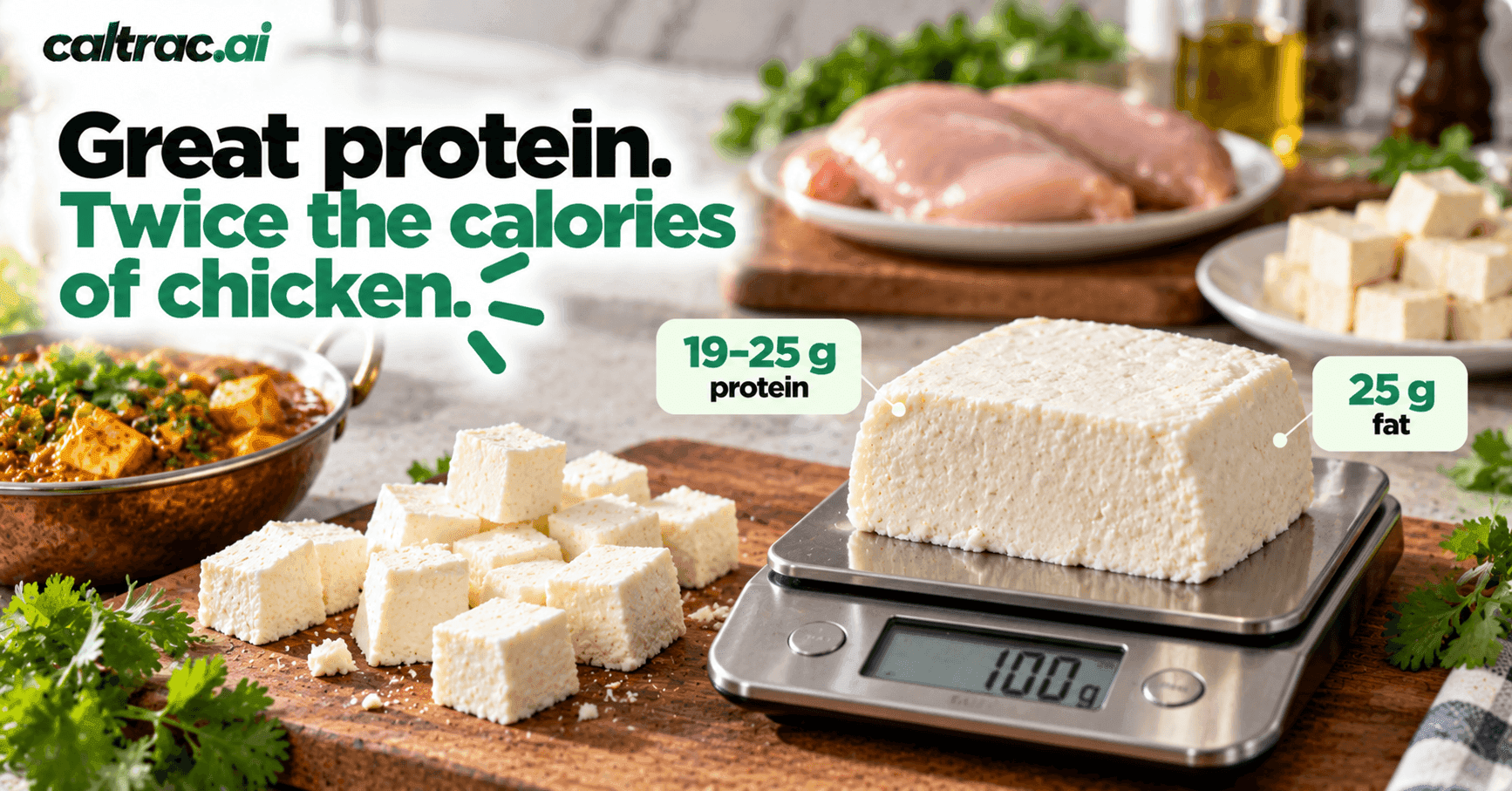
Paneer is the protein India's vegetarians rely on most and understand least. Per 100 g it carries 18 to 25 g of protein, which is excellent; it also carries 18 to 25 g of fat, which is why 100 g of paneer costs twice the calories of 100 g of chicken breast for less protein. Both facts matter for weight loss, and this article gives the numbers from four sources, USDA branded records, the USDA survey database and the Indian Food Composition Tables, explains why they differ, compares paneer with tofu, chicken, eggs, dal and soya, and shows how to use it in a deficit.
Paneer Nutrition per 100 g
Four sources, four slightly different answers, because paneer is not a standardised product: the fat depends on whether the milk was full-cream or toned, and the protein on how hard it was pressed.
| Source | Calories | Protein | Fat | Saturated fat | Carbohydrate | Calcium | Sodium |
|---|---|---|---|---|---|---|---|
| Indian Food Composition Tables 2017 [1] | 305 | 18.9 g | 24.8 g | n/a | 2.4 g | 476 mg | about 18 mg |
| Karoun / Gopi paneer, US brand [2] | 321 | 25 g | 25 g | 17.9 g | 3.6 g | 407 mg | 18 mg |
| Royal Mahout paneer, US brand [3] | 321 | 25 g | 25 g | 16.1 g | 0 g | 536 mg | 36 mg |
| Deep paneer, whole and skim milk [4] | 286 | 21.4 g | 17.9 g | 12.5 g | 3.6 g | 536 mg | 107 mg |
| USDA survey database [5] | 299 | 15.9 g | 15.5 g | 9.0 g | not used | 597 mg | 185 mg |
A reasonable working figure for full-fat Indian paneer is 300 to 320 kcal, 19 to 25 g of protein and 20 to 25 g of fat per 100 g, two-thirds of it saturated. The branded US records read higher on protein because they are scaled from a 28 g label serving and carry rounding error; the Indian tables, from laboratory analysis of Indian paneer, give 18.9 g [1]. The survey record's 22 g of carbohydrate per 100 g is almost certainly a database error, since paneer is made by curdling milk and draining the whey, which removes most of the lactose; the Indian tables and the brand labels agree on 0 to 4 g.
Calcium. Paneer is one of the richest common sources: 400 to 600 mg per 100 g, a third or more of the 1,300 mg daily value [6]. Sodium is low in traditional paneer at 18 to 36 mg, because no salt is added, and higher in salted commercial versions. Saturated fat is the cost: 100 g of full-fat paneer carries 16 to 18 g, nearly the whole 20 g daily value [6], and replacing saturated with unsaturated fat cut cardiovascular events by 17% in a Cochrane review of trials [7].
Protein Quality
Paneer is casein, the curd protein of milk, and milk protein is among the highest-quality proteins in the diet. Using the current digestible indispensable amino acid score method, dairy proteins score higher than soy, pea or wheat proteins, and the older scoring method tends to overstate the plant proteins [8]. Protein quality matters most for building muscle, where the leucine content of dairy drives the response [9]. For India this is relevant beyond the gym: Indian diets draw about 60% of protein from cereals, which are low in quality and digestibility, and a third of some populations are at risk of inadequate protein once quality is counted [10]. Paneer is one of the few traditional vegetarian foods that fixes both quantity and quality at once.
Paneer vs Tofu vs Chicken vs Everything Else
The question for weight loss is not protein per 100 g but protein per calorie.
| Food | Calories per 100 g | Protein per 100 g | Protein per 100 kcal | Fat per 100 g |
|---|---|---|---|---|
| Chicken breast, roasted [11] | 165 | 31 g | 18.8 g | 3.6 g |
| Nonfat Greek yogurt [12] | 54 | 9.5 g | 17.6 g | 0.4 g |
| Soya chunks, dry [13] | 345 | 52 g | 15.1 g | 0.5 g |
| Cottage cheese, 2% [14] | 81 | 10.4 g | 12.8 g | 2.3 g |
| Tofu, firm [15] | 144 | 17.3 g | 12.0 g | 8.7 g |
| Mozzarella, part skim [16] | 254 | 24.3 g | 9.6 g | 15.9 g |
| Egg, boiled [17] | 155 | 12.6 g | 8.1 g | 10.6 g |
| Paneer, full fat [2] [1] | 305 to 321 | 19 to 25 g | 6 to 7.8 g | 25 g |
| Paneer, lower fat [4] | 286 | 21.4 g | 7.5 g | 17.9 g |
| Dal, as prepared [18] | 145 | 8.6 g | 5.9 g | 2.7 g |
Paneer sits near the bottom of the protein-per-calorie table, just above dal and below eggs. Tofu delivers 60% more protein per calorie, cottage cheese nearly double, Greek yogurt and soya chunks more than double, chicken breast nearly triple. One hundred grams of paneer and 100 g of chicken breast have similar protein; the paneer costs 320 calories and the chicken 165.
This does not make paneer a bad food. It makes it a protein-and-fat food, like cheese or salmon, that needs a portion size. Fifty grams of paneer, about four cubes, is 160 kcal and 10 to 12 g of protein, and that is the serving that fits a weight-loss plate alongside dal, egg or soya for the rest of the protein.
Paneer in a Deficit
The research target for weight loss is 1.2 to 1.6 g of protein per kilogram a day [19] [20], 25 to 30 g per meal [21], inside a 500 to 750 kcal daily deficit [22]. Paneer can be part of that if it is weighed and the fat around it is controlled.
The paneer itself is not the problem; the gravy is. Palak paneer from the USDA survey database is 101 kcal per 100 g, about 200 for a cup [23], but restaurant versions with cream and extra oil run far higher, and shahi paneer, paneer butter masala and malai kofta are built on cream, butter and cashew paste before the paneer arrives.
Frying doubles it. Paneer absorbs oil. Grilled or dry-roasted paneer tikka is paneer plus spices; fried paneer pakora is paneer plus batter plus the oil the batter soaks up.
Four ways to use 50 to 75 g of paneer at 25 g of protein per meal:
- Paneer bhurji with egg whites: 50 g paneer crumbled with onion, tomato and two egg whites, 1 tsp oil: about 240 kcal, 20 g protein; with one roti, 360 kcal and 23 g [2] [24] [25].
- Paneer tikka on a salad: 75 g paneer grilled with 200 g capsicum and onion, lemon and chaat masala: about 290 kcal, 20 g protein.
- Dal with paneer: 200 g dal with 50 g paneer stirred through: 450 kcal, 30 g protein, 15 g fibre [18] [2].
- Paneer and sprout chaat: 50 g paneer cubes with 150 g boiled moong sprouts, onion, tomato and lemon: about 320 kcal, 23 g protein.
Make it lower-fat at home. Paneer set from toned or skimmed milk has roughly half the fat of full-cream paneer at similar protein; the Deep record, made from a mix of whole and skim milk, shows the direction at 286 kcal and 17.9 g of fat [4]. Home-made low-fat paneer is firmer and drier, which suits tikka and bhurji better than gravies anyway.
The Honest Verdict
Paneer is high-quality protein with a lot of saturated fat attached. For a vegetarian trying to lose weight it is useful at 50 to 75 g a meal as part of the protein, and poor as the whole of it, because reaching 30 g of protein from paneer alone costs 400 calories and 20 g of saturated fat. Pair it with the leaner vegetarian proteins, dal, soya chunks, Greek yogurt, egg whites and tofu, and the plate reaches its protein target at half the calories.
Set your protein target in the macro calculator and your calories in the calorie calculator; then the paneer portion is the one that fills the gap the other proteins leave, not the one that fills the plate.
That is where tracking earns its keep. Paneer is almost never weighed and almost always under-estimated, because four cubes look like a modest portion and are 160 calories. Snap a photo of the plate or type "75 g paneer tikka, 1 roti" and track it automatically with Caltrac. You will see the protein and the saturated fat side by side, and your Apple Health-powered net calorie count shows how the portion fit the day. Eat the paneer; let the app weigh it.
Frequently Asked Questions
How much protein is in 100 g of paneer? About 19 g by the Indian Food Composition Tables and 21 to 25 g on US brand labels, depending on how hard it is pressed and how the label is rounded [1] [2] [4].
How many calories in 100 g of paneer? About 305 to 321 for full-fat paneer and 286 for a lower-fat version made with part skim milk [1] [2] [4].
Is paneer good for weight loss? In measured portions, yes: 50 to 75 g supplies 10 to 19 g of high-quality protein. It is fat-dense at 25 g per 100 g, so it should be part of the protein on a plate, not all of it [2] [19].
Paneer or tofu for weight loss? Tofu: 12 g of protein per 100 kcal against 6 to 8 for paneer, with less than half the fat [15] [2]. Paneer has higher protein quality and far more calcium [8] [1].
Is paneer high in cholesterol or saturated fat? It is high in saturated fat, 16 to 18 g per 100 g, close to the 20 g daily value [2] [6]. Keeping portions to 50 to 75 g and choosing lower-fat paneer limits it [4] [7].
How much paneer can I eat in a day? Fifty to one hundred grams fits most weight-loss plans: 160 to 320 kcal and 10 to 25 g of protein. Beyond that the saturated fat and calories crowd out leaner protein sources [2] [22].
References
- Longvah T, Ananthan R, Bhaskarachary K, Venkaiah K. Indian Food Composition Tables 2017. Hyderabad: ICMR-National Institute of Nutrition; 2017 (paneer: 1,278 kJ, about 305 kcal, 18.9 g protein, 24.8 g fat, 2.4 g carbohydrate, 476 mg calcium, 330 mg phosphorus per 100 g). nin.res.in
- USDA FoodData Central, Branded. Karoun Dairies / Gopi Paneer (pasteurised milk and vinegar): 321 kcal, 25 g protein, 25 g fat, 17.9 g saturated fat, 3.6 g carbohydrate, 407 mg calcium, 18 mg sodium per 100 g. FDC ID 2429587. fdc.nal.usda.gov
- USDA FoodData Central, Branded. Royal Mahout Paneer Cheese (pasteurised milk, acetic and lactic acid): 321 kcal, 25 g protein, 25 g fat, 16.1 g saturated fat, 536 mg calcium, 36 mg sodium per 100 g. FDC ID 2597884. fdc.nal.usda.gov
- USDA FoodData Central, Branded. Deep Indian Gourmet Paneer (whole and skim milk, vinegar, salt): 286 kcal, 21.4 g protein, 17.9 g fat, 12.5 g saturated fat, 536 mg calcium, 107 mg sodium per 100 g. FDC ID 2053888. fdc.nal.usda.gov
- USDA FoodData Central, FNDDS. Cheese, paneer: 299 kcal, 15.9 g protein, 15.5 g fat, 597 mg calcium per 100 g (the record's 22 g carbohydrate appears erroneous and is not used). FDC ID 2705740. fdc.nal.usda.gov
- US Food and Drug Administration. Daily Value on the Nutrition and Supplement Facts Labels (calcium 1,300 mg; saturated fat 20 g; sodium 2,300 mg). fda.gov
- Hooper L, et al. Reduction in saturated fat intake for cardiovascular disease. Cochrane Database of Systematic Reviews. 2020;5:CD011737. pubmed.ncbi.nlm.nih.gov
- Mathai JK, Liu Y, Stein HH. Values for digestible indispensable amino acid scores (DIAAS) for some dairy and plant proteins may better describe protein quality than values calculated using the concept for protein digestibility-corrected amino acid scores (PDCAAS). British Journal of Nutrition. 2017;117(4):490-499. pubmed.ncbi.nlm.nih.gov
- Phillips SM. The impact of protein quality on the promotion of resistance exercise-induced changes in muscle mass. Nutrition & Metabolism. 2016;13:64. pubmed.ncbi.nlm.nih.gov
- Swaminathan S, Vaz M, Kurpad AV. Protein intakes in India. British Journal of Nutrition. 2012;108 Suppl 2:S50-S58. pubmed.ncbi.nlm.nih.gov
- USDA FoodData Central. Chicken breast, meat only, roasted: 165 kcal, 31 g protein per 100 g. SR Legacy 171477. fdc.nal.usda.gov
- USDA FoodData Central. Yogurt, Greek, nonfat, plain: 54 kcal, 9.5 g protein per 100 g. SR Legacy 171312. fdc.nal.usda.gov
- Nutrela soya chunks pack nutritional facts per 100 g dry (345 kcal, 52 g protein), as reproduced in a retailer listing. thedesifood.com
- USDA FoodData Central. Cheese, cottage, 2% milkfat: 81 kcal, 10.4 g protein per 100 g. SR Legacy 172182. fdc.nal.usda.gov
- USDA FoodData Central. Tofu, firm: 144 kcal, 17.3 g protein per 100 g. SR Legacy 172475. fdc.nal.usda.gov
- USDA FoodData Central. Cheese, mozzarella, part skim: 254 kcal, 24.3 g protein, 619 mg sodium per 100 g. SR Legacy 170847. fdc.nal.usda.gov
- USDA FoodData Central. Egg, whole, hard-boiled: 155 kcal, 12.6 g protein per 100 g. SR Legacy 173424. fdc.nal.usda.gov
- USDA FoodData Central, FNDDS. Dal (as prepared): 145 kcal, 8.6 g protein per 100 g; 1 cup 240 g. FDC ID 2707427. fdc.nal.usda.gov
- Leidy HJ, et al. The role of protein in weight loss and maintenance. American Journal of Clinical Nutrition. 2015;101(6):1320S-1329S. pubmed.ncbi.nlm.nih.gov
- Phillips SM, Chevalier S, Leidy HJ. Protein "requirements" beyond the RDA: implications for optimizing health. Applied Physiology, Nutrition, and Metabolism. 2016;41(5):565-572. pubmed.ncbi.nlm.nih.gov
- Schoenfeld BJ, Aragon AA. How much protein can the body use in a single meal for muscle-building? Implications for daily protein distribution. Journal of the International Society of Sports Nutrition. 2018;15:10. pubmed.ncbi.nlm.nih.gov
- Jensen MD, et al. 2013 AHA/ACC/TOS guideline for the management of overweight and obesity in adults. Circulation. 2014;129(25 Suppl 2):S102-S138. pubmed.ncbi.nlm.nih.gov
- USDA FoodData Central, FNDDS. Palak paneer: 101 kcal, 5.4 g protein per 100 g; 1 cup 200 g. FDC ID 2709631. fdc.nal.usda.gov
- USDA FoodData Central, FNDDS. Bread, chapatti or roti: 299 kcal per 100 g; 1 medium 40 g. FDC ID 2707713. fdc.nal.usda.gov
- USDA FoodData Central. Oil, olive, salad or cooking: 884 kcal per 100 g; 1 teaspoon 4.5 g, 40 kcal. SR Legacy 171413. fdc.nal.usda.gov