


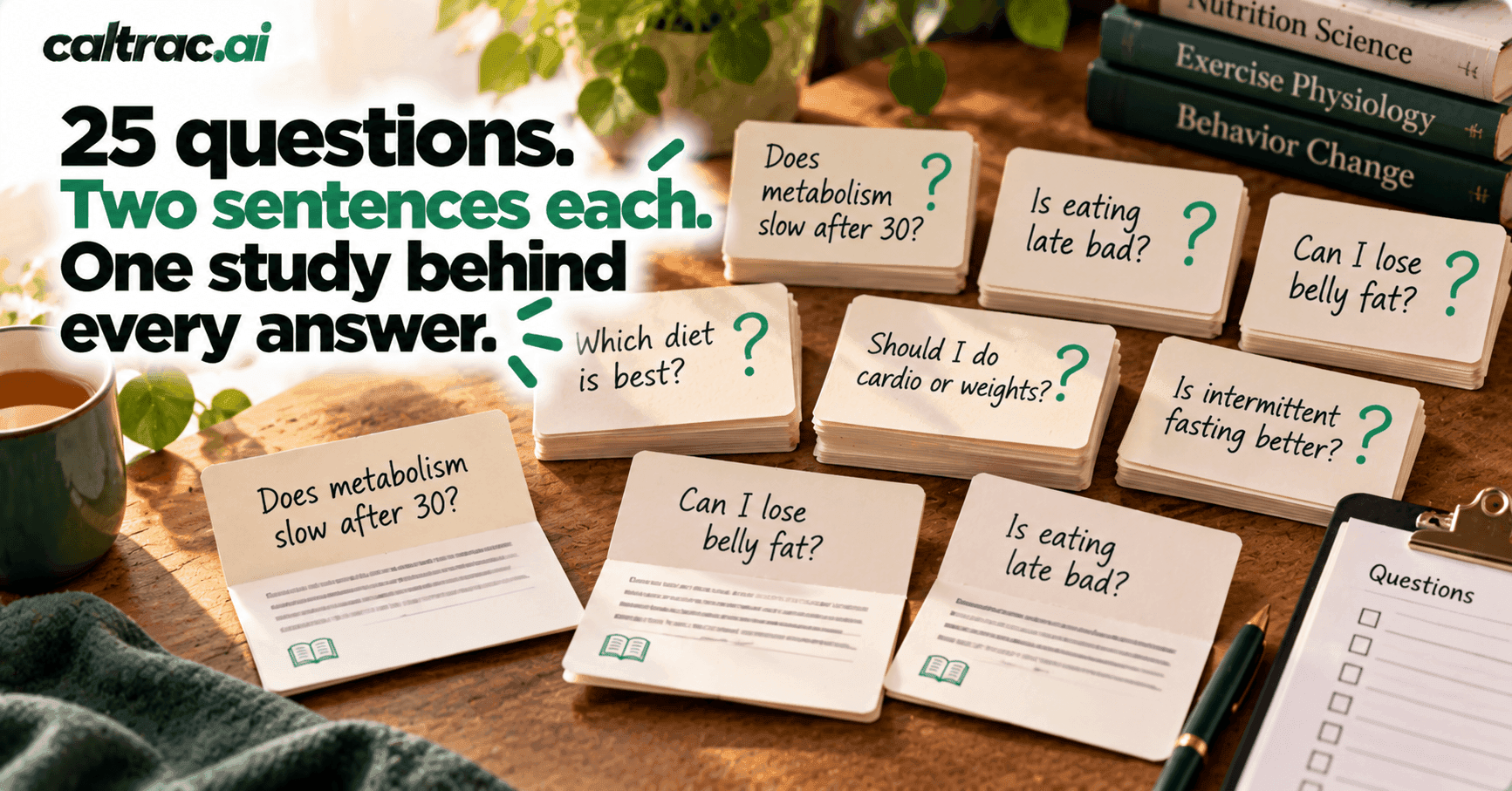
These are the twenty-five questions that come up in almost every conversation about losing weight, answered in two or three sentences each with the study behind the answer. The point of the format is speed: most of these questions have been settled by trials, and the answer fits in a paragraph. Where the honest answer is "it depends" or "we do not know", that is what the paragraph says.
This is general nutrition information, not medical advice.
Calories and Metabolism
1. How many calories should I eat to lose weight? About 500 to 750 a day below what you burn, which the obesity treatment guideline gives as either that deficit or a prescription of 1,200 to 1,500 kcal for women and 1,500 to 1,800 for men, adjusted for body weight [1]. Find your maintenance with the calorie calculator and subtract from it rather than starting from a search result.
2. Is the 3,500 calories per pound rule true? Not over any useful period. Energy expenditure falls as you lose weight, so the same deficit produces less loss each month, and the body's response to a change in intake has a half-time of about a year [2]. The rule roughly doubles what a year of dieting will deliver.
3. Does metabolism slow with age? Not between 20 and 60. Measurements of total energy expenditure in thousands of people from eight days to 95 years old show that, adjusted for body size and composition, expenditure is stable through adulthood and only begins declining in older age [3]. Mid-life weight gain is activity and intake, not metabolism.
4. Does dieting put me in starvation mode? Metabolism does adapt to a deficit, by more than the weight loss alone predicts, but the effect is modest for ordinary dieting and the body does not stop losing fat; even the Minnesota Starvation Experiment's semi-starved men kept losing weight [4]. The extreme case, contestants who lost 58 kg, showed a resting metabolism about 500 kcal below expectation six years later, which is the ceiling of the effect, not the norm [5].
5. Why have I plateaued? Almost always because intake has drifted up, not because metabolism has stalled. Weight loss in trials plateaus at about six months, while the models predict one to two years, and the gap is explained by intermittent lapses in adherence [6]. A two-week break at maintenance followed by a recalculated deficit worked better than pushing on in the one trial that tested it [7].
6. Can I lose belly fat specifically? No. Six weeks of daily abdominal exercise produced no change in abdominal fat, body fat percentage or waist circumference, although it did improve curl-up performance [8]. Fat comes off where genetics decides; the deficit decides how much.
What to Eat
7. Which diet is best? The one you will keep. Across 48 trials of named diets, low-carbohydrate and low-fat approaches lost almost identical amounts, about 7.3 kg at a year, and differences between brands were minimal [9]. In a head-to-head of four diets, weight loss correlated with adherence and not at all with which diet was assigned [10].
8. Are carbs fattening? Not at equal calories. A year-long trial of low-fat against low-carbohydrate diets found both lost 5 to 6 kg with no difference [11], and a two-year trial of four macronutrient splits found the same loss on all of them [12]. Controlled feeding studies show no metabolic advantage to cutting carbohydrate when calories and protein are matched [13].
9. How much protein should I eat? About 1.2 to 1.6 g per kilogram of body weight a day, with 25 to 30 g at each meal, the range that preserves muscle and reduces appetite during weight loss [14]. When people were moved to 30% of calories from protein and told to eat freely, they ate 441 fewer calories a day [15]. Set it in the macro calculator.
10. Is a high-protein diet bad for my kidneys? Not in healthy people. A meta-analysis of 28 trials found no difference in kidney function between higher- and lower-protein diets [16]. People with existing kidney disease should follow medical advice.
11. Does protein timing around workouts matter? Very little. A meta-analysis of 23 studies found no effect of protein timing on muscle growth once total daily protein was accounted for; total intake was what predicted results [17].
12. Do I need to eat every two to three hours to keep my metabolism up? No. Meal frequency has no effect on weight or body composition at equal calories in a meta-analysis of trials [18]. Eat the number of meals that controls your hunger.
13. Is intermittent fasting better than just eating less? It is a way of eating less, not a better one. In a year-long trial, calorie restriction with an eight-hour eating window lost 8.0 kg against 6.3 kg for calorie restriction alone, a difference that was not statistically significant [19].
14. Should I eat breakfast? Only if you want it. Across 13 trials, people assigned to eat breakfast consumed about 260 more calories a day and weighed slightly more than those who skipped it [20]. What matters is the protein in your first meal, not its clock time.
15. Does eating late at night cause weight gain? The calories are the same, but the timing is not neutral. In a controlled crossover, eating identical meals four hours later increased hunger, lowered leptin and reduced energy expenditure the next day [21], and in a 20-week programme people who ate their main meal after 3 p.m. lost less weight than early eaters at the same intake [22].
16. Do artificial sweeteners make you gain weight? Not according to the trials. Low-energy sweeteners in place of sugar reduced intake by about 94 kcal in short-term studies and produced 1.35 kg more weight loss in sustained trials [23]. The WHO advises against using them for long-term weight control on the basis of observational evidence [24]; the randomised evidence points the other way.
17. Do liquid calories count the same? On the scale, yes; in your appetite, no. People given 450 kcal a day as a sugary drink did not compensate by eating less and gained weight, while the same calories as solid food were largely offset [25].
18. Are eggs bad for cholesterol? Up to one a day was not associated with cardiovascular disease across three cohorts and a meta-analysis of 1.7 million people [26]. Saturated fat matters more than dietary cholesterol for most people; those with diabetes should follow medical advice.
19. Do ultra-processed foods matter if the calories are the same? Yes, because the calories do not stay the same. Adults given free access to an ultra-processed menu ate about 508 more calories a day than on an unprocessed one matched for nutrients on offer, and gained weight in two weeks [27].
20. How much fibre, and does it help? Aim for 25 to 38 g. Fibre intake predicted weight loss and adherence better than any other dietary factor in a six-month calorie-restricted trial [28].
Habits and Tactics
21. Does drinking water help weight loss? A little, before meals. Adults who drank 500 ml of water before each meal lost 2 kg more over 12 weeks than those who did not [29]. Water replaces drinks with calories and fills the stomach; it does not burn fat.
22. Should I weigh myself every day? If you can do it without distress, yes. Daily weighers lost about 6 kg more over six months than less frequent weighers and adopted more weight-control behaviours [30]. Weigh at the same time, and read the weekly trend, not the day.
23. Do smaller plates and eating slowly really work? Both have trial evidence. Larger portions, packages and tableware increased consumption across 72 studies, by enough to account for 144 to 228 kcal a day [31], and slower eating reduced intake across 22 studies without increasing later hunger [32].
24. Do detoxes, fat burners or fasted cardio work? Detox diets have no evidence of eliminating toxins or producing lasting weight loss [33]. Green tea catechins, the best-supported fat burner, produced about 1.3 kg in a meta-analysis [34]. Fasted cardio burned no more fat than fed cardio over four weeks at equal calories [35].
25. Will I keep the weight off? About 20% of people who lose 10% of their weight keep it off for a year, and the people who do share habits: about an hour of physical activity a day, a consistent eating pattern across the week, regular breakfast and regular self-weighing; once weight has been held for two to five years the odds of keeping it improve greatly [36]. Commercial programmes average modest results, about 3% of weight at two years for the best-studied one [37]. The hunger hormones of weight loss persist for at least a year [38], which is why the habits matter more than the diet that produced the loss.
The Pattern in the Answers
Read together, the twenty-five answers say one thing in several ways. The deficit decides the weight; protein and fibre decide how hungry you are while you hold it; the diet's name, meal timing, frequency and supplements decide almost nothing; and the habits that keep weight off are measurement and consistency. Protein also has a small thermic cost, since digesting it burns more energy than digesting fat or carbohydrate [39], which is one more reason to put it first on the plate.
That is where tracking earns its keep. Nearly every question above is answered by a number that is invisible without a log: the deficit, the protein per meal, the fibre, the drinks, the weekend. Snap a photo of the plate or type "dal, 1 roti, cucumber salad" and track it automatically with Caltrac. You will see the numbers the research says matter, and your Apple Health-powered net calorie count shows whether the deficit you planned is the deficit you have. Ask the question; let the app show the answer.
Frequently Asked Questions
What is the single most important factor for weight loss? A sustained calorie deficit of 500 to 750 kcal a day [1]; adherence, not diet type, predicted weight loss in head-to-head trials [10] [9].
Does metabolism slow down after 30? Not until older age. Adjusted energy expenditure is stable from 20 to 60 in the largest dataset ever assembled [3].
Is it better to eat three meals or six? Neither; meal frequency does not affect weight at equal calories [18].
How long does a weight-loss plateau last? Until intake changes. Plateaus arrive at about six months because of adherence lapses, not metabolic adaptation [6]; a short maintenance break and a recalculated deficit restarts loss [7].
Does eating at night make you fat? Not by itself, but later eating increased hunger and reduced next-day energy expenditure in a controlled trial [21] and predicted slower loss in a 20-week programme [22].
What percentage of people keep weight off? About 20% maintain a 10% loss for a year; those who do are active about an hour a day, eat consistently, and weigh themselves regularly [36].
References
- Jensen MD, et al. 2013 AHA/ACC/TOS guideline for the management of overweight and obesity in adults. Circulation. 2014;129(25 Suppl 2):S102-S138. pubmed.ncbi.nlm.nih.gov
- Hall KD, et al. Quantification of the effect of energy imbalance on bodyweight. Lancet. 2011;378(9793):826-837. pubmed.ncbi.nlm.nih.gov
- Pontzer H, et al. Daily energy expenditure through the human life course. Science. 2021;373(6556):808-812. pubmed.ncbi.nlm.nih.gov
- Müller MJ, et al. Metabolic adaptation to caloric restriction and subsequent refeeding: the Minnesota Starvation Experiment revisited. American Journal of Clinical Nutrition. 2015;102(4):807-819. pubmed.ncbi.nlm.nih.gov
- Fothergill E, et al. Persistent metabolic adaptation 6 years after "The Biggest Loser" competition. Obesity. 2016;24(8):1612-1619. pubmed.ncbi.nlm.nih.gov
- Thomas DM, Gonzalez MC, Pereira AZ, Redman LM, Heymsfield SB. Time to correctly predict the amount of weight loss with dieting. Journal of the Academy of Nutrition and Dietetics. 2014;114(6):857-861. pubmed.ncbi.nlm.nih.gov
- Byrne NM, Sainsbury A, King NA, Hills AP, Wood RE. Intermittent energy restriction improves weight loss efficiency in obese men: the MATADOR study. International Journal of Obesity. 2018;42(2):129-138. pubmed.ncbi.nlm.nih.gov
- Vispute SS, et al. The effect of abdominal exercise on abdominal fat. Journal of Strength and Conditioning Research. 2011;25(9):2559-2564. pubmed.ncbi.nlm.nih.gov
- Johnston BC, et al. Comparison of weight loss among named diet programs in overweight and obese adults: a meta-analysis. JAMA. 2014;312(9):923-933. pubmed.ncbi.nlm.nih.gov
- Dansinger ML, Gleason JA, Griffith JL, Selker HP, Schaefer EJ. Comparison of the Atkins, Ornish, Weight Watchers, and Zone diets for weight loss and heart disease risk reduction: a randomized trial. JAMA. 2005;293(1):43-53. pubmed.ncbi.nlm.nih.gov
- Gardner CD, et al. Effect of Low-Fat vs Low-Carbohydrate Diet on 12-Month Weight Loss in Overweight Adults and the Association With Genotype Pattern or Insulin Secretion: The DIETFITS Randomized Clinical Trial. JAMA. 2018;319(7):667-679. pubmed.ncbi.nlm.nih.gov
- Sacks FM, et al. Comparison of weight-loss diets with different compositions of fat, protein, and carbohydrates. New England Journal of Medicine. 2009;360(9):859-873. pubmed.ncbi.nlm.nih.gov
- Hall KD, Guo J. Obesity Energetics: Body Weight Regulation and the Effects of Diet Composition. Gastroenterology. 2017;152(7):1718-1727. pubmed.ncbi.nlm.nih.gov
- Leidy HJ, et al. The role of protein in weight loss and maintenance. American Journal of Clinical Nutrition. 2015;101(6):1320S-1329S. pubmed.ncbi.nlm.nih.gov
- Weigle DS, et al. A high-protein diet induces sustained reductions in appetite, ad libitum caloric intake, and body weight despite compensatory changes in diurnal plasma leptin and ghrelin concentrations. American Journal of Clinical Nutrition. 2005;82(1):41-48. pubmed.ncbi.nlm.nih.gov
- Devries MC, et al. Changes in Kidney Function Do Not Differ between Healthy Adults Consuming Higher- Compared with Lower- or Normal-Protein Diets: A Systematic Review and Meta-Analysis. Journal of Nutrition. 2018;148(11):1760-1775. pubmed.ncbi.nlm.nih.gov
- Schoenfeld BJ, Aragon AA, Krieger JW. The effect of protein timing on muscle strength and hypertrophy: a meta-analysis. Journal of the International Society of Sports Nutrition. 2013;10(1):53. pubmed.ncbi.nlm.nih.gov
- Schoenfeld BJ, Aragon AA, Krieger JW. Effects of meal frequency on weight loss and body composition: a meta-analysis. Nutrition Reviews. 2015;73(2):69-82. pubmed.ncbi.nlm.nih.gov
- Liu D, et al. Calorie Restriction with or without Time-Restricted Eating in Weight Loss. New England Journal of Medicine. 2022;386(16):1495-1504. pubmed.ncbi.nlm.nih.gov
- Sievert K, et al. Effect of breakfast on weight and energy intake: systematic review and meta-analysis of randomised controlled trials. BMJ. 2019;364:l42. pubmed.ncbi.nlm.nih.gov
- Vujović N, et al. Late isocaloric eating increases hunger, decreases energy expenditure, and modifies metabolic pathways in adults with overweight and obesity. Cell Metabolism. 2022;34(10):1486-1498. pubmed.ncbi.nlm.nih.gov
- Garaulet M, et al. Timing of food intake predicts weight loss effectiveness. International Journal of Obesity. 2013;37(4):604-611. pubmed.ncbi.nlm.nih.gov
- Rogers PJ, et al. Does low-energy sweetener consumption affect energy intake and body weight? A systematic review, including meta-analyses, of the evidence from human and animal studies. International Journal of Obesity. 2016;40(3):381-394. pubmed.ncbi.nlm.nih.gov
- World Health Organization. WHO advises not to use non-sugar sweeteners for weight control (2023 guideline). who.int
- DiMeglio DP, Mattes RD. Liquid versus solid carbohydrate: effects on food intake and body weight. International Journal of Obesity. 2000;24(6):794-800. pubmed.ncbi.nlm.nih.gov
- Drouin-Chartier JP, et al. Egg consumption and risk of cardiovascular disease: three large prospective US cohort studies, systematic review, and updated meta-analysis. BMJ. 2020;368:m513. pubmed.ncbi.nlm.nih.gov
- Hall KD, et al. Ultra-Processed Diets Cause Excess Calorie Intake and Weight Gain: An Inpatient Randomized Controlled Trial of Ad Libitum Food Intake. Cell Metabolism. 2019;30(1):67-77. pubmed.ncbi.nlm.nih.gov
- Miketinas DC, et al. Fiber Intake Predicts Weight Loss and Dietary Adherence in Adults Consuming Calorie-Restricted Diets: The POUNDS Lost Study. Journal of Nutrition. 2019;149(10):1742-1748. pubmed.ncbi.nlm.nih.gov
- Dennis EA, et al. Water consumption increases weight loss during a hypocaloric diet intervention in middle-aged and older adults. Obesity. 2010;18(2):300-307. pubmed.ncbi.nlm.nih.gov
- Steinberg DM, Bennett GG, Askew S, Tate DF. Weighing every day matters: daily weighing improves weight loss and adoption of weight control behaviors. Journal of the Academy of Nutrition and Dietetics. 2015;115(4):511-518. pubmed.ncbi.nlm.nih.gov
- Hollands GJ, et al. Portion, package or tableware size for changing selection and consumption of food, alcohol and tobacco. Cochrane Database of Systematic Reviews. 2015;9:CD011045. pubmed.ncbi.nlm.nih.gov
- Robinson E, et al. A systematic review and meta-analysis examining the effect of eating rate on energy intake and hunger. American Journal of Clinical Nutrition. 2014;100(1):123-151. pubmed.ncbi.nlm.nih.gov
- Klein AV, Kiat H. Detox diets for toxin elimination and weight management: a critical review of the evidence. Journal of Human Nutrition and Dietetics. 2015;28(6):675-686. pubmed.ncbi.nlm.nih.gov
- Hursel R, Viechtbauer W, Westerterp-Plantenga MS. The effects of green tea on weight loss and weight maintenance: a meta-analysis. International Journal of Obesity. 2009;33(9):956-961. pubmed.ncbi.nlm.nih.gov
- Schoenfeld BJ, et al. Body composition changes associated with fasted versus non-fasted aerobic exercise. Journal of the International Society of Sports Nutrition. 2014;11:54. pubmed.ncbi.nlm.nih.gov
- Wing RR, Phelan S. Long-term weight loss maintenance. American Journal of Clinical Nutrition. 2005;82(1 Suppl):222S-225S. pubmed.ncbi.nlm.nih.gov
- Tsai AG, Wadden TA. Systematic review: an evaluation of major commercial weight loss programs in the United States. Annals of Internal Medicine. 2005;142(1):56-66. pubmed.ncbi.nlm.nih.gov
- Sumithran P, et al. Long-term persistence of hormonal adaptations to weight loss. New England Journal of Medicine. 2011;365(17):1597-1604. pubmed.ncbi.nlm.nih.gov
- Westerterp KR. Diet induced thermogenesis. Nutrition & Metabolism. 2004;1:5. pubmed.ncbi.nlm.nih.gov