


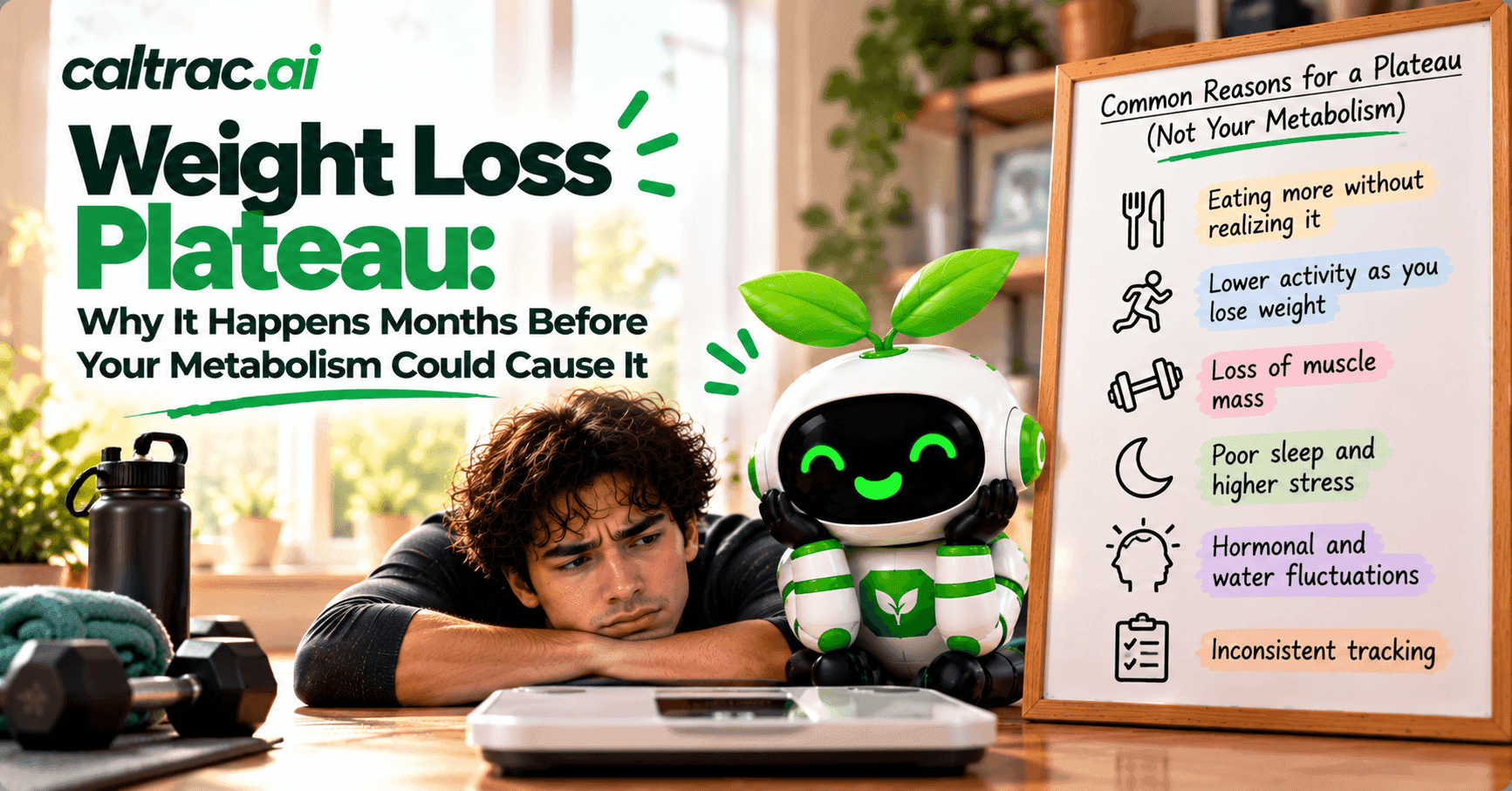
Every diet stalls. Weight comes off for two or three months, then the scale stops, and the explanation that arrives first is that your metabolism has "adapted" and the deficit no longer works. The research says something less flattering and more useful: the plateau usually arrives months before any metabolic adaptation could cause it, and the main reason is that the deficit quietly stopped being a deficit. Here is why plateaus happen, how to tell which kind you are in, and what breaks each one.
When Plateaus Happen, and When They Should
Weight loss in clinical trials typically stabilises at around six months. Mathematical models of energy balance, however, predict that a maintained calorie deficit should keep producing loss, slowing gradually, with a true plateau only after one to two years [1]. The gap between the six-month reality and the two-year prediction is the puzzle, and when researchers built a model that allowed for intermittent lapses in adherence, it reproduced the six-month plateau exactly. Their conclusion: "an intermittent lack of diet adherence, not metabolic adaptation, is a major contributor to the frequently observed early weight-loss plateau" [1].
The CALERIE 2 trial shows the pattern in real people. Participants prescribed a 25% calorie reduction for two years hit their best adherence early; it began to slip after about week 20, and weight loss stopped at about week 60 [2]. The deficit did not stop working. It stopped being there.
The Four Causes, in Order
1. Intake has crept up
This is the plateau most people are in. Nobody notices a 200-calorie drift: an extra tablespoon of oil, a bigger rice portion, a weekend that stopped being logged. Human estimation is biased in one direction. People who insisted they could not lose weight were found to under-report intake by 47% and over-report exercise by 51% [3]; even dietitians under-report by about 10% when checked against gold-standard measurement, and non-dietitians by about 19% [4].
The test: log everything, by weight, for seven days, including oils, drinks and weekends. If the honest average is higher than your target, you have found the plateau.
The fix: tighten logging for two weeks, not the target.
2. The target is stale
A 500 kcal deficit set at 90 kg is not a 500 kcal deficit at 80 kg. A lighter body burns less, so a fixed intake delivers a shrinking deficit, and the NIH's dynamic model shows that a constant intake produces loss that slows and levels off, with half the eventual change in the first year [5]. On top of that, the body reduces expenditure about 10 to 15% beyond what the smaller size predicts once a 10% loss is maintained [6].
The test: have you lost more than 5 kg since you set the target?
The fix: recalculate maintenance at your current weight with the calorie calculator and reset the deficit from there. The BMR calculator shows how much of the drop is simply your smaller resting cost.
3. Exercise is being overcounted
Fitness trackers overestimate energy expenditure; none of seven devices tested came within 20% of the true value [7]. The body also offsets about 28% of exercise calories through reduced expenditure elsewhere [8]. If you eat back the 600 calories your watch awards for a run, the real deficit is gone.
The test: are you adding exercise calories to your intake allowance?
The fix: stop. Set the calorie target at a fixed activity level and treat workouts as a bonus you do not eat.
4. It is not a plateau, it is water
Weight follows a weekly cycle, highest after the weekend and lowest mid-week [9], and the body stores roughly 500 g of glycogen bound to three to four times its weight in water [10]. A salty meal, a high-carbohydrate day, a hard training session or the menstrual cycle can hold two kilos of water for a week while fat continues to fall underneath. Three weeks of a flat weekly average is a plateau. Ten days is weather.
The test: compare seven-day averages, not days, and look back at least three weeks.
The fix: patience, and a waist measurement, which does not care about water.
What About Metabolic Adaptation?
It is real, it is smaller than its reputation, and it is rarely the reason a diet stalls at month three. In a three-week study at half of energy needs, resting expenditure fell by 266 kcal/day, of which only about 72 kcal/day was true adaptation beyond the loss of tissue, and weight loss continued throughout [11]. Adaptation of 10 to 15% below predicted after a maintained 10% loss [6] means a target that should be 1,700 kcal is really about 1,550. That is a correction to make, not a wall.
Where the body does fight back hard is appetite. A year after a 13.5 kg loss, hunger hormones remained elevated and fullness hormones suppressed [12], and recent modelling of the weight-loss plateau concludes that diet restriction stalls earlier than drugs or surgery precisely because it leaves this appetite feedback intact, so that intake drifts upward as weight falls [13]. The plateau, in other words, is cause 1 again, driven by biology rather than carelessness. The answer is the same: measure, and manage hunger deliberately.
How to Break a Plateau
Run this in order. Most people never get past step 3.
- Confirm it. Three or more weeks of flat seven-day averages [9]. Weigh daily; daily weighers lose more and adopt more weight-control behaviours [14].
- Audit intake for a week. Weigh food, log oils and drinks, log weekends. Under-reporting is the most common finding [3] [4].
- Recalculate. New maintenance at current weight, minus 500 to 750 kcal [15], minus a further 100 for adaptation [6].
- Stop eating back exercise. Trackers over-award [7] and the body compensates [8].
- Raise protein. If it is below 1.2 g per kilogram, lift it to 1.2 to 1.6 g/kg [16]; higher-protein deficits preserve resting expenditure and lean mass [17]. Set it in the macro calculator.
- Add movement, not workouts. Lean adults stand and move about two hours a day more than obese adults, worth roughly 350 kcal [18]. Steps do not get compensated for the way gym sessions do.
- Sleep. Short sleep halves fat loss on the same deficit [19].
- Consider a diet break. Two weeks at maintenance, then back to the deficit. One trial found breaks improved total loss and reduced adaptation [20]; another found no advantage but lower hunger [21]. They do not hurt, and the break itself often reveals that maintenance is lower than assumed.
What not to do is cut another 500 calories on top of a deficit you cannot verify. If intake has drifted, the cut fixes nothing; if the deficit is genuine, it pushes you into muscle loss and the hunger that caused the drift in the first place.
That is where tracking earns its keep. A plateau is a measurement problem before it is a metabolism problem, and the fix starts with knowing what you actually ate. Snap a photo of every plate for a week, including the weekend, or type what you ate, and track it automatically with Caltrac. You will see the real weekly average against your target, and your Apple Health-powered net calorie count shows whether the movement side has slipped too. Find the drift; let the app show you where.
Frequently Asked Questions
Why have I stopped losing weight on a calorie deficit? Most often intake has drifted upward, the target has not been recalculated for your lower weight, or exercise calories are being over-counted [1] [5] [7]. Metabolic adaptation is real but small [11].
How long does a weight loss plateau last? A true plateau is three or more weeks of a flat weekly average; shorter stalls are usually water and the weekly weight rhythm [9] [10]. It lasts until the cause is corrected.
Is my metabolism damaged? No. After a maintained 10% loss, expenditure is about 10 to 15% below what body size predicts [6], a correction of 100 to 200 kcal, not a shutdown.
Should I eat more to break a plateau? Sometimes. A two-week break at maintenance did not hurt in trials and may help adherence [20] [21]. More often the fix is accurate logging and a recalculated target.
Does exercise help break a plateau? Daily movement does; formal exercise is partly offset by the body [8] and over-counted by trackers [7]. Add steps, and do not eat the calories back.
How often should I recalculate my calorie target? Every 5 kg lost, because a smaller body burns less and a fixed intake delivers a shrinking deficit [5].
References
- Thomas DM, et al. Effect of dietary adherence on the body weight plateau: a mathematical model incorporating intermittent compliance with energy intake prescription. American Journal of Clinical Nutrition. 2014;100(3):787-795. pubmed.ncbi.nlm.nih.gov
- Dorling JL, et al. Changes in body weight, adherence, and appetite during 2 years of calorie restriction: the CALERIE 2 randomized clinical trial. European Journal of Clinical Nutrition. 2020;74(8):1210-1220. pubmed.ncbi.nlm.nih.gov
- Lichtman SW, et al. Discrepancy between self-reported and actual caloric intake and exercise in obese subjects. New England Journal of Medicine. 1992;327(27):1893-1898. pubmed.ncbi.nlm.nih.gov
- Champagne CM, et al. Energy intake and energy expenditure: a controlled study comparing dietitians and non-dietitians. Journal of the American Dietetic Association. 2002;102(10):1428-1432. pubmed.ncbi.nlm.nih.gov
- Hall KD, et al. Quantification of the effect of energy imbalance on bodyweight. Lancet. 2011;378(9793):826-837. pubmed.ncbi.nlm.nih.gov
- Rosenbaum M, Leibel RL. Adaptive thermogenesis in humans. International Journal of Obesity. 2010;34 Suppl 1:S47-S55. pubmed.ncbi.nlm.nih.gov
- Shcherbina A, et al. Accuracy in Wrist-Worn, Sensor-Based Measurements of Heart Rate and Energy Expenditure in a Diverse Cohort. Journal of Personalized Medicine. 2017;7(2):3. pubmed.ncbi.nlm.nih.gov
- Careau V, et al. Energy compensation and adiposity in humans. Current Biology. 2021;31(20):4659-4666. pubmed.ncbi.nlm.nih.gov
- Orsama AL, et al. Weight rhythms: weight increases during weekends and decreases during weekdays. Obesity Facts. 2014;7(1):36-47. pubmed.ncbi.nlm.nih.gov
- Kreitzman SN, Coxon AY, Szaz KF. Glycogen storage: illusions of easy weight loss, excessive weight regain, and distortions in estimates of body composition. American Journal of Clinical Nutrition. 1992;56(1 Suppl):292S-293S. pubmed.ncbi.nlm.nih.gov
- Müller MJ, et al. Metabolic adaptation to caloric restriction and subsequent refeeding: the Minnesota Starvation Experiment revisited. American Journal of Clinical Nutrition. 2015;102(4):807-819. pubmed.ncbi.nlm.nih.gov
- Sumithran P, et al. Long-term persistence of hormonal adaptations to weight loss. New England Journal of Medicine. 2011;365(17):1597-1604. pubmed.ncbi.nlm.nih.gov
- Hall KD, et al. Physiology of the weight-loss plateau in response to diet restriction, GLP-1 receptor agonism, and bariatric surgery. Obesity. 2024;32(6):1163-1168. pubmed.ncbi.nlm.nih.gov
- Steinberg DM, Bennett GG, Askew S, Tate DF. Weighing every day matters: daily weighing improves weight loss and adoption of weight control behaviors. Journal of the Academy of Nutrition and Dietetics. 2015;115(4):511-518. pubmed.ncbi.nlm.nih.gov
- Jensen MD, et al. 2013 AHA/ACC/TOS guideline for the management of overweight and obesity in adults. Circulation. 2014;129(25 Suppl 2):S102-S138. pubmed.ncbi.nlm.nih.gov
- Leidy HJ, et al. The role of protein in weight loss and maintenance. American Journal of Clinical Nutrition. 2015;101(6):1320S-1329S. pubmed.ncbi.nlm.nih.gov
- Wycherley TP, et al. Effects of energy-restricted high-protein, low-fat compared with standard-protein, low-fat diets: a meta-analysis of randomized controlled trials. American Journal of Clinical Nutrition. 2012;96(6):1281-1298. pubmed.ncbi.nlm.nih.gov
- Levine JA, et al. Interindividual variation in posture allocation: possible role in human obesity. Science. 2005;307(5709):584-586. pubmed.ncbi.nlm.nih.gov
- Nedeltcheva AV, et al. Insufficient sleep undermines dietary efforts to reduce adiposity. Annals of Internal Medicine. 2010;153(7):435-441. pubmed.ncbi.nlm.nih.gov
- Byrne NM, et al. Intermittent energy restriction improves weight loss efficiency in obese men: the MATADOR study. International Journal of Obesity. 2018;42(2):129-138. pubmed.ncbi.nlm.nih.gov
- Peos JJ, et al. Continuous versus Intermittent Dieting for Fat Loss and Fat-Free Mass Retention in Resistance-trained Adults: The ICECAP Trial. Medicine & Science in Sports & Exercise. 2021;53(8):1685-1698. pubmed.ncbi.nlm.nih.gov