


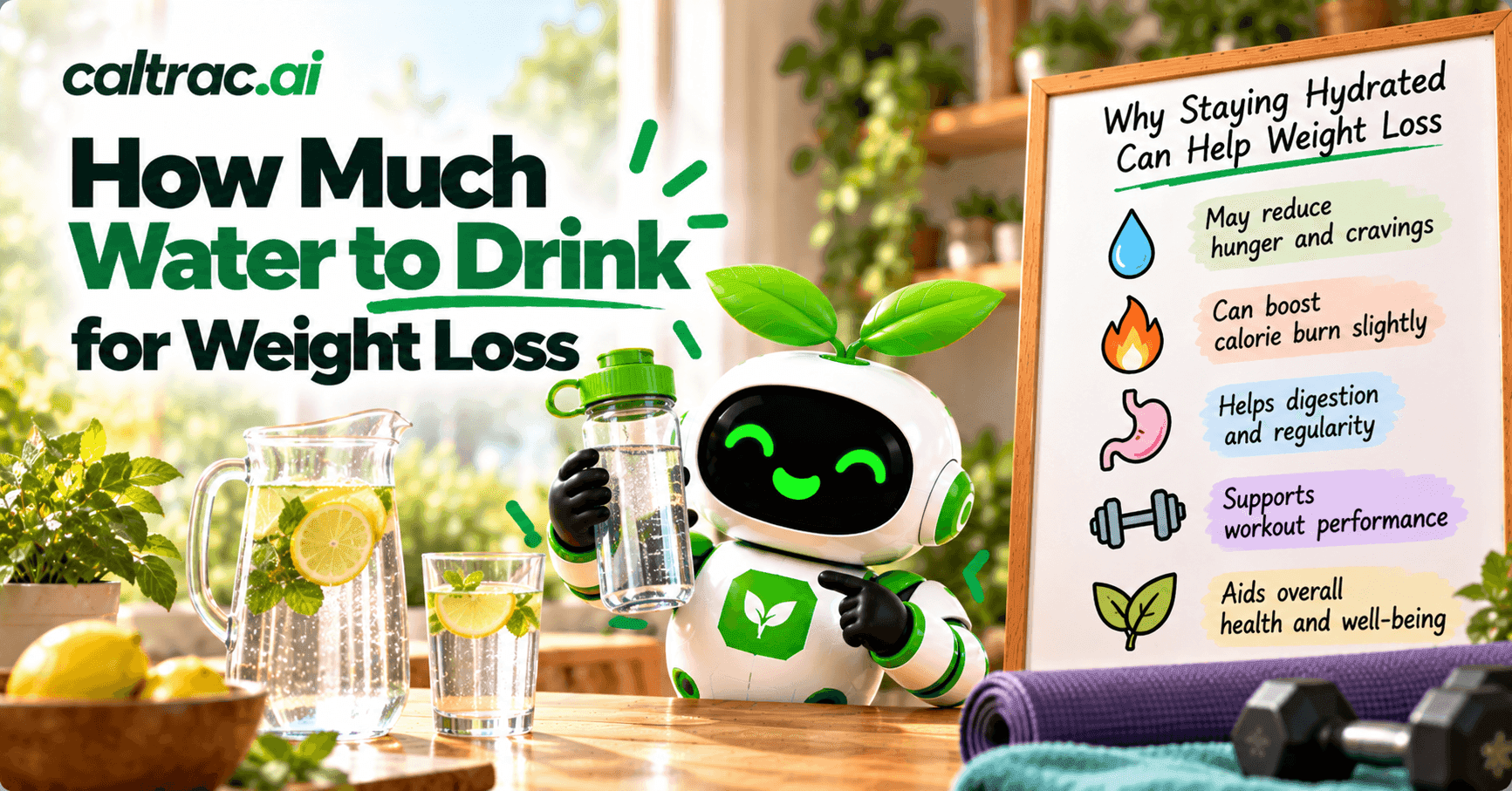
Water is the one dietary habit that costs nothing, has no downside, and is surrounded by more confident nonsense than almost any other. You do not need eight glasses a day. Drinking cold water does not meaningfully raise your metabolism. And yet water genuinely does help weight loss, through one mechanism that holds up and one that depends on what the water replaces. Here is what the evidence shows, how much you actually need, and how to use water as the free tool it is.
How Much Water You Actually Need
The "eight glasses a day" rule has no scientific origin. When a physiologist searched the literature for its basis, he found none, and noted that caffeinated drinks count toward fluid intake and that most healthy adults in temperate climates get enough by drinking when thirsty [1].
The official figures are higher than eight glasses but include everything. The Institute of Medicine's adequate intake is about 2.7 litres a day of total water for women and 3.7 litres for men, from all beverages and from food, which supplies about 20% of the total; the report states that the vast majority of healthy people meet their needs by letting thirst guide them [2]. The European figures are 2.0 litres for women and 2.5 litres for men under moderate conditions [3]. Subtract the roughly half litre that comes from food and the coffee, tea and milk most people already drink, and the amount of plain water a sedentary adult needs to add is usually one to two litres, not the three or four that bottles and apps push.
Heat, exercise and high-fibre or high-protein diets raise the need. Thirst, and pale yellow urine, remain the best indicators.
Does Water Boost Metabolism?
Barely, and the famous study has not held up. In 2003, researchers reported that drinking 500 ml of water raised metabolic rate by 30% for about an hour, worth roughly 24 kcal, and extrapolated that two litres a day might burn 400 kJ, about 95 kcal [4]. A follow-up by a different group using better methods found no increase in energy expenditure after distilled water or saline, and only a 4.5% rise after very cold water, concluding that the results "cast doubt on water as a thermogenic agent for the management of obesity" [5]. Even taking the optimistic study at face value, the effect is under 100 calories a day. Drink water because it is good for you, not because it burns fat.
Where Water Does Help: Before Meals
The one direct mechanism with trial support is the preload. Forty-eight adults aged 55 to 75 followed a calorie-restricted diet for twelve weeks, half of them drinking 500 ml of water before each meal. The water group lost about 2 kg more, a 44% faster rate of loss, and ate about 40 fewer calories at a test meal at the start of the study [6]. Two cautions: the participants were older, and gastric emptying slows with age, so the fullness effect may be smaller in younger people; and the preload's effect on test-meal intake had faded by week twelve even though the weight difference held.
Observational support points the same way. Among 173 overweight women in a year-long diet trial, those who increased their water intake lost more weight and body fat, independent of diet and activity [7]. A systematic review of the water literature found that in dieters, the small number of trials consistently showed added water reduced weight over three to twelve months, while in people not dieting it had no effect, and rated the overall evidence as low [8].
The honest summary: a glass or two of water before meals is a modest, free, zero-risk aid that works best inside a calorie deficit and probably does little on its own.
Where Water Helps Most: What It Replaces
The largest effect of water on weight has nothing to do with the water. It is the sugary drink it displaces.
Liquid calories do not register as food. When people were given 450 kcal a day as soda for four weeks, they did not eat any less of anything else and gained weight; the same calories as jelly beans were fully compensated for [9]. A review of beverage studies found that a meal's total energy intake was 7.8% higher when a sugar-sweetened drink rather than water was consumed beforehand, and 14.9% higher with milk or juice; non-nutritive sweeteners versus water made no difference [10].
Over the long run the numbers are consistent. Across three cohorts of about 125,000 adults, each extra cup of water a day was associated with 0.13 kg less weight gain per four years, while each extra sugar-sweetened drink added 0.36 kg. Replacing one sugary drink a day with water was associated with 0.49 kg less gain per four years, and replacing juice with water 0.35 kg [11]. A single can of cola is about 149 kcal [12]; three a day is a weight-loss deficit's worth of calories that the body never notices arriving.
If you drink anything with calories other than milk, switching it to water is the single highest-value hydration change you can make. Diet drinks are a reasonable bridge: randomised trials show low-energy sweeteners lead to slightly lower weight than sugar and no increase in intake [13].
Water and the Scale
Water is also why the scale lies. Glycogen is stored with three to four times its weight in water [14], so a high-carbohydrate day adds a kilo overnight and a low-carbohydrate day removes it, with no change in fat. A salty meal holds water for a day or two; dehydration after alcohol or a hard workout drops it. The first week of any diet produces a flattering loss that is mostly water, and the first weekend produces an alarming gain that is mostly water too. Judge progress on weekly averages and drink consistently, so the day-to-day noise is as small as it can be.
Special Cases
High-protein and high-fibre diets. Both increase water needs, protein because of the nitrogen the kidneys must clear and fibre because it absorbs water in the gut. If you have raised either, raise water with them.
GLP-1 medications. Appetite suppression reduces fluid intake alongside food, and constipation is common. The expert consensus for people on these drugs recommends more than two litres of fluid a day specifically for this reason [15].
Hot climates and training. Thirst lags behind need during heavy sweating. Drink to a schedule on those days, not to thirst.
A Practical Water Plan
- A glass before each meal. The one habit with trial support [6], and it costs nothing.
- Replace every sugary drink with water or a zero-calorie alternative. The biggest lever by far [11] [9].
- Aim for one to two litres of plain water on top of what food and other drinks provide, more in heat or with exercise [2] [3].
- Keep it boring. Water, sparkling water, black coffee and plain tea all count [1]. Juice is not hydration; it is calories.
- Judge weight weekly. Daily swings are water [14].
Water affects the calorie side of your deficit only through what it replaces, so start with the target itself: Caltrac's calorie calculator gives maintenance and a weight-loss figure, and the three cans of cola you swap for water are 150 kcal each against it.
That is where tracking earns its keep. Snap a photo of your meal or type what you ate and drank, and track it automatically with Caltrac. Drinks with calories show up in your day's total exactly as they should, so the cola, the juice and the sweet chai stop hiding, and your Apple Health-powered net calorie count shows what the swap to water was worth. Drink the water; let the app count what it replaced.
Frequently Asked Questions
How much water should I drink a day to lose weight? There is no weight-loss dose. Adequate total intake is about 2.7 litres for women and 3.7 for men including food and all drinks [2], which for most people means one to two litres of plain water. A glass before meals showed a modest benefit in a diet trial [6].
Does drinking water burn calories? Negligibly. The study claiming a 30% metabolic rise after 500 ml [4] was not replicated; a later trial found no effect from room-temperature water [5].
Does drinking water before meals help you lose weight? In older adults on a diet, 500 ml before each meal produced about 2 kg more loss over twelve weeks [6]. The evidence is limited but consistent in dieters [8].
Is it a myth that you need 8 glasses of water a day? Yes. No scientific basis for the rule was found, and caffeinated drinks count toward fluid intake [1].
Does replacing soda with water help weight loss? Yes, more than any other hydration change. Each sugary drink replaced with water was associated with about 0.5 kg less weight gain per four years [11], because liquid calories are not compensated for [9].
Why does my weight jump after a salty or high-carb day? Glycogen is stored with three to four times its weight in water [14], and salt retains water. The gain is fluid, not fat, and clears within days.
References
- Valtin H. "Drink at least eight glasses of water a day." Really? Is there scientific evidence for "8 x 8"? American Journal of Physiology, Regulatory, Integrative and Comparative Physiology. 2002;283(5):R993-R1004. pubmed.ncbi.nlm.nih.gov
- National Academies (Institute of Medicine). Report Sets Dietary Intake Levels for Water, Salt, and Potassium. 11 February 2004 (total water 2.7 L women, 3.7 L men, including food and all beverages). nationalacademies.org
- European Food Safety Authority. Dietary Reference Values for nutrients: Summary report. 2017 (adequate total water intake 2.0 L women, 2.5 L men). efsa.europa.eu
- Boschmann M, et al. Water-induced thermogenesis. Journal of Clinical Endocrinology & Metabolism. 2003;88(12):6015-6019. pubmed.ncbi.nlm.nih.gov
- Brown CM, Dulloo AG, Montani JP. Water-induced thermogenesis reconsidered: the effects of osmolality and water temperature on energy expenditure after drinking. Journal of Clinical Endocrinology & Metabolism. 2006;91(9):3598-3602. pubmed.ncbi.nlm.nih.gov
- Dennis EA, et al. Water consumption increases weight loss during a hypocaloric diet intervention in middle-aged and older adults. Obesity. 2010;18(2):300-307. pubmed.ncbi.nlm.nih.gov
- Stookey JD, Constant F, Popkin BM, Gardner CD. Drinking water is associated with weight loss in overweight dieting women independent of diet and activity. Obesity. 2008;16(11):2481-2488. pubmed.ncbi.nlm.nih.gov
- Muckelbauer R, Sarganas G, Grüneis A, Müller-Nordhorn J. Association between water consumption and body weight outcomes: a systematic review. American Journal of Clinical Nutrition. 2013;98(2):282-299. pubmed.ncbi.nlm.nih.gov
- DiMeglio DP, Mattes RD. Liquid versus solid carbohydrate: effects on food intake and body weight. International Journal of Obesity. 2000;24(6):794-800. pubmed.ncbi.nlm.nih.gov
- Daniels MC, Popkin BM. Impact of water intake on energy intake and weight status: a systematic review. Nutrition Reviews. 2010;68(9):505-521. pubmed.ncbi.nlm.nih.gov
- Pan A, et al. Changes in water and beverage intake and long-term weight changes: results from three prospective cohort studies. International Journal of Obesity. 2013;37(10):1378-1385. pubmed.ncbi.nlm.nih.gov
- USDA FoodData Central. Beverages, carbonated, cola, regular: 42 kcal per 100 g (355 ml can about 149 kcal). SR Legacy 174852. fdc.nal.usda.gov
- Rogers PJ, et al. Does low-energy sweetener consumption affect energy intake and body weight? A systematic review, including meta-analyses, of the evidence from human and animal studies. International Journal of Obesity. 2016;40(3):381-394. pubmed.ncbi.nlm.nih.gov
- Kreitzman SN, Coxon AY, Szaz KF. Glycogen storage: illusions of easy weight loss, excessive weight regain, and distortions in estimates of body composition. American Journal of Clinical Nutrition. 1992;56(1 Suppl):292S-293S. pubmed.ncbi.nlm.nih.gov
- Sievenpiper JL, et al. Nutritional and lifestyle supportive care recommendations for management of obesity with GLP-1-based therapies: An expert consensus statement using a modified Delphi approach. Obesity Pillars. 2025;17:100228. pubmed.ncbi.nlm.nih.gov