


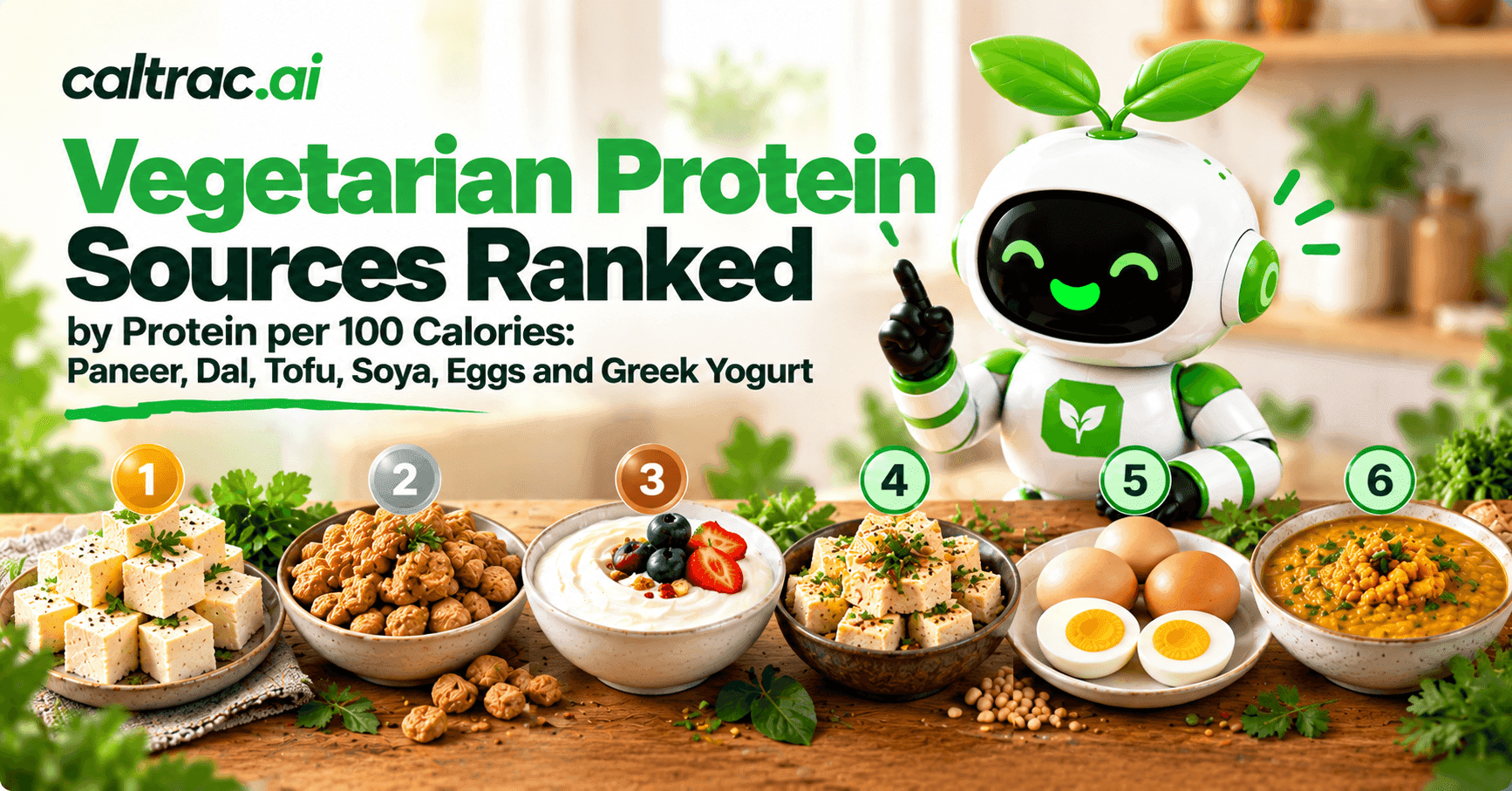
Ask most vegetarians where their protein comes from and the answer is "dal and paneer." Both are fine foods. Neither is an efficient protein source, and that is the problem this article solves. Dal delivers about 9 g of protein per 100 g cooked but costs 116 calories to get it; paneer delivers 20 to 25 g but costs more than 320 calories [1] [2] [3]. If you are trying to hit a protein target without blowing a calorie budget, the only ranking that matters is protein per 100 calories, and on that measure the vegetarian list looks very different from the one most people carry in their heads.
Below, 30 vegetarian and vegan protein foods ranked by protein density, using USDA FoodData Central values throughout, with notes on protein quality, iron, and how to build a day from them.
The Ranking: Protein per 100 Calories
All figures per 100 g as eaten, from the sources linked in each row. The last column is the one to read.
| Rank | Food | Calories per 100 g | Protein per 100 g | Protein per 100 kcal |
|---|---|---|---|---|
| 1 | Egg whites [4] | 52 | 10.9 g | 21.0 g |
| 2 | Greek yogurt, nonfat plain [5] | 54 | 9.5 g | 17.6 g |
| 3 | Whey protein isolate [6] | 359 | 58.1 g | 16.2 g |
| 4 | Soya chunks, dry [7] | 345 | 52 g | 15.1 g |
| 5 | Cottage cheese, 2% [8] | 81 | 10.4 g | 12.8 g |
| 6 | Tofu, firm [9] | 144 | 17.3 g | 12.0 g |
| 7 | Tempeh, cooked [10] | 195 | 19.9 g | 10.2 g |
| 8 | Edamame [11] | 121 | 11.9 g | 9.8 g |
| 9 | Skim milk [12] | 37 | 3.6 g | 9.6 g |
| 10 | Whole eggs [13] | 143 | 12.6 g | 8.8 g |
| 11 | Ricotta, part skim [14] | 138 | 11.4 g | 8.3 g |
| 12 | Paneer, firm (US label) [2] | 321 | 25 g | 7.8 g |
| 13 | Lentils (dal), cooked [1] | 116 | 9.0 g | 7.8 g |
| 14 | Split peas, cooked [15] | 118 | 8.3 g | 7.1 g |
| 15 | White beans, cooked [16] | 139 | 9.7 g | 7.0 g |
| 16 | Kidney beans (rajma), cooked [17] | 127 | 8.7 g | 6.8 g |
| 17 | Mung beans (moong), cooked [18] | 105 | 7.0 g | 6.7 g |
| 18 | Black beans, cooked [19] | 132 | 8.9 g | 6.7 g |
| 19 | Green peas, cooked [20] | 84 | 5.4 g | 6.4 g |
| 20 | Paneer, malai (Indian label) [3] | 323 | 20 g | 6.2 g |
| 21 | Soy milk, unsweetened [21] | 54 | 3.3 g | 6.1 g |
| 22 | Hemp seeds [22] | 553 | 31.6 g | 5.7 g |
| 23 | Pumpkin seeds [23] | 559 | 30.2 g | 5.4 g |
| 24 | Chickpeas (chana), cooked [24] | 164 | 8.9 g | 5.4 g |
| 25 | Whole milk [25] | 61 | 3.2 g | 5.2 g |
| 26 | Peanuts [26] | 567 | 25.8 g | 4.6 g |
| 27 | Peanut butter [27] | 598 | 22.2 g | 3.7 g |
| 28 | Quinoa, cooked [28] | 120 | 4.4 g | 3.7 g |
| 29 | Almonds [29] | 579 | 21.2 g | 3.7 g |
| Reference | Chicken breast, skinless [30] | 165 | 31 g | 18.8 g |
A few things the ranking makes obvious:
- The top of the list is dairy, eggs and soy. Egg whites, Greek yogurt and whey beat chicken breast on protein per calorie. Soya chunks and tofu are the only non-dairy, non-egg foods in the top six, and both are soy.
- Pulses are mid-table, not top. Dal, rajma and chana are good foods with excellent fibre, but they are roughly 25% protein by calories, with the rest carbohydrate. Eating enough dal to reach 100 g of protein a day would mean well over 1,000 calories of dal.
- Nuts and seeds are at the bottom. Almonds have more protein per 100 g than eggs, which is why they appear on "high protein" lists, but 80% of their calories are fat. They are an energy food that happens to contain protein, not a protein food.
- Paneer depends on the paneer. A firm, lower-moisture paneer reaches 25 g per 100 g; a soft malai paneer is closer to 20 g at the same calories [2] [3]. Either way, three quarters of paneer's calories come from fat.
Protein Quality: Does Plant Protein Count the Same?
Protein density is only half the question. The other half is whether the protein contains the essential amino acids in the proportions your body needs, which is measured by the FAO's DIAAS score [31].
Dairy, egg and soy proteins are complete. A 2022 review that pooled the published protein-quality studies on soy found mean DIAAS and PDCAAS scores in the mid-80s, with most above 75, the FAO threshold for a high-quality protein claim [32]. Pulses and cereals are each individually incomplete in a useful, mirror-image way: cereal grains such as rice and wheat are low in lysine, while pulses are rich in lysine but low in methionine. Eating them together in the same day, which is what dal-chawal, rajma-rice and hummus with bread have always done, gives a complete amino acid profile. This complementary effect has been recognised in the nutrition literature for decades [33]. Soy is the exception among plants: defatted soy flour, the raw material of soya chunks, carries 3.1 g of lysine per 100 g, more than most meats per gram of protein [34].
Practical rule: if you are getting most of your protein from pulses, pair them with a grain in the same day and include at least one dairy, egg or soy source. If you are vegan, soy does the heavy lifting.
The Iron Catch
Vegetarian protein sources deliver iron, but it is non-heme iron, which the body absorbs far less efficiently than the iron in meat. Overall iron absorption from vegetarian diets is estimated at 5 to 12%, against 14 to 18% from mixed diets, and vitamin C is the best-established enhancer of non-heme iron absorption [35]. Pumpkin seeds (8.8 mg iron per 100 g), hemp seeds (8.0 mg) and lentils (3.3 mg) are among the richest sources on this list [23] [22] [1]. Squeeze lemon on the dal and add tomatoes or capsicum to the meal. It genuinely helps.
How Much Protein Do You Actually Need?
Enough that the ranking above matters. The research on muscle maintenance points to about 1.6 g per kilogram of body weight per day as the point where additional protein stops adding muscle during training [36], and to spreading it across at least four meals of roughly 0.4 g/kg each [37]. For weight loss, higher-protein diets of 1.2 to 1.6 g/kg improve appetite control and preserve lean mass [38]. The FDA Daily Value on food labels is 50 g, which is a floor, not a target [39].
For a 70 kg vegetarian, 1.6 g/kg is 112 g a day. Caltrac's macro calculator turns your weight and goal into a daily protein figure using a slider from 1.2 to 2.4 g/kg; set it at 1.6 if you train, 1.2 to 1.4 if you do not.
Building 110 g of Vegetarian Protein in a Day
Here is what a realistic 1,700 calorie Indian vegetarian day looks like when it is built from the top of the ranking rather than the middle. Figures from the USDA and label sources above.
| Meal | Food | Calories | Protein |
|---|---|---|---|
| Breakfast | 200 g Greek yogurt, nonfat [5] + 30 g almonds [29] | 282 | 25 g |
| Lunch | 50 g soya chunks (dry) in curry [7] + 150 g cooked rice | 370 | 29 g |
| Snack | 2 whole eggs [13] or 150 g edamame [11] | 143 to 182 | 13 to 18 g |
| Dinner | 200 g cooked dal [1] + 100 g firm paneer [2] + 2 rotis | 790 | 48 g |
| Total | ~1,650 | ~118 g |
The same day built on dal and rice alone, with paneer as the only concentrated source, lands near 60 to 70 g of protein at the same calories. The difference is almost entirely the swap of a soya-chunk lunch and a yogurt breakfast for carbohydrate-heavy versions.
Protein Powders: Where They Fit
Whey isolate carries 58 g of protein per 100 g, and soy isolate 88 g [6] [40]. A 30 g scoop of whey is therefore about 17 g of protein for 108 calories, which puts it level with egg whites on density. Powders are not necessary, and a vegetarian eating from the top third of the ranking will rarely need one. They are useful in two situations: when appetite is low, and when the alternative is reaching the target with 400 g of paneer.
A Note on Weight Loss
Vegetarian diets have a good record for weight: a meta-analysis of twelve randomised trials found vegetarian diets produced about 2 kg more weight loss than comparison diets, and vegan diets about 2.5 kg [41]. The usual reason is lower calorie density. The usual failure mode is low protein, which leaves people hungry and losing muscle along with fat. The ranking above is how you keep the first advantage without the second problem.
That is where tracking earns its keep. Snap a photo of the thali or type "200 g dal, 100 g paneer" and track it automatically with Caltrac. You will see the protein, calories and fibre logged in seconds, and your Apple Health-powered net calorie count will show exactly how it fits your day. Eat the dal; let the app count the protein.
Frequently Asked Questions
What is the best vegetarian protein source? By protein per calorie: egg whites, nonfat Greek yogurt, whey, soya chunks and cottage cheese [4] [5] [6] [7] [8]. For vegans, soya chunks, tofu, tempeh and edamame lead [9] [10] [11].
Is paneer a good source of protein? It is a reasonable one. Firm paneer has 20 to 25 g of protein per 100 g, but it costs about 320 calories, so it ranks below dal on protein per calorie [2] [3] [1]. Use it as part of a meal, not the whole protein plan.
How much protein is in dal? About 9 g per 100 g cooked, or 18 g in a generous 200 g bowl, with 116 calories per 100 g and 7.9 g of fibre [1]. Moong dal is slightly lower at 7 g per 100 g [18].
Is soya chunks protein better than paneer protein? Per calorie, by a wide margin: 15.1 g per 100 kcal for soya chunks versus 6 to 8 g for paneer [7] [2] [3]. Soy is also a complete protein with high protein-quality scores [32].
Can vegetarians build muscle? Yes. The research target of about 1.6 g of protein per kilogram per day [36] is reachable from dairy, eggs and soy without supplements, as the sample day above shows.
Are nuts a good protein source? Not primarily. Almonds and peanuts contain 21 to 26 g of protein per 100 g but 570 to 580 calories, so they rank near the bottom on protein per calorie [29] [26]. Treat them as healthy fats with a protein bonus.
References
- USDA FoodData Central. Lentils, mature seeds, cooked, boiled, without salt: 116 kcal, 9.02 g protein, 7.9 g fibre per 100 g. SR Legacy 172421. fdc.nal.usda.gov
- USDA FoodData Central, Branded Foods. Karoun Dairies Paneer (milk and vinegar): 321 kcal, 25 g protein, 25 g fat, 3.6 g carbohydrate per 100 g. FDC ID 2429587. fdc.nal.usda.gov
- Amul. Amul Malai Paneer nutritional information per 100 g: 323 kcal, 20 g protein, 25 g fat. amul.com
- USDA FoodData Central. Egg, white, raw, fresh: 52 kcal, 10.9 g protein per 100 g. SR Legacy 172183. fdc.nal.usda.gov
- USDA FoodData Central. Yogurt, Greek, nonfat, plain: 54 kcal, 9.53 g protein per 100 g. SR Legacy 171312. fdc.nal.usda.gov
- USDA FoodData Central. Beverages, whey protein powder isolate: 359 kcal, 58.1 g protein per 100 g. SR Legacy 173177. fdc.nal.usda.gov
- Nutrela soya chunks pack nutritional facts per 100 g dry (345 kcal, 52 g protein), as reproduced in a retailer listing. thedesifood.com
- USDA FoodData Central. Cheese, cottage, lowfat, 2% milkfat: 81 kcal, 10.4 g protein per 100 g. SR Legacy 172182. fdc.nal.usda.gov
- USDA FoodData Central. Tofu, raw, firm, prepared with calcium sulfate: 144 kcal, 17.3 g protein per 100 g. SR Legacy 172475. fdc.nal.usda.gov
- USDA FoodData Central. Tempeh, cooked: 195 kcal, 19.9 g protein per 100 g. SR Legacy 172467. fdc.nal.usda.gov
- USDA FoodData Central. Edamame, frozen, prepared: 121 kcal, 11.9 g protein, 5.2 g fibre per 100 g. SR Legacy 168411. fdc.nal.usda.gov
- USDA FoodData Central. Milk, nonfat, fluid, with added milk solids: 37 kcal, 3.57 g protein per 100 g. SR Legacy 171270. fdc.nal.usda.gov
- USDA FoodData Central. Egg, whole, raw, fresh: 143 kcal, 12.6 g protein per 100 g. SR Legacy 171287. fdc.nal.usda.gov
- USDA FoodData Central. Cheese, ricotta, part skim milk: 138 kcal, 11.4 g protein per 100 g. SR Legacy 171248. fdc.nal.usda.gov
- USDA FoodData Central. Peas, split, mature seeds, cooked, boiled, without salt: 118 kcal, 8.34 g protein, 8.3 g fibre per 100 g. SR Legacy 172429. fdc.nal.usda.gov
- USDA FoodData Central. Beans, white, mature seeds, cooked: 139 kcal, 9.73 g protein per 100 g. SR Legacy 175203. fdc.nal.usda.gov
- USDA FoodData Central. Beans, kidney, all types, cooked: 127 kcal, 8.67 g protein, 6.4 g fibre per 100 g. SR Legacy 173740. fdc.nal.usda.gov
- USDA FoodData Central. Mung beans, mature seeds, cooked: 105 kcal, 7.02 g protein, 7.6 g fibre per 100 g. SR Legacy 174257. fdc.nal.usda.gov
- USDA FoodData Central. Beans, black, mature seeds, cooked: 132 kcal, 8.86 g protein, 8.7 g fibre per 100 g. SR Legacy 173735. fdc.nal.usda.gov
- USDA FoodData Central. Peas, green, cooked, boiled: 84 kcal, 5.36 g protein per 100 g. SR Legacy 170420. fdc.nal.usda.gov
- USDA FoodData Central. Soymilk, original and vanilla, unfortified: 54 kcal, 3.27 g protein per 100 g. SR Legacy 172446. fdc.nal.usda.gov
- USDA FoodData Central. Seeds, hemp seed, hulled: 553 kcal, 31.6 g protein per 100 g. SR Legacy 170148. fdc.nal.usda.gov
- USDA FoodData Central. Seeds, pumpkin and squash seed kernels, dried: 559 kcal, 30.2 g protein per 100 g. SR Legacy 170556. fdc.nal.usda.gov
- USDA FoodData Central. Chickpeas, mature seeds, cooked: 164 kcal, 8.86 g protein, 7.6 g fibre per 100 g. SR Legacy 173757. fdc.nal.usda.gov
- USDA FoodData Central. Milk, whole, 3.25% milkfat: 61 kcal, 3.15 g protein per 100 g. SR Legacy 171265. fdc.nal.usda.gov
- USDA FoodData Central. Peanuts, all types, raw: 567 kcal, 25.8 g protein per 100 g. SR Legacy 172430. fdc.nal.usda.gov
- USDA FoodData Central. Peanut butter, smooth style, without salt: 598 kcal, 22.2 g protein per 100 g. SR Legacy 172470. fdc.nal.usda.gov
- USDA FoodData Central. Quinoa, cooked: 120 kcal, 4.4 g protein per 100 g. SR Legacy 168917. fdc.nal.usda.gov
- USDA FoodData Central. Nuts, almonds: 579 kcal, 21.2 g protein, 12.5 g fibre per 100 g. SR Legacy 170567. fdc.nal.usda.gov
- USDA FoodData Central. Chicken, broilers or fryers, breast, meat only, cooked, roasted: 165 kcal, 31 g protein per 100 g. SR Legacy 171477. fdc.nal.usda.gov
- FAO. Dietary protein quality evaluation in human nutrition: Report of an FAO Expert Consultation. FAO Food and Nutrition Paper 92. Rome, 2013. fao.org
- van den Berg LA, Mes JJ, Mensink M, Wanders AJ. Protein quality of soy and the effect of processing: A quantitative review. Frontiers in Nutrition. 2022;9:1004754. frontiersin.org
- Young VR, Pellett PL. Plant proteins in relation to human protein and amino acid nutrition. American Journal of Clinical Nutrition. 1994;59(5 Suppl):1203S-1212S. pubmed.ncbi.nlm.nih.gov
- USDA FoodData Central. Soy flour, defatted: 51.5 g protein, 3.13 g lysine, 0.63 g methionine per 100 g. SR Legacy 174275. fdc.nal.usda.gov
- Hurrell R, Egli I. Iron bioavailability and dietary reference values. American Journal of Clinical Nutrition. 2010;91(5):1461S-1467S. pubmed.ncbi.nlm.nih.gov
- Morton RW, et al. A systematic review, meta-analysis and meta-regression of the effect of protein supplementation on resistance training-induced gains in muscle mass and strength in healthy adults. British Journal of Sports Medicine. 2018;52(6):376-384. pubmed.ncbi.nlm.nih.gov
- Schoenfeld BJ, Aragon AA. How much protein can the body use in a single meal for muscle-building? Implications for daily protein distribution. Journal of the International Society of Sports Nutrition. 2018;15:10. pubmed.ncbi.nlm.nih.gov
- Leidy HJ, et al. The role of protein in weight loss and maintenance. American Journal of Clinical Nutrition. 2015;101(6):1320S-1329S. pubmed.ncbi.nlm.nih.gov
- US Food and Drug Administration. Daily Value on the Nutrition and Supplement Facts Labels (protein 50 g). fda.gov
- USDA FoodData Central. Soy protein isolate: 335 kcal, 88.3 g protein per 100 g. SR Legacy 174276. fdc.nal.usda.gov
- Huang RY, Huang CC, Hu FB, Chavarro JE. Vegetarian Diets and Weight Reduction: a Meta-Analysis of Randomized Controlled Trials. Journal of General Internal Medicine. 2016;31(1):109-116. pubmed.ncbi.nlm.nih.gov