


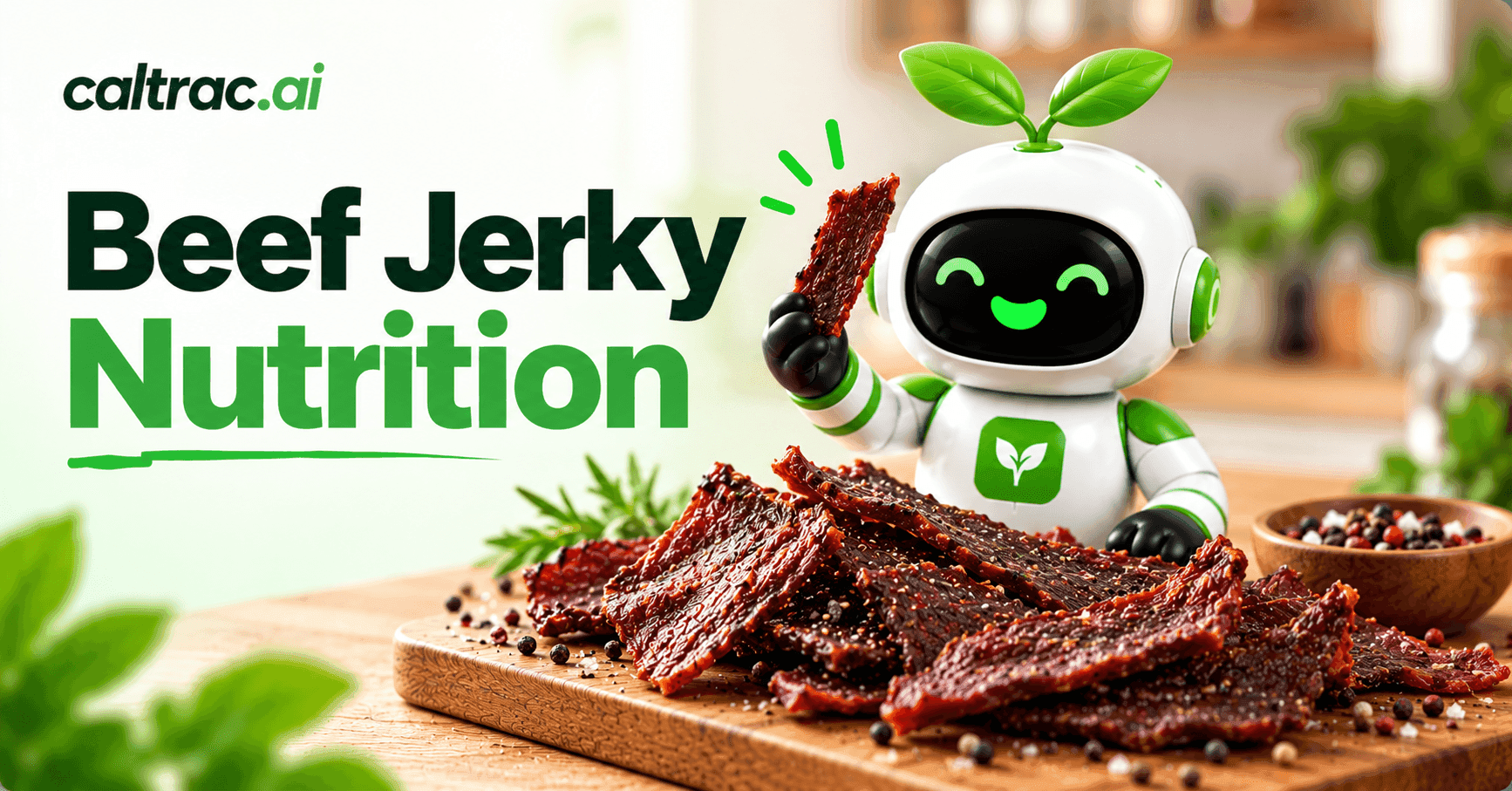
Beef jerky is beef with the water taken out. That one fact explains almost everything about its nutrition: it is one of the most protein-dense snacks you can buy, it is also one of the saltiest, and a small bag can hide more calories than it looks like it should. A typical 28 g (1 oz) serving of modern whole-muscle jerky delivers 70 to 100 calories, 10 to 14 g of protein, 1 to 2 g of fat, 0 to 7 g of sugar, and 400 to 700 mg of sodium [3] [4] [5] [6].
Here is the full nutrition profile of beef jerky, why two bags with the same name can differ wildly, what the sodium really means, and how to pick a jerky that earns its place in a weight-loss or muscle-building diet.
Beef Jerky Nutrition Facts
The USDA's generic entry for beef jerky is the "chopped and formed" style, the older, fattier type made from ground beef pressed into strips [1]. It is the baseline most calorie databases use when you type "beef jerky," so it is worth knowing.
| Nutrient | 1 oz (28 g) | 100 g | % Daily Value (per oz) |
|---|---|---|---|
| Calories | 116 kcal | 410 kcal | |
| Protein | 9.4 g | 33.2 g | 19% |
| Total fat | 7.3 g | 25.6 g | 9% |
| Saturated fat | 3.1 g | 10.8 g | 15% |
| Carbohydrate | 3.1 g | 11.0 g | 1% |
| Sugars | 2.5 g | 9.0 g | |
| Fiber | 0.5 g | 1.8 g | 2% |
| Cholesterol | 14 mg | 48 mg | 5% |
| Sodium | 505 mg | 1,780 mg | 22% |
Source: USDA FoodData Central [1]. Daily Values from the FDA [8].
Two things stand out. First, the fat: at 25.6 g per 100 g, chopped-and-formed jerky is fattier than a ribeye. Second, the sodium: one ounce is already a fifth of the daily limit. If this were the only kind of jerky, the "healthy snack" label would be hard to defend.
Why Jerky Labels Vary So Much
It is not the only kind. USDA's inspection rules recognise several distinct products. Plain "Beef Jerky" must be made from a single piece of beef; "Chunked and Formed" is moulded from chunks; "Chopped and Formed" or "Ground and Formed" is made from ground meat [11]. Nearly every major brand today sells whole-muscle jerky cut from lean rounds, and the nutrition is dramatically different from the USDA generic.
Here is how real products compare, per 28 g serving, using the manufacturers' own labels as filed in the USDA Branded Foods database:
| Product (28 g serving) | Calories | Protein | Fat | Sugar | Sodium | Protein per 100 kcal | Source |
|---|---|---|---|---|---|---|---|
| USDA generic, chopped and formed | 116 kcal | 9.4 g | 7.3 g | 2.5 g | 505 mg | 8.1 g | [1] |
| Jack Link's Beef Jerky (Original) | 80 kcal | 11 g | 1 g | 7 g | 389 mg | 13.7 g | [3] |
| Jack Link's Premium Cuts | 70 kcal | 10 g | 1 g | 2 g | 680 mg | 14.3 g | [4] |
| Jack Link's Brown Sugar | 100 kcal | 12 g | 1 g | 6 g | 650 mg | 12.0 g | [5] |
| Old Trapper Zero Sugar | 70 kcal | 14 g | 0.5 g | 0 g | 619 mg | 20.0 g | [6] |
| Stryve Original Biltong (air-dried beef) | 90 kcal | 16 g | 2 g | 0 g | 431 mg | 17.8 g | [7] |
The spread is enormous. Between the generic entry and a zero-sugar whole-muscle jerky, protein per calorie more than doubles, fat drops by more than 90%, and sugar ranges from zero to 7 g per serving. If you track your food, logging "beef jerky" from a generic database entry can be off by 40 calories and 5 g of protein per ounce. Use the label on the bag.
Vitamins and Minerals in Beef Jerky
Because jerky is concentrated beef, it is concentrated in beef's minerals too. Per ounce of the USDA generic entry [1], with FDA Daily Values [8]:
| Mineral or vitamin | Per 1 oz (28 g) | % Daily Value |
|---|---|---|
| Zinc | 2.3 mg | 21% |
| Vitamin B12 | 0.28 mcg | 12% |
| Folate | 38 mcg | 10% |
| Phosphorus | 115 mg | 9% |
| Iron | 1.5 mg | 9% |
| Choline | 31 mg | 6% |
| Selenium | 3.0 mcg | 5% |
| Potassium | 169 mg | 4% |
| Magnesium | 14 mg | 3% |
Zinc is the headline: an ounce of jerky covers a fifth of the day's requirement, which is one reason jerky is a sensible snack for people who train hard. The iron is heme iron, the well-absorbed kind. B12 is respectable for a snack. Jerky has essentially no vitamin C, vitamin D, or fiber.
The Sodium Problem
Salt is not optional in jerky. It draws out moisture, suppresses bacteria, and is the reason the product sits on a shelf for a year. The result is that jerky is among the saltiest foods in the supermarket.
The FDA's Daily Value for sodium is 2,300 mg [8]. The American Heart Association recommends no more than 2,300 mg a day, with an ideal target of 1,500 mg for most adults, and notes that Americans already average over 3,100 mg [9]. Against those numbers:
- One ounce of a typical whole-muscle jerky is 400 to 700 mg, or 17 to 30% of the 2,300 mg limit [3] [4].
- A standard 2.85 oz (80 g) bag, which many people finish in one sitting, is 1,100 to 2,000 mg. That is close to or above the AHA's ideal for the entire day.
- Per 100 g, the Premium Cuts and Brown Sugar varieties exceed 2,300 mg, meaning 100 g of jerky contains more sodium than the whole day allows [4] [5].
Practical rule: treat one ounce as a serving, not the bag, and look for products under 450 mg per serving. Biltong, which is cured with vinegar and air-dried rather than brined and smoked, tends to run lower [7].
Sugar in Beef Jerky
Most mainstream jerky is marinated in a sugar-and-soy-sauce base. Sugar is often the second ingredient after beef [3]. The result is 5 to 7 g of sugar per ounce in "original" and teriyaki styles, more in brown-sugar and honey varieties. That is a teaspoon and a half of sugar in a snack most people think of as pure protein.
Zero-sugar jerky exists and is genuinely zero, usually using a vinegar or hydrolysed-protein marinade for flavour instead [6]. Biltong is naturally sugar-free [7]. If you are eating jerky daily or following a low-carb plan, this is the line on the label to check after sodium.
Protein Quality and Satiety
Jerky's protein is beef protein, so it is complete, highly digestible, and rich in leucine. What makes jerky different from a steak is concentration: USDA's food safety service notes that a pound of meat weighs about four ounces once it is made into jerky [11]. Protein that was 30 g per 100 g in a cooked sirloin [14] becomes 36 to 57 g per 100 g in whole-muscle jerky and biltong [4] [7].
That matters for appetite. Protein is the most satiating macronutrient, and research supports roughly 25 to 30 g of protein per eating occasion for appetite control and weight management [12] [13]. A single ounce of jerky gets you a third to half of the way there for under 100 calories, which is why it works as a bridge between meals when a protein bar or a handful of nuts would cost twice the calories.
The weak point is the same as its strength: jerky is dry and chewy, which slows eating, but it has no volume and no water. Most people find a 1 oz portion less filling than its protein content suggests, and the open bag is still sitting there.
Is Beef Jerky Good for Weight Loss?
Used correctly, yes. Whole-muscle jerky offers 14 to 20 g of protein per 100 calories [4] [6], which is better than fresh sirloin at 16 g [14] and far better than almost any other shelf-stable snack. It needs no refrigeration, survives a gym bag, and takes long enough to chew that you cannot inhale it.
Three cautions keep it honest:
- Portion creep. Bags are 2.5 to 3 servings. The difference between one ounce and the whole bag is 150 to 200 calories, which is enough to erase a modest deficit.
- Sodium and water weight. A high-sodium day can add half a kilo or more of retained water overnight. It is not fat, but it is demoralising on the scale.
- Sugar in disguise. Choose zero-sugar or low-sugar varieties if jerky is a daily habit.
Processed Meat: The Health Caveat
Jerky is cured, dried, and often smoked, which puts it squarely in the category the World Health Organization calls processed meat. WHO classifies processed meat as Group 1, "carcinogenic to humans," based on evidence linking regular consumption to colorectal cancer, and red meat itself as Group 2A, "probably carcinogenic" [10]. Many jerky brands also list sodium nitrite as a curing agent [4] [5] [6].
The reasonable response is proportion, not panic. The risk in the research is tied to habitual daily intake of processed meat as a dietary staple. A few ounces of jerky a week is a different exposure from bacon every morning. If you want to minimise it, choose products without added nitrite, such as vinegar-cured biltong [7], and keep jerky as one protein snack among several rather than the only one.
How to Choose a Better Beef Jerky
Read the label in this order:
- Protein per serving: 10 g or more per 28 g. Below that, you are paying for marinade.
- Sodium: under 450 mg per serving is good; under 350 mg is excellent.
- Sugar: 3 g or less. Zero is available.
- Ingredients: beef should be first, and the list should be short. Sugar as the second ingredient is a red flag.
- Style: whole-muscle beats chopped-and-formed on fat and protein every time. Biltong beats both on protein density and sugar, though the texture is different.
Making Jerky at Home
Homemade jerky lets you control salt and sugar completely, but the food safety rules matter more than people assume. USDA's Food Safety and Inspection Service recommends heating meat to 160°F (71°C) before dehydrating, because a dehydrator running at 130 to 140°F will not reliably kill bacteria, and bacteria become more heat-resistant as the meat dries. After that step, dry at a steady 130 to 140°F until leathery. Marinating alone does not make raw meat safe. Commercially packaged jerky keeps about 12 months; homemade keeps 1 to 2 months [11].
Use lean cuts such as eye of round or top round, trim every trace of fat (fat goes rancid, not dry), slice thin against the grain, and expect about 4 oz of jerky from each pound of raw beef.
Tracking Beef Jerky Accurately
Jerky is one of the easiest foods to mis-log. USDA's survey database lists a single "Giant Jerk" piece at 18 g and a "Super Jerk" at under 10 g [2], so counting pieces is guesswork. Generic database entries use the fatty chopped-and-formed values, which overstate the calories of most modern jerky by about 40 per ounce and understate the protein. And bags are rarely one serving.
That is where tracking earns its keep. Snap a photo of the bag's label or type "28 g beef jerky" and track it automatically with Caltrac. You will see the protein, calories, and sodium logged in seconds, and your Apple Health-powered net calorie count will show exactly how it fits your day. Enjoy the snack; let the app watch the numbers.
Frequently Asked Questions
How many calories are in beef jerky? About 70 to 100 calories per 28 g (1 oz) serving for modern whole-muscle jerky, and 116 calories for the fattier chopped-and-formed style in the USDA database [3] [6] [1]. Per 100 g, that is 250 to 410 calories.
How much protein is in beef jerky? Typically 10 to 14 g per ounce, or 36 to 50 g per 100 g, for whole-muscle jerky [4] [6]. Biltong reaches 16 g per ounce [7].
Is beef jerky healthy? It is a high-protein, low-fat snack with useful zinc, iron, and B12, but it is very high in sodium, often sugary, and counts as processed meat. In one-ounce portions a few times a week, it is a reasonable choice. As a daily staple, the sodium adds up quickly.
Is beef jerky good for weight loss? Yes, in measured portions. It offers more protein per calorie than almost any other portable snack. Stick to one ounce, choose a low-sugar variety, and watch the bag size.
Is beef jerky keto? Zero-sugar and biltong varieties are, at 0 to 2 g of carbs per ounce. Original and teriyaki styles carry 6 to 7 g of sugar per ounce, which adds up on a strict keto plan [3] [6].
What is the difference between jerky and biltong? Jerky is marinated, then dried with heat and usually smoked. Biltong is cured in vinegar and salt, then air-dried without heat, and is cut thicker. Biltong typically has more protein, more fat, no sugar, and less sodium per ounce [7].
How long does beef jerky last? Commercially packaged jerky keeps about 12 months unopened. Homemade jerky keeps 1 to 2 months [11].
References
- USDA FoodData Central. Snacks, beef jerky, chopped and formed. SR Legacy, FDC ID 167536. fdc.nal.usda.gov
- USDA FoodData Central. Beef jerky. Survey (FNDDS), FDC ID 2705860. fdc.nal.usda.gov
- USDA FoodData Central, Branded Foods. Link Snacks, Inc. Beef Jerky (28 g serving: 80 kcal, 11 g protein, 7 g sugar, 389 mg sodium). FDC ID 384889. fdc.nal.usda.gov
- USDA FoodData Central, Branded Foods. Jack Link's Premium Cuts Beef Jerky. FDC ID 2011606. fdc.nal.usda.gov
- USDA FoodData Central, Branded Foods. Link Snacks, Inc. Beef Jerky, Brown Sugar. FDC ID 2073517. fdc.nal.usda.gov
- USDA FoodData Central, Branded Foods. Old Trapper Smoked Products, Zero Sugar Beef Jerky. FDC ID 2392697. fdc.nal.usda.gov
- USDA FoodData Central, Branded Foods. Stryve Foods, Original Beef Biltong. FDC ID 2670208. fdc.nal.usda.gov
- US Food and Drug Administration. Daily Value on the Nutrition and Supplement Facts Labels. fda.gov
- American Heart Association. How Much Sodium Should I Eat Per Day? heart.org
- World Health Organization. Cancer: Carcinogenicity of the consumption of red meat and processed meat (Q&A). who.int
- USDA Food Safety and Inspection Service. Jerky and Food Safety. fsis.usda.gov
- Leidy HJ, Clifton PM, Astrup A, et al. The role of protein in weight loss and maintenance. American Journal of Clinical Nutrition. 2015;101(6):1320S-1329S. PubMed 25926512
- Paddon-Jones D, Westman E, Mattes RD, Wolfe RR, Astrup A, Westerterp-Plantenga M. Protein, weight management, and satiety. American Journal of Clinical Nutrition. 2008;87(5):1558S-1561S. PubMed 18469287
- USDA FoodData Central. Beef, top sirloin, steak, separable lean only, trimmed to 0" fat, choice, cooked, broiled. SR Legacy, FDC ID 168635. fdc.nal.usda.gov