


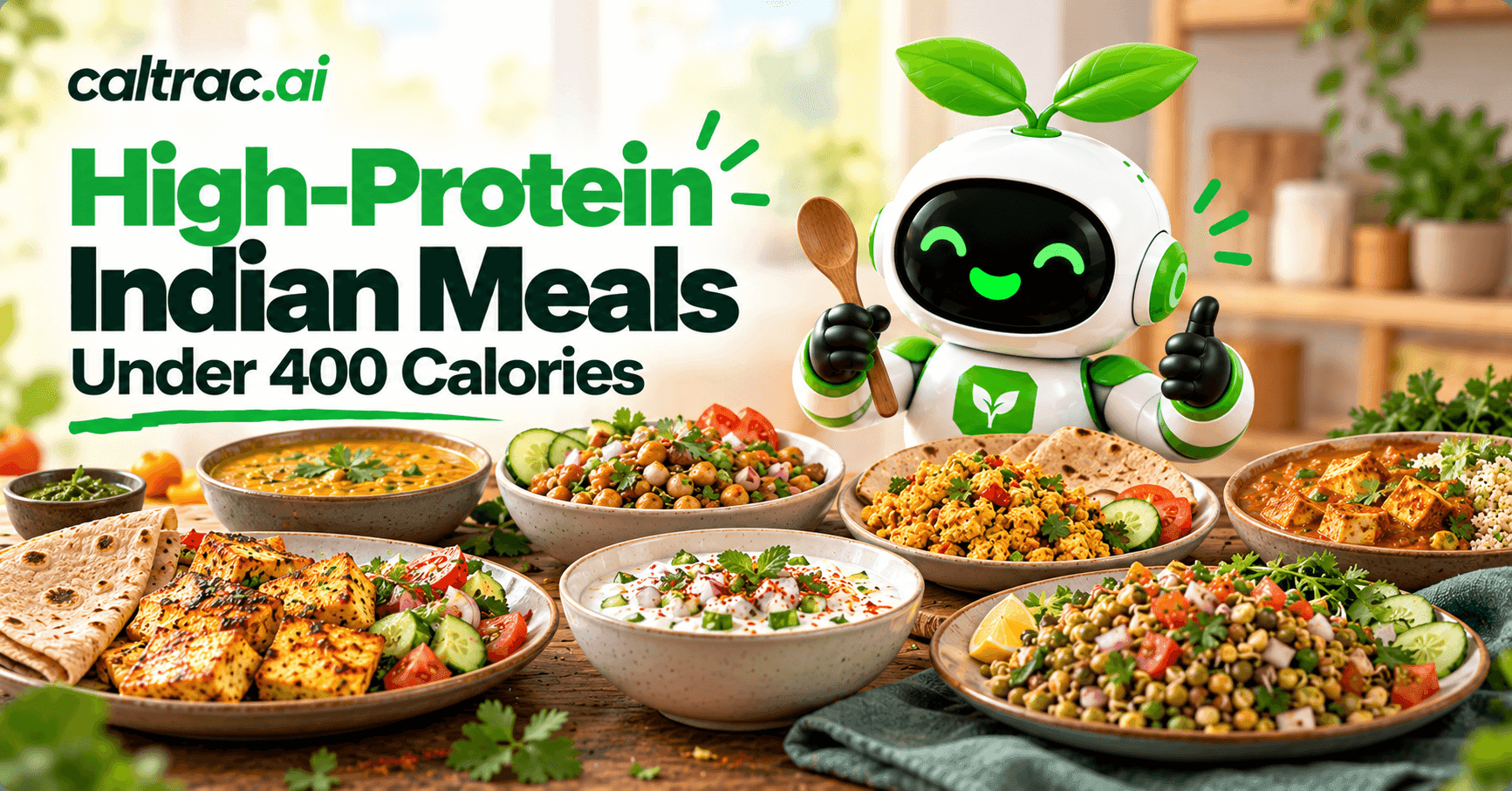
The standard Indian plate has a protein problem that has nothing to do with the food and everything to do with the proportions. A thali built on two cups of rice, a bowl of dal and a sabzi cooked in three spoons of oil lands near 700 calories and about 20 g of protein. The same ingredients, rearranged, can deliver 30 g of protein for under 400 calories. This article shows how, with twelve meals and the arithmetic behind each one.
Every figure below is from USDA FoodData Central or a manufacturer label. The meals are built, not invented: each row lists the exact quantities so you can weigh them once and know your numbers from then on.
The Rules These Meals Follow
- At least 20 g of protein, under 400 calories. That is roughly 0.3 g of protein per kilogram for a 70 kg adult, the per-meal amount research associates with better appetite control and muscle maintenance [1] [2].
- One teaspoon of oil per serving, counted. A teaspoon is about 4.5 g and 40 kcal [3]. Three teaspoons is 120 kcal, which is where most home-cooked meals quietly lose their calorie budget.
- The protein is the centre of the plate. Rice or roti is the side, measured by weight, not the base.
- Onion-tomato masala, spices and vegetables are counted at a flat 40 kcal per serving, a conservative estimate for 100 to 150 g of cooked vegetables [4].
Twelve High-Protein Indian Meals Under 400 Calories
| # | Meal | What is in it | Calories | Protein |
|---|---|---|---|---|
| 1 | Chicken tikka | 150 g chicken breast [5], 50 g curd marinade [6], spices, no oil | 280 kcal | 48 g |
| 2 | Tofu bhurji | 200 g firm tofu [7], 1 tsp oil [3], onion, tomato, capsicum | 370 kcal | 36 g |
| 3 | Chicken curry, home style | 150 g chicken breast [5], 1 tsp oil, onion-tomato masala | 330 kcal | 48 g |
| 4 | Soya chunk curry with roti | 50 g dry soya chunks [8], 1 tsp oil, masala, 1 medium roti [9] | 370 kcal | 31 g |
| 5 | Soya pulao | 40 g dry soya chunks [8], 100 g cooked rice [10], 1 tsp oil, vegetables | 350 kcal | 25 g |
| 6 | Paneer bhurji | 100 g firm paneer [11], 1 tsp oil, onion, tomato, peas | 400 kcal | 27 g |
| 7 | Egg bhurji with roti | 3 eggs [12], 1 tsp oil, onion, tomato, 1 medium roti [9] | 395 kcal | 24 g |
| 8 | Dahi, peanut and banana bowl | 200 g nonfat Greek yogurt [13], 30 g peanuts [14], 100 g banana [15] | 365 kcal | 28 g |
| 9 | Rajma chawal | 200 g cooked rajma [16], 70 g cooked rice [10], 1 tsp oil, masala | 385 kcal | 20 g |
| 10 | Sprouted moong chaat | 200 g cooked moong [17], 30 g peanuts [14], onion, tomato, lemon, no oil | 380 kcal | 22 g |
| 11 | Idli sambar | 3 idlis (114 g) [18], 1 cup sambar (248 g) [19] | 360 kcal | 18 g |
| 12 | Dal and rice | 200 g dal [20], 80 g cooked rice [10] | 395 kcal | 19 g |
The table reads top to bottom from best to worst on protein per calorie, and the ordering is instructive. The chicken and soy meals deliver 25 to 48 g of protein; the pulse-and-grain classics at the bottom deliver 18 to 20 g for the same calories. Meals 11 and 12 are included because they are what most people eat, and because they show the baseline the others improve on.
How Each Meal Adds Up
1. Chicken tikka (280 kcal, 48 g protein). 150 g of roasted chicken breast is 248 kcal and 46.5 g protein [5]; 50 g of curd in the marinade adds 31 kcal and 1.7 g [6]. Grilled or air-fried, no oil needed. This is the most protein-dense meal on the list and leaves room for a roti or a cup of rice if you want a 400 kcal plate.
2. Tofu bhurji (370 kcal, 36 g). 200 g of firm tofu is 288 kcal and 34.5 g protein [7]. Crumble it like paneer, cook in 1 tsp oil (40 kcal) with onion, tomato and capsicum (40 kcal). It tastes like paneer bhurji at half the calories and more protein.
3. Chicken curry (330 kcal, 48 g). The same 150 g of chicken breast (248 kcal, 46.5 g) in a masala of 1 tsp oil, onion and tomato (80 kcal). The USDA's generic chicken curry carries only 6.5 g protein per 100 g because it is mostly gravy [21]; building it yourself from breast meat quadruples the protein per bite.
4. Soya chunk curry with roti (370 kcal, 31 g). 50 g of dry soya chunks is 173 kcal and 26 g protein [8]; cooked in 1 tsp oil with masala (80 kcal); one 40 g roti adds 120 kcal and 3 g protein [9]. Soya chunks are a complete protein with protein-quality scores in the mid-80s on the FAO scale [22], which is why they can anchor a meal the way dal cannot.
5. Soya pulao (350 kcal, 25 g). 40 g dry soya (138 kcal, 21 g) cooked into 100 g of rice (130 kcal, 2.7 g) with 1 tsp oil and vegetables (80 kcal). The pulao most people make, with rice as 80% of the dish, is 350 calories and 6 g of protein; this one simply flips the ratio.
6. Paneer bhurji (400 kcal, 27 g). 100 g of firm paneer is 321 kcal and 25 g protein [11], with 1 tsp oil and vegetables adding 80 kcal. Paneer is the most calorie-expensive protein on this list because three quarters of its calories are fat, which is why the portion is 100 g and there is no roti. If you use a softer malai paneer, protein drops to about 20 g at the same calories [23].
7. Egg bhurji with roti (395 kcal, 24 g). Three hard-boiled-equivalent eggs are 232 kcal and 19 g protein [12]; 1 tsp oil with onion and tomato adds 80; a 40 g roti adds 120 kcal and 3 g [9]. Two eggs would save 80 kcal but drop protein to 17 g; three is the right number.
8. Dahi, peanut and banana bowl (365 kcal, 28 g). 200 g of nonfat Greek yogurt is 108 kcal and 19 g protein [13]; 30 g of peanuts is 170 kcal and 7.7 g [14]; 100 g of banana is 89 kcal [15]. Ordinary whole-milk curd has only 3.5 g protein per 100 g [6], so the same bowl made with regular dahi would carry about 15 g; hung curd or Greek yogurt is what makes it work.
9. Rajma chawal (385 kcal, 20 g). 200 g of cooked rajma is 254 kcal and 17.3 g protein with 13 g of fibre [16]; 70 g of rice is 91 kcal and 1.9 g [10]; 1 tsp oil for the masala is 40. Rajma is a genuinely good protein for a pulse, but notice the rice has been cut to a third of a cup to keep the plate under 400.
10. Sprouted moong chaat (380 kcal, 22 g). 200 g of cooked moong is 210 kcal and 14 g protein [17]; 30 g of peanuts adds 170 kcal and 7.7 g [14]. Lemon, onion, tomato and chaat masala cost nothing. The lemon is not decoration: vitamin C substantially improves absorption of the non-heme iron in pulses and nuts [24].
11. Idli sambar (360 kcal, 18 g). Three 38 g idlis are 146 kcal and 7.3 g protein [18]; a 248 g cup of sambar is 213 kcal and 10.7 g [19]. A classic, filling, low-fat breakfast that falls just short of the 20 g target. Adding 100 g of Greek yogurt or two egg whites on the side would close the gap for about 60 kcal.
12. Dal and rice (395 kcal, 19 g). 200 g of prepared dal is 290 kcal and 17.2 g protein [20]; 80 g of rice is 104 kcal and 2.2 g [10]. Dal-chawal is a complete protein, because the lysine in the pulse covers the gap in the grain and vice versa [25], but it is not a concentrated one. Swapping half the rice for 100 g of Greek yogurt turns it into a 25 g protein meal.
The Three Swaps That Change Everything
Looking across the twelve meals, three changes account for almost all of the difference between a 20 g plate and a 40 g plate.
Swap the base. Rice and roti are 2.7 and 7.9 g of protein per 100 g respectively [10] [9]. Halving the grain and doubling the dal, soya or paneer costs nothing in calories and roughly doubles the protein.
Swap the dairy. Whole-milk curd is 3.5 g of protein per 100 g; nonfat Greek yogurt or well-hung curd is 9.5 g [6] [13]. Same food, nearly three times the protein.
Swap the oil for a measured spoon. Every unmeasured tablespoon is about 120 kcal [3]. On a 400 kcal plate, that is the difference between hitting the target and missing it by 30%.
Rice vs Roti: The Honest Answer
One medium roti is about 120 kcal and 3.1 g protein with 3.9 g of fibre [9]; 90 g of cooked rice is the same calories with 2.4 g protein and almost no fibre [10]. Roti is slightly better on protein and clearly better on fibre. But the question matters less than the quantity: two rotis or a cup of rice is 240 to 260 kcal either way, and that is the number that has to fit under 400 alongside your protein.
Building a Day From These Meals
Three meals from the list plus one snack lands between 1,400 and 1,600 kcal and 100 to 130 g of protein, which is 1.4 to 1.8 g per kilogram for a 70 kg adult, inside the range research supports for fat loss and muscle maintenance [1] [26]. Caltrac's macro calculator gives you your own protein target from your weight and goal, and the calorie calculator tells you how many of these 400 kcal plates fit in your day. High-volume, lower-density meals like these are also simply more filling per calorie, which is what keeps a deficit sustainable [27].
That is where tracking earns its keep. Snap a photo of your thali or type "50 g soya chunks, 1 roti, 1 tsp oil" and track it automatically with Caltrac. You will see the protein and calories logged in seconds against your target, and your Apple Health-powered net calorie count will show how the plate fits your day. Cook the meal; let the app count the protein.
Frequently Asked Questions
What Indian food is high in protein and low in calories? Chicken tikka, tofu bhurji, soya chunk curry and paneer bhurji all deliver 25 to 48 g of protein in under 400 calories when built from measured ingredients [5] [7] [8] [11].
Is paneer or chicken better for protein? Chicken breast, by a wide margin: 31 g of protein per 165 kcal versus 20 to 25 g per 320 kcal for paneer [5] [11] [23]. Paneer is a fat-rich food with protein, chicken breast is protein.
How much protein is in dal? About 8.6 g per 100 g as prepared, or 17 g in a 200 g bowl, for 290 kcal [20]. It is a good protein for a pulse but a modest one per calorie.
How much protein is in soya chunks? 52 g per 100 g dry, so a 50 g serving gives 26 g of protein for 173 kcal [8], the best ratio of any vegetarian food on this list.
Can vegetarians get 100 g of protein a day from Indian food? Yes. Meals 2, 4, 5, 6, 8 and 10 above average 28 g of protein each; four of them in a day is 110 g for about 1,500 kcal.
Is rice or roti better for weight loss? One roti (120 kcal) equals about 90 g of cooked rice. Roti has more protein and fibre per calorie [9] [10]; the amount you eat matters more than the choice.
References
- Leidy HJ, et al. The role of protein in weight loss and maintenance. American Journal of Clinical Nutrition. 2015;101(6):1320S-1329S. pubmed.ncbi.nlm.nih.gov
- Schoenfeld BJ, Aragon AA. How much protein can the body use in a single meal for muscle-building? Implications for daily protein distribution. Journal of the International Society of Sports Nutrition. 2018;15:10. pubmed.ncbi.nlm.nih.gov
- USDA FoodData Central. Oil, olive, salad or cooking: 884 kcal per 100 g (used for all cooking oils; 1 teaspoon about 4.5 g, 40 kcal). SR Legacy 171413. fdc.nal.usda.gov
- USDA FoodData Central. Broccoli, raw: 34 kcal, 2.8 g protein per 100 g. SR Legacy 170379. fdc.nal.usda.gov
- USDA FoodData Central. Chicken breast, meat only, roasted: 165 kcal, 31 g protein per 100 g. SR Legacy 171477. fdc.nal.usda.gov
- USDA FoodData Central. Yogurt, plain, whole milk: 61 kcal, 3.5 g protein per 100 g. SR Legacy 171284. fdc.nal.usda.gov
- USDA FoodData Central. Tofu, firm: 144 kcal, 17.3 g protein per 100 g. SR Legacy 172475. fdc.nal.usda.gov
- Nutrela soya chunks pack label per 100 g dry (345 kcal, 52 g protein, 13 g fibre), as reproduced in a retailer listing. thedesifood.com
- USDA FoodData Central, FNDDS. Bread, chapatti or roti: 299 kcal, 7.9 g protein, 9.7 g fibre per 100 g; 1 medium (7 inch) 40 g. FDC ID 2707713. fdc.nal.usda.gov
- USDA FoodData Central. Rice, white, long-grain, cooked: 130 kcal, 2.7 g protein per 100 g. SR Legacy 168878. fdc.nal.usda.gov
- USDA FoodData Central, Branded. Karoun Dairies Paneer: 321 kcal, 25 g protein, 25 g fat per 100 g. FDC ID 2429587. fdc.nal.usda.gov
- USDA FoodData Central. Egg, whole, hard-boiled: 155 kcal, 12.6 g protein per 100 g. SR Legacy 173424. fdc.nal.usda.gov
- USDA FoodData Central. Yogurt, Greek, nonfat, plain: 54 kcal, 9.5 g protein per 100 g. SR Legacy 171312. fdc.nal.usda.gov
- USDA FoodData Central. Peanuts, raw: 567 kcal, 25.8 g protein per 100 g. SR Legacy 172430. fdc.nal.usda.gov
- USDA FoodData Central. Bananas, raw: 89 kcal per 100 g. SR Legacy 173944. fdc.nal.usda.gov
- USDA FoodData Central. Beans, kidney, cooked: 127 kcal, 8.7 g protein, 6.4 g fibre per 100 g. SR Legacy 173740. fdc.nal.usda.gov
- USDA FoodData Central. Mung beans, cooked: 105 kcal, 7 g protein, 7.6 g fibre per 100 g. SR Legacy 174257. fdc.nal.usda.gov
- USDA FoodData Central, FNDDS. Idli: 128 kcal, 6.4 g protein per 100 g; 1 item 38 g. FDC ID 2708346. fdc.nal.usda.gov
- USDA FoodData Central, FNDDS. Sambar, vegetable stew: 86 kcal, 4.3 g protein per 100 g; 1 cup 248 g. FDC ID 2707430. fdc.nal.usda.gov
- USDA FoodData Central, FNDDS. Dal (as prepared): 145 kcal, 8.6 g protein, 7.5 g fibre per 100 g; 1 cup 240 g. FDC ID 2707427. fdc.nal.usda.gov
- USDA FoodData Central, FNDDS. Biryani with chicken: 104 kcal, 7.2 g protein per 100 g; 1 cup 196 g. FDC ID 2706538. fdc.nal.usda.gov
- van den Berg LA, et al. Protein quality of soy and the effect of processing: A quantitative review. Frontiers in Nutrition. 2022;9:1004754. frontiersin.org
- Amul. Amul Malai Paneer nutritional information per 100 g: 323 kcal, 20 g protein, 25 g fat. amul.com
- Hurrell R, Egli I. Iron bioavailability and dietary reference values. American Journal of Clinical Nutrition. 2010;91(5):1461S-1467S. pubmed.ncbi.nlm.nih.gov
- Young VR, Pellett PL. Plant proteins in relation to human protein and amino acid nutrition. American Journal of Clinical Nutrition. 1994;59(5 Suppl):1203S-1212S. pubmed.ncbi.nlm.nih.gov
- Morton RW, et al. A systematic review, meta-analysis and meta-regression of the effect of protein supplementation on resistance training-induced gains in muscle mass and strength in healthy adults. British Journal of Sports Medicine. 2018;52(6):376-384. pubmed.ncbi.nlm.nih.gov
- Ello-Martin JA, et al. Dietary energy density in the treatment of obesity: a year-long trial comparing 2 weight-loss diets. American Journal of Clinical Nutrition. 2007;85(6):1465-1477. pubmed.ncbi.nlm.nih.gov