


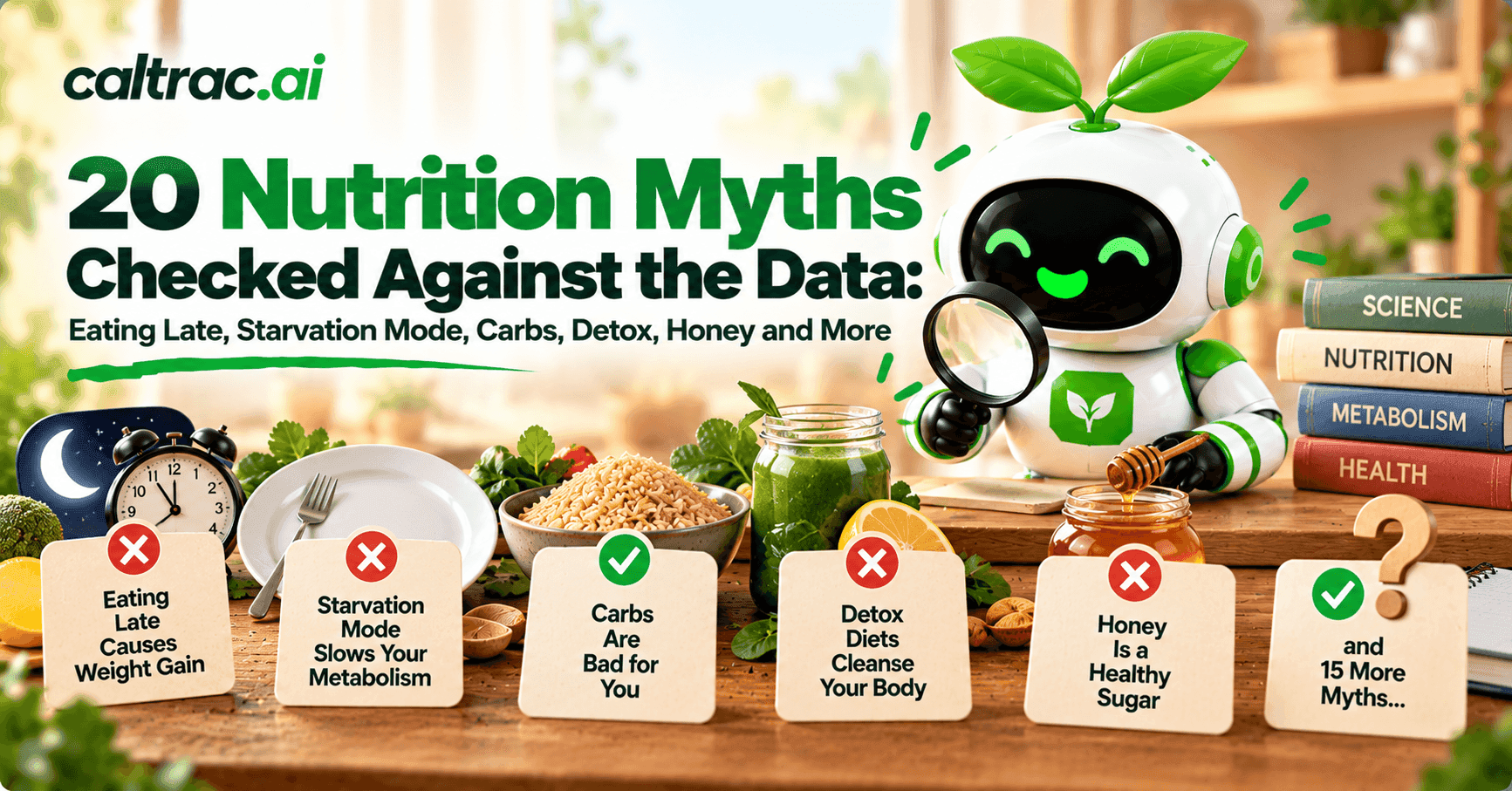
Nutrition is the one field where everyone's grandmother, personal trainer and favourite influencer all have a firm opinion, and most of those opinions were formed before the relevant trials were run. Some of the most repeated rules in dieting are simply false. Others are half-true in a way that makes them useless. A few turn out to be right for the wrong reasons.
Here are twenty of the most common, each checked against the best available evidence: randomised trials and meta-analyses where they exist, with every source linked. The verdicts are blunt, because the data usually is.
1. "Eating late at night makes you gain weight"
Verdict: mostly myth. A tightly controlled crossover trial fed people identical calories either early or four hours later. Late eating increased hunger, lowered waking energy expenditure and shifted fat-storage pathways, so there is a real mechanism [1]. But when it comes to actual weight, timing does not beat calories: in a year-long trial, adding an eight-hour eating window to a calorie-restricted diet produced no significant extra weight loss over calorie restriction alone [2]. Late eating makes you hungrier. It does not make a calorie heavier.
2. "Eat too little and you'll go into starvation mode"
Verdict: myth, built on a grain of truth. The body does reduce energy expenditure a little more than weight loss alone predicts. In a three-week study at half of energy needs, resting expenditure fell 266 kcal/day, of which only about 72 kcal/day was true adaptation beyond the loss of tissue, and participants kept losing weight throughout [3]. Even Biggest Loser contestants, six years after extreme loss, had a metabolic adaptation of about 500 kcal/day, and the ones with the most adaptation had kept off the most weight [4]. Metabolism slows a bit. It never stops a deficit from working.
3. "Skipping breakfast makes you gain weight"
Verdict: myth. A meta-analysis of 13 randomised trials found that people assigned to eat breakfast ate about 260 more calories a day and ended up 0.44 kg heavier than those who skipped it [5]. The trials were short and of modest quality, so the honest conclusion is that breakfast is neither required nor harmful. Eat it if you are hungry.
4. "Small frequent meals boost your metabolism"
Verdict: myth. Whole-body calorimetry studies find no difference in 24-hour energy expenditure between "nibbling" and "gorging" the same calories [6]. A meta-analysis of 15 studies found that the apparent benefit of more frequent meals for body composition disappeared when a single outlier study was removed [7]. Eat three meals or six. The total is what counts.
5. "Carbs make you fat" and "low-carb has a metabolic advantage"
Verdict: myth. In a meta-analysis of 32 controlled feeding studies that swapped carbohydrate for fat at equal calories, energy expenditure and fat loss were actually slightly higher on the lower-fat diets, by 26 kcal/day and 16 g/day [8]. When men lived in a metabolic ward and switched to a ketogenic diet at the same calories, energy expenditure rose by only about 57 kcal/day and body-fat loss slowed [9]. In the largest head-to-head trial, 609 adults lost 5.3 kg on healthy low-fat and 6.0 kg on healthy low-carb over a year, a difference that was not significant [10]. Carbohydrate is not fattening. Excess calories are.
6. "Eggs will raise your cholesterol dangerously"
Verdict: myth for most people. Across three US cohorts with 215,618 participants and a meta-analysis covering 1.7 million people, eating one more egg a day was not associated with cardiovascular disease [11]. The 2015 US Dietary Guidelines dropped the long-standing 300 mg daily cholesterol cap, while noting that dietary cholesterol still matters within a healthy pattern [12]. One or two eggs a day is fine for healthy adults.
7. "Detox diets remove toxins"
Verdict: myth. A critical review found no randomised controlled trials of commercial detox diets at all, and that the handful of small studies were methodologically flawed [13]. Your liver and kidneys are the detox programme. Juice is juice.
8. "Fruit sugar is as bad as added sugar"
Verdict: myth. When fructose replaced other carbohydrates at equal calories across 31 trials, weight did not change; weight rose only when fructose was added as extra calories, which the authors attributed to the calories rather than the fructose [14]. WHO's sugar guideline explicitly excludes the sugars in whole fruit and vegetables from its limits, because there is no evidence of harm from them, while counting honey, syrups and fruit juice as free sugars [15]. An apple is not a doughnut.
9. "Artificial sweeteners make you gain weight"
Verdict: myth, with a caveat. Randomised trials lasting from four weeks to over three years found that low-energy sweeteners led to 1.35 kg less weight than sugar and 1.24 kg less than water [16]. WHO's 2023 guideline recommends against using them for weight control, on the grounds that they show no long-term benefit for body fat, not that they cause gain; the recommendation is rated conditional [17]. Sweeteners are not a weight-loss tool. They are also not a weight-gain cause.
10. "You must drink eight glasses of water a day"
Verdict: myth. A physiologist's exhaustive search found no scientific evidence for the "8 x 8" rule, and noted that caffeinated drinks count toward fluid intake [18]. The Institute of Medicine's adequate intakes of 2.7 litres (women) and 3.7 litres (men) include all beverages and the water in food, about 20% of the total, and the report states that healthy people meet their needs by letting thirst be their guide [19]. Drink when thirsty. More when it is hot or you are training.
11. "Microwaving destroys nutrients"
Verdict: myth, and backwards. In a study of 20 vegetables and six cooking methods, microwaving, griddling and baking produced the smallest losses of antioxidant activity, while boiling and pressure-cooking produced the largest. The authors' summary: water is not the cook's best friend when preparing vegetables [20]. The microwave is one of the gentler options.
12. "Brown sugar, honey and jaggery are healthier than white sugar"
Verdict: myth. Per 100 g, white sugar is 387 kcal and 99.8 g sugar; brown sugar is 380 kcal and 97 g sugar with 83 mg calcium and 0.7 mg iron; honey is 304 kcal and 82 g sugar [21] [22] [23]. A teaspoon of brown sugar therefore delivers about 3 mg of calcium, a quarter of one percent of the daily requirement. WHO classifies honey as a free sugar subject to the same limits as table sugar [15]. Choose by taste, not health.
13. "Eating fat makes you fat"
Verdict: myth. A meta-analysis of 53 trials and 68,128 participants found that low-fat diets produced no more long-term weight loss than higher-fat diets of similar intensity, and slightly less than low-carbohydrate diets [24]. Reducing saturated fat specifically does cut cardiovascular events by about 21%, with small reductions in weight, so fat quality matters for the heart [25]. For the scale, total calories decide.
14. "Gluten-free is healthier for everyone"
Verdict: myth. Gluten-free eating among people without celiac disease roughly tripled between 2009 and 2014 while celiac disease itself stayed flat [26]. Following 110,017 adults for 26 years, gluten intake was not associated with heart disease, and avoiding gluten tended to mean avoiding whole grains; the authors wrote that promoting gluten-free diets to people without celiac disease "should not be encouraged" [27]. Unless you have celiac disease or a diagnosed sensitivity, gluten is just a wheat protein.
15. "High protein damages your kidneys"
Verdict: myth for healthy kidneys. A meta-analysis of 28 trials and 1,358 people found no difference in kidney function between higher-protein diets (1.5 g/kg or more) and lower-protein diets [28]. People with existing kidney disease are a different matter and should follow medical advice. Everyone else can stop worrying.
16. "Crunches burn belly fat" and "green tea melts fat"
Verdict: myth and nearly-myth. Six weeks of daily abdominal exercise improved endurance but produced no change in abdominal fat, waist circumference or body weight [29]. You cannot choose where fat comes off. Green tea catechins do have a measurable effect in meta-analysis, about 1.3 kg overall and 0.8 kg in Caucasian participants, which is real but small [30]. Nothing you eat burns fat off a specific place.
17. "A 3,500-calorie deficit equals one pound of fat"
Verdict: myth as commonly used. The rule ignores that a shrinking body burns less, so weight loss slows and eventually plateaus. In measured data from a controlled dieting study, the energy content of weight lost in the first four weeks was about 2,200 kcal per pound, not 3,500, and the rule's prediction of endless linear loss never materialises [31]. The better rule of thumb from the NIH's model: each 10 kcal/day cut leads to about one pound of eventual loss, with half of it arriving in the first year [32].
18. "Weighing yourself every day is bad for you"
Verdict: myth. A systematic review of 17 studies found regular self-weighing associated with more weight loss and no adverse psychological effects [33]. In a six-month trial, people who weighed daily lost 6.1 kg more than those who weighed less often [34]. The scale fluctuates daily with water; the trick is watching the weekly average, not avoiding the number.
19. "Fasted cardio burns more fat"
Verdict: myth. When women did an hour of steady cardio three times a week for four weeks, either fasted or after a shake, both groups lost weight and fat and there was no difference between them [35]. Training fasted burns more fat during the session and less afterwards; over 24 hours it evens out. Train whenever you will actually show up.
20. "Organic and natural foods are healthier or lower in calories"
Verdict: myth on nutrition, half-true on pesticides. A systematic review of 17 human studies and 223 food studies found no strong evidence that organic foods are more nutritious than conventional ones; the one consistent difference was a 30% lower risk of detectable pesticide residues [36]. Organic sugar is sugar. Organic butter is butter. The calorie count on the label does not know how the food was grown.
What Survives
Strip away the twenty myths and three things remain standing in the trials:
- Total calories decide weight. Diets with every macronutrient split produce similar loss when calories match [37] [10].
- Protein decides what the weight is made of and how hungry you are while losing it [38].
- Measurement beats intuition. The people who weigh daily and track consistently lose more [34] [33].
If you want the first of those as a number, Caltrac's calorie calculator gives you maintenance calories and a deficit target, and the BMR calculator shows the resting figure that "starvation mode" is supposed to crush and does not. The macro calculator covers the second.
That is where tracking earns its keep. Snap a photo of your dinner, however late you eat it, or type what you had, and track it automatically with Caltrac. You will see the calories and protein logged in seconds, and your Apple Health-powered net calorie count will show exactly how the day fits, regardless of what your grandmother says about eating after eight. Trust the numbers; let the app check the myths.
Frequently Asked Questions
Does eating after 8 pm cause weight gain? Not by itself. Late eating raises hunger and slightly lowers energy expenditure [1], but trials show meal timing adds nothing to weight loss once calories are controlled [2].
Is starvation mode real? Adaptive thermogenesis is real but small, roughly 70 kcal/day beyond what tissue loss predicts in a severe three-week deficit [3]. It slows loss slightly; it does not stop it.
Is honey healthier than sugar? No. Honey is 82% sugar and counts as a free sugar in WHO guidance [23] [15]. Its trace minerals are nutritionally negligible per serving.
Do artificial sweeteners cause weight gain? Randomised trials show the opposite, with modest weight advantages over sugar [16], though WHO notes no long-term benefit for body fat [17].
Is it bad to weigh yourself every day? No. Daily weighing is associated with more weight loss and no psychological harm in the research [33] [34].
Does gluten-free help you lose weight? Not unless you have celiac disease. Gluten intake is unrelated to heart disease in non-celiacs, and avoiding it tends to cut whole grains [27].
References
- Vujović N, et al. Late isocaloric eating increases hunger, decreases energy expenditure, and modifies metabolic pathways in adults with overweight and obesity. Cell Metabolism. 2022;34(10):1486-1498. pubmed.ncbi.nlm.nih.gov
- Liu D, et al. Calorie Restriction with or without Time-Restricted Eating in Weight Loss. New England Journal of Medicine. 2022;386(16):1495-1504. pubmed.ncbi.nlm.nih.gov
- Müller MJ, et al. Metabolic adaptation to caloric restriction and subsequent refeeding: the Minnesota Starvation Experiment revisited. American Journal of Clinical Nutrition. 2015;102(4):807-819. pubmed.ncbi.nlm.nih.gov
- Fothergill E, et al. Persistent metabolic adaptation 6 years after "The Biggest Loser" competition. Obesity. 2016;24(8):1612-1619. pubmed.ncbi.nlm.nih.gov
- Sievert K, et al. Effect of breakfast on weight and energy intake: systematic review and meta-analysis of randomised controlled trials. BMJ. 2019;364:l42. pubmed.ncbi.nlm.nih.gov
- Bellisle F, McDevitt R, Prentice AM. Meal frequency and energy balance. British Journal of Nutrition. 1997;77 Suppl 1:S57-S70. pubmed.ncbi.nlm.nih.gov
- Schoenfeld BJ, Aragon AA, Krieger JW. Effects of meal frequency on weight loss and body composition: a meta-analysis. Nutrition Reviews. 2015;73(2):69-82. pubmed.ncbi.nlm.nih.gov
- Hall KD, Guo J. Obesity Energetics: Body Weight Regulation and the Effects of Diet Composition. Gastroenterology. 2017;152(7):1718-1727. pubmed.ncbi.nlm.nih.gov
- Hall KD, et al. Energy expenditure and body composition changes after an isocaloric ketogenic diet in overweight and obese men. American Journal of Clinical Nutrition. 2016;104(2):324-333. pubmed.ncbi.nlm.nih.gov
- Gardner CD, et al. Effect of Low-Fat vs Low-Carbohydrate Diet on 12-Month Weight Loss in Overweight Adults: The DIETFITS Randomized Clinical Trial. JAMA. 2018;319(7):667-679. pubmed.ncbi.nlm.nih.gov
- Drouin-Chartier JP, et al. Egg consumption and risk of cardiovascular disease: three large prospective US cohort studies, systematic review, and updated meta-analysis. BMJ. 2020;368:m513. pubmed.ncbi.nlm.nih.gov
- US Department of Health and Human Services and USDA. 2015-2020 Dietary Guidelines for Americans, Chapter 1, Dietary Cholesterol. odphp.health.gov
- Klein AV, Kiat H. Detox diets for toxin elimination and weight management: a critical review of the evidence. Journal of Human Nutrition and Dietetics. 2015;28(6):675-686. pubmed.ncbi.nlm.nih.gov
- Sievenpiper JL, et al. Effect of fructose on body weight in controlled feeding trials: a systematic review and meta-analysis. Annals of Internal Medicine. 2012;156(4):291-304. pubmed.ncbi.nlm.nih.gov
- World Health Organization. WHO calls on countries to reduce sugars intake among adults and children (2015 sugars guideline). who.int
- Rogers PJ, et al. Does low-energy sweetener consumption affect energy intake and body weight? A systematic review, including meta-analyses, of the evidence from human and animal studies. International Journal of Obesity. 2016;40(3):381-394. pubmed.ncbi.nlm.nih.gov
- World Health Organization. WHO advises not to use non-sugar sweeteners for weight control in newly released guideline. 15 May 2023. who.int
- Valtin H. "Drink at least eight glasses of water a day." Really? Is there scientific evidence for "8 x 8"? American Journal of Physiology, Regulatory, Integrative and Comparative Physiology. 2002;283(5):R993-R1004. pubmed.ncbi.nlm.nih.gov
- National Academies (Institute of Medicine). Report Sets Dietary Intake Levels for Water, Salt, and Potassium. 11 February 2004. nationalacademies.org
- Jiménez-Monreal AM, et al. Influence of cooking methods on antioxidant activity of vegetables. Journal of Food Science. 2009;74(3):H97-H103. pubmed.ncbi.nlm.nih.gov
- USDA FoodData Central. Sugars, granulated: 387 kcal, 99.8 g sugar, 1 mg calcium, 0.05 mg iron per 100 g. SR Legacy 169655. fdc.nal.usda.gov
- USDA FoodData Central. Sugars, brown: 380 kcal, 97 g sugar, 83 mg calcium, 0.71 mg iron per 100 g. SR Legacy 168833. fdc.nal.usda.gov
- USDA FoodData Central. Honey: 304 kcal, 82.1 g sugar, 0.42 mg iron per 100 g. SR Legacy 169640. fdc.nal.usda.gov
- Tobias DK, et al. Effect of low-fat diet interventions versus other diet interventions on long-term weight change in adults: a systematic review and meta-analysis. Lancet Diabetes & Endocrinology. 2015;3(12):968-979. pubmed.ncbi.nlm.nih.gov
- Hooper L, et al. Reduction in saturated fat intake for cardiovascular disease. Cochrane Database of Systematic Reviews. 2020;5:CD011737. pubmed.ncbi.nlm.nih.gov
- Kim HS, et al. Time Trends in the Prevalence of Celiac Disease and Gluten-Free Diet in the US Population: Results From NHANES 2009-2014. JAMA Internal Medicine. 2016;176(11):1716-1717. pubmed.ncbi.nlm.nih.gov
- Lebwohl B, et al. Long term gluten consumption in adults without celiac disease and risk of coronary heart disease: prospective cohort study. BMJ. 2017;357:j1892. pubmed.ncbi.nlm.nih.gov
- Devries MC, et al. Changes in Kidney Function Do Not Differ between Healthy Adults Consuming Higher- Compared with Lower- or Normal-Protein Diets: A Systematic Review and Meta-Analysis. Journal of Nutrition. 2018;148(11):1760-1775. pubmed.ncbi.nlm.nih.gov
- Vispute SS, et al. The effect of abdominal exercise on abdominal fat. Journal of Strength and Conditioning Research. 2011;25(9):2559-2564. pubmed.ncbi.nlm.nih.gov
- Hursel R, Viechtbauer W, Westerterp-Plantenga MS. The effects of green tea on weight loss and weight maintenance: a meta-analysis. International Journal of Obesity. 2009;33(9):956-961. pubmed.ncbi.nlm.nih.gov
- Thomas DM, et al. Time to correctly predict the amount of weight loss with dieting. Journal of the Academy of Nutrition and Dietetics. 2014;114(6):857-861. pubmed.ncbi.nlm.nih.gov
- Hall KD, et al. Quantification of the effect of energy imbalance on bodyweight. Lancet. 2011;378(9793):826-837. pubmed.ncbi.nlm.nih.gov
- Zheng Y, et al. Self-weighing in weight management: a systematic literature review. Obesity. 2015;23(2):256-265. pubmed.ncbi.nlm.nih.gov
- Steinberg DM, Bennett GG, Askew S, Tate DF. Weighing every day matters: daily weighing improves weight loss and adoption of weight control behaviors. Journal of the Academy of Nutrition and Dietetics. 2015;115(4):511-518. pubmed.ncbi.nlm.nih.gov
- Schoenfeld BJ, et al. Body composition changes associated with fasted versus non-fasted aerobic exercise. Journal of the International Society of Sports Nutrition. 2014;11:54. pubmed.ncbi.nlm.nih.gov
- Smith-Spangler C, et al. Are organic foods safer or healthier than conventional alternatives?: a systematic review. Annals of Internal Medicine. 2012;157(5):348-366. pubmed.ncbi.nlm.nih.gov
- Sacks FM, et al. Comparison of weight-loss diets with different compositions of fat, protein, and carbohydrates. New England Journal of Medicine. 2009;360(9):859-873. pubmed.ncbi.nlm.nih.gov
- Leidy HJ, et al. The role of protein in weight loss and maintenance. American Journal of Clinical Nutrition. 2015;101(6):1320S-1329S. pubmed.ncbi.nlm.nih.gov