


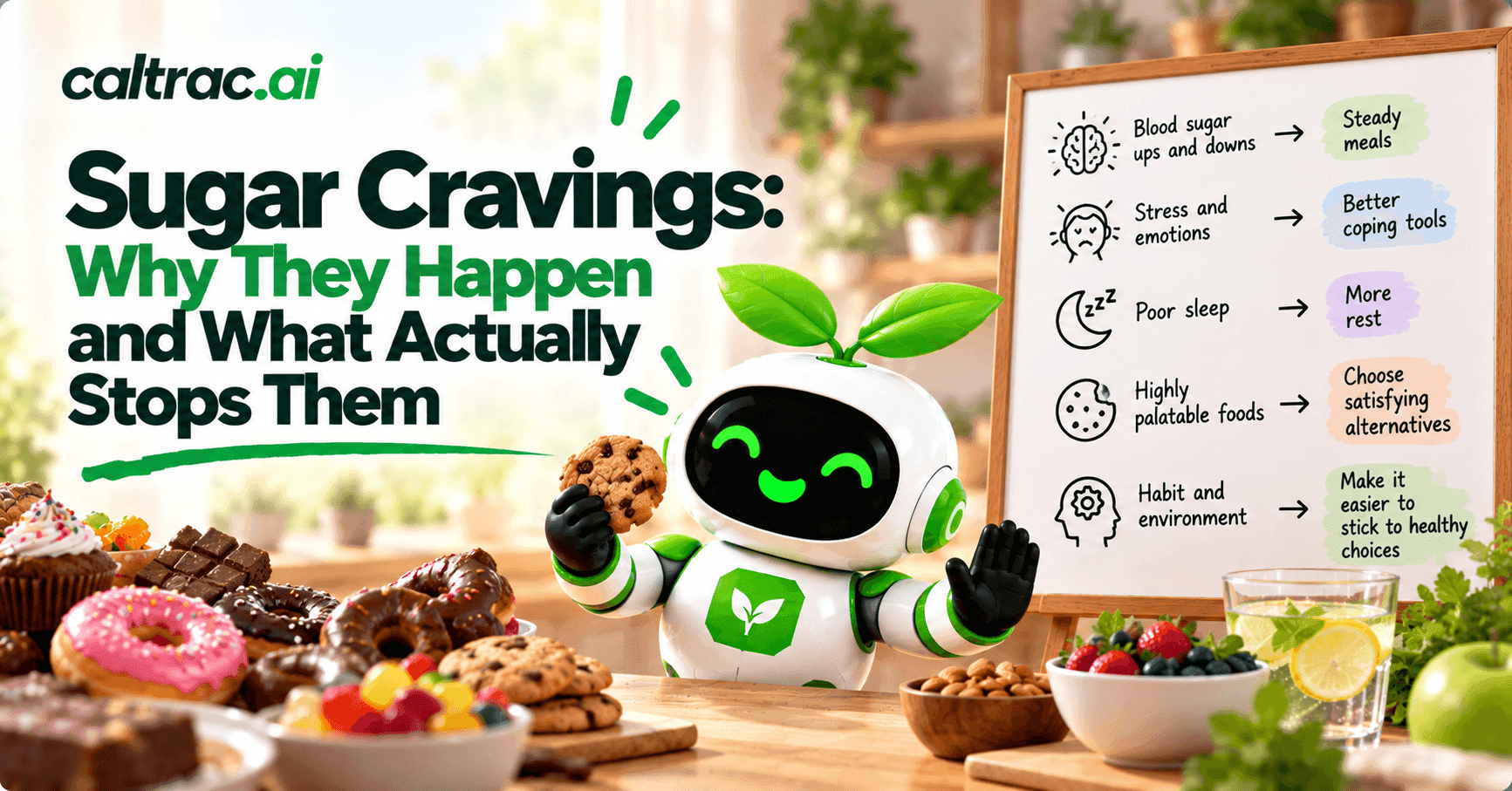
Most advice about sugar cravings starts from a false premise: that the craving means your body needs something. It does not need sugar, and it almost certainly does not need magnesium. Cravings are learned responses to cues, mood and restriction, and the research on them is clearer and more useful than the folklore. It also contains one genuinely counter-intuitive finding: the same restriction that makes a craving worse in week one makes it weaker by month three.
Here is what the studies show about why sugar cravings happen, what makes them worse, and what reliably reduces them.
What a Craving Is
A food craving is an intense desire for a specific food, and it is near universal: most young adults report them [1]. In a seven-day diary study of 129 women, chocolate alone accounted for 37% of all recorded cravings, and about 70% of cravings in every group led to eating the food [2].
Two things cravings are not. They are not hunger: craving is closely tied to liking a food, not to needing energy, and fasting makes cravings fade rather than grow [1]. And they are not addiction in any meaningful sense. A 2016 review of the "sugar addiction" literature found little evidence for it in humans; the bingeing seen in rats occurs only when sugar access is intermittent, pointing to the pattern of access, not the sugar, as the driver [3].
Why You Crave Sugar: The Five Real Causes
1. Restriction, in the short term
This is the paradox at the centre of the research. In the diary study, women who were dieting had significantly more cravings than non-dieters, their cravings were stronger and harder to resist, and they were for exactly the foods they were trying to avoid [2]. Declaring a food off-limits increases the craving for it [1]. A 2020 review puts it precisely: short-term, selective deprivation of a food increases craving for that food [4].
2. Cues
Cravings are conditioned responses. A meta-analysis of 45 studies with 3,292 participants found that reactivity to food cues and the cravings they trigger predict both how much people eat and how much weight they gain, and that pictures and videos of food provoke cravings about as strongly as the real thing [5]. The afternoon biscuit craving is not your blood sugar. It is the tin, the time, and the habit.
3. Blood sugar swings from the last meal
When obese teenagers ate identical-calorie breakfasts of high, medium or low glycemic index, they ate 53% more after the high-GI meal than after the medium one over the following five hours, and 81% more than after the low-GI one, with the rise and fall in blood glucose explaining about half the difference [6]. A sugary breakfast makes a mid-morning sugar craving almost inevitable.
4. Short sleep
After a night without sleep, brain regions that evaluate food choices went quiet, the amygdala became more active, and participants showed a significantly stronger desire for high-calorie foods, in proportion to how sleepy they were [7]. Two nights of four hours' sleep raised appetite for calorie-dense carbohydrate by a third to a half in another study [8].
5. Stress
In women put through a laboratory stressor, those whose cortisol rose most ate more overall on the stressful day and ate significantly more sweet food across both days [9]. Stress does not create a nutritional need for sugar. It lowers the threshold for reaching for something that reliably feels good.
The Magnesium Myth
The idea that chocolate cravings signal magnesium deficiency is one of nutrition's most durable pieces of folklore. It has been tested. When people craving chocolate were given capsules containing all of cocoa's pharmacologically active compounds but none of its taste, the capsules had virtually no effect; white chocolate, which contains none of the cocoa compounds, partially satisfied the craving. The authors concluded there was no role for pharmacology, including minerals, in satisfying chocolate craving [10]. A separate review noted that the levels of magnesium and other active compounds in chocolate are "so low as to preclude" an effect on mood [11]. You crave chocolate because it tastes like chocolate.
What Actually Reduces Sugar Cravings
Sustained, moderate restriction
Here is the other half of the paradox. Short-term, selective deprivation increases cravings; long-term energy restriction reduces them [4]. In a 12-week trial, every measure of food craving fell in people on a very-low-calorie diet by week six and did not rebound when solid food returned, and cravings did not increase on either the low- or very-low-calorie diet [12]. In the two-year POUNDS LOST trial of 811 adults, cravings for sweets, high-fat foods and starches fell significantly on all four diets [13]. Cravings are conditioned responses, and conditioned responses weaken when they stop being reinforced [4].
The practical reading: the first two to three weeks of eating less sugar are the hardest, and they are not representative of what comes after.
Restricting the specific food you crave, consistently
Counter to the "forbidden fruit" intuition, when obese adults followed either a low-carbohydrate or a low-fat diet for two years, the low-carb group showed larger decreases in cravings for carbohydrates and sugary foods and the low-fat group larger decreases in cravings for fatty foods. Restricting a type of food reduced craving for that type [14]. Occasional restriction sharpens a craving; consistent restriction dulls it.
Protein at every meal
Protein is the most satiating macronutrient and higher-protein diets improve appetite control [15]. A breakfast of 300 g of Greek yogurt, with 28 g of protein for 160 kcal [16], produces a very different 11 a.m. from a pastry with the same calories. Pairing any carbohydrate with protein, fat or fibre flattens the glucose swing that drives the next craving [6].
Sleep and stress, honestly
Seven hours of sleep removes one of the two biological amplifiers [7] [8]. For stress, the realistic goal is not eliminating it but breaking the link between the stress cue and the sweet response: a walk, a call, a shower, anything that occupies the ten minutes a craving typically lasts.
Changing the cues, not just the willpower
Since cues predict eating [5], the cheapest intervention is environmental. Sweets out of sight, not on the counter. No food videos at 10 p.m. A fixed snack time so that "I could have something" is not an open question all afternoon.
Should You Just Give In?
Sometimes, deliberately. Flexible dieters, who allow planned exceptions within an overall pattern, have lower body weight and more weight-loss success than rigid all-or-nothing dieters in a study of more than 54,000 people [17]. A planned 25 g of chocolate is about 135 kcal [18]; eaten inside a calorie target it is a Tuesday, not a lapse. What drives weight gain is the unplanned version after a week of denial, which the restriction research predicts precisely [2].
Two cautions. Non-sugar sweeteners are a reasonable bridge, and the trial evidence does not show they increase intake or weight [19], though they do nothing to retrain the craving itself. And fruit is not the enemy: WHO's sugar limits explicitly exclude the sugars in whole fruit [20], and a banana brings 2.6 g of fibre with its sugar [21].
A Four-Week Plan to Retrain Sugar Cravings
- Week 1: protein and breakfast. 25 to 30 g of protein at every meal, starting with breakfast. Set the target in the macro calculator. Expect cravings to continue; this week is about removing the glucose swings that feed them.
- Week 2: cues. Move sweets out of sight, pick a fixed snack time, and stop food content before bed.
- Week 3: planned sweetness. One portioned treat a day inside your calorie target, logged. This is the week the craving usually starts to lose intensity [12].
- Week 4: consistency. Keep the rules the same. The conditioned response is weakening [4]; the job now is not to re-teach it with an intermittent binge, which is the one pattern the animal data say creates sugar-seeking [3].
That is where tracking earns its keep. Snap a photo of the treat or type "25 g chocolate" and track it automatically with Caltrac. You will see it logged inside your day's calories rather than outside your rules, and your Apple Health-powered net calorie count will show it fits. Plan the sweet; let the app keep it honest.
Frequently Asked Questions
Why do I crave sugar so much? Mostly restriction, cues, blood-sugar swings from high-glycemic meals, short sleep and stress [2] [5] [6] [7] [9]. Not a nutritional need.
Does craving chocolate mean I need magnesium? No. Cocoa compounds in capsules did nothing for chocolate cravings while white chocolate partly satisfied them, and chocolate's magnesium content is too low to matter [10] [11].
Is sugar addictive? A review of the evidence found little support for sugar addiction in humans; intermittent access to sweet food, not sugar itself, drives binge-like behaviour in animals [3].
Do cravings go away when you stop eating sugar? Yes, over weeks. Cravings fell by week six on a very-low-calorie diet without rebounding, and fell on all four diets over two years in the POUNDS LOST trial [12] [13]. The first few weeks are the worst.
What should I eat when craving sugar? Protein first, then fruit if you want sweetness. A high-protein meal reduces the glucose swing that triggers the next craving [6] [15]; whole fruit is excluded from WHO sugar limits [20].
Should I cut out sugar completely? Consistent moderate restriction reduces cravings; occasional strict bans increase them [4] [14]. A planned daily portion inside your calorie target is more sustainable than prohibition [17].
References
- Hill AJ. The psychology of food craving. Proceedings of the Nutrition Society. 2007;66(2):277-285. pubmed.ncbi.nlm.nih.gov
- Massey A, Hill AJ. Dieting and food craving. A descriptive, quasi-prospective study. Appetite. 2012;58(3):781-785. pubmed.ncbi.nlm.nih.gov
- Westwater ML, Fletcher PC, Ziauddeen H. Sugar addiction: the state of the science. European Journal of Nutrition. 2016;55(Suppl 2):55-69. pubmed.ncbi.nlm.nih.gov
- Meule A. The Psychology of Food Cravings: the Role of Food Deprivation. Current Nutrition Reports. 2020;9(3):251-257. pubmed.ncbi.nlm.nih.gov
- Boswell RG, Kober H. Food cue reactivity and craving predict eating and weight gain: a meta-analytic review. Obesity Reviews. 2016;17(2):159-177. pubmed.ncbi.nlm.nih.gov
- Ludwig DS, et al. High glycemic index foods, overeating, and obesity. Pediatrics. 1999;103(3):E26. pubmed.ncbi.nlm.nih.gov
- Greer SM, Goldstein AN, Walker MP. The impact of sleep deprivation on food desire in the human brain. Nature Communications. 2013;4:2259. pubmed.ncbi.nlm.nih.gov
- Spiegel K, Tasali E, Penev P, Van Cauter E. Sleep curtailment in healthy young men is associated with decreased leptin levels, elevated ghrelin levels, and increased hunger and appetite. Annals of Internal Medicine. 2004;141(11):846-850. pubmed.ncbi.nlm.nih.gov
- Epel E, Lapidus R, McEwen B, Brownell K. Stress may add bite to appetite in women: a laboratory study of stress-induced cortisol and eating behavior. Psychoneuroendocrinology. 2001;26(1):37-49. pubmed.ncbi.nlm.nih.gov
- Michener W, Rozin P. Pharmacological versus sensory factors in the satiation of chocolate craving. Physiology & Behavior. 1994;56(3):419-422. pubmed.ncbi.nlm.nih.gov
- Benton D, Donohoe RT. The effects of nutrients on mood. Public Health Nutrition. 1999;2(3A):403-409. pubmed.ncbi.nlm.nih.gov
- Martin CK, O'Neil PM, Pawlow L. Changes in food cravings during low-calorie and very-low-calorie diets. Obesity. 2006;14(1):115-121. pubmed.ncbi.nlm.nih.gov
- Anton SD, et al. Diet type and changes in food cravings following weight loss: findings from the POUNDS LOST Trial. Eating and Weight Disorders. 2012;17(2):e101-e108. pubmed.ncbi.nlm.nih.gov
- Martin CK, et al. Change in food cravings, food preferences, and appetite during a low-carbohydrate and low-fat diet. Obesity. 2011;19(10):1963-1970. pubmed.ncbi.nlm.nih.gov
- Leidy HJ, et al. The role of protein in weight loss and maintenance. American Journal of Clinical Nutrition. 2015;101(6):1320S-1329S. pubmed.ncbi.nlm.nih.gov
- USDA FoodData Central. Yogurt, Greek, nonfat, plain: 54 kcal, 9.5 g protein per 100 g. SR Legacy 171312. fdc.nal.usda.gov
- Westenhoefer J, Stunkard AJ, Pudel V. Validation of the flexible and rigid control dimensions of dietary restraint. International Journal of Eating Disorders. 1999;26(1):53-64. pubmed.ncbi.nlm.nih.gov
- USDA FoodData Central. Candies, milk chocolate: 535 kcal, 59.4 g carbohydrate per 100 g. SR Legacy 167587. fdc.nal.usda.gov
- Rogers PJ, et al. Does low-energy sweetener consumption affect energy intake and body weight? A systematic review, including meta-analyses, of the evidence from human and animal studies. International Journal of Obesity. 2016;40(3):381-394. pubmed.ncbi.nlm.nih.gov
- World Health Organization. WHO calls on countries to reduce sugars intake among adults and children (2015 sugars guideline). who.int
- USDA FoodData Central. Bananas, raw: 89 kcal, 2.6 g fibre per 100 g. SR Legacy 173944. fdc.nal.usda.gov