


If a supplement cut your daily intake by 270 calories without any effort, kept you from losing muscle on a diet, and turned down your appetite for junk food, it would be the best-selling product in nutrition. That supplement is an extra hour of sleep, and the trials behind that sentence are among the cleanest in weight-loss research, because sleep is one of the few variables you can manipulate in a laboratory and measure with doubly labelled water.
This article covers what short sleep does to appetite, intake and body composition, what happens when people sleep more, and how to treat sleep as part of a diet rather than something separate from it.
Quick Answer
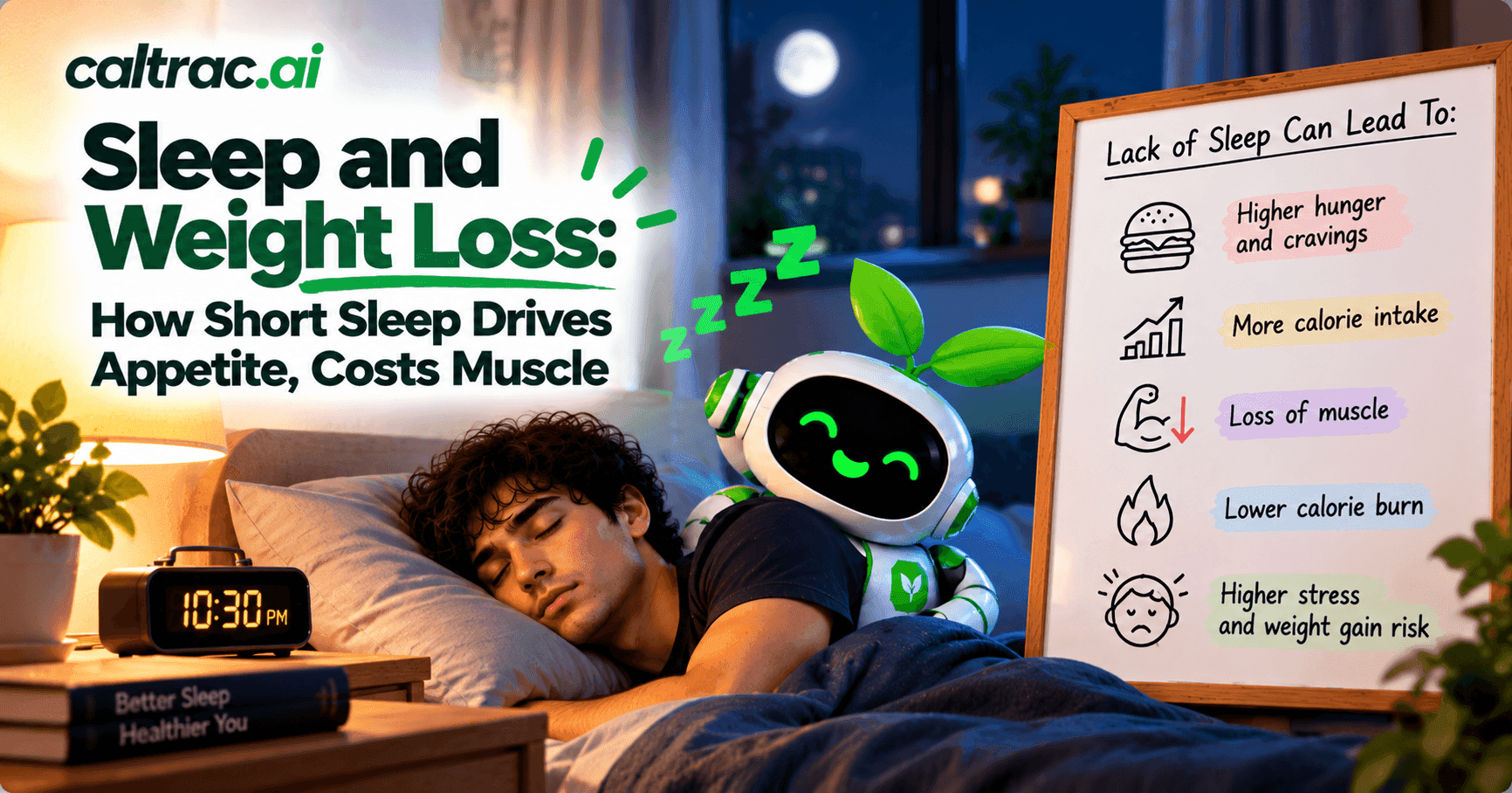
- Short sleep makes you hungrier, hormonally. Two nights of four hours' sleep cut the fullness hormone leptin by 18%, raised the hunger hormone ghrelin by 28%, and increased hunger by 24% [1].
- Short sleep makes you eat more, measurably. Five nights of four hours added about 300 kcal a day to intake, mostly as fat, with no increase in energy burned [2].
- Short sleep makes a diet lose muscle instead of fat. On the same calorie restriction, people sleeping 5.5 hours lost 55% less fat and 60% more lean mass than when sleeping 8.5 hours [3].
- More sleep reverses it. Overweight adults who extended their sleep by about 1.2 hours a night ate 270 fewer calories a day with no other instruction [4].
- Target: seven or more hours for adults aged 18 to 60 [5] [6].
What Short Sleep Does to Appetite
The foundational study restricted twelve healthy young men to four hours in bed for two nights, then extended them to ten hours for two nights, with food and activity held constant. After the short nights, leptin fell 18%, ghrelin rose 28%, hunger ratings rose 24% and overall appetite 23%. The sharpest change was in what they wanted: appetite for calorie-dense, high-carbohydrate foods, the sweets, salty snacks and starches, rose by 33 to 45% [1].
Brain imaging explains the pattern. After a night of sleep deprivation, activity fell in the frontal and insular regions that evaluate food choices and rose in the amygdala, and participants showed a significantly stronger desire for high-calorie foods, scaling with how sleepy they felt [7]. Tired brains do not want food in general. They want the specific foods a diet is trying to limit.
What Short Sleep Does to Intake
Hormones and desire are mechanisms. Intake is the outcome, and it has been measured directly.
Thirty normal-weight adults spent five nights sleeping four hours and five nights sleeping nine hours, in a crossover design. On the short-sleep schedule they ate 2,814 kcal a day against 2,518 on the long schedule, about 296 kcal more, and the extra came mainly from fat and saturated fat. Resting and total energy expenditure, measured by doubly labelled water, did not change [2]. Short sleep added calories in without adding any out.
In a two-week inpatient study, five days of insufficient sleep actually raised total daily energy expenditure by about 5%, but intake rose by more, especially after dinner, and participants gained 0.82 kg in five days. When sleep was restored, intake of fat and carbohydrate fell again [8]. The late-night eating that short sleep enables is itself a problem: identical calories eaten late increase hunger and lower energy expenditure compared with eating them earlier [9].
At population scale, a meta-analysis of 634,511 people found short sleepers had 55% higher odds of obesity, with each hour less sleep associated with 0.35 higher BMI [10]. Observational data cannot prove cause, as the authors note, but the trials above show the mechanism operating in real people over days.
What Short Sleep Does to a Diet
This is the finding that should change how dieters think about sleep. Ten overweight adults followed a 14-day calorie-restricted diet twice, once with 8.5 hours in bed and once with 5.5 hours, same calories both times. Weight loss was similar. What the weight was made of was not. With 8.5 hours of sleep they lost 1.4 kg of fat and 1.5 kg of lean mass; with 5.5 hours they lost 0.6 kg of fat and 2.4 kg of lean mass. Fat loss fell by more than half and lean loss rose by 60%, while hunger increased and the body shifted toward burning less fat [3].
A deficit on short sleep still moves the scale. It does so by spending muscle instead of fat, which is the opposite of the point.
What Happens When People Sleep More
The reverse experiment has been run. Eighty overweight adults who habitually slept under 6.5 hours were randomised to a single sleep-hygiene counselling session aiming for 8.5 hours in bed, or to no change, for two weeks. The counselled group slept about 1.2 hours more a night, and their energy intake, measured objectively, fell by 270 kcal a day relative to control. Energy expenditure did not change, so the group lost weight, with no dietary instruction whatsoever [4].
A 270 kcal daily reduction is about half the deficit that clinical guidelines prescribe for weight loss [11]. It was produced by going to bed earlier.
How Much Sleep
The American Academy of Sleep Medicine and Sleep Research Society consensus is that adults should sleep seven or more hours a night on a regular basis, and that regularly sleeping less is associated with weight gain and obesity among other harms [5]. The CDC's guidance matches: seven or more hours for adults aged 18 to 60, seven to nine for 61 to 64, and seven to eight for 65 and over [6].
Note that the trials above used sleep restriction to four to five and a half hours, which is extreme. The sleep-extension trial, however, recruited ordinary people sleeping under 6.5 hours, which describes a large share of working adults, and found the full effect in them [4].
Treating Sleep as Part of the Diet
Three practical consequences follow from the evidence.
1. Budget the hours before you budget the calories. A 500 to 750 kcal deficit [11] on six hours of sleep is being fought against a 300 kcal appetite handicap [2]. Fix the sleep first and the deficit becomes smaller and easier, or arrives on its own [4].
2. Protect muscle twice. Short sleep shifts loss toward lean mass [3]; so does rapid loss [12]. The counters are the same for both: adequate sleep, a moderate deficit, and protein at 1.2 to 1.6 g per kilogram of body weight [13]. Set that figure in the macro calculator.
3. Close the kitchen after dinner. The extra intake on short sleep arrives disproportionately at night [8], and late eating independently raises hunger and lowers expenditure [9]. A fixed last-meal time removes the hours when a tired brain does its worst choosing [7].
A Two-Week Sleep Experiment for Dieters
The sleep-extension trial used one counselling session and a target of 8.5 hours in bed. You can run the same experiment:
- Pick a bedtime that gives 8 to 8.5 hours in bed and keep it for 14 nights, weekends included.
- No screens in bed; caffeine before 2 p.m.; a fixed last meal three hours before bed.
- Keep your calorie target unchanged from the calorie calculator and log everything.
- Compare the second week's average intake and hunger with the week before you started.
In the trial, intake fell by 270 kcal a day within two weeks [4]. If yours does too, you have found a deficit that costs nothing.
That is where tracking earns its keep. Snap a photo of each meal or type what you ate and track it automatically with Caltrac. Over two weeks you will see whether the sleep change moved your intake, and your Apple Health-powered net calorie count folds in your movement so the comparison is honest. Sleep the hours; let the app measure what changed.
Frequently Asked Questions
Does lack of sleep cause weight gain? Short sleep raises hunger hormones and appetite [1], increases intake by about 300 kcal a day in controlled studies [2], and is associated with 55% higher odds of obesity across more than 600,000 people [10].
Can you lose weight by sleeping more? Overweight adults who extended sleep by about 1.2 hours a night ate 270 fewer calories a day and lost weight with no dietary advice [4].
How many hours of sleep do I need to lose weight? Seven or more for adults 18 to 60 [5] [6]. The trials showing harm used four to 5.5 hours; the trial showing benefit took people from under 6.5 hours to about 7.5.
Does sleep deprivation make you lose muscle? On a diet, yes. Sleeping 5.5 instead of 8.5 hours cut fat loss by 55% and increased lean mass loss by 60% at identical calories [3].
Why do I crave junk food when tired? Sleep loss quiets the brain regions that weigh food choices and amplifies reward signalling, increasing desire for high-calorie foods [7]; it also raises appetite for calorie-dense carbohydrate by a third or more [1].
Does sleeping burn calories? Resting metabolism continues during sleep, but sleeping more does not raise expenditure; in the extension trial expenditure was unchanged and all the benefit came from eating less [4].
References
- Spiegel K, Tasali E, Penev P, Van Cauter E. Sleep curtailment in healthy young men is associated with decreased leptin levels, elevated ghrelin levels, and increased hunger and appetite. Annals of Internal Medicine. 2004;141(11):846-850. pubmed.ncbi.nlm.nih.gov
- St-Onge MP, et al. Short sleep duration increases energy intakes but does not change energy expenditure in normal-weight individuals. American Journal of Clinical Nutrition. 2011;94(2):410-416. pubmed.ncbi.nlm.nih.gov
- Nedeltcheva AV, Kilkus JM, Imperial J, Schoeller DA, Penev PD. Insufficient sleep undermines dietary efforts to reduce adiposity. Annals of Internal Medicine. 2010;153(7):435-441. pubmed.ncbi.nlm.nih.gov
- Tasali E, Wroblewski K, Kahn E, Kilkus J, Schoeller DA. Effect of Sleep Extension on Objectively Assessed Energy Intake Among Adults With Overweight in Real-life Settings: A Randomized Clinical Trial. JAMA Internal Medicine. 2022;182(4):365-374. pubmed.ncbi.nlm.nih.gov
- Watson NF, et al. Recommended Amount of Sleep for a Healthy Adult: A Joint Consensus Statement of the American Academy of Sleep Medicine and Sleep Research Society. Sleep. 2015;38(6):843-844. pubmed.ncbi.nlm.nih.gov
- Centers for Disease Control and Prevention. About Sleep: recommended hours by age (adults 18 to 60: 7 or more hours). cdc.gov
- Greer SM, Goldstein AN, Walker MP. The impact of sleep deprivation on food desire in the human brain. Nature Communications. 2013;4:2259. pubmed.ncbi.nlm.nih.gov
- Markwald RR, et al. Impact of insufficient sleep on total daily energy expenditure, food intake, and weight gain. Proceedings of the National Academy of Sciences. 2013;110(14):5695-5700. pubmed.ncbi.nlm.nih.gov
- Vujović N, et al. Late isocaloric eating increases hunger, decreases energy expenditure, and modifies metabolic pathways in adults with overweight and obesity. Cell Metabolism. 2022;34(10):1486-1498. pubmed.ncbi.nlm.nih.gov
- Cappuccio FP, et al. Meta-analysis of short sleep duration and obesity in children and adults. Sleep. 2008;31(5):619-626. pubmed.ncbi.nlm.nih.gov
- Jensen MD, et al. 2013 AHA/ACC/TOS guideline for the management of overweight and obesity in adults. Circulation. 2014;129(25 Suppl 2):S102-S138. pubmed.ncbi.nlm.nih.gov
- Garthe I, et al. Effect of two different weight-loss rates on body composition and strength and power-related performance in elite athletes. International Journal of Sport Nutrition and Exercise Metabolism. 2011;21(2):97-104. pubmed.ncbi.nlm.nih.gov
- Leidy HJ, et al. The role of protein in weight loss and maintenance. American Journal of Clinical Nutrition. 2015;101(6):1320S-1329S. pubmed.ncbi.nlm.nih.gov