


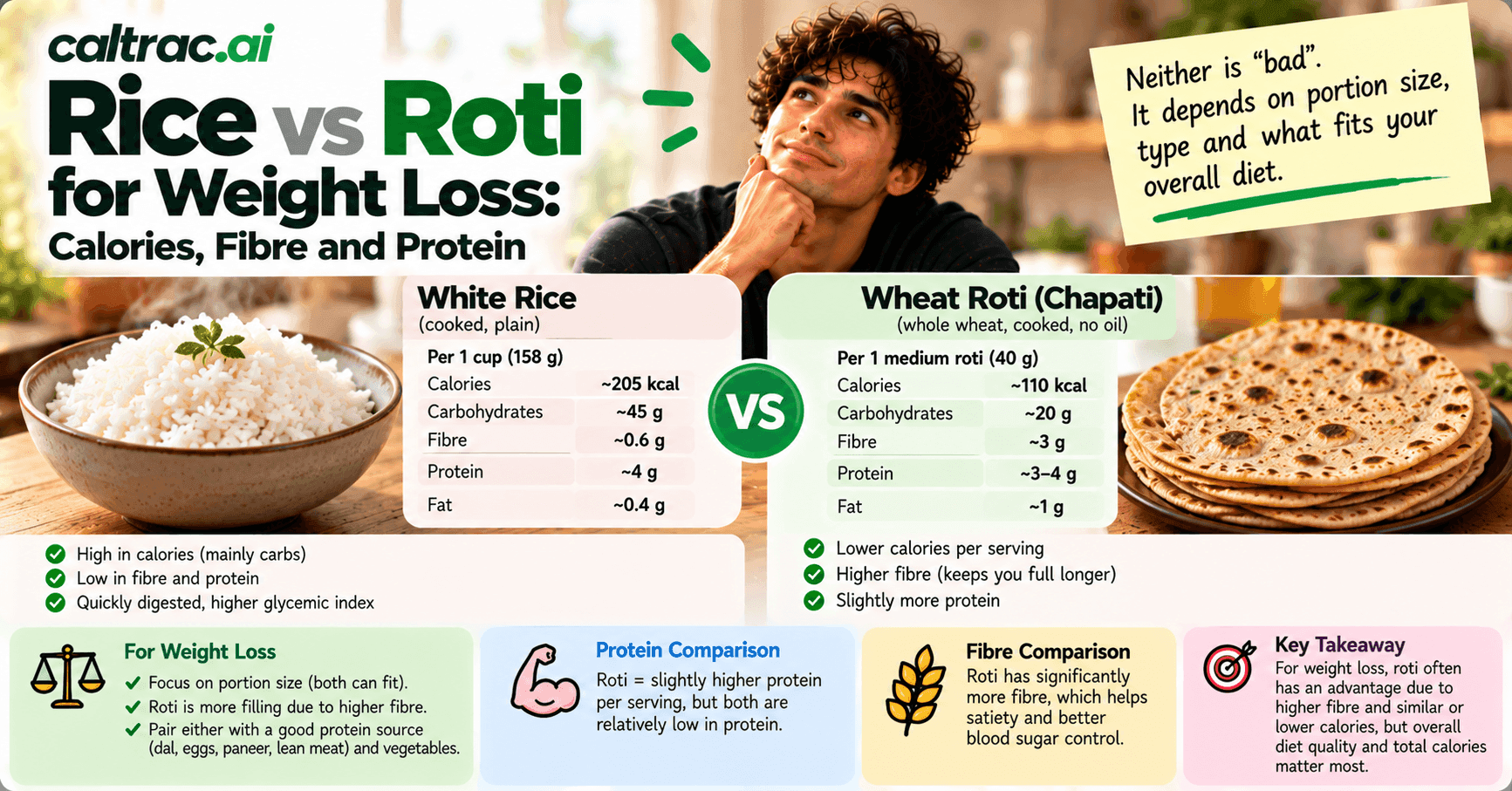
Rice or roti is the most asked weight-loss question in India, and the honest answer is that it is the wrong question. Both are grain. Both are mostly starch. A plate of either loses weight only if the plate is smaller than what you burn, and the thing on the plate that decides whether you stay full is the dal, not the grain. That said, the two are not identical: roti carries more fibre and protein per calorie, brown rice splits the difference, and the research on refined grains in Indian diets is worth knowing. Here is what USDA data and the trials say, and how to use either one.
Rice vs Roti: The Numbers
USDA FoodData Central values. The roti figure is the as-prepared survey record, which includes the fat most kitchens use; a dry roti made from atta and water alone is also shown.
| Food | Portion | Calories | Protein | Carbohydrate | Fibre | Fat |
|---|---|---|---|---|---|---|
| White rice, cooked [1] | 1 cup, 158 g | 205 | 4.3 g | 44.5 g | 0.6 g | 0.4 g |
| Brown rice, cooked [2] | 1 cup, 158 g | 194 | 4.3 g | 40.4 g | 2.5 g | 1.5 g |
| Roti, as prepared [3] | 2 medium, 80 g | 239 | 6.3 g | 36 g | 7.8 g | 7.4 g |
| Roti, atta and water only [4] | 2 medium, 60 g atta | 199 | 5.8 g | 43 g | 7.9 g | 1.5 g |
| Millet, cooked [5] | 1 cup, 174 g | 207 | 6.1 g | 41 g | 2.3 g | 1.7 g |
Per 100 calories, the comparison is cleaner:
| Food | Protein per 100 kcal | Fibre per 100 kcal |
|---|---|---|
| White rice | 2.1 g | 0.3 g |
| Brown rice | 2.2 g | 1.3 g |
| Roti, atta and water | 2.9 g | 3.9 g |
| Roti, as prepared | 2.6 g | 3.2 g |
| Millet | 2.9 g | 1.1 g |
Three things stand out.
- Calories are a wash. A cup of rice and two plain rotis are within a few calories of each other. Two rotis cooked with ghee or oil cost about 40 extra, which is the fat, not the wheat [3] [6].
- Roti wins on fibre by a factor of ten. Two rotis carry nearly 8 g of fibre against 0.6 g in a cup of white rice [4] [1]. Brown rice recovers some of the gap at 2.5 g [2].
- Neither is a protein source. Roti has more, about 6 g per two rotis against 4 g per cup of rice, but both are far from the 25 to 35 g a meal should carry. Protein comes from the dal, the curd, the paneer, the egg or the chicken beside the grain, never from the grain.
What the Research Says
Refined grains and metabolic risk in India. In Chennai, refined grains, mostly polished white rice, supplied 47% of calories; adults in the highest quarter of intake had nearly eight times the odds of metabolic syndrome of those in the lowest [7]. Across Asian populations, each additional daily serving of white rice was associated with an 11% higher risk of type 2 diabetes [8]. These are observational studies, and people eating the most white rice were also eating the least of everything else, but the signal is consistent.
Brown rice and blood sugar. In a randomised crossover trial in overweight Indian adults, brown rice produced a 19.8% lower five-day glucose response than white rice, and brown rice with legumes a 22.9% lower one [9]. The legumes added almost as much as the bran did.
Whole grains and body weight. This is where the roti case weakens. A meta-analysis of 26 randomised trials found that swapping refined grains for whole grains had no effect on body weight, with only a small reduction in body fat percentage [10]. Fibre helps weight loss mainly through adherence: in a six-month calorie-restricted trial, fibre intake was the strongest predictor of both weight lost and sticking to the diet [11]. Roti's fibre is useful, then, because it may keep you fuller and more consistent, not because whole wheat burns differently.
Glycaemic index. Rice is often called high-GI and roti low-GI. The 2021 international GI tables show the problem with that: rice values vary enormously by variety, processing and cooking, so a single number for "rice" does not exist [12]. Basmati, parboiled and short-grain rice behave differently, and what sits on the rice matters more than the rice.
The calorie rule still applies. The guideline deficit for weight loss is 500 to 750 kcal a day [13], and controlled feeding studies show that at equal calories and protein, the carbohydrate source makes no meaningful difference to fat loss [14]. A rice eater and a roti eater on the same deficit lose the same weight.
What India's Own Guidelines Say
The 2024 ICMR-NIN dietary guidelines set the frame: cereals and millets should supply no more than 45% of calories, with millets making up 30 to 40% of the cereal share, pulses and animal foods up to 15%, and half the plate vegetables and fruit [15]. The typical Indian plate inverts this, with grain at 60% or more and vegetables as a garnish; Indian diets draw about 60% of their protein from cereals, which is low-quality protein, and a third of some populations are at risk of inadequate intake once quality is counted [16]. Whether the grain is rice or roti, the guidelines' message is the same: less of it, and more dal and vegetables around it.
So Which Should You Eat?
Choose roti if: you struggle with hunger between meals, you eat your grain with little dal or vegetable, or you want fibre without thinking about it. Two plain rotis deliver a third of a day's fibre target [4].
Choose rice if: you find roti heavy or hard to digest, you cook with legumes anyway, or you simply prefer it. Switch to brown, red or parboiled rice for part of the week and the fibre and glucose gap narrows [9] [2].
Choose millet some days either way: ragi, jowar and bajra rotis or cooked millet sit between the two on fibre and above both on protein per calorie [5], and the national guidelines want them at a third of your cereal intake [15].
Whichever you choose, fix the proportions. One cup of rice or two rotis, 150 g of dal (218 kcal, 13 g protein, 11 g fibre) [17], and 150 g or more of vegetables is a 500 to 550 kcal meal with 20 g of protein and 15 g of fibre. Two cups of rice or four rotis with a ladle of dal is a 700 kcal meal with the same protein, and that is the meal that stalls weight loss, not the grain it was built on.
Set your target with the calorie calculator, and your protein with the macro calculator. On a 1,600 kcal day, one cup of rice or two rotis at each of two meals is about 400 to 480 kcal, a quarter to a third of the day, and well inside the 45% cereal ceiling.
That is where tracking earns its keep. Snap a photo of the plate or type "1 cup rice, 150 g dal, sabzi" and track it automatically with Caltrac. You will see the grain's share of the day, the protein the dal actually delivered, and your Apple Health-powered net calorie count showing whether the meal fit. Eat the grain you like; let the app keep the portion honest.
Frequently Asked Questions
Is roti better than rice for weight loss? Not by calories: a cup of rice and two plain rotis are both about 200 kcal [1] [4]. Roti has ten times the fibre, which may help with fullness and consistency, but trials show swapping refined for whole grains does not change body weight on its own [10].
How many calories are in one roti? About 100 kcal for a 40 g roti made from atta and water, or about 120 as usually prepared with a little oil or ghee [4] [3].
How many calories in a cup of cooked rice? About 205 kcal for 158 g of white rice, with 4.3 g of protein and 0.6 g of fibre [1]. Brown rice is about 194 kcal with 2.5 g of fibre [2].
Is brown rice better than white rice? It has four times the fibre and lowered the glucose response by about 20% in overweight Indian adults [9] [2]. The calories are nearly the same.
Can I eat rice at night and still lose weight? Yes. The time of day does not change the calories; the total for the day does [13]. Keep the portion to a cup and eat it with dal and vegetables.
How much rice or roti should I eat a day for weight loss? Enough to keep cereals under 45% of calories [15]: on 1,600 kcal, that is at most about 700 kcal of grain, or roughly three cups of rice or six rotis spread across the day, with most people doing better at half that and more dal and vegetables.
References
- USDA FoodData Central. Rice, white, long-grain, regular, cooked: 130 kcal, 2.7 g protein, 28.2 g carbohydrate, 0.4 g fibre per 100 g. SR Legacy 168878. fdc.nal.usda.gov
- USDA FoodData Central. Rice, brown, long-grain, cooked: 123 kcal, 2.7 g protein, 25.6 g carbohydrate, 1.6 g fibre per 100 g. SR Legacy 169704. fdc.nal.usda.gov
- USDA FoodData Central, FNDDS. Bread, chapatti or roti (as prepared, includes cooking fat): 299 kcal, 7.9 g protein, 9.2 g fat, 9.7 g fibre per 100 g; 1 medium 40 g. FDC ID 2707713. fdc.nal.usda.gov
- USDA FoodData Central. Wheat flour, whole-grain: 332 kcal, 9.6 g protein, 13.1 g fibre per 100 g. SR Legacy 168944. fdc.nal.usda.gov
- USDA FoodData Central. Millet, cooked: 119 kcal, 3.5 g protein, 1.3 g fibre per 100 g. SR Legacy 168871. fdc.nal.usda.gov
- USDA FoodData Central. Oil, olive, salad or cooking: 884 kcal per 100 g (1 tsp about 4.5 g, 40 kcal). SR Legacy 171413. fdc.nal.usda.gov
- Radhika G, Van Dam RM, Sudha V, Ganesan A, Mohan V. Refined grain consumption and the metabolic syndrome in urban Asian Indians (Chennai Urban Rural Epidemiology Study 57). Metabolism. 2009;58(5):675-681. pubmed.ncbi.nlm.nih.gov
- Hu EA, Pan A, Malik V, Sun Q. White rice consumption and risk of type 2 diabetes: meta-analysis and systematic review. BMJ. 2012;344:e1454. pubmed.ncbi.nlm.nih.gov
- Mohan V, et al. Effect of brown rice, white rice, and brown rice with legumes on blood glucose and insulin responses in overweight Asian Indians: a randomized controlled trial. Diabetes Technology and Therapeutics. 2014;16(5):317-325. pubmed.ncbi.nlm.nih.gov
- Pol K, et al. Whole grain and body weight changes in apparently healthy adults: a systematic review and meta-analysis of randomized controlled studies. American Journal of Clinical Nutrition. 2013;98(4):872-884. pubmed.ncbi.nlm.nih.gov
- Miketinas DC, et al. Fiber Intake Predicts Weight Loss and Dietary Adherence in Adults Consuming Calorie-Restricted Diets: The POUNDS Lost Study. Journal of Nutrition. 2019;149(10):1742-1748. pubmed.ncbi.nlm.nih.gov
- Atkinson FS, Brand-Miller JC, Foster-Powell K, Buyken AE, Goletzke J. International tables of glycemic index and glycemic load values 2021: a systematic review. American Journal of Clinical Nutrition. 2021;114(5):1625-1632. pubmed.ncbi.nlm.nih.gov
- Jensen MD, et al. 2013 AHA/ACC/TOS guideline for the management of overweight and obesity in adults. Circulation. 2014;129(25 Suppl 2):S102-S138. pubmed.ncbi.nlm.nih.gov
- Hall KD, Guo J. Obesity Energetics: Body Weight Regulation and the Effects of Diet Composition. Gastroenterology. 2017;152(7):1718-1727. pubmed.ncbi.nlm.nih.gov
- ICMR-National Institute of Nutrition. Dietary Guidelines for Indians, Revised Edition 2024 (cereals and millets not more than 45% of calories; millets 30 to 40% of cereals; pulses, beans and meat up to 15%; half the plate vegetables and fruit). nin.res.in
- Swaminathan S, Vaz M, Kurpad AV. Protein intakes in India. British Journal of Nutrition. 2012;108 Suppl 2:S50-S58. pubmed.ncbi.nlm.nih.gov
- USDA FoodData Central, FNDDS. Dal (lentil curry): 145 kcal, 8.6 g protein, 7.5 g fibre per 100 g. FDC ID 2707427. fdc.nal.usda.gov