


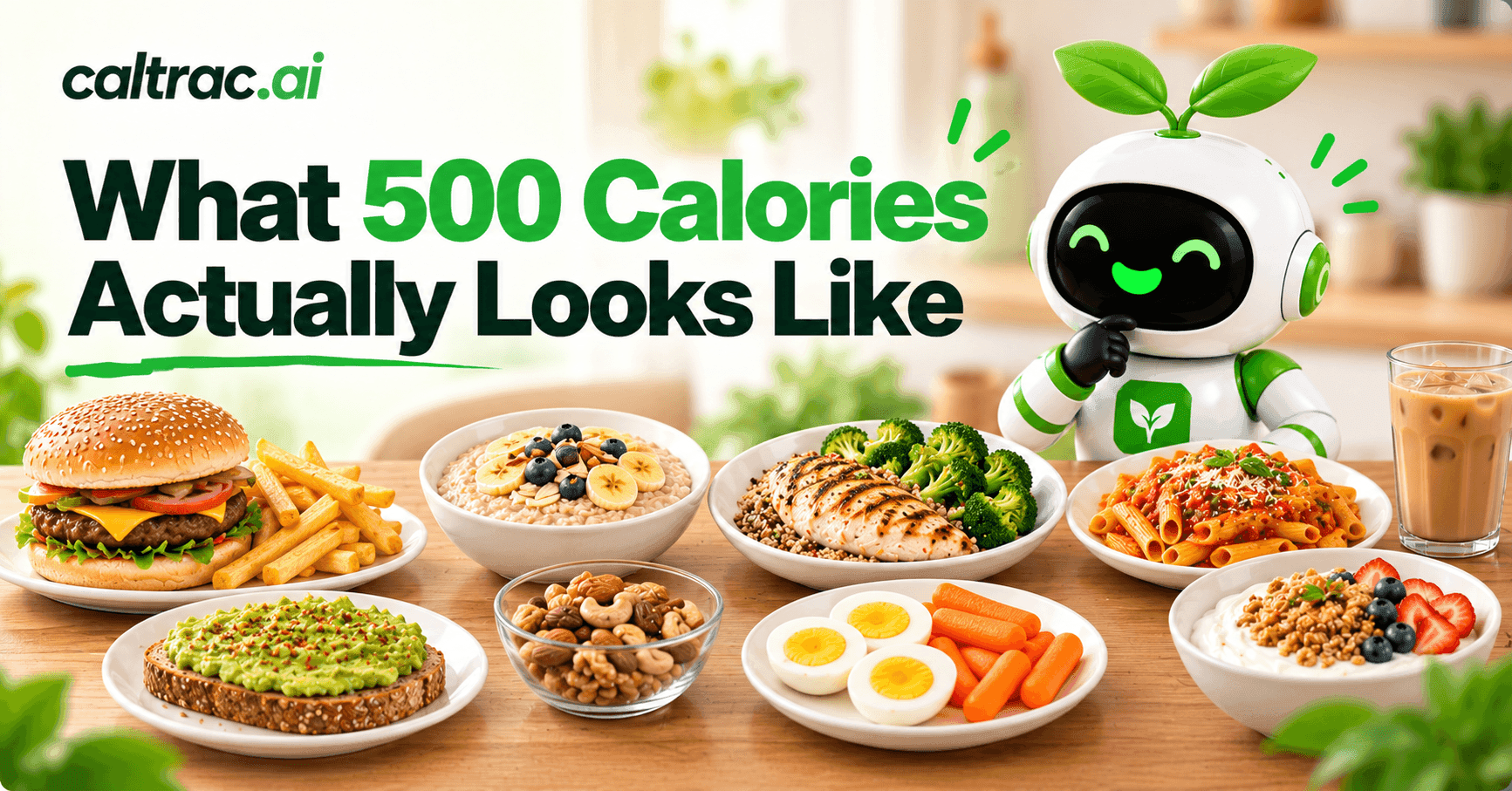
Five hundred calories is the most important number in weight loss that nobody can picture. It is the daily deficit clinical guidelines recommend [1]. It is almost exactly how much more people ate per day when researchers fed them ultra-processed food instead of whole food in a locked metabolic ward: 508 extra calories, without noticing [2]. And it is the difference between a diet that works and one that quietly does not.
So what does 500 calories actually look like? Not in photographs, which depend on the plate and the camera, but in grams, on a kitchen scale, across 40 everyday foods. The numbers below are all from USDA FoodData Central and manufacturer labels, and the spread between the top and bottom of each table is the whole lesson of calorie density in one glance.
500 Calories of Vegetables and Fruit
| Food | Grams for 500 kcal | What that is | Source |
|---|---|---|---|
| Broccoli, raw | 1,470 g | About four large heads | [3] |
| Oranges | 1,090 g | Seven to eight oranges | [4] |
| Banana | 560 g | Four to five medium bananas | [5] |
| Sweet potato, baked | 555 g | Three medium sweet potatoes | [6] |
| Potato, baked with skin | 525 g | Two and a half large potatoes | [7] |
| Avocado | 300 g | Two whole avocados | [8] |
Nobody has ever accidentally eaten 1.5 kg of broccoli. That is the point. Foods that are mostly water and fibre make 500 calories physically difficult to consume, which is why trials that add fruit and vegetables to a reduced-fat diet produce more weight loss and less hunger than the reduced-fat diet alone [9]. Avocado is the exception in this group: it is a fat, nutritionally, and two of them is a realistic portion for guacamole.
500 Calories of Protein Foods
| Food | Grams for 500 kcal | What that is | Protein in that amount | Source |
|---|---|---|---|---|
| Greek yogurt, nonfat | 925 g | Nearly a 1 kg tub | 88 g | [10] |
| Cottage cheese, 2% | 615 g | Two and a half cups | 64 g | [11] |
| Lentils (dal), cooked | 430 g | Nearly two cups | 39 g | [12] |
| Dal, as prepared | 345 g | About 1.5 cups | 30 g | [13] |
| Tofu, firm | 345 g | One large block | 60 g | [14] |
| Eggs, hard-boiled | 325 g | Six and a half eggs | 41 g | [15] |
| Chicken breast, roasted | 305 g | Two large breasts | 94 g | [16] |
| Salmon, cooked | 245 g | One and a half fillets | 54 g | [17] |
| Paneer, firm | 155 g | A palm-sized block | 39 g | [18] |
| Soya chunks, dry | 145 g | Nearly a full 200 g pack | 75 g | [19] |
Two things stand out. First, how much protein 500 calories buys when you choose well: 94 g from chicken breast or 88 g from Greek yogurt, against 39 g from paneer or dal. Second, how different the volumes are. Nine hundred grams of yogurt and 155 g of paneer are the same calories. Protein is the most satiating macronutrient [20], and the high-volume, high-protein foods at the top of this table are the most filling things on this page.
500 Calories of Grains and Breads
| Food | Grams for 500 kcal | What that is | Source |
|---|---|---|---|
| Rice, white, cooked | 385 g | About two cups | [21] |
| Idli | 390 g | Ten idlis | [22] |
| Pasta, cooked | 315 g | Two generous bowls | [23] |
| Dosa, plain | 240 g | One and a half large dosas | [24] |
| Whole-wheat bread | 200 g | About seven slices | [25] |
| Whole-wheat naan | 175 g | Two naans | [26] |
| Roti or chapati | 167 g | Four medium rotis | [27] |
| Paratha | 153 g | Two parathas | [28] |
The rice-versus-roti question that half of India argues about resolves here. Per 100 g, roti is more than twice as calorie-dense as cooked rice, because rice is 70% water. But a medium roti weighs 40 g, so one roti is about 120 calories, roughly the same as 90 g of cooked rice. Four rotis or two cups of rice: the calories are identical. Roti brings more protein and fibre per calorie [27] [21]; the deciding factor is which one you can stop eating.
500 Calories of Fats, Nuts and Oils
| Food | Grams for 500 kcal | What that is | Source |
|---|---|---|---|
| Almonds | 86 g | About 70 almonds | [29] |
| Peanut butter | 84 g | Five tablespoons | [30] |
| Butter | 70 g | Five tablespoons | [31] |
| Olive oil | 57 g | Four tablespoons | [32] |
This is the table that explains most "I eat healthy but I'm not losing weight" stories. Four tablespoons of olive oil is the deficit for a whole day. A tadka, a drizzle on salad and a tablespoon in the pan at dinner gets there without anyone noticing, and none of it shows up in a photo of the plate. Nuts are genuinely nutritious and genuinely 580 calories per 100 g [29]; a handful is 30 g and about 175 calories.
500 Calories of Fast Food and Snacks
| Food | Grams for 500 kcal | What that is | Source |
|---|---|---|---|
| Ice cream, vanilla | 240 g | Three scoops | [33] |
| Pizza, cheese, regular crust | 190 g | Under two slices of a 14-inch pizza | [34] |
| Cheeseburger, regular | 185 g | One and a half cheeseburgers | [35] |
| French fries, fast food | 160 g | Slightly less than one large order | [36] |
| Potato chips | 94 g | Most of a large bag | [37] |
| Milk chocolate | 93 g | Just under two standard bars | [38] |
Compare the top of this table with the top of the vegetable table: 240 g of ice cream and 1,470 g of broccoli are the same calories. Ultra-processed foods are engineered to be eaten quickly and in volume, and the 508-calorie overeating gap in the NIH ward study is what that looks like in practice [2].
500 Calories of Drinks
| Drink | Amount for 500 kcal | Source |
|---|---|---|
| Red wine | 590 ml, about four large glasses | [39] |
| Beer, regular | 1,165 ml, about three and a half pints | [40] |
| Cola, regular | 1,190 ml, about three and a half cans | [41] |
Liquids are the easiest 500 calories to consume and the hardest to remember. Three cans of cola across a day is almost exactly the recommended deficit, and it is the item most often missing from a food log.
500 Calories of Indian Meals
| Dish | Grams for 500 kcal | What that is | Protein in that amount | Source |
|---|---|---|---|---|
| Sambar | 580 g | Over two cups | 25 g | [42] |
| Palak paneer | 495 g | Two and a half cups | 27 g | [43] |
| Biryani with chicken | 480 g | About two and a half cups | 34 g | [44] |
| Chicken curry | 465 g | Nearly two cups | 30 g | [45] |
| Dal | 345 g | About 1.5 cups | 30 g | [13] |
Restaurant versions will be higher, mostly because of oil and cream, but the pattern holds: a plate of biryani or two cups of curry is a 500-calorie meal, and it is not a high-protein one. Pairing a cup of dal or curry with a lean protein, rather than with more rice, is the single easiest fix to an Indian plate.
How to Use This
Five hundred calories is about a quarter of most adults' daily needs, but your own figure matters more than the average. Caltrac's free calorie calculator gives you maintenance calories and a weight-loss target in under a minute; the macro calculator splits that target into protein, carbohydrate and fat. Once you know that 500 calories is 20% or 30% of your day, the tables above become decisions rather than trivia: a tablespoon of oil is 5% of a 1,600 calorie day, a large order of fries is 35%, and 300 g of chicken breast with a kilo of vegetables is an enormous dinner for the same price as two slices of pizza.
That is where tracking earns its keep. Snap a photo of your plate or type "100 g rice, 1 cup dal, 1 tsp oil" and track it automatically with Caltrac. You will see the calories and protein logged in seconds against your own target, and your Apple Health-powered net calorie count will show exactly where today's 500 calories went. Weigh it once; after that, the app knows.
Frequently Asked Questions
What does 500 calories look like in food? About 300 g of chicken breast, 385 g of cooked rice, four medium rotis, 86 g of almonds, 57 g of olive oil, 190 g of pizza or 1.5 kg of raw broccoli [16] [21] [27] [29] [32] [34] [3].
Is 500 calories a lot? It is roughly a quarter of an average adult's daily needs and the size of deficit most clinical guidelines recommend for weight loss [1]. Use the calorie calculator for your own percentage.
What 500-calorie meal has the most protein? Chicken breast (94 g of protein), Greek yogurt (88 g), soya chunks (75 g) and tofu (60 g) give the most protein for 500 calories [16] [10] [19] [14].
How many rotis is 500 calories? About four medium 40 g rotis, or two parathas, or two whole-wheat naans [27] [28] [26].
Is rice or roti better for weight loss? Per calorie they are close; one medium roti is about 120 kcal, the same as 90 g of cooked rice. Roti has more protein and fibre per calorie [27] [21]. Portion control matters more than the choice.
Why do I eat 500 extra calories without noticing? Because calorie-dense foods, oils and drinks deliver it in small volumes. In a controlled NIH study, people on an ultra-processed diet ate 508 more calories a day than on a whole-food diet without feeling they had eaten more [2].
References
- Jensen MD, et al. 2013 AHA/ACC/TOS guideline for the management of overweight and obesity in adults. Circulation. 2014;129(25 Suppl 2):S102-S138. pubmed.ncbi.nlm.nih.gov
- Hall KD, et al. Ultra-Processed Diets Cause Excess Calorie Intake and Weight Gain: An Inpatient Randomized Controlled Trial of Ad Libitum Food Intake. Cell Metabolism. 2019;30(1):67-77. pubmed.ncbi.nlm.nih.gov
- USDA FoodData Central. Broccoli, raw: 34 kcal, 2.8 g protein, 2.6 g fibre per 100 g. SR Legacy 170379. fdc.nal.usda.gov
- USDA FoodData Central. Oranges, raw, Florida: 46 kcal, 2.4 g fibre per 100 g. SR Legacy 169918. fdc.nal.usda.gov
- USDA FoodData Central. Bananas, raw: 89 kcal, 2.6 g fibre per 100 g. SR Legacy 173944. fdc.nal.usda.gov
- USDA FoodData Central. Sweet potato, baked in skin: 90 kcal, 3.3 g fibre per 100 g. SR Legacy 170134. fdc.nal.usda.gov
- USDA FoodData Central. Potatoes, Russet, flesh and skin, baked: 95 kcal, 2.6 g protein, 2.3 g fibre per 100 g. SR Legacy 170030. fdc.nal.usda.gov
- USDA FoodData Central. Avocados, raw, California: 167 kcal, 6.8 g fibre per 100 g. SR Legacy 171706. fdc.nal.usda.gov
- Ello-Martin JA, Roe LS, Ledikwe JH, Beach AM, Rolls BJ. Dietary energy density in the treatment of obesity: a year-long trial comparing 2 weight-loss diets. American Journal of Clinical Nutrition. 2007;85(6):1465-1477. pubmed.ncbi.nlm.nih.gov
- USDA FoodData Central. Yogurt, Greek, nonfat, plain: 54 kcal, 9.5 g protein per 100 g. SR Legacy 171312. fdc.nal.usda.gov
- USDA FoodData Central. Cheese, cottage, 2% milkfat: 81 kcal, 10.4 g protein per 100 g. SR Legacy 172182. fdc.nal.usda.gov
- USDA FoodData Central. Lentils, cooked: 116 kcal, 9 g protein, 7.9 g fibre per 100 g. SR Legacy 172421. fdc.nal.usda.gov
- USDA FoodData Central, FNDDS. Dal (as prepared): 145 kcal, 8.6 g protein, 7.5 g fibre per 100 g; 1 cup 240 g. FDC ID 2707427. fdc.nal.usda.gov
- USDA FoodData Central. Tofu, firm: 144 kcal, 17.3 g protein per 100 g. SR Legacy 172475. fdc.nal.usda.gov
- USDA FoodData Central. Egg, whole, hard-boiled: 155 kcal, 12.6 g protein per 100 g. SR Legacy 173424. fdc.nal.usda.gov
- USDA FoodData Central. Chicken breast, meat only, roasted: 165 kcal, 31 g protein per 100 g. SR Legacy 171477. fdc.nal.usda.gov
- USDA FoodData Central. Salmon, Atlantic, farmed, cooked: 206 kcal, 22.1 g protein per 100 g. SR Legacy 175168. fdc.nal.usda.gov
- USDA FoodData Central, Branded. Karoun Dairies Paneer: 321 kcal, 25 g protein per 100 g. FDC ID 2429587. fdc.nal.usda.gov
- Nutrela soya chunks pack label per 100 g dry (345 kcal, 52 g protein), as reproduced in a retailer listing. thedesifood.com
- Leidy HJ, et al. The role of protein in weight loss and maintenance. American Journal of Clinical Nutrition. 2015;101(6):1320S-1329S. pubmed.ncbi.nlm.nih.gov
- USDA FoodData Central. Rice, white, long-grain, cooked: 130 kcal, 2.7 g protein per 100 g. SR Legacy 168878. fdc.nal.usda.gov
- USDA FoodData Central, FNDDS. Idli: 128 kcal, 6.4 g protein per 100 g; 1 item 38 g. FDC ID 2708346. fdc.nal.usda.gov
- USDA FoodData Central. Pasta, cooked, enriched: 158 kcal, 5.8 g protein per 100 g. SR Legacy 169737. fdc.nal.usda.gov
- USDA FoodData Central, FNDDS. Dosa, plain: 210 kcal per 100 g; 1 large 155 g. FDC ID 2708347. fdc.nal.usda.gov
- USDA FoodData Central. Bread, whole-wheat, commercially prepared: 252 kcal, 12.4 g protein per 100 g. SR Legacy 172688. fdc.nal.usda.gov
- USDA FoodData Central. Bread, naan, whole wheat: 286 kcal per 100 g. SR Legacy 174077. fdc.nal.usda.gov
- USDA FoodData Central, FNDDS. Bread, chapatti or roti: 299 kcal, 7.9 g protein, 9.7 g fibre per 100 g; 1 medium (7 inch) 40 g. FDC ID 2707713. fdc.nal.usda.gov
- USDA FoodData Central, FNDDS. Bread, paratha: 326 kcal, 13.2 g fat per 100 g; 1 paratha 70 g. FDC ID 2707715. fdc.nal.usda.gov
- USDA FoodData Central. Nuts, almonds: 579 kcal, 21.2 g protein per 100 g. SR Legacy 170567. fdc.nal.usda.gov
- USDA FoodData Central. Peanut butter, smooth: 598 kcal per 100 g. SR Legacy 172470. fdc.nal.usda.gov
- USDA FoodData Central. Butter, salted: 717 kcal per 100 g. SR Legacy 173410. fdc.nal.usda.gov
- USDA FoodData Central. Oil, olive: 884 kcal per 100 g. SR Legacy 171413. fdc.nal.usda.gov
- USDA FoodData Central. Ice creams, vanilla: 207 kcal per 100 g. SR Legacy 167575. fdc.nal.usda.gov
- USDA FoodData Central. Fast food pizza chain, 14-inch cheese pizza, regular crust: 266 kcal, 11.4 g protein per 100 g. SR Legacy 173292. fdc.nal.usda.gov
- USDA FoodData Central. Fast foods, cheeseburger, single regular patty, with condiments: 270 kcal, 13.5 g protein per 100 g. SR Legacy 170691. fdc.nal.usda.gov
- USDA FoodData Central, FNDDS. Potato, french fries, fast food: 312 kcal per 100 g; 1 large order 180 g. FDC ID 2709461. fdc.nal.usda.gov
- USDA FoodData Central. Snacks, potato chips, plain, salted: 532 kcal per 100 g. SR Legacy 169677. fdc.nal.usda.gov
- USDA FoodData Central. Candies, milk chocolate: 535 kcal per 100 g. SR Legacy 167587. fdc.nal.usda.gov
- USDA FoodData Central. Wine, table, red: 85 kcal per 100 g. SR Legacy 173190. fdc.nal.usda.gov
- USDA FoodData Central. Beer, regular: 43 kcal per 100 g. SR Legacy 168746. fdc.nal.usda.gov
- USDA FoodData Central. Beverages, carbonated, cola, regular: 42 kcal per 100 g. SR Legacy 174852. fdc.nal.usda.gov
- USDA FoodData Central, FNDDS. Sambar, vegetable stew: 86 kcal, 4.3 g protein per 100 g; 1 cup 248 g. FDC ID 2707430. fdc.nal.usda.gov
- USDA FoodData Central, FNDDS. Palak paneer: 101 kcal, 5.4 g protein per 100 g; 1 cup 200 g. FDC ID 2709631. fdc.nal.usda.gov
- USDA FoodData Central, FNDDS. Biryani with chicken: 104 kcal, 7.2 g protein per 100 g; 1 cup 196 g. FDC ID 2706538. fdc.nal.usda.gov
- USDA FoodData Central, FNDDS. Chicken curry: 107 kcal, 6.5 g protein per 100 g; 1 cup 240 g. FDC ID 2706437. fdc.nal.usda.gov