


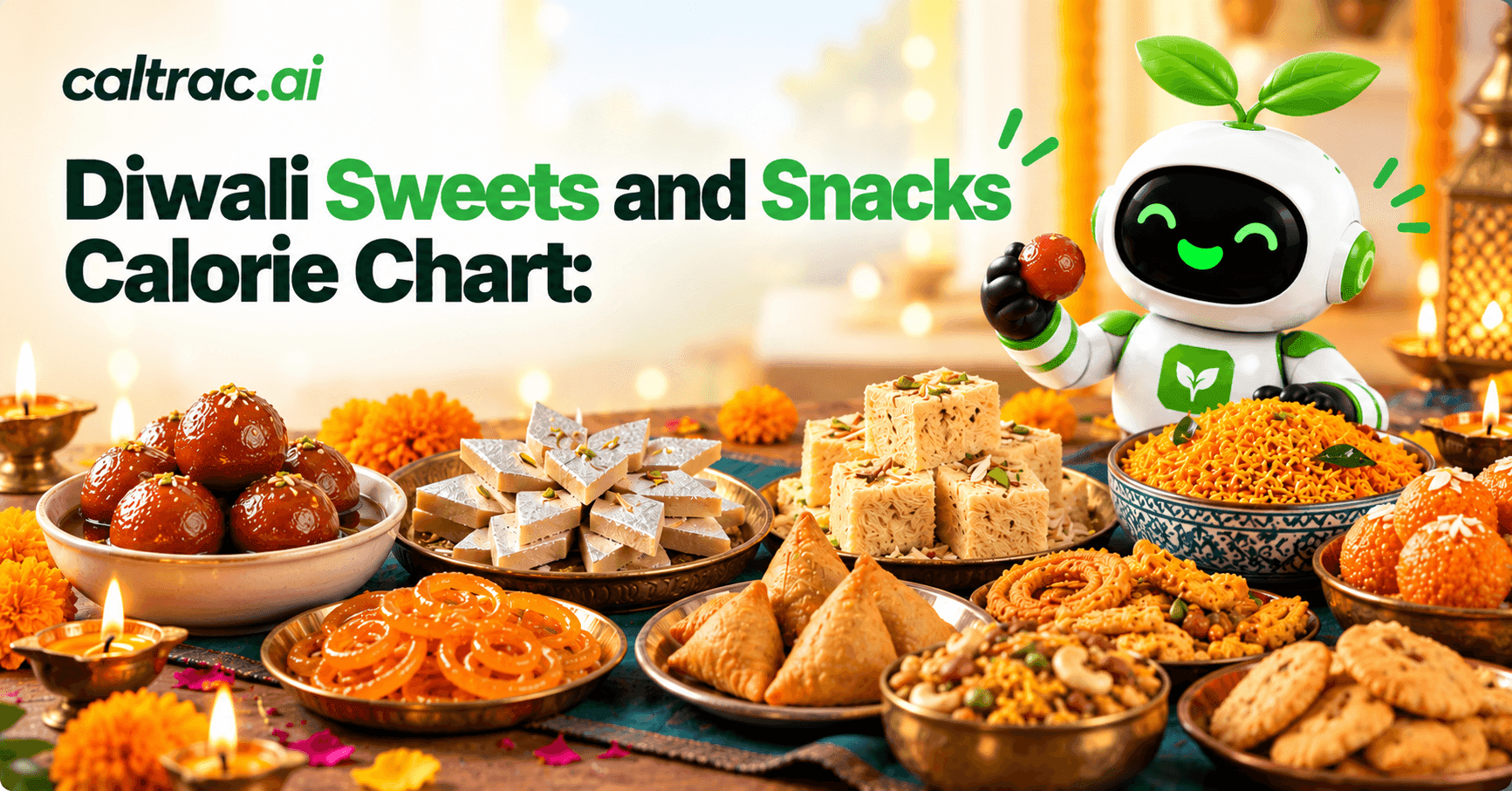
Diwali falls on Sunday, 8 November in 2026 [1], and for most households the eating starts a week earlier and ends a week later. Nobody should spend the festival of lights counting ladoos. But most people would like to know, roughly, what the box of mithai on the table costs, so that the choices they make are deliberate rather than accidental.
This chart puts numbers on the most common Diwali sweets and savoury snacks, per 100 g and per realistic piece, using manufacturer nutrition labels and the USDA food database wherever they exist. Where no verified label exists for a homemade sweet, the figure is a recipe-based estimate and is marked as one. At the end there is a short, practical plan for enjoying the festival without undoing October.
The Short Version
- Cheapest sweets per piece: kaju katli (about 45 kcal per 10 g piece) and rasgulla (about 110 kcal per piece, and mostly milk protein and syrup rather than fat).
- Most expensive per piece: soan papdi, mysore pak and besan ladoo, all 500 kcal or more per 100 g because they are built on ghee and sugar.
- The hidden cost is savoury. A 30 g handful of aloo bhujia is 175 kcal and a quarter of a day's sodium limit, and nobody stops at 30 g [2].
- Two gulab jamuns use up a whole day's free-sugar allowance under WHO guidance before you have eaten anything else [3] [4].
Diwali Sweets Calorie Chart
Values per 100 g are from the sources cited; per-piece figures are calculated from them using the piece weight shown. Piece sizes vary enormously between shops and homes, so weigh one piece from your own box if you want precision.
| Sweet | Per 100 g | Typical piece | Calories per piece | Sugar per piece | Source |
|---|---|---|---|---|---|
| Kaju katli | 450 kcal, 42.5 g sugar, 17.5 g fat | 10 g | 45 kcal | 4 g | [5] |
| Peda (recipe estimate) | ~400 kcal | 20 g | ~80 kcal | ~8 g | see method below |
| Rasgulla (in syrup) | 242 kcal, 44 g sugar, 2 g fat | 45 g | 109 kcal | 20 g | [6] |
| Jalebi (recipe estimate) | ~350 kcal | 30 g | ~105 kcal | ~10 g | see method below |
| Soan papdi | 550 kcal, 50 g sugar, 30 g fat | 20 g | 110 kcal | 10 g | [7] |
| Motichoor ladoo | 410 kcal, 50 g sugar, 16.5 g fat | 28 g | 115 kcal | 14 g | [8] |
| Gulab jamun (in syrup) | 317 kcal, 48.1 g sugar, 5 g fat | 40 g | 127 kcal | 19 g | [3] |
| Barfi (khoya) | 284 kcal, 37 g sugar, 11.4 g fat | 45 g | 128 kcal | 17 g | [9] |
| Peanut chikki | 532 kcal, 41.9 g sugar, 29 g fat | 31 g bar | 165 kcal | 13 g | [10] |
| Mysore pak (recipe estimate) | ~580 kcal | 30 g | ~175 kcal | ~12 g | see method below |
| Kheer or phirni | 144 kcal, 15.7 g sugar, 3.1 g fat | 130 g bowl | 187 kcal | 20 g | [11] |
| Rasmalai (with milk) | 302 kcal, 17.6 g sugar, 12.6 g fat | 63 g piece | 190 kcal | 11 g | [12] |
| Besan ladoo | 411 kcal, 29.8 g sugar, 22.3 g fat | 60 g (USDA) | 247 kcal | 18 g | [13] |
| Gajar halwa (recipe estimate) | ~270 kcal | 100 g bowl | ~270 kcal | ~20 g | see method below |
Three things the table shows that intuition gets wrong:
- Syrup sweets are lighter than ghee sweets. Gulab jamun and rasgulla feel indulgent because they are soaked in sugar, but they are mostly water. Per 100 g they carry a third to half the calories of soan papdi or mysore pak, whose weight is ghee, sugar and flour with almost no water [3] [6] [7].
- The small pieces are the trap. Kaju katli at 45 kcal is the lowest number on the chart, and that is exactly why people eat six. Six is 270 kcal and 25 g of sugar.
- Milk sweets carry some protein. Rasmalai gives about 3.3 g of protein per 100 kcal, rasgulla 2.5 g, against 1.3 g for gulab jamun and 1.8 g for soan papdi [12] [6] [3] [7]. If you are going to eat a sweet, the milk-based ones do slightly more for fullness.
How the recipe estimates were made. Jalebi, peda, mysore pak and gajar halwa have no verified manufacturer label or USDA entry. Their figures were calculated from standard recipes using USDA values for the ingredients: ghee [14], sugar at 387 kcal per 100 g [15], chickpea flour [16], whole milk and carrots. Treat them as accurate to within about 15%; a sweet shop's version made with extra ghee will be higher.
Diwali Savoury Snacks Calorie Chart
Namkeen is where Diwali calories actually accumulate, because it sits in an open bowl all evening and because fried gram-flour snacks are among the most energy-dense foods in any cuisine. A 30 g handful is a realistic single serving; a 200 g pack is six to seven of them.
| Snack | Per 100 g | 30 g handful | Sodium per handful | Source |
|---|---|---|---|---|
| Aloo bhujia | 584 kcal, 41.5 g fat, 849 mg sodium | 175 kcal | 255 mg | [2] |
| Plain bhujia | 580 kcal, 44 g fat, 780 mg sodium | 174 kcal | 234 mg | [17] |
| Boondi masala | 543 kcal, 40 g fat, 857 mg sodium | 163 kcal | 257 mg | [18] |
| Mathri (recipe estimate) | ~550 kcal | 165 kcal (3 pieces) | ~250 mg | see method above |
| Bombay mix (chana, peanut) | 514 kcal, 25.7 g fat, 20 g protein, 457 mg sodium | 154 kcal | 137 mg | [19] |
| Chakli or murukku | 464 kcal, 25 g fat, 857 mg sodium | 139 kcal | 257 mg | [20] |
| Roasted poha chivda (recipe estimate) | ~450 kcal | ~135 kcal | ~200 mg | see method above |
| Samosa, small (25 g) | 310 kcal per 100 g | 78 kcal each | 97 mg | [21] |
| Samosa, regular (100 g) | 310 kcal, 17.5 g fat, 388 mg sodium | 310 kcal each | 388 mg | [21] |
The sodium column matters as much as the calories. The FDA Daily Value for sodium is 2,300 mg [22]. Four handfuls of bhujia across an evening is roughly 1,000 mg, before any meal, and a 100 g samosa adds nearly 400 mg more [2] [21]. That is why the scale jumps a kilo the morning after Diwali: it is water held by salt and by the glycogen your body stores alongside a sugar-heavy day, at three to four grams of water for every gram of glycogen [23]. It is not fat, and it leaves within days.
Bombay mix is the least bad option on the table. It is still 514 kcal per 100 g, but the chana and peanuts give it 20 g of protein and 5.7 g of fibre per 100 g, which is more than any other snack here [19].
What a Typical Diwali Evening Adds Up To
Here is an ordinary, not greedy, festival evening, built from the charts above:
| Item | Calories | Sugar |
|---|---|---|
| 2 gulab jamun | 254 kcal | 38 g |
| 2 kaju katli | 90 kcal | 8 g |
| 1 soan papdi | 110 kcal | 10 g |
| 1 handful aloo bhujia (30 g) | 175 kcal | 1 g |
| 1 regular samosa | 310 kcal | 1 g |
| Total before dinner | 939 kcal | 58 g |
WHO advises keeping free sugars below 10% of energy, about 50 g a day on 2,000 calories, with further benefit below 5% or about 25 g [4] [24]. The FDA Daily Value for added sugars is also 50 g [22]. This evening spends the whole day's allowance on five sweets, and nearly 940 calories, roughly half of many people's daily target, on snacks eaten standing up before a meal.
That is not an argument for skipping Diwali. It is an argument for knowing which five items you are choosing.
Eight Rules for Enjoying Diwali Without Regretting It
1. Pick your three. Decide in advance which three sweets of the season you genuinely love and eat those, properly, without guilt. Skip the ones you would eat only because they are there. For most people this alone halves festival sugar intake.
2. Sweet after protein, not before. Eat your sweets after a meal that contained dal, paneer, chicken or eggs rather than on an empty stomach. Protein is the most satiating macronutrient, and a protein-containing meal blunts the appetite for a second and third piece [25].
3. Choose the syrup sweets over the ghee sweets. If calories are the concern, a rasgulla or a gulab jamun costs less than a soan papdi or a piece of mysore pak of the same weight, and the milk-based ones bring a little protein with them.
4. Pour the namkeen into a bowl, then put the pack away. A 30 g bowl is 140 to 175 kcal. An open 200 g pack within reach is 1,000.
5. Treat the small pieces as whole pieces. Kaju katli, peda and mini ladoos are the ones that get eaten in multiples. Count them.
6. Be sceptical of "sugar-free" mithai. Replacing sugar with a sweetener removes the sugar but not the ghee, khoya and nuts, which supply most of the calories in a besan ladoo or barfi. WHO's 2023 guideline also found no long-term weight benefit from non-sugar sweeteners [26]. A sugar-free kaju katli is still a cashew sweet.
7. Walk after the big meal. Festival evenings concentrate eating and remove movement. Even a 20-minute walk after dinner is worth taking, and it is the easiest Diwali habit to keep.
8. Weigh yourself on Thursday, not Monday. Weekend and festival eating reliably shows up as a sharp rise on the scale within a day, driven by salt, sugar and water rather than fat [27] [23]. Judge the festival by your weight a week later, when the water has gone.
Where Diwali Fits in Your Day
One gulab jamun is about 127 calories. For someone with a 1,500 calorie target that is 8% of the day; for someone at 2,200 it is under 6%. The number that makes the chart useful is your own target. Caltrac's free calorie calculator gives you a maintenance figure and a weight-loss target from your age, height, weight and activity level, and the macro calculator will tell you how much protein to build the rest of the day around so the sweets fit.
That is where tracking earns its keep. Snap a photo of the mithai plate or type "2 gulab jamun, 1 kaju katli" and track it automatically with Caltrac. You will see the calories and sugar logged in seconds, and your Apple Health-powered net calorie count will show exactly how the evening fits your day. Light the diyas; let the app count the ladoos.
Frequently Asked Questions
How many calories are in one gulab jamun? About 127 calories and 19 g of sugar for a 40 g piece in syrup, based on a manufacturer label of 317 kcal and 48 g sugar per 100 g [3]. Large sweet-shop pieces of 60 g run closer to 190 calories.
How many calories are in kaju katli? About 45 calories per 10 g piece, or 450 per 100 g, with 42.5 g of sugar per 100 g [5]. It is the lowest-calorie sweet per piece on this chart because the pieces are small.
Which Diwali sweet has the fewest calories? Per 100 g, rasgulla (242 kcal) and kheer or phirni (144 kcal) are lowest, because both are mostly water and milk [6] [11]. Per piece, kaju katli wins simply on size.
Which Diwali sweet is highest in calories? Soan papdi at 550 kcal per 100 g [7], with mysore pak and besan ladoo close behind. All three are mostly ghee and sugar with almost no water.
How many calories are in bhujia? About 580 kcal per 100 g, or 175 kcal for a 30 g handful, with roughly 250 mg of sodium per handful [2] [17].
Is sugar-free mithai good for weight loss? Not especially. Most of the calories in ghee- and nut-based sweets come from the fat, not the sugar, and WHO does not recommend non-sugar sweeteners for weight control [26]. It can help people managing blood sugar.
Why did I gain a kilo after Diwali? Salt from namkeen and glycogen from sugar both hold water, several grams of water per gram of glycogen [23], and weekend-style eating patterns show up on the scale within a day [27]. Most of it is gone within a week of normal eating.
References
- SmartPuja. Diwali 2026: Date, Lakshmi Puja Muhurat, Vidhi and Significance (Diwali falls on Sunday 8 November 2026). smartpuja.com
- Carrefour UAE product listing with manufacturer nutrition panel. Haldiram's Aloo Bhujia, 200 g: 584 kcal, 42.4 g carbohydrate, 3.8 g sugar, 10.3 g protein, 41.5 g fat, 849 mg sodium per 100 g. carrefouruae.com
- Carrefour UAE product listing with manufacturer nutrition panel. Haldiram's Gulab Jamun, 1 kg: 317 kcal, 64 g carbohydrate, 48.1 g sugar, 4 g protein, 5 g fat per 100 g. carrefouruae.com
- World Health Organization. Healthy diet (fact sheet): free sugars below 10% of energy, about 50 g or 12 teaspoons on 2,000 kcal; below 5% for further benefit; saturated fat below 10% of energy. who.int
- USDA FoodData Central, Branded Foods. Mo'Pleez Mitha Magic Kaju Katli (cashew nuts and sugar): 450 kcal, 42.5 g sugar, 17.5 g fat, 10 g protein per 100 g; serving 4 pieces, 40 g. FDC ID 740348. fdc.nal.usda.gov
- Carrefour UAE product listing with manufacturer nutrition panel. Haldiram's Rasgulla, 1 kg: 242 kcal, 50 g carbohydrate, 44 g sugar, 6 g protein, 2 g fat per 100 g. carrefouruae.com
- Carrefour UAE product listing with manufacturer nutrition panel. Haldiram's Soan Papdi Sweet, 250 g: 550 kcal, 60 g carbohydrate, 50 g sugar, 10 g protein, 30 g fat, 17 g saturated fat per 100 g. carrefouruae.com
- McGrocer (UK) product listing with manufacturer nutrition table. Haldiram's Motichoor Ladoo, 300 g: 410 kcal, 16.5 g fat, 60.6 g carbohydrate, 50 g sugar, 3.8 g protein per 100 g. mcgrocer.com
- USDA FoodData Central, FNDDS. Barfi or Burfi, Indian dessert: 284 kcal, 40.4 g carbohydrate, 37 g sugar, 11.4 g fat, 5.4 g protein per 100 g; 1 piece 45 g. FDC ID 2705700. fdc.nal.usda.gov
- USDA FoodData Central, Branded Foods. Deep Peanut Brittle Chikki: 532 kcal, 41.9 g sugar, 29 g fat, 12.9 g protein per 100 g; serving 31 g. FDC ID 2041185. fdc.nal.usda.gov
- USDA FoodData Central, FNDDS. Firni, Indian pudding (rice and milk pudding, kheer-style): 144 kcal, 25.1 g carbohydrate, 15.7 g sugar, 3.1 g fat, 3.6 g protein per 100 g; 1 cup 260 g. FDC ID 2705686. fdc.nal.usda.gov
- USDA FoodData Central, Branded Foods. Haldiram's Mitha Magic Rasmalai: 190 kcal, 6.35 g protein, 7.94 g fat, 11.1 g sugar per 63 g serving. FDC ID 1126072. fdc.nal.usda.gov
- USDA FoodData Central, FNDDS. Ladoo, round ball: 411 kcal, 46.7 g carbohydrate, 29.8 g sugar, 22.3 g fat, 6.9 g protein per 100 g; 1 piece 60 g. FDC ID 2710351. fdc.nal.usda.gov
- USDA FoodData Central, SR Legacy. Butter, clarified butter (ghee). FDC ID 171314. fdc.nal.usda.gov
- USDA FoodData Central, SR Legacy. Sugars, granulated: 387 kcal, 99.8 g sugars per 100 g. FDC ID 169655. fdc.nal.usda.gov
- USDA FoodData Central, SR Legacy. Chickpea flour (besan). FDC ID 174288. fdc.nal.usda.gov
- USDA FoodData Central, Branded Foods. Haldiram's Plain Bhujia: 580 kcal, 44 g fat, 12 g protein, 10 g fibre, 780 mg sodium per 100 g. FDC ID 904996. fdc.nal.usda.gov
- USDA FoodData Central, Branded Foods. Haldiram's Boondi Masala: 543 kcal, 40 g fat, 8.6 g protein, 857 mg sodium per 100 g; serving 35 g. FDC ID 510972. fdc.nal.usda.gov
- USDA FoodData Central, Branded Foods. Haldiram's Namkeen Bombay Mix: 514 kcal, 25.7 g fat, 20 g protein, 5.7 g fibre, 457 mg sodium per 100 g; serving 35 g. FDC ID 1032627. fdc.nal.usda.gov
- USDA FoodData Central, Branded Foods. Deep Rice Murukku: 464 kcal, 25 g fat, 50 g carbohydrate, 857 mg sodium per 100 g; serving 28 g. FDC ID 2440218. fdc.nal.usda.gov
- USDA FoodData Central, FNDDS. Samosa: 310 kcal, 33.2 g carbohydrate, 17.5 g fat, 5.1 g protein, 388 mg sodium per 100 g; 1 small 25 g, 1 regular 100 g. FDC ID 2708730. fdc.nal.usda.gov
- US Food and Drug Administration. Daily Value on the Nutrition and Supplement Facts Labels (sodium 2,300 mg; added sugars 50 g; saturated fat 20 g). fda.gov
- Kreitzman SN, Coxon AY, Szaz KF. Glycogen storage: illusions of easy weight loss, excessive weight regain, and distortions in estimates of body composition. American Journal of Clinical Nutrition. 1992;56(1 Suppl):292S-293S. pubmed.ncbi.nlm.nih.gov
- World Health Organization. WHO calls on countries to reduce sugars intake among adults and children (2015 sugars guideline): free sugars include honey and syrups; whole fruit excluded; 25 g a day for further benefit. who.int
- Leidy HJ, et al. The role of protein in weight loss and maintenance. American Journal of Clinical Nutrition. 2015;101(6):1320S-1329S. pubmed.ncbi.nlm.nih.gov
- World Health Organization. WHO advises not to use non-sugar sweeteners for weight control (2023 guideline). who.int
- Racette SB, et al. Influence of weekend lifestyle patterns on body weight. Obesity. 2008;16(8):1826-1830. pubmed.ncbi.nlm.nih.gov