


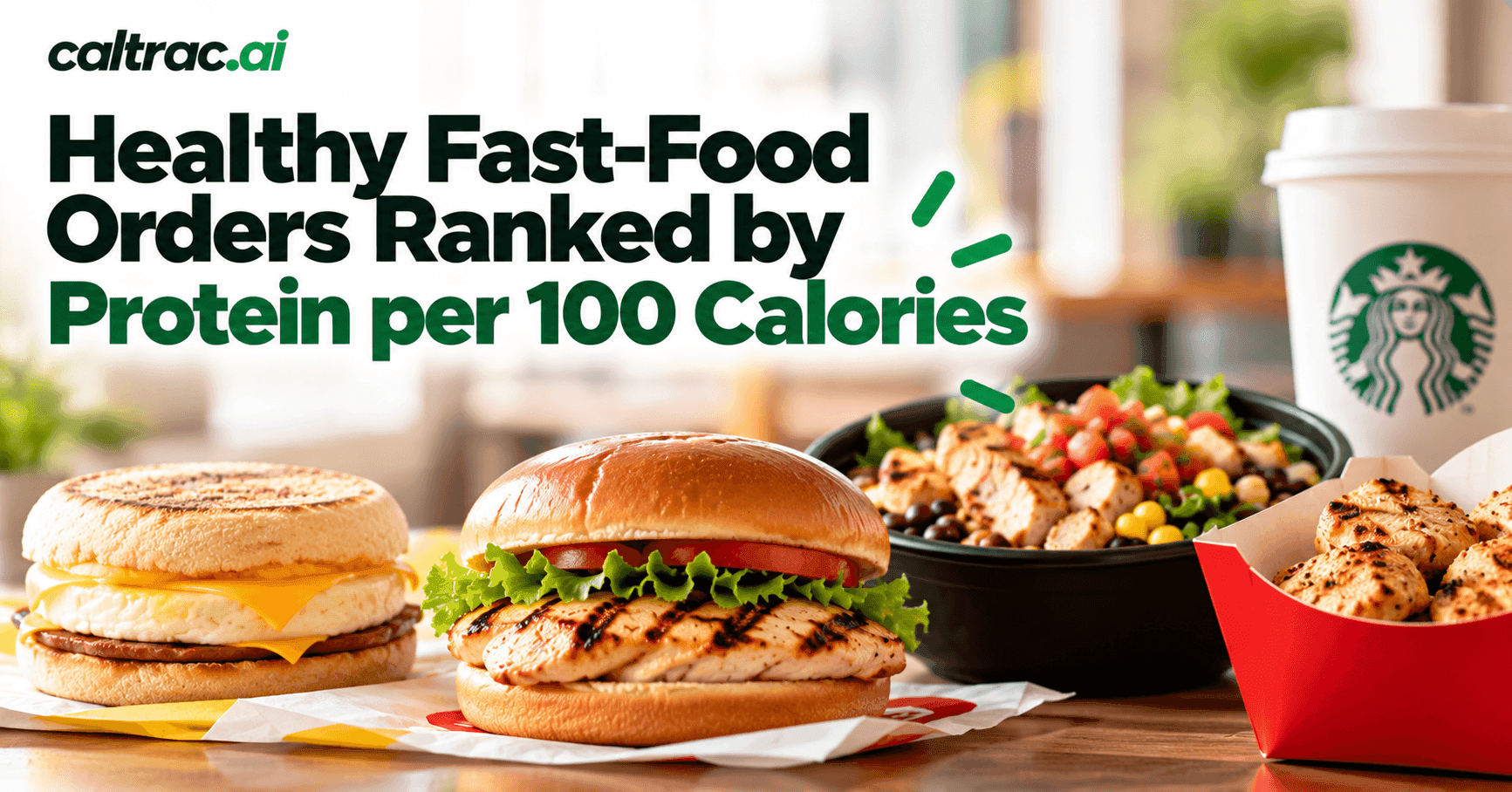
Fast food is not going anywhere, and a weight-loss plan that depends on never eating it is a plan with an expiry date. The useful question is not whether to order but what, and the answer is more interesting than "the salad." Ranked by protein per 100 calories, which is the number that matters inside a deficit, a fried chicken breast beats a bean burrito, a grilled chicken sandwich beats a Big Mac by a wide margin, and the fries and the drink do more damage than any main course on the menu.
This article uses USDA's own nutrient data for named chain items, ranks them, and gives the ordering rules that follow.
Why Fast Food Is a Weight Problem
Three findings frame the issue. In the 15-year CARDIA study, young adults who ate fast food more than twice a week gained 4.5 kg more and developed twice the increase in insulin resistance of those eating it less than once a week [1]. On any given day, 36% of American adults eat fast food, averaging 315 kcal from it [2]. And people have no idea what they are eating: adults at fast-food restaurants underestimated their meal by an average of 175 kcal against a true mean of 836, and diners at chains with a healthy image underestimated by more, not less [3]. Restaurant foods also averaged 18% more energy than their stated values when measured in a laboratory [4].
A systematic review concluded the evidence was sufficient to recommend limiting fast food [5]. That is sound public-health advice and useless on a Tuesday at 1 p.m. with twenty minutes for lunch. What follows is for the Tuesday.
Fast-Food Items Ranked by Protein per 100 Calories
All figures are USDA FoodData Central values for the named products, per 100 g. Protein per 100 kcal is the ranking column. Portion sizes vary; these are the densities you are choosing between.
| Rank | Item | Calories per 100 g | Protein per 100 g | Sodium per 100 g | Protein per 100 kcal |
|---|---|---|---|---|---|
| 1 | McDonald's Bacon Ranch Salad with Grilled Chicken [6] | 81 | 10.3 g | 230 mg | 12.7 g |
| 2 | KFC Original Recipe chicken breast [7] | 231 | 21.9 g | 606 mg | 9.5 g |
| 3 | Wendy's Ultimate Chicken Grill Sandwich [8] | 179 | 14.7 g | 427 mg | 8.2 g |
| 4 | Chick-fil-A chicken sandwich [9] | 249 | 16.3 g | 753 mg | 6.5 g |
| 5 | Subway turkey breast sub (6 inch) [10] | 147 | 9.1 g | 317 mg | 6.2 g |
| 6 | McDonald's Egg McMuffin [11] | 228 | 13.6 g | 617 mg | 6.0 g |
| 7 | McDonald's Chicken McNuggets [12] | 302 | 15.8 g | 566 mg | 5.2 g |
| 8 | KFC Popcorn Chicken [13] | 351 | 17.7 g | 1,140 mg | 5.0 g |
| 9 | McDonald's Hamburger [14] | 264 | 12.9 g | 494 mg | 4.9 g |
| 10 | McDonald's Big Mac [15] | 257 | 11.8 g | 460 mg | 4.6 g |
| 11 | Burger King Whopper, no cheese [16] | 233 | 10.7 g | 313 mg | 4.6 g |
| 12 | Domino's cheese pizza, thin crust [17] | 298 | 12.3 g | 628 mg | 4.1 g |
| 13 | Taco Bell Taco Salad [18] | 170 | 6.7 g | 363 mg | 3.9 g |
| 14 | Pizza Hut cheese pizza, pan crust [19] | 276 | 10.8 g | 580 mg | 3.9 g |
| 15 | Bean burrito [20] | 206 | 6.5 g | 454 mg | 3.2 g |
| 16 | Samosa [21] | 310 | 5.1 g | 388 mg | 1.6 g |
| 17 | McDonald's french fries [22] | 323 | 3.4 g | 189 mg | 1.1 g |
| 18 | Regular cola [23] | 42 | 0 g | 3 mg | 0 g |
Several things in this table contradict the usual advice.
- Grilled chicken anything is the best choice on every menu. The grilled chicken salad delivers 12.7 g of protein per 100 kcal, nearly as good as plain chicken breast, and the grilled chicken sandwich is close behind. Skip the ranch dressing packet and the salad stays at the top.
- Fried chicken beats burgers and pizza on protein. A KFC breast, breading and all, carries more than twice the protein per calorie of a Big Mac or a slice of pan pizza. The sodium is high, but as a protein source it is far from the worst thing on the menu.
- The taco salad is a trap. The word salad does not make it one: at 3.9 g of protein per 100 kcal it ranks below a hamburger, because the shell, cheese and sour cream carry the calories.
- Pizza is bread with a little protein. Both chain pizzas sit near the bottom of the main-course list. Two slices is 400 to 500 kcal for about 20 g of protein.
- Sides and drinks have no protein at all. Fries deliver 1.1 g per 100 kcal and a large portion is around 500 kcal; a large cola is 250 kcal of sugar and nothing else. These two items, not the burger, are what make a fast-food meal 1,200 calories.
The Rules That Follow
- Order the protein, skip the side. A grilled chicken sandwich alone is 400 to 450 kcal and 35 g of protein. Add fries and a regular cola and it is 1,000 kcal with the same protein. The main course is rarely the problem.
- Grilled over fried where offered; fried chicken over burgers where not. Protein per calorie, in that order.
- Hold the sauce. Mayonnaise, ranch and "special" sauces add 100 to 150 kcal for no protein. Mustard, hot sauce and salsa are free.
- No cheese on burgers, no bacon on anything. Each adds 50 to 100 kcal for a few grams of protein. The Whopper without cheese is already the leanest burger in the table.
- Water, diet soda or black coffee. The drink is the easiest 250 calories to delete from any order.
- Treat sodium as a one-meal budget. A single fried chicken meal can exceed 1,500 mg, two-thirds of the 2,300 mg daily value [24]. Keep the rest of the day's sodium low on fast-food days.
- Read the menu board. Chains with 20 or more locations must post calories [25], and the posting works: menu labelling reduced calories purchased by about 47 kcal per order in a Cochrane review and by about 60 kcal per transaction in a large chain [26] [27]. Then add 18% for the gap between stated and measured [4].
Three Orders That Work
Protein-first orders at three common chains, assembled from the table above, each landing near 450 to 550 kcal with 30 g or more of protein. The exact figures depend on the chain's current recipes, so check the posted calories; the structure is what matters.
- Burger chain: grilled chicken sandwich, no mayonnaise, side salad with vinaigrette, water. About 450 kcal, 35 g protein.
- Fried chicken chain: one Original Recipe breast, green beans or coleslaw in a small portion, water. About 450 kcal, 40 g protein. Skip the biscuit, which is 180 kcal of flour and shortening.
- Sandwich chain: 6-inch turkey or chicken breast sub on wheat, double meat, all the vegetables, mustard, no cheese, water. About 400 kcal, 35 g protein. The double meat is the single best upgrade on any fast-food menu: it doubles the protein for about 70 kcal.
Each of these fits inside a 500 to 750 kcal deficit day [28] and delivers the 25 to 35 g of protein per meal that keeps appetite controlled [29]. The same restaurants will also sell you a 1,400 kcal meal with 30 g of protein; the difference is entirely in the side, the drink and the sauce.
The Honest Caveats
Fast food is high in sodium at every rank in the table, often processed, and its stated calories run about a fifth low [4]. Eating it more than twice a week was associated with substantial weight gain over 15 years [1]. None of the ordering rules above change that. They make the occasional fast-food meal a neutral event in a weight-loss week instead of the event that ends it, which is a realistic goal; "never" is not.
Set your daily target with the calorie calculator and a protein figure with the macro calculator. A 450 kcal grilled chicken order is about 28% of a 1,600 kcal day and carries a third of its protein; the 1,200 kcal version is three-quarters of the day with the same protein.
That is where tracking earns its keep. Fast food is the meal people most under-estimate [3], and the one they most often skip logging. Type "grilled chicken sandwich, small fries" or snap the tray, and track it automatically with Caltrac. You will see the real calories and protein against your targets, and your Apple Health-powered net calorie count shows what the meal did to the day. Order smart; let the app keep the receipt.
Frequently Asked Questions
What is the healthiest fast food for weight loss? Grilled chicken items: a grilled chicken salad without dressing or a grilled chicken sandwich without mayonnaise give the most protein per calorie, about 8 to 13 g per 100 kcal [6] [8].
Can you eat fast food and lose weight? Yes, if the order fits your calorie and protein targets. Ordering the protein without fries, sugary drinks and creamy sauces keeps most chain meals under 500 kcal with 30 g or more of protein.
Is fried chicken or a burger better for weight loss? Fried chicken breast, on protein per calorie: 9.5 g per 100 kcal against 4.6 for a Big Mac [7] [15]. The burger has less sodium.
How many calories are in fast food meals? Adults' fast-food meals averaged 836 kcal in a large observational study, and diners underestimated them by about 175 kcal [3]. Measured calories ran 18% above stated values [4].
Is a fast-food salad a good choice? Only if it is built on grilled chicken without creamy dressing. A taco salad has less protein per calorie than a hamburger [18] [14].
Does menu calorie labelling work? Modestly. Labelling cut calories purchased by about 47 kcal per order across trials [26] and about 60 kcal per transaction in a large chain, an effect that faded over a year [27].
References
- Pereira MA, et al. Fast-food habits, weight gain, and insulin resistance (the CARDIA study): 15-year prospective analysis. Lancet. 2005;365(9453):36-42. pubmed.ncbi.nlm.nih.gov
- Powell LM, Nguyen BT, Han E. Energy intake from restaurants: demographics and socioeconomics, 2003-2008. American Journal of Preventive Medicine. 2012;43(5):498-504. pubmed.ncbi.nlm.nih.gov
- Block JP, et al. Consumers' estimation of calorie content at fast food restaurants: cross sectional observational study. BMJ. 2013;346:f2907. pubmed.ncbi.nlm.nih.gov
- Urban LE, et al. The accuracy of stated energy contents of reduced-energy, commercially prepared foods. Journal of the American Dietetic Association. 2010;110(1):116-123. pubmed.ncbi.nlm.nih.gov
- Rosenheck R. Fast food consumption and increased caloric intake: a systematic review of a trajectory towards weight gain and obesity risk. Obesity Reviews. 2008;9(6):535-547. pubmed.ncbi.nlm.nih.gov
- USDA FoodData Central. McDonald's Bacon Ranch Salad with Grilled Chicken: 81 kcal, 10.3 g protein per 100 g. SR Legacy 173312. fdc.nal.usda.gov
- USDA FoodData Central. KFC Fried Chicken, Original Recipe, breast, meat and skin with breading: 231 kcal, 21.9 g protein, 606 mg sodium per 100 g. SR Legacy 170744. fdc.nal.usda.gov
- USDA FoodData Central. Wendy's Ultimate Chicken Grill Sandwich: 179 kcal, 14.7 g protein per 100 g. SR Legacy 170724. fdc.nal.usda.gov
- USDA FoodData Central. Chick-fil-A chicken sandwich: 249 kcal, 16.3 g protein, 753 mg sodium per 100 g. SR Legacy 170790. fdc.nal.usda.gov
- USDA FoodData Central. Subway turkey breast sub on white bread with lettuce and tomato: 147 kcal, 9.1 g protein per 100 g. SR Legacy 170711. fdc.nal.usda.gov
- USDA FoodData Central. McDonald's Egg McMuffin: 228 kcal, 13.6 g protein, 617 mg sodium per 100 g. SR Legacy 173307. fdc.nal.usda.gov
- USDA FoodData Central. McDonald's Chicken McNuggets: 302 kcal, 15.8 g protein per 100 g. SR Legacy 173297. fdc.nal.usda.gov
- USDA FoodData Central. KFC Popcorn Chicken: 351 kcal, 17.7 g protein, 1,140 mg sodium per 100 g. SR Legacy 170737. fdc.nal.usda.gov
- USDA FoodData Central. McDonald's Hamburger: 264 kcal, 12.9 g protein per 100 g. SR Legacy 170717. fdc.nal.usda.gov
- USDA FoodData Central. McDonald's Big Mac: 257 kcal, 11.8 g protein per 100 g. SR Legacy 170720. fdc.nal.usda.gov
- USDA FoodData Central. Burger King Whopper, no cheese: 233 kcal, 10.7 g protein per 100 g. SR Legacy 170727. fdc.nal.usda.gov
- USDA FoodData Central. Domino's 14-inch cheese pizza, crunchy thin crust: 298 kcal, 12.3 g protein per 100 g. SR Legacy 172043. fdc.nal.usda.gov
- USDA FoodData Central. Taco Bell Taco Salad: 170 kcal, 6.7 g protein per 100 g. SR Legacy 170736. fdc.nal.usda.gov
- USDA FoodData Central. Pizza Hut 14-inch cheese pizza, pan crust: 276 kcal, 10.8 g protein per 100 g. SR Legacy 173291. fdc.nal.usda.gov
- USDA FoodData Central. Fast foods, burrito, with beans: 206 kcal, 6.5 g protein per 100 g. SR Legacy 172038. fdc.nal.usda.gov
- USDA FoodData Central, FNDDS. Samosa: 310 kcal, 5.1 g protein per 100 g; 1 regular 100 g. FDC ID 2708730. fdc.nal.usda.gov
- USDA FoodData Central. McDonald's french fries: 323 kcal, 3.4 g protein per 100 g. SR Legacy 170721. fdc.nal.usda.gov
- USDA FoodData Central. Beverages, carbonated, cola, regular: 42 kcal per 100 g. SR Legacy 174852. fdc.nal.usda.gov
- US Food and Drug Administration. Daily Value on the Nutrition and Supplement Facts Labels (sodium 2,300 mg). fda.gov
- US Food and Drug Administration. Menu Labeling Requirements (chains with 20 or more locations must list calories). fda.gov
- Crockett RA, et al. Nutritional labelling for healthier food or non-alcoholic drink purchasing and consumption. Cochrane Database of Systematic Reviews. 2018;2:CD009315. pubmed.ncbi.nlm.nih.gov
- Petimar J, et al. Estimating the effect of calorie menu labeling on calories purchased in a large restaurant franchise in the southern United States: quasi-experimental study. BMJ. 2019;367:l5837. pubmed.ncbi.nlm.nih.gov
- Jensen MD, et al. 2013 AHA/ACC/TOS guideline for the management of overweight and obesity in adults. Circulation. 2014;129(25 Suppl 2):S102-S138. pubmed.ncbi.nlm.nih.gov
- Leidy HJ, et al. The role of protein in weight loss and maintenance. American Journal of Clinical Nutrition. 2015;101(6):1320S-1329S. pubmed.ncbi.nlm.nih.gov