


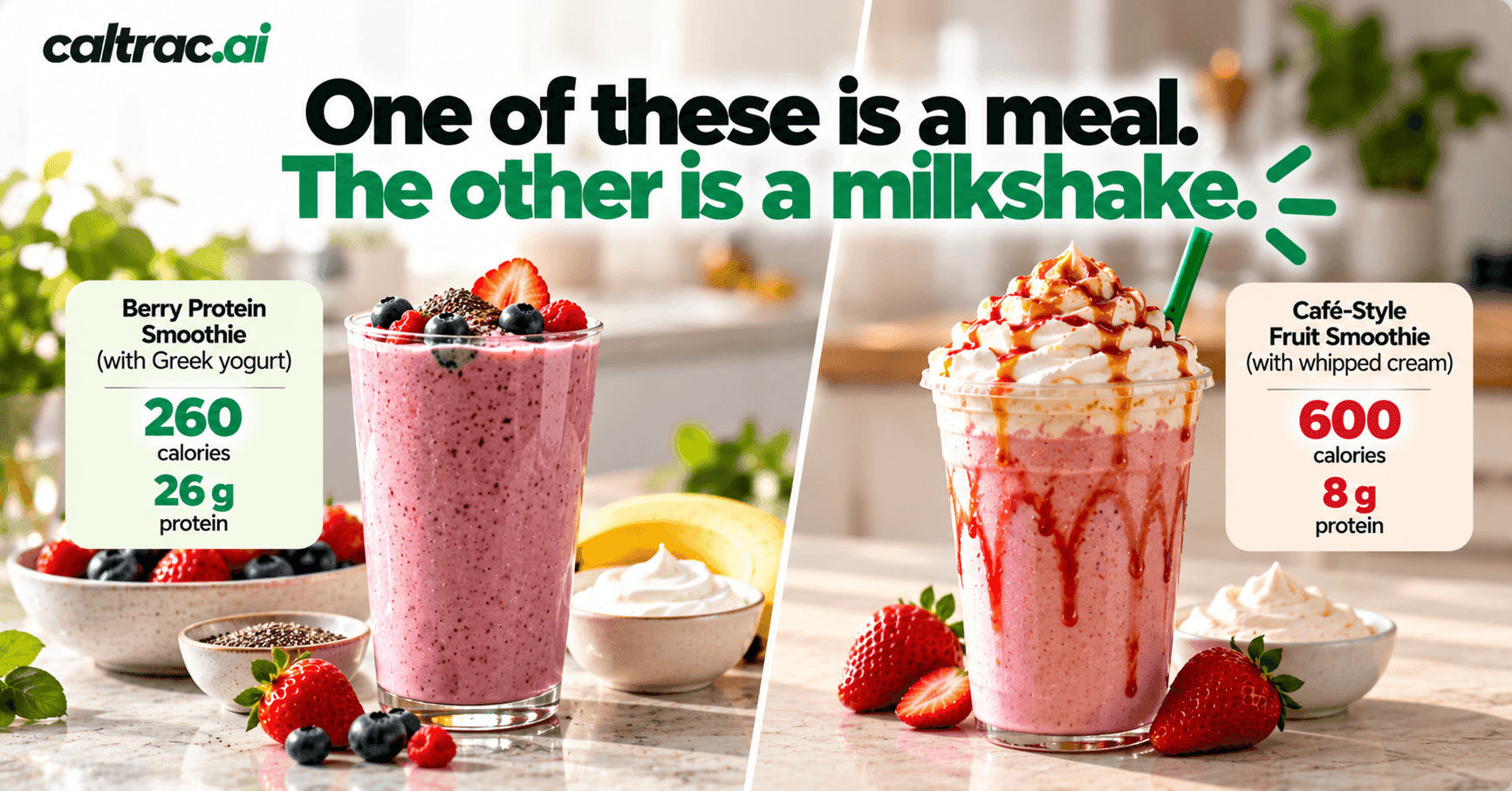
A smoothie is the easiest 30 g of protein in the day or the easiest 600 calories of sugar, and the only difference is what goes in the blender. The café version is fruit, juice and a scoop of frozen yogurt: 450 to 700 kcal, 60 to 90 g of sugar, under 10 g of protein. The version that helps weight loss starts with a protein, adds one piece of fruit, uses milk or water rather than juice, and lands at 250 to 350 kcal with 25 to 35 g of protein. Below are eight recipes that do that, four with protein powder and four without, built from USDA data, and the research on why a drink has to work harder than a meal to fill you up.
Why Smoothies Fail
Liquid calories are poorly compensated. When adults added 450 kcal a day as a sugary drink, they did not eat less to make up for it and gained weight over four weeks; when they added the same calories as solid jelly beans, they ate less at other meals and did not gain [1]. Clear, energy-containing beverages have weak satiety value, which is why they are used by people trying to gain weight [2]. A fruit smoothie is thicker than juice and fares better than a soda, but it is still a drink.
Blending reduces fullness. When 58 adults were given an apple, applesauce or apple juice before lunch, each at 125 kcal, the whole apple reduced lunch intake by 15%, about 187 kcal, while the juice did not; fullness ranked apple, then sauce, then juice, and adding fibre back to the juice did not help [3]. Chewing and solid structure matter. A smoothie sits between the sauce and the juice.
Fruit is sugar once it is liquid. A banana, a mango and a cup of orange juice in a blender is about 70 g of sugar, 50 g of it from the juice [4] [5]. The WHO recommends free sugars under 10% of calories, about 50 g on a 2,000 kcal day, with further benefit below 25 g [6]. Sugar in whole fruit does not count as free sugar; sugar in juice does. One smoothie can use the whole day's allowance.
What Makes a Smoothie Work
Protein first. The satiety case for protein is the strongest in nutrition: 25 to 30 g per eating occasion controls appetite and protects muscle in a deficit [7] [8]. Whey has a particular advantage in a drink: in a crossover trial of liquid protein meals, whey produced lower hunger ratings and lower intake at a buffet four hours later than tuna, turkey or egg protein [9].
One fruit, not three. Berries carry the least sugar per gram, 5 g per 100 g for strawberries against 12 for banana and 14 for mango [10] [4] [5]. One portion of any fruit is enough; the sweetness comes from the fruit and the creaminess from the protein.
Milk, soy milk or water, not juice. Skim milk adds 9 g of protein per 250 ml for 93 kcal [11]; unsweetened soy milk adds 9 g for 93 kcal [12]; almond milk adds 1 g for 37 kcal, which makes it a flavour, not a protein source [13]. Orange juice adds about 110 kcal and 21 g of sugar and no protein.
Fibre and fat for staying power. A tablespoon of chia or ground flax, a spoon of oats or a quarter of an avocado slows the drink down and adds fibre, at 40 to 80 kcal [14] [15] [16].
Eight Protein Smoothies, With Macros
USDA values, summed. Ice and water are free; sweeten with cinnamon, vanilla or a few drops of sweetener rather than honey or syrup, each tablespoon of which is 60 to 65 kcal of free sugar.
With protein powder (30 g whey isolate adds 108 kcal and 17 g protein [17])
| # | Smoothie | Calories | Protein | Sugar | Fibre |
|---|---|---|---|---|---|
| 1 | Classic: 30 g whey, 250 ml skim milk, 100 g banana, 10 g chia, cinnamon [17] [11] [4] [14] | 339 | 29 g | 25 g | 6 g |
| 2 | Berry: 30 g whey, 250 ml skim milk, 150 g strawberries, 20 g oats [17] [11] [10] [15] | 325 | 31 g | 20 g | 5 g |
| 3 | Green: 30 g whey, 250 ml unsweetened soy milk, 50 g spinach, 50 g avocado, 100 g blueberries [17] [12] [18] [16] [19] | 350 | 30 g | 15 g | 7 g |
| 4 | Peanut butter: 30 g whey, 250 ml skim milk, 15 g peanut butter, 50 g banana, 10 g dark chocolate [17] [11] [20] [4] [21] | 395 | 31 g | 20 g | 3 g |
Without protein powder
| # | Smoothie | Calories | Protein | Sugar | Fibre |
|---|---|---|---|---|---|
| 5 | Greek yogurt and berry: 200 g nonfat Greek yogurt, 150 ml skim milk, 150 g strawberries, 10 g chia [22] [11] [10] [14] | 260 | 26 g | 20 g | 6 g |
| 6 | Cottage cheese and mango: 150 g 2% cottage cheese, 150 ml skim milk, 100 g mango, ice [23] [11] [5] | 237 | 22 g | 24 g | 2 g |
| 7 | Tofu and banana: 150 g firm tofu, 250 ml unsweetened soy milk, 100 g banana, 10 g peanut butter, cinnamon [24] [12] [4] [20] | 458 | 38 g | 15 g | 4 g |
| 8 | Egg-white mocha: 150 g pasteurised egg whites, 250 ml skim milk, 100 g banana, 1 shot espresso, 10 g dark chocolate [25] [11] [4] [21] | 320 | 27 g | 27 g | 4 g |
The egg-white version uses pasteurised liquid egg whites from a carton, which are safe to drink uncooked; shell eggs are not, and cooking also roughly doubles how much egg protein the body can use, so raw shell eggs are both a safety risk and a poor protein source.
For comparison, a 411 ml bottled coffee frappuccino is about 300 kcal with 47 g of sugar and under 10 g of protein [26]; a café fruit smoothie with juice and frozen yogurt is typically 450 to 700 kcal with similar protein. Every drink in the tables above has two to four times the protein for the same or fewer calories.
Protein Powder: Do You Need It?
No, but it is useful. Whey isolate is 58 g of protein per 100 g [17], so a 30 g scoop delivers 17 g for 108 kcal, roughly what 300 g of Greek yogurt delivers for 162 kcal. It is a concentrated food, not a supplement in the pill sense. The evidence on its effect is specific: protein supplementation increases strength and lean mass gains from resistance training, with no further benefit above about 1.6 g of total protein per kilogram a day [27], and does little for people who are not training [28]. If your meals already reach 1.2 to 1.6 g/kg [7], the powder adds calories; if they do not, it is the cheapest way to close the gap, and a drink is the easiest place to put it.
Smoothies 5 to 8 show the alternative: Greek yogurt, cottage cheese, firm tofu and pasteurised egg whites each deliver 20 to 38 g of protein in a blender without a scoop.
When a Smoothie Makes Sense
As a breakfast you would otherwise skip. As a post-workout meal when appetite is low. As a way to get 30 g of protein into someone who cannot face eggs. Not as a snack on top of three meals, and not as a "healthy" alternative to a meal you would have chewed, because the chewed meal would have filled you more [3]. Within a 500 to 750 kcal deficit [29], a 300 kcal, 30 g protein smoothie is a good meal; a 600 kcal, 8 g one is a dessert.
Set your protein target with the macro calculator and your calories with the calorie calculator; a smoothie from the tables above covers about a quarter of each.
That is where tracking earns its keep. The blender hides everything: the second banana, the honey, the full-fat milk that was all that was in the fridge. Type "30 g whey, 250 ml skim milk, 1 banana, 10 g chia" or snap the glass and track it automatically with Caltrac. You will see the protein and sugar side by side, and your Apple Health-powered net calorie count shows whether the drink was a meal or an extra. Blend the protein; let the app count the fruit.
Frequently Asked Questions
Are smoothies good for weight loss? Only if they are built on protein and limited to one fruit. Liquid calories are poorly compensated [1] and blended fruit is less filling than whole fruit [3], so a fruit-and-juice smoothie usually adds calories; a 300 kcal smoothie with 30 g of protein replaces a meal.
How much protein should a smoothie have? About 25 to 30 g, the per-meal dose that controls appetite [7] [8]. Thirty grams of whey isolate or 200 g of Greek yogurt gets there [17] [22].
How do I make a protein smoothie without powder? Use 200 g Greek yogurt (19 g protein), 150 g cottage cheese (16 g), 150 g firm tofu (26 g) or 150 g pasteurised egg whites (16 g) as the base [22] [23] [24] [25].
Is it safe to put raw eggs in a smoothie? Use pasteurised liquid egg whites from a carton. Raw shell eggs carry a salmonella risk and raw egg protein is only about half as digestible as cooked.
Why does my smoothie not keep me full? Probably sugar without protein: a fruit-and-juice smoothie can carry 60 to 90 g of sugar and under 10 g of protein. Whey in particular lowered hunger and later intake more than other liquid proteins in a controlled trial [9].
Is whey protein worth it? As a food, yes, when meals fall short of 1.2 to 1.6 g of protein per kilogram [7]. It improves training results only up to about 1.6 g/kg total intake [27] and does little without training [28].
References
- DiMeglio DP, Mattes RD. Liquid versus solid carbohydrate: effects on food intake and body weight. International Journal of Obesity. 2000;24(6):794-800. pubmed.ncbi.nlm.nih.gov
- Mattes R. Fluid calories and energy balance: the good, the bad, and the uncertain. Physiology & Behavior. 2006;89(1):66-70. pubmed.ncbi.nlm.nih.gov
- Flood-Obbagy JE, Rolls BJ. The effect of fruit in different forms on energy intake and satiety at a meal. Appetite. 2009;52(2):416-422. pubmed.ncbi.nlm.nih.gov
- USDA FoodData Central. Bananas, raw: 89 kcal, 1.1 g protein, 12.2 g sugar, 2.6 g fibre per 100 g. SR Legacy 173944. fdc.nal.usda.gov
- USDA FoodData Central. Mangos, raw: 60 kcal, 13.7 g sugar per 100 g. SR Legacy 169910. fdc.nal.usda.gov
- World Health Organization. WHO calls on countries to reduce sugars intake among adults and children (2015 sugars guideline). who.int
- Leidy HJ, et al. The role of protein in weight loss and maintenance. American Journal of Clinical Nutrition. 2015;101(6):1320S-1329S. pubmed.ncbi.nlm.nih.gov
- Schoenfeld BJ, Aragon AA. How much protein can the body use in a single meal for muscle-building? Implications for daily protein distribution. Journal of the International Society of Sports Nutrition. 2018;15:10. pubmed.ncbi.nlm.nih.gov
- Pal S, Ellis V. The acute effects of four protein meals on insulin, glucose, appetite and energy intake in lean men. British Journal of Nutrition. 2010;104(8):1241-1248. pubmed.ncbi.nlm.nih.gov
- USDA FoodData Central. Strawberries, raw: 32 kcal, 4.9 g sugar, 2 g fibre per 100 g. SR Legacy 167762. fdc.nal.usda.gov
- USDA FoodData Central. Milk, nonfat (skim): 37 kcal, 3.6 g protein per 100 g. SR Legacy 171270. fdc.nal.usda.gov
- USDA FoodData Central, FNDDS. Soy milk, unsweetened: 38 kcal, 3.6 g protein per 100 g; 1 cup 244 g. FDC ID 2705405. fdc.nal.usda.gov
- USDA FoodData Central. Almond milk, unsweetened, shelf stable: 15 kcal, 0.4 g protein per 100 g. SR Legacy 174832. fdc.nal.usda.gov
- USDA FoodData Central. Seeds, chia seeds, dried: 486 kcal, 16.5 g protein, 34.4 g fibre per 100 g. SR Legacy 170554. fdc.nal.usda.gov
- USDA FoodData Central. Cereals, oats, dry: 379 kcal, 13.2 g protein, 10.1 g fibre per 100 g. SR Legacy 173904. fdc.nal.usda.gov
- USDA FoodData Central. Avocados, raw, all commercial varieties: 160 kcal, 6.7 g fibre per 100 g. SR Legacy 171705. fdc.nal.usda.gov
- USDA FoodData Central. Beverages, whey protein powder isolate: 359 kcal, 58.1 g protein per 100 g. SR Legacy 173177. fdc.nal.usda.gov
- USDA FoodData Central. Spinach, raw: 23 kcal, 2.9 g protein per 100 g. SR Legacy 168462. fdc.nal.usda.gov
- USDA FoodData Central. Blueberries, raw: 57 kcal, 10 g sugar, 2.4 g fibre per 100 g. SR Legacy 171711. fdc.nal.usda.gov
- USDA FoodData Central. Peanut butter, smooth: 598 kcal, 22.2 g protein per 100 g. SR Legacy 172470. fdc.nal.usda.gov
- USDA FoodData Central. Chocolate, dark, 70-85% cacao: 598 kcal per 100 g. SR Legacy 170273. fdc.nal.usda.gov
- USDA FoodData Central. Yogurt, Greek, nonfat, plain: 54 kcal, 9.5 g protein per 100 g. SR Legacy 171312. fdc.nal.usda.gov
- USDA FoodData Central. Cheese, cottage, 2% milkfat: 81 kcal, 10.4 g protein per 100 g. SR Legacy 172182. fdc.nal.usda.gov
- USDA FoodData Central. Tofu, firm: 144 kcal, 17.3 g protein per 100 g. SR Legacy 172475. fdc.nal.usda.gov
- USDA FoodData Central. Egg, white, raw: 52 kcal, 10.9 g protein per 100 g. SR Legacy 172183. fdc.nal.usda.gov
- USDA FoodData Central, Branded. Starbucks Frappuccino chilled coffee drink: 73 kcal per 100 ml; 411 ml bottle about 300 kcal, 47 g sugar. FDC ID 497086. fdc.nal.usda.gov
- Morton RW, et al. A systematic review, meta-analysis and meta-regression of the effect of protein supplementation on resistance training-induced gains in muscle mass and strength in healthy adults. British Journal of Sports Medicine. 2018;52(6):376-384. pubmed.ncbi.nlm.nih.gov
- Pasiakos SM, McLellan TM, Lieberman HR. The effects of protein supplements on muscle mass, strength, and aerobic and anaerobic power in healthy adults: a systematic review. Sports Medicine. 2015;45(1):111-131. pubmed.ncbi.nlm.nih.gov
- Jensen MD, et al. 2013 AHA/ACC/TOS guideline for the management of overweight and obesity in adults. Circulation. 2014;129(25 Suppl 2):S102-S138. pubmed.ncbi.nlm.nih.gov