


After 60, the body needs more protein, not less, and most people eat less of it. Appetite falls, meals get smaller, and the protein in each meal falls below the amount an older muscle needs to respond to it at all. The result is sarcopenia, the loss of muscle mass and strength that turns a stumble into a fracture and a flight of stairs into a decision. The evidence on how much protein prevents it is unusually consistent across expert groups, and the practical problem is not knowing the number but reaching it on a smaller appetite. This article gives the number, the reasons, and a day of food that gets a 75 kg person there without a supplement.
This is general nutrition information, not medical advice. Anyone with kidney disease, or on a medically prescribed diet, should set protein targets with their clinician.
How Much: 1.0 to 1.2 g Per Kilogram, More With Training or Illness
The official allowance for adults, 0.8 g of protein per kilogram of body weight a day, is the same at 70 as at 25, and three independent expert groups have concluded it is too low for older people.
- The PROT-AGE study group recommends that people over 65 eat at least 1.0 to 1.2 g/kg a day, at least 1.2 g/kg if they exercise, and 1.2 to 1.5 g/kg during acute or chronic illness, with the exception of severe kidney disease not on dialysis [1].
- The European Society for Clinical Nutrition and Metabolism's expert group gives the same ranges: 1.0 to 1.2 g/kg for healthy older adults and 1.2 to 1.5 g/kg for those malnourished or at risk, together with daily physical activity [2].
- A 2018 review argues the evidence now supports recommending at least 1.2 g/kg for older individuals, and that the long-standing concerns about kidneys and bone have no scientific foundation in healthy humans [3]. An earlier review put the reasonable target at about 1.5 g/kg, or 15 to 20% of calories, and called the renal and bone concerns "generally unfounded" [4].
For a 75 kg person that is 75 to 90 g a day at minimum, 90 g or more if active, and up to 112 g when ill or recovering. The general higher-protein range for weight loss and appetite control in adults, 1.2 to 1.6 g/kg, overlaps with it [5]. Healthy kidneys handle it: a meta-analysis of 28 trials found no difference in kidney function between higher- and lower-protein diets in healthy adults [6].
Why More: Anabolic Resistance
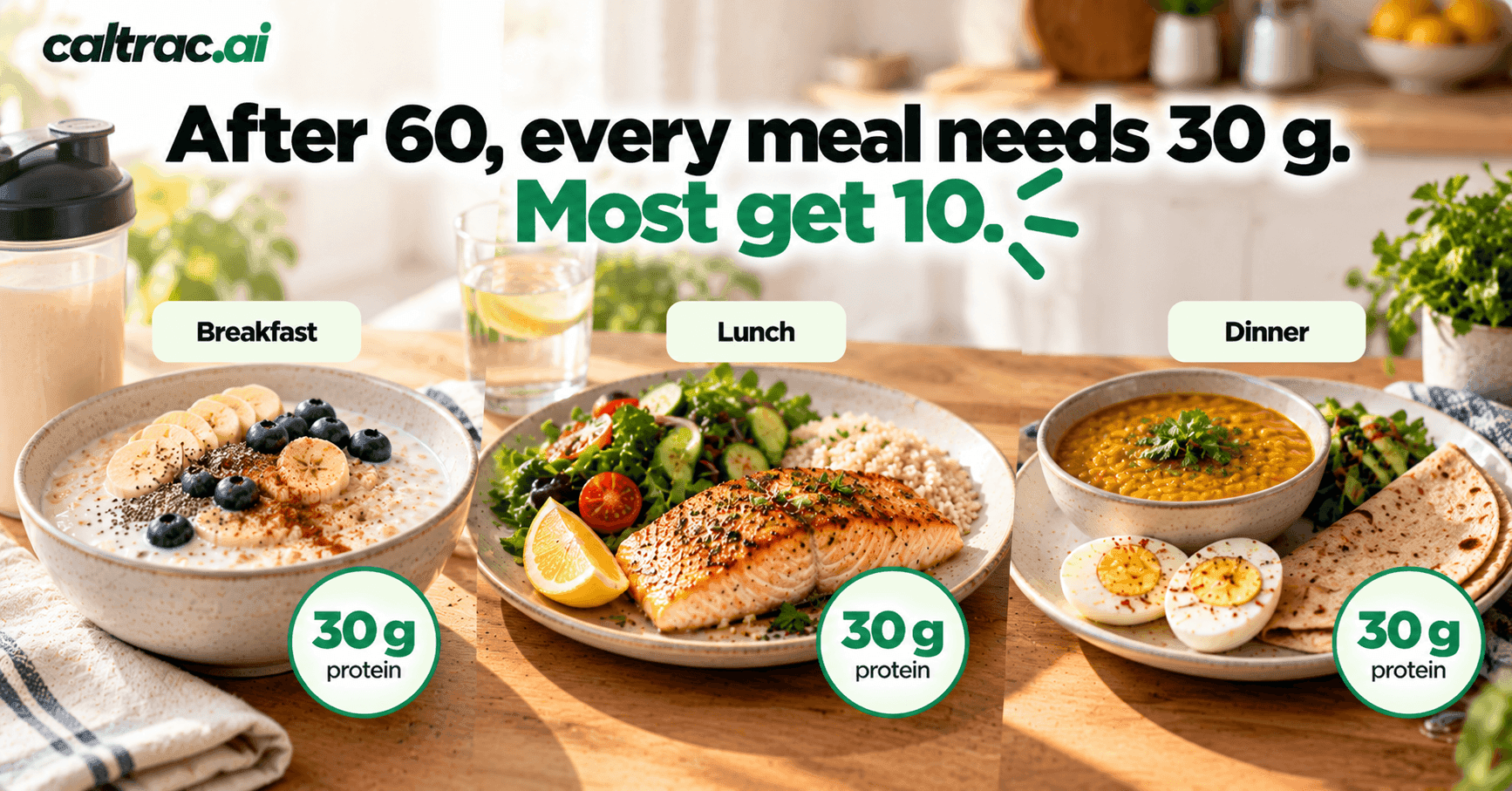
Older muscle is less sensitive to protein. In a study comparing men around 71 with men around 22, the dose of protein that maximally stimulated muscle protein synthesis was 0.40 g per kilogram of body weight in the older men against 0.24 g in the younger [7]. The older muscle needed two-thirds more protein to get the same response. Below about 20 g in a meal, the response in older people is blunted; around 25 to 30 g per meal is the dose that maximises it [8].
That has a direct consequence. A 70-year-old eating 60 g of protein a day as 10 g at breakfast, 20 g at lunch and 30 g at dinner gets a muscle-building response from one meal. The same 60 g as 20, 20 and 20 gets a response from none of them. The target is 30 g per meal, which for a 75 kg person is 0.4 g/kg [7].
The consequences of not reaching it are visible over years. In 2,066 adults aged 70 to 79 followed for three years, those in the highest fifth of protein intake lost about 40% less lean mass than those in the lowest fifth [9]. Sarcopenia is now defined by the European consensus as a muscle disease rooted in adverse changes accruing across a lifetime, with low muscle strength as its key characteristic [10]; protein and resistance training are the two things that act on it.
Protein Alone Is Half the Answer
Protein feeds muscle; resistance training tells it what to do with the food. Across 22 randomised trials of resistance training lasting six weeks or more, adding protein increased lean mass gains by 0.69 kg and leg-press strength by 13.5 kg compared with training alone, in both younger and older participants [11]. Both expert groups pair their protein recommendation with daily physical activity or exercise [1] [2].
Two or three sessions a week of basic strength work, a sit-to-stand, a step-up, a push against a wall or a weight, a row with a band, progressing as it gets easier, is enough to make the protein count. Walking is good for the heart and does little for muscle.
Reaching 90 g on a Smaller Appetite
The obstacle is practical. Older adults eat less, and the traditional breakfast and lunch, toast and tea, soup and a roll, dal and rice, carry 5 to 15 g of protein each. The fixes, in order of effectiveness:
- Make breakfast a protein meal. It is the meal furthest from 30 g for almost everyone. Greek yogurt, eggs, cottage cheese or milk with whey get it there.
- Use protein-dense foods. Per 100 kcal, nonfat Greek yogurt carries 17.6 g of protein, egg whites 21 g, cod 18 g, chicken breast 19 g, cottage cheese 13 g, tofu 12 g; dal carries 6 g and bread 5 g [12] [13] [14] [15] [16] [17] [18] [19]. When appetite is the limit, protein per calorie is the number to maximise.
- Add protein to what you already eat. Two egg whites in the dal, milk instead of water in the oats, a scoop of whey in the morning tea or milk, Greek yogurt instead of curd. Each adds 7 to 17 g without adding a dish.
- Eat protein first at each meal. Fullness arrives before the plate is finished; the protein should already be eaten.
- Use whey or milk protein as a food, not a supplement. Thirty grams of whey isolate is 108 kcal and 17 g of protein [20], dissolves in milk, coffee or oats, and is the simplest way to lift a 15 g meal to 30 g for someone who cannot eat more volume.
A Day at 1,550 Calories and 125 g of Protein
Built from USDA data for a 75 kg adult, 1.5 g/kg:
| Meal | Food | Calories | Protein |
|---|---|---|---|
| Breakfast | 40 g oats cooked in 250 ml skim milk, 20 g whey stirred in, 100 g banana [21] [22] [20] [23] | 406 | 27 g |
| Lunch | 150 g grilled cod or 120 g chicken breast, 100 g rice, 150 g vegetables (counted at 40 kcal), 1 tsp oil [14] [15] [24] [25] | 372 | 32 g |
| Snack | 200 g nonfat Greek yogurt with cinnamon [12] | 108 | 19 g |
| Dinner | 200 g dal with 2 egg whites stirred in, 1 slice whole-wheat bread or 1 roti, 150 g broccoli, 1 tsp oil [18] [13] [19] [26] [25] | 491 | 32 g |
| Evening | 250 ml skim milk, 1 boiled egg [22] [27] | 171 | 15 g |
| Total | 1,548 | 125 g |
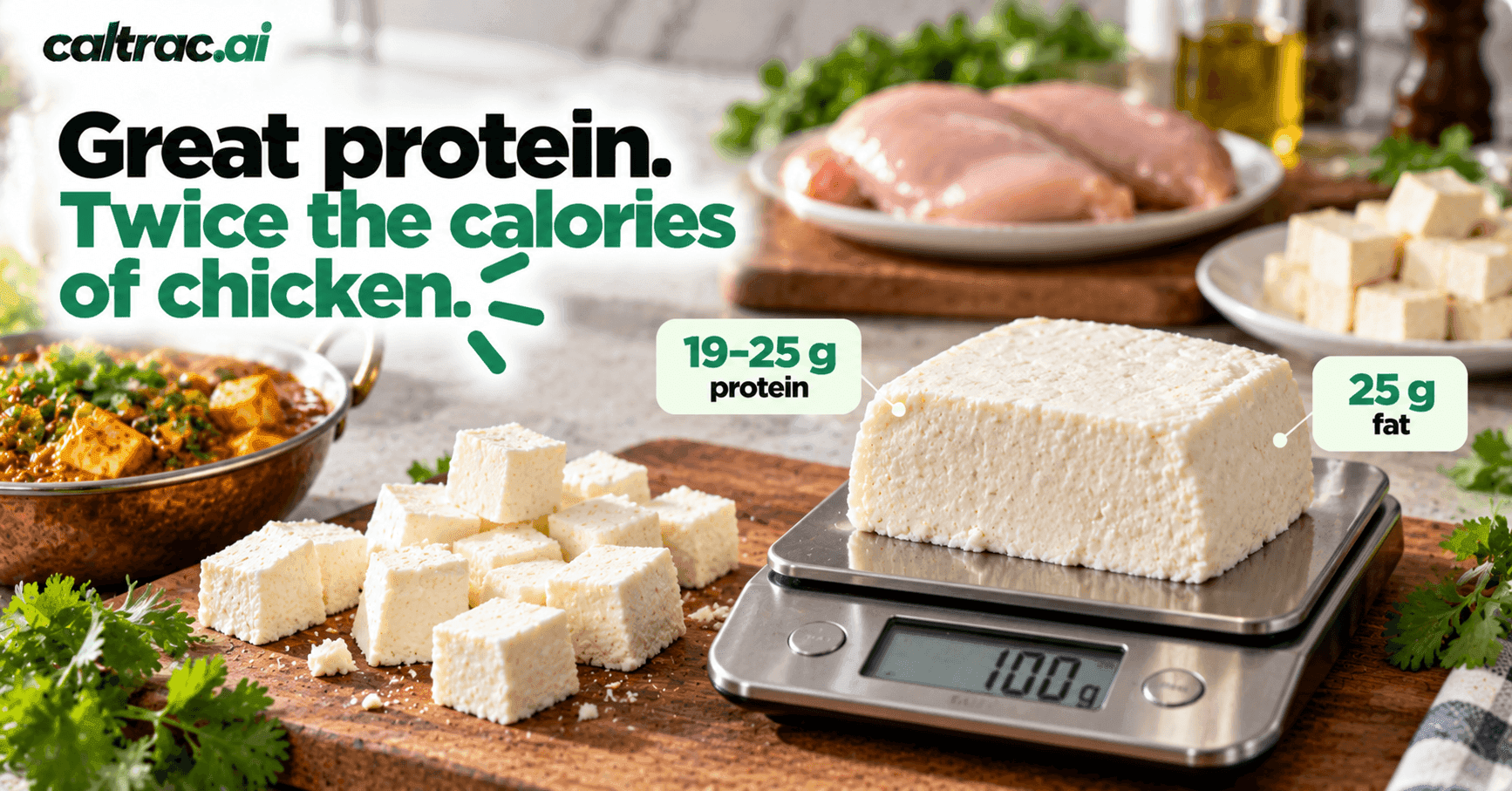
That lands at 1,550 kcal with 125 g of protein, 1.7 g/kg, and leaves 250 kcal for fruit, a second roti or a small dessert while staying at 1.5 g/kg or above. For a vegetarian, 100 g of paneer (321 kcal, 25 g) [28], 150 g of tofu (216 kcal, 26 g) [17] or 40 g of dry soya chunks (138 kcal, 21 g) [29] replaces the fish or chicken at lunch with no loss of protein.
Four of the five eating occasions carry 27 to 32 g, which is the per-meal dose older muscle needs [7] [8]; the fifth tops the day up.
Protein and Weight After 60
Many people over 60 are also trying to lose weight, and the two goals conflict only if protein is low. A moderate deficit of 500 kcal [30] with protein at 1.2 to 1.5 g/kg loses fat while protecting lean mass [5]; the same deficit at 0.8 g/kg loses muscle with it, and lost muscle after 60 is hard to get back. The protein target does not fall when calories do; if anything, it should rise as a share of the plate. Find your maintenance with the BMR calculator, set a modest deficit in the calorie calculator, and set the protein slider in the macro calculator toward the higher end.
That is where tracking earns its keep. The protein problem after 60 is a per-meal problem, and no one can feel the difference between a 15 g lunch and a 30 g one. Snap a photo of the plate or type "200 g dal, 2 egg whites, 1 roti" and track it automatically with Caltrac. You will see the protein in each meal against the 30 g line, and your Apple Health-powered net calorie count keeps the deficit modest enough to spare muscle. Eat the protein; let the app check every meal.
Frequently Asked Questions
How much protein should a 65 year old eat per day? At least 1.0 to 1.2 g per kilogram of body weight, 1.2 g/kg or more if exercising, and 1.2 to 1.5 g/kg during illness, according to the PROT-AGE and ESPEN expert groups [1] [2]. For 75 kg that is 75 to 112 g.
Why do older adults need more protein? Older muscle needs about 0.40 g/kg of protein in a meal to respond maximally, against 0.24 g/kg in young adults [7], and higher intake was associated with 40% less lean mass loss over three years [9].
How much protein per meal after 60? About 25 to 30 g, roughly 0.4 g/kg; below about 20 g the muscle response is blunted in older people [8] [7].
Is too much protein bad for older kidneys? In healthy adults, higher-protein diets did not change kidney function across 28 trials [6], and expert reviews consider the concern unfounded in healthy people [3] [4]. People with kidney disease should follow medical advice [1].
What are the best protein foods for seniors? Protein-dense, easy-to-eat foods: Greek yogurt, eggs and egg whites, milk, cottage cheese, fish, chicken, paneer, tofu, dal with egg whites added, and whey stirred into oats or milk [12] [27] [14] [28] [20].
Does protein help build muscle after 60 without exercise? It slows loss [9], but gains need resistance training: protein added 0.69 kg of lean mass and 13.5 kg of leg strength to training results across 22 trials [11].
References
- Bauer J, et al. Evidence-based recommendations for optimal dietary protein intake in older people: a position paper from the PROT-AGE Study Group. Journal of the American Medical Directors Association. 2013;14(8):542-559. pubmed.ncbi.nlm.nih.gov
- Deutz NE, et al. Protein intake and exercise for optimal muscle function with aging: recommendations from the ESPEN Expert Group. Clinical Nutrition. 2014;33(6):929-936. pubmed.ncbi.nlm.nih.gov
- Traylor DA, Gorissen SHM, Phillips SM. Perspective: Protein Requirements and Optimal Intakes in Aging: Are We Ready to Recommend More Than the Recommended Daily Allowance? Advances in Nutrition. 2018;9(3):171-182. pubmed.ncbi.nlm.nih.gov
- Wolfe RR, Miller SL, Miller KB. Optimal protein intake in the elderly. Clinical Nutrition. 2008;27(5):675-684. pubmed.ncbi.nlm.nih.gov
- Leidy HJ, et al. The role of protein in weight loss and maintenance. American Journal of Clinical Nutrition. 2015;101(6):1320S-1329S. pubmed.ncbi.nlm.nih.gov
- Devries MC, et al. Changes in Kidney Function Do Not Differ between Healthy Adults Consuming Higher- Compared with Lower- or Normal-Protein Diets: A Systematic Review and Meta-Analysis. Journal of Nutrition. 2018;148(11):1760-1775. pubmed.ncbi.nlm.nih.gov
- Moore DR, et al. Protein ingestion to stimulate myofibrillar protein synthesis requires greater relative protein intakes in healthy older versus younger men. Journals of Gerontology Series A. 2015;70(1):57-62. pubmed.ncbi.nlm.nih.gov
- Paddon-Jones D, Rasmussen BB. Dietary protein recommendations and the prevention of sarcopenia. Current Opinion in Clinical Nutrition and Metabolic Care. 2009;12(1):86-90. pubmed.ncbi.nlm.nih.gov
- Houston DK, et al. Dietary protein intake is associated with lean mass change in older, community-dwelling adults: the Health, Aging, and Body Composition (Health ABC) Study. American Journal of Clinical Nutrition. 2008;87(1):150-155. pubmed.ncbi.nlm.nih.gov
- Cruz-Jentoft AJ, et al. Sarcopenia: revised European consensus on definition and diagnosis. Age and Ageing. 2019;48(1):16-31. pubmed.ncbi.nlm.nih.gov
- Cermak NM, Res PT, de Groot LC, Saris WH, van Loon LJ. Protein supplementation augments the adaptive response of skeletal muscle to resistance-type exercise training: a meta-analysis. American Journal of Clinical Nutrition. 2012;96(6):1454-1464. pubmed.ncbi.nlm.nih.gov
- USDA FoodData Central. Yogurt, Greek, nonfat, plain: 54 kcal, 9.5 g protein per 100 g. SR Legacy 171312. fdc.nal.usda.gov
- USDA FoodData Central. Egg, white, raw: 52 kcal, 10.9 g protein per 100 g. SR Legacy 172183. fdc.nal.usda.gov
- USDA FoodData Central, FNDDS. Fish, cod, grilled: 108 kcal, 19.4 g protein per 100 g. FDC ID 2706242. fdc.nal.usda.gov
- USDA FoodData Central. Chicken breast, meat only, roasted: 165 kcal, 31 g protein per 100 g. SR Legacy 171477. fdc.nal.usda.gov
- USDA FoodData Central. Cheese, cottage, 2% milkfat: 81 kcal, 10.4 g protein per 100 g. SR Legacy 172182. fdc.nal.usda.gov
- USDA FoodData Central. Tofu, firm: 144 kcal, 17.3 g protein per 100 g. SR Legacy 172475. fdc.nal.usda.gov
- USDA FoodData Central, FNDDS. Dal (as prepared): 145 kcal, 8.6 g protein, 7.5 g fibre per 100 g; 1 cup 240 g. FDC ID 2707427. fdc.nal.usda.gov
- USDA FoodData Central. Bread, whole-wheat: 252 kcal, 12.4 g protein per 100 g; 1 slice about 30 g. SR Legacy 172688. fdc.nal.usda.gov
- USDA FoodData Central. Beverages, whey protein powder isolate: 359 kcal, 58.1 g protein per 100 g. SR Legacy 173177. fdc.nal.usda.gov
- USDA FoodData Central. Cereals, oats, dry: 379 kcal, 13.2 g protein, 10.1 g fibre per 100 g. SR Legacy 173904. fdc.nal.usda.gov
- USDA FoodData Central. Milk, nonfat (skim): 37 kcal, 3.6 g protein per 100 g. SR Legacy 171270. fdc.nal.usda.gov
- USDA FoodData Central. Bananas, raw: 89 kcal per 100 g. SR Legacy 173944. fdc.nal.usda.gov
- USDA FoodData Central. Rice, white, long-grain, cooked: 130 kcal, 2.7 g protein per 100 g. SR Legacy 168878. fdc.nal.usda.gov
- USDA FoodData Central. Oil, olive: 884 kcal per 100 g; 1 teaspoon about 4.5 g, 40 kcal. SR Legacy 171413. fdc.nal.usda.gov
- USDA FoodData Central. Broccoli, raw: 34 kcal, 2.8 g protein per 100 g. SR Legacy 170379. fdc.nal.usda.gov
- USDA FoodData Central. Egg, whole, hard-boiled: 155 kcal, 12.6 g protein per 100 g; 1 large 50 g. SR Legacy 173424. fdc.nal.usda.gov
- USDA FoodData Central, Branded. Karoun Dairies Paneer: 321 kcal, 25 g protein per 100 g. FDC ID 2429587. fdc.nal.usda.gov
- Nutrela soya chunks pack nutritional facts per 100 g dry (345 kcal, 52 g protein), as reproduced in a retailer listing. thedesifood.com
- Jensen MD, et al. 2013 AHA/ACC/TOS guideline for the management of overweight and obesity in adults. Circulation. 2014;129(25 Suppl 2):S102-S138. pubmed.ncbi.nlm.nih.gov