



Losing weight is a project with an end date. Keeping it off is the rest of your life, and it is the part most people fail. About 20% of people who lose a meaningful amount of weight keep at least 10% of it off for a year [1]. The reason is not that they stop trying. It is that the body they finished the diet in is not the body they started with: it burns fewer calories, it is hungrier, and the number they need to eat to stay put is lower than the arithmetic suggests. Maintenance calories are a moving target, and this article explains how to find yours, why it is lower than you expect, and what the people who succeed actually do.
What "Maintenance Calories" Means
Maintenance calories are the daily intake at which your weight stays stable: your total daily energy expenditure, or TDEE. Caltrac's free calorie calculator estimates it from the Mifflin-St Jeor equation [2] and your activity level, and shows the maintenance figure alongside the weight-loss target. For someone who has never dieted, that estimate is a good starting point. For someone who has just lost 10 kg, it is probably too high, for three reasons.
Why Maintenance Is Lower After a Diet
1. You are smaller. A lighter body costs less to run. This is the obvious part, and the calculator captures it when you enter your new weight. Half of the weight response to any calorie change arrives within about a year, and expenditure keeps falling as weight does [3].
2. Your body has adapted beyond that. Maintaining a loss of 10% or more of body weight is accompanied by a reduction in energy expenditure about 10 to 15% greater than the loss of tissue alone predicts [4]. In the extreme case, Biggest Loser contestants six years after losing an average of 58 kg had resting metabolisms about 500 kcal/day lower than their body size predicted [5]. For an ordinary 10 kg loss the adaptation is far smaller, but it is real: the calculator's estimate for a 75 kg person who used to weigh 85 is a little generous.
3. You are hungrier than you were. A year after losing 13.5 kg, people's levels of the hunger hormone ghrelin were still elevated and the fullness hormones leptin, PYY and CCK still suppressed, along with their reported hunger [6]. The reduced-weight state is, physiologically, a state of mild and persistent deprivation [7]. Maintenance is harder than losing not because the maths changes but because the appetite does.
How to Find Your Real Maintenance Number
The equation gets you close; the scale gets you exact. Here is the process that works.
- Run the calculator at your new weight and take the maintenance figure. Treat it as a ceiling, not a target.
- Start at that figure minus 100 to 150 kcal to allow for adaptive thermogenesis [4].
- Weigh daily and average weekly. Weight follows a weekly rhythm, highest after the weekend and lowest mid-week [8], so a single day tells you nothing; a seven-day average tells you almost everything. Daily weighers also simply do better: in a six-month trial they lost 6.1 kg more than less frequent weighers and adopted more weight-control behaviours [9].
- Adjust by 100 kcal every two weeks. If the weekly average is rising, subtract 100; if it is falling and you want to hold, add 100. After six to eight weeks you will have a measured maintenance figure that no equation could have given you.
- Expect it to rise slowly. As the body settles and, if you train, as muscle returns, maintenance drifts upward over months. Keep adjusting.
Should You "Reverse Diet"?
Reverse dieting, adding calories back in small weekly steps after a diet, has a logic to it: it avoids the overshoot that comes from jumping straight to a calculated maintenance figure that is too high. The step-by-step process above is a reverse diet in all but name. What the evidence does not support is the stronger claim that slowly adding calories repairs metabolism or lets you eat more than your new body size warrants. Metabolic adaptation reflects the energy deficit and the smaller body [10]; it eases as you move to maintenance, but it does not reverse into a bonus.
The trial evidence on diet breaks is mixed in an informative way. In the MATADOR trial, men who alternated two weeks of dieting with two weeks at maintenance lost more weight (14.1 versus 9.1 kg) and showed less metabolic adaptation than men who dieted continuously [11]. In the ICECAP trial of resistance-trained adults, one-week breaks every three weeks produced the same fat loss as continuous dieting, with no metabolic advantage but lower hunger [12]. Breaks do not hurt and may help adherence; they are not a metabolic trick.
What the People Who Keep It Off Actually Do
The National Weight Control Registry tracks thousands of people who have lost at least 13.6 kg and kept it off for more than a year. Its members lost an average of 33 kg and have maintained for more than five years, and their habits are strikingly consistent: about an hour a day of physical activity, a lower-calorie, lower-fat diet, eating breakfast, regular self-weighing, and eating the same way on weekdays and weekends [1]. At ten years, 87% of 2,886 members were still maintaining at least a 10% loss, with an average of 23 kg kept off, and the ones who regained were those who cut activity, weighed less often, and let dietary restraint slip [13]. The same review notes the encouraging part: after two to five years of maintenance, the odds of long-term success rise sharply [1].
Three of those habits deserve emphasis.
Movement. Exercise is a weak tool for losing weight and a strong one for keeping it off. In a Danish trial, after a 13 kg diet-induced loss, people randomised to a supervised exercise programme kept off 4.1 kg more than placebo over a year; combined with medication, 9.5 kg more [14]. Part of the mechanism is simply that activity raises the maintenance number, even allowing for the roughly 28% of exercise calories the body compensates for [15].
Protein. Higher-protein diets preserve lean mass and resting expenditure during loss [16] and improve appetite control at 1.2 to 1.6 g per kilogram [17], which is exactly the problem maintenance presents. Keep protein where it was during the diet; set it with the macro calculator.
Consistency. The registry members eat the same way on Saturdays as on Tuesdays [1]. The weekend rhythm in body weight [8] is where most maintenance quietly fails.
Does How Fast You Lost Matter?
Less than feared. In a trial that randomised 200 people to lose the same amount of weight over 12 weeks or 36 weeks, both groups had regained about 71% of it three years later; the rate of loss did not affect regain [18]. The determinants of maintenance are what you do afterwards, not how quickly you got there.
One important exception: weight lost with medication. When semaglutide was stopped after 68 weeks, people regained two-thirds of their lost weight within a year [19]. The maintenance habits above have to be in place before the prescription ends.
A Maintenance Plan
- Recalculate maintenance with the calorie calculator at your new weight; start 100 to 150 kcal below it.
- Hold protein at 1.2 to 1.6 g/kg [17].
- Weigh daily, read the weekly average, adjust by 100 kcal every two weeks [9].
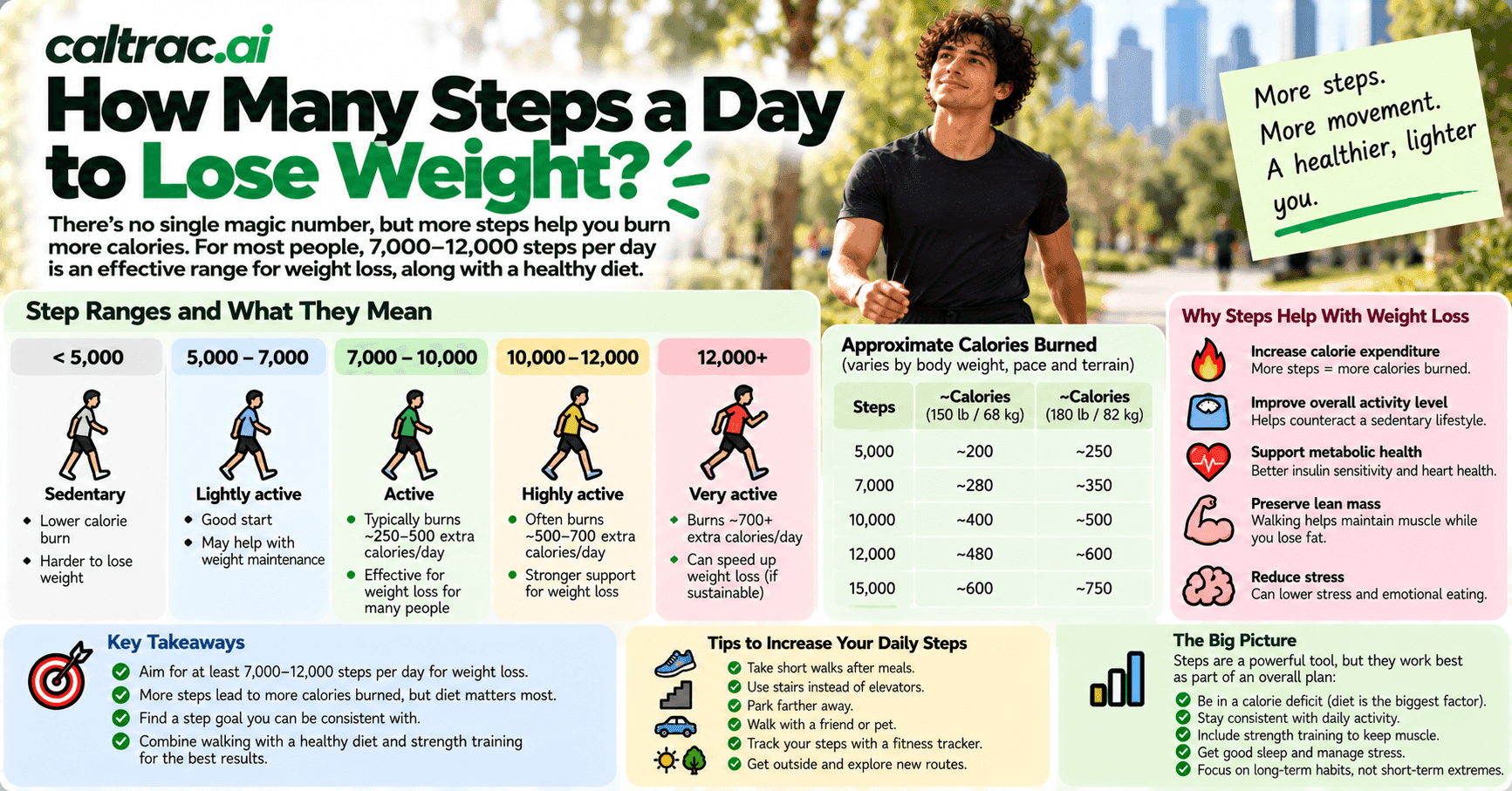
- Keep an hour of daily activity, mostly walking [1].
- Eat the same way seven days a week [8].
- Set a trigger weight, 2 kg above your maintenance average, at which you return to a short deficit. The registry data say the people who act on small regains are the ones still maintaining a decade later [13].
That is where tracking earns its keep. The dieters who keep weight off are the ones who keep measuring, and maintenance is when logging gets boring. Snap a photo of your plate or type what you ate and track it automatically with Caltrac. You will see intake against your measured maintenance figure, and your Apple Health-powered net calorie count shows whether the hour of walking happened. Find the number; let the app help you hold it.
Frequently Asked Questions
How do I calculate my maintenance calories? Start with the Mifflin-St Jeor estimate and your activity level from the calorie calculator [2], then refine it against two to three weeks of daily weigh-ins averaged weekly [8].
Why are my maintenance calories lower after losing weight? A smaller body burns less, and the body adapts a further 10 to 15% beyond that [4] [3]. Appetite also stays elevated for at least a year [6].
What is reverse dieting and does it work? Adding calories back gradually after a diet. It is a sensible way to find real maintenance without overshooting; it does not repair or boost metabolism beyond what your body size warrants [10].
How much weight do people regain after dieting? Most people regain much of it; in one trial about 71% within three years regardless of how fast it was lost [18]. Among registry members who maintain a year, 87% are still maintaining at ten years [13].
What is the best way to maintain weight loss? About an hour of daily activity, a consistent eating pattern across the week, regular self-weighing, breakfast and adequate protein are the habits common to long-term maintainers [1] [17].
Do diet breaks help? They did in one trial of continuous versus intermittent dieting [11] and did not in another [12]. They reliably reduce hunger and do not hurt; treat them as an adherence tool.
References
- Wing RR, Phelan S. Long-term weight loss maintenance. American Journal of Clinical Nutrition. 2005;82(1 Suppl):222S-225S. pubmed.ncbi.nlm.nih.gov
- Mifflin MD, et al. A new predictive equation for resting energy expenditure in healthy individuals. American Journal of Clinical Nutrition. 1990;51(2):241-247. pubmed.ncbi.nlm.nih.gov
- Hall KD, et al. Quantification of the effect of energy imbalance on bodyweight. Lancet. 2011;378(9793):826-837. pubmed.ncbi.nlm.nih.gov
- Rosenbaum M, Leibel RL. Adaptive thermogenesis in humans. International Journal of Obesity. 2010;34 Suppl 1:S47-S55. pubmed.ncbi.nlm.nih.gov
- Fothergill E, et al. Persistent metabolic adaptation 6 years after "The Biggest Loser" competition. Obesity. 2016;24(8):1612-1619. pubmed.ncbi.nlm.nih.gov
- Sumithran P, et al. Long-term persistence of hormonal adaptations to weight loss. New England Journal of Medicine. 2011;365(17):1597-1604. pubmed.ncbi.nlm.nih.gov
- Anastasiou CA, Karfopoulou E, Yannakoulia M. Weight regaining: From statistics and behaviors to physiology and metabolism. Metabolism. 2015;64(11):1395-1407. pubmed.ncbi.nlm.nih.gov
- Orsama AL, et al. Weight rhythms: weight increases during weekends and decreases during weekdays. Obesity Facts. 2014;7(1):36-47. pubmed.ncbi.nlm.nih.gov
- Steinberg DM, Bennett GG, Askew S, Tate DF. Weighing every day matters: daily weighing improves weight loss and adoption of weight control behaviors. Journal of the Academy of Nutrition and Dietetics. 2015;115(4):511-518. pubmed.ncbi.nlm.nih.gov
- Trexler ET, Smith-Ryan AE, Norton LE. Metabolic adaptation to weight loss: implications for the athlete. Journal of the International Society of Sports Nutrition. 2014;11:7. pubmed.ncbi.nlm.nih.gov
- Byrne NM, Sainsbury A, King NA, Hills AP, Wood RE. Intermittent energy restriction improves weight loss efficiency in obese men: the MATADOR study. International Journal of Obesity. 2018;42(2):129-138. pubmed.ncbi.nlm.nih.gov
- Peos JJ, et al. Continuous versus Intermittent Dieting for Fat Loss and Fat-Free Mass Retention in Resistance-trained Adults: The ICECAP Trial. Medicine & Science in Sports & Exercise. 2021;53(8):1685-1698. pubmed.ncbi.nlm.nih.gov
- Thomas JG, Bond DS, Phelan S, Hill JO, Wing RR. Weight-loss maintenance for 10 years in the National Weight Control Registry. American Journal of Preventive Medicine. 2014;46(1):17-23. pubmed.ncbi.nlm.nih.gov
- Lundgren JR, et al. Healthy Weight Loss Maintenance with Exercise, Liraglutide, or Both Combined. New England Journal of Medicine. 2021;384(18):1719-1730. pubmed.ncbi.nlm.nih.gov
- Careau V, et al. Energy compensation and adiposity in humans. Current Biology. 2021;31(20):4659-4666. pubmed.ncbi.nlm.nih.gov
- Wycherley TP, et al. Effects of energy-restricted high-protein, low-fat compared with standard-protein, low-fat diets: a meta-analysis of randomized controlled trials. American Journal of Clinical Nutrition. 2012;96(6):1281-1298. pubmed.ncbi.nlm.nih.gov
- Leidy HJ, et al. The role of protein in weight loss and maintenance. American Journal of Clinical Nutrition. 2015;101(6):1320S-1329S. pubmed.ncbi.nlm.nih.gov
- Purcell K, et al. The effect of rate of weight loss on long-term weight management: a randomised controlled trial. Lancet Diabetes & Endocrinology. 2014;2(12):954-962. pubmed.ncbi.nlm.nih.gov
- Wilding JPH, et al. Weight regain and cardiometabolic effects after withdrawal of semaglutide: The STEP 1 trial extension. Diabetes, Obesity and Metabolism. 2022;24(8):1553-1564. pubmed.ncbi.nlm.nih.gov