


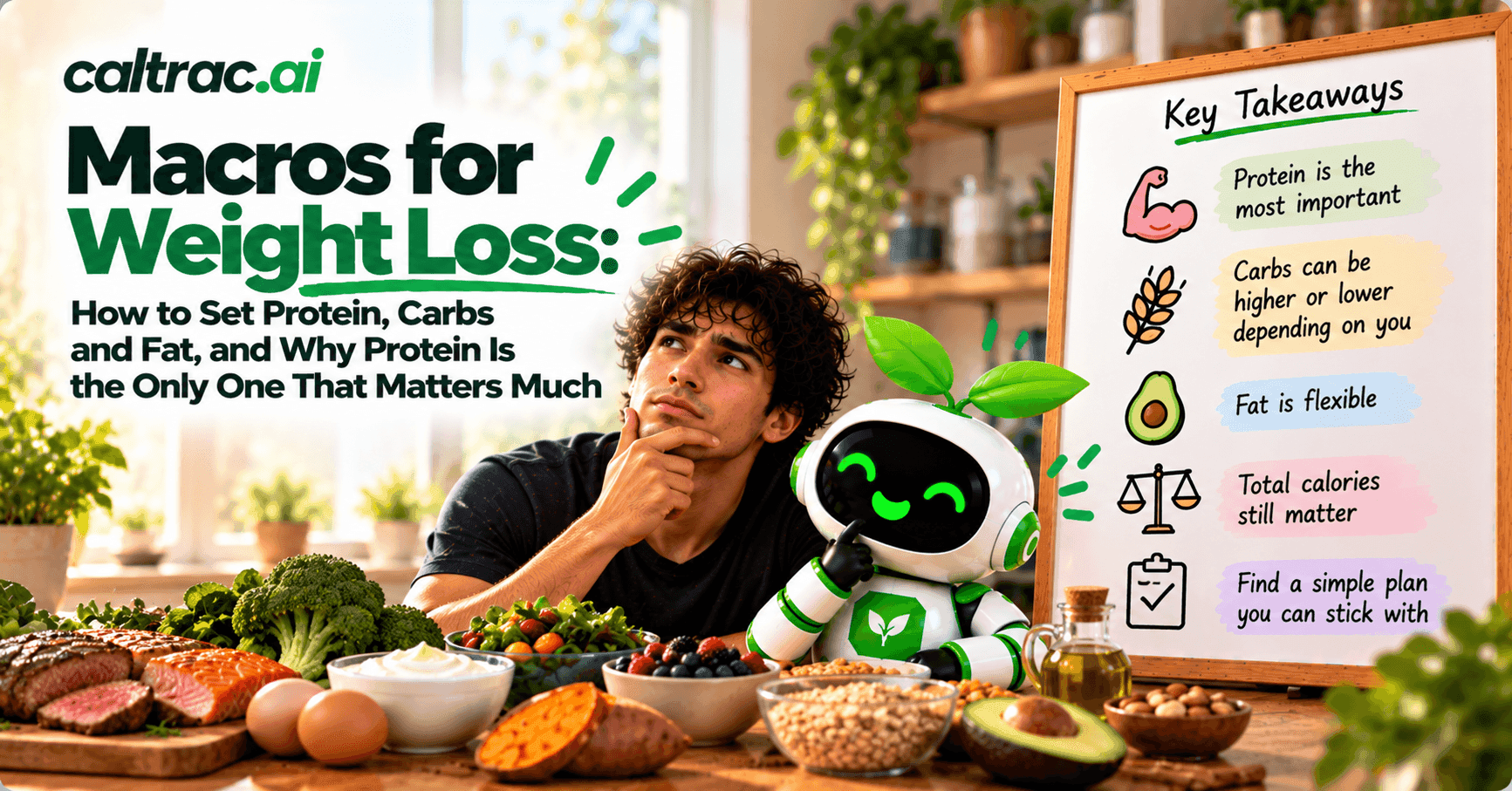
"What should my macros be?" is the question that launched a thousand spreadsheets, and the research gives a clearer answer than the spreadsheets do: for weight loss, protein is the macro that matters, fat has a floor, and the carbohydrate-versus-fat split is largely a matter of preference. Once calories are set, protein decides how much of the weight you lose is fat, how hungry you are while losing it, and how much muscle you keep. The rest is adherence.
This article explains how to set each macronutrient, in order of importance, with the evidence for each decision. Caltrac's free macro calculator does the arithmetic from your weight, goal and activity level; this is the reasoning behind its defaults.
Quick Answer: Macros for Weight Loss
- Calories first. Maintenance minus 500 to 750 kcal [1]. Everything below is a split of that number.
- Protein: 1.6 to 2.2 g per kg of body weight (1.2 to 1.6 g/kg if you do not train). For a 75 kg person, 120 to 165 g a day [2] [3].
- Fat: 25 to 35% of calories, never below about 20%. Saturated fat under 10% of calories [4].
- Carbohydrate: whatever is left. Spend it on fibre-rich sources; 25 to 38 g of fibre a day.
- The low-fat versus low-carb question does not change weight loss in trials [5] [6]. Pick the split you will stick to.
Step 1: Calories Decide Whether You Lose Weight
Macros are a division of calories, not a substitute for them. In the largest macronutrient trial ever run, 811 adults were assigned to four diets with fat from 20 to 40%, protein from 15 to 25% and carbohydrate from 35 to 65% of calories. Every group lost about 6 kg at six months and 3 to 4 kg at two years, with no difference between them [6]. Set the calorie target with the calorie calculator, then split it.
Step 2: Protein Decides What You Lose
Protein is the one macronutrient where the research is decisive, for three reasons.
It protects muscle in a deficit. A meta-analysis of 24 calorie-restricted trials found higher-protein diets produced more fat loss and preserved 0.43 kg more fat-free mass and about 140 kcal/day more resting energy expenditure than standard-protein diets [7]. In a severe 40% deficit with training, men on 2.4 g/kg gained 1.2 kg of lean mass while losing 4.8 kg of fat; those on 1.2 g/kg gained almost no lean mass and lost less fat [8].
It reduces hunger. Protein is the most satiating macronutrient, and intakes of 1.2 to 1.6 g/kg with 25 to 30 g per meal improve appetite control and weight management [3].
It costs calories to digest. Diet-induced thermogenesis is highest for protein [9], so a high-protein split produces a slightly larger real deficit than the arithmetic shows.
How much. For people who train, 1.6 g/kg is where muscle-building benefit plateaus in a 49-study meta-analysis, with 2.2 g/kg as the upper figure used in distribution guidance [2] [10]. During a deficit, erring high is safer than low. For people who do not train, 1.2 to 1.6 g/kg covers the appetite and lean-mass benefits [3]. All of this is well above the 0.8 g/kg RDA, which was designed as a minimum to prevent deficiency, not an optimum [11].
In the calculator. The protein slider on the macro calculator runs from 1.2 to 2.4 g/kg. Set 1.2 to 1.6 for general health and weight loss without training, and 1.6 to 2.2 if you are losing weight while training or building muscle. Split the daily figure across at least four meals of about 0.4 g/kg each [10].
Step 3: Fat Has a Floor and a Quality Rule
Fat is essential for hormone production, absorption of fat-soluble vitamins and the structure of every cell, and diets that cut it too far become unpleasant and hard to sustain. The practical range is 25 to 35% of calories, and dropping below about 20% rarely helps and often costs adherence.
The WHO recommends total fat below 30% of energy and saturated fat below 10% [4]. The second number matters more than the first: replacing saturated fat with unsaturated fat reduced cardiovascular events by about 21% across 15 trials, with small reductions in weight [12]. For weight loss alone, the fat percentage is not decisive; in a meta-analysis of 32 controlled feeding studies, lower-fat diets produced slightly greater fat loss than lower-carb diets at equal calories, by 16 g a day, a difference too small to matter in practice [13].
In the calculator. The fat setting defaults to 30% of calories. Go to 25% if you prefer more carbohydrate for training; go to 35% if you prefer fewer, larger fat-based meals. Neither choice changes the outcome.
Step 4: Carbohydrate Is What Is Left
Once protein and fat are set, carbohydrate fills the remaining calories. For a 75 kg person at 1,800 kcal with protein at 1.8 g/kg (135 g, 540 kcal) and fat at 30% (60 g, 540 kcal), carbohydrate is 720 kcal, or 180 g.
The amount matters less than people think. The DIETFITS trial randomised 609 adults to a healthy low-fat or healthy low-carb diet for a year, ending at 48% versus 30% carbohydrate. Weight loss was 5.3 versus 6.0 kg, not significantly different, and neither genotype nor insulin secretion predicted which diet suited whom [5]. A network meta-analysis of 121 trials and 14 named diets found low-carb and low-fat patterns produced near-identical loss at six months and that the differences between them had largely gone by twelve [14]. Even a ketogenic diet, tested in a metabolic ward at equal calories, raised energy expenditure by only about 57 kcal a day and slowed fat loss slightly [15].
What does matter is quality. Fibre intake was the strongest predictor of weight loss and adherence in a six-month calorie-restriction trial, independent of macronutrients [16], and intakes of 25 to 29 g a day are associated with 15 to 30% lower mortality [17]. Spend the carbohydrate budget on pulses, whole grains, fruit and vegetables and the fibre target takes care of itself.
Worked Examples
Using the macro calculator defaults with a 500 kcal deficit:
| Person | Calories | Protein | Fat | Carbohydrate |
|---|---|---|---|---|
| 65 kg woman, office job, walks, losing weight, no training | 1,450 kcal | 1.4 g/kg = 91 g (364 kcal) | 30% = 48 g (435 kcal) | 163 g (651 kcal) |
| 75 kg man, trains 3 times a week, losing weight | 1,900 kcal | 1.8 g/kg = 135 g (540 kcal) | 30% = 63 g (570 kcal) | 198 g (790 kcal) |
| 90 kg man, on a GLP-1 medication, low appetite | 1,400 kcal | 1.4 g/kg = 126 g (504 kcal) | 30% = 47 g (420 kcal) | 119 g (476 kcal) |
| 60 kg woman, strength training, aggressive fat loss | 1,350 kcal | 2.2 g/kg = 132 g (528 kcal) | 30% = 45 g (405 kcal) | 104 g (417 kcal) |
Notice what the table does and does not do. Protein ranges from 25% to 39% of calories depending on body weight and goal, because it is set per kilogram, not as a percentage. Fat holds at 30%. Carbohydrate absorbs the difference. The percentages people argue about, 40/30/30 or 50/25/25, are outputs of this process, not inputs to it.
Three Mistakes to Avoid
Setting protein as a percentage. Thirty percent protein on a 1,300 kcal diet is 98 g, which may be fine for a 60 kg woman and too little for a 90 kg man. Grams per kilogram of body weight is the only unit that scales [2].
Cutting fat below 20% to make room for carbs. It rarely improves anything and makes food worse. Hormones, vitamins and satiety all need fat.
Treating the split as a rule rather than a budget. Rigid, all-or-nothing dietary control is associated with higher body weight and more binge eating than flexible control across more than 54,000 people [18]. Hit protein daily, keep calories close, and let carbohydrate and fat swap with each other as meals dictate.
That is where tracking earns its keep. Snap a photo of your plate or type what you ate and track it automatically with Caltrac. You will see protein, carbohydrate and fat logged against the targets you set in the calculator, and your Apple Health-powered net calorie count shows the deficit the macros sit inside. Set the protein; let the app balance the rest.
Frequently Asked Questions
What should my macros be to lose weight? Protein at 1.6 to 2.2 g per kilogram of body weight if you train, 1.2 to 1.6 if you do not [2] [3]; fat at 25 to 35% of calories; carbohydrate as the remainder, inside a 500 to 750 kcal deficit [1].
Is 40/30/30 a good macro split for weight loss? It is fine for some people and wrong for others, because protein should be set in grams per kilogram, not as a percentage. For a 60 kg woman at 1,400 kcal, 30% protein is 105 g, about 1.75 g/kg, a reasonable target; for a 100 kg man at 2,000 kcal it is 150 g, 1.5 g/kg, on the low side.
Low-carb or low-fat for weight loss? Neither wins. In the DIETFITS trial the difference was 0.7 kg over a year and not significant [5]; across 121 trials the two patterns converge by twelve months [14]. Choose by preference.
How much protein should I eat to lose fat and keep muscle? About 1.6 to 2.2 g/kg per day, with the higher end for larger deficits and training [2] [8]. Spread it over four meals of about 0.4 g/kg [10].
How much fat should I eat on a diet? About 25 to 35% of calories, with saturated fat under 10% [4]. Below 20% offers no weight-loss advantage [13] and hurts adherence.
Do carbs matter for weight loss? Total carbohydrate does not change weight loss at equal calories [6] [5]. Carbohydrate quality does: fibre intake predicts weight loss and adherence [16].
References
- Jensen MD, et al. 2013 AHA/ACC/TOS guideline for the management of overweight and obesity in adults. Circulation. 2014;129(25 Suppl 2):S102-S138. pubmed.ncbi.nlm.nih.gov
- Morton RW, et al. A systematic review, meta-analysis and meta-regression of the effect of protein supplementation on resistance training-induced gains in muscle mass and strength in healthy adults. British Journal of Sports Medicine. 2018;52(6):376-384. pubmed.ncbi.nlm.nih.gov
- Leidy HJ, et al. The role of protein in weight loss and maintenance. American Journal of Clinical Nutrition. 2015;101(6):1320S-1329S. pubmed.ncbi.nlm.nih.gov
- World Health Organization. Healthy diet (fact sheet): total fat below 30% of energy, saturated fat below 10%, free sugars below 10%. who.int
- Gardner CD, et al. Effect of Low-Fat vs Low-Carbohydrate Diet on 12-Month Weight Loss in Overweight Adults and the Association With Genotype Pattern or Insulin Secretion: The DIETFITS Randomized Clinical Trial. JAMA. 2018;319(7):667-679. pubmed.ncbi.nlm.nih.gov
- Sacks FM, et al. Comparison of weight-loss diets with different compositions of fat, protein, and carbohydrates. New England Journal of Medicine. 2009;360(9):859-873. pubmed.ncbi.nlm.nih.gov
- Wycherley TP, et al. Effects of energy-restricted high-protein, low-fat compared with standard-protein, low-fat diets: a meta-analysis of randomized controlled trials. American Journal of Clinical Nutrition. 2012;96(6):1281-1298. pubmed.ncbi.nlm.nih.gov
- Longland TM, et al. Higher compared with lower dietary protein during an energy deficit combined with intense exercise promotes greater lean mass gain and fat mass loss: a randomized trial. American Journal of Clinical Nutrition. 2016;103(3):738-746. pubmed.ncbi.nlm.nih.gov
- Westerterp KR. Diet induced thermogenesis. Nutrition & Metabolism. 2004;1:5. pubmed.ncbi.nlm.nih.gov
- Schoenfeld BJ, Aragon AA. How much protein can the body use in a single meal for muscle-building? Implications for daily protein distribution. Journal of the International Society of Sports Nutrition. 2018;15:10. pubmed.ncbi.nlm.nih.gov
- Wolfe RR, Cifelli AM, Kostas G, Kim IY. Optimizing Protein Intake in Adults: Interpretation and Application of the Recommended Dietary Allowance Compared with the Acceptable Macronutrient Distribution Range. Advances in Nutrition. 2017;8(2):266-275. pubmed.ncbi.nlm.nih.gov
- Hooper L, et al. Reduction in saturated fat intake for cardiovascular disease. Cochrane Database of Systematic Reviews. 2020;5:CD011737. pubmed.ncbi.nlm.nih.gov
- Hall KD, Guo J. Obesity Energetics: Body Weight Regulation and the Effects of Diet Composition. Gastroenterology. 2017;152(7):1718-1727. pubmed.ncbi.nlm.nih.gov
- Ge L, et al. Comparison of dietary macronutrient patterns of 14 popular named dietary programmes for weight and cardiovascular risk factor reduction in adults: systematic review and network meta-analysis of randomised trials. BMJ. 2020;369:m696. pubmed.ncbi.nlm.nih.gov
- Hall KD, et al. Energy expenditure and body composition changes after an isocaloric ketogenic diet in overweight and obese men. American Journal of Clinical Nutrition. 2016;104(2):324-333. pubmed.ncbi.nlm.nih.gov
- Miketinas DC, et al. Fiber Intake Predicts Weight Loss and Dietary Adherence in Adults Consuming Calorie-Restricted Diets: The POUNDS Lost Study. Journal of Nutrition. 2019;149(10):1742-1748. pubmed.ncbi.nlm.nih.gov
- Reynolds A, et al. Carbohydrate quality and human health: a series of systematic reviews and meta-analyses. Lancet. 2019;393(10170):434-445. pubmed.ncbi.nlm.nih.gov
- Westenhoefer J, Stunkard AJ, Pudel V. Validation of the flexible and rigid control dimensions of dietary restraint. International Journal of Eating Disorders. 1999;26(1):53-64. pubmed.ncbi.nlm.nih.gov