


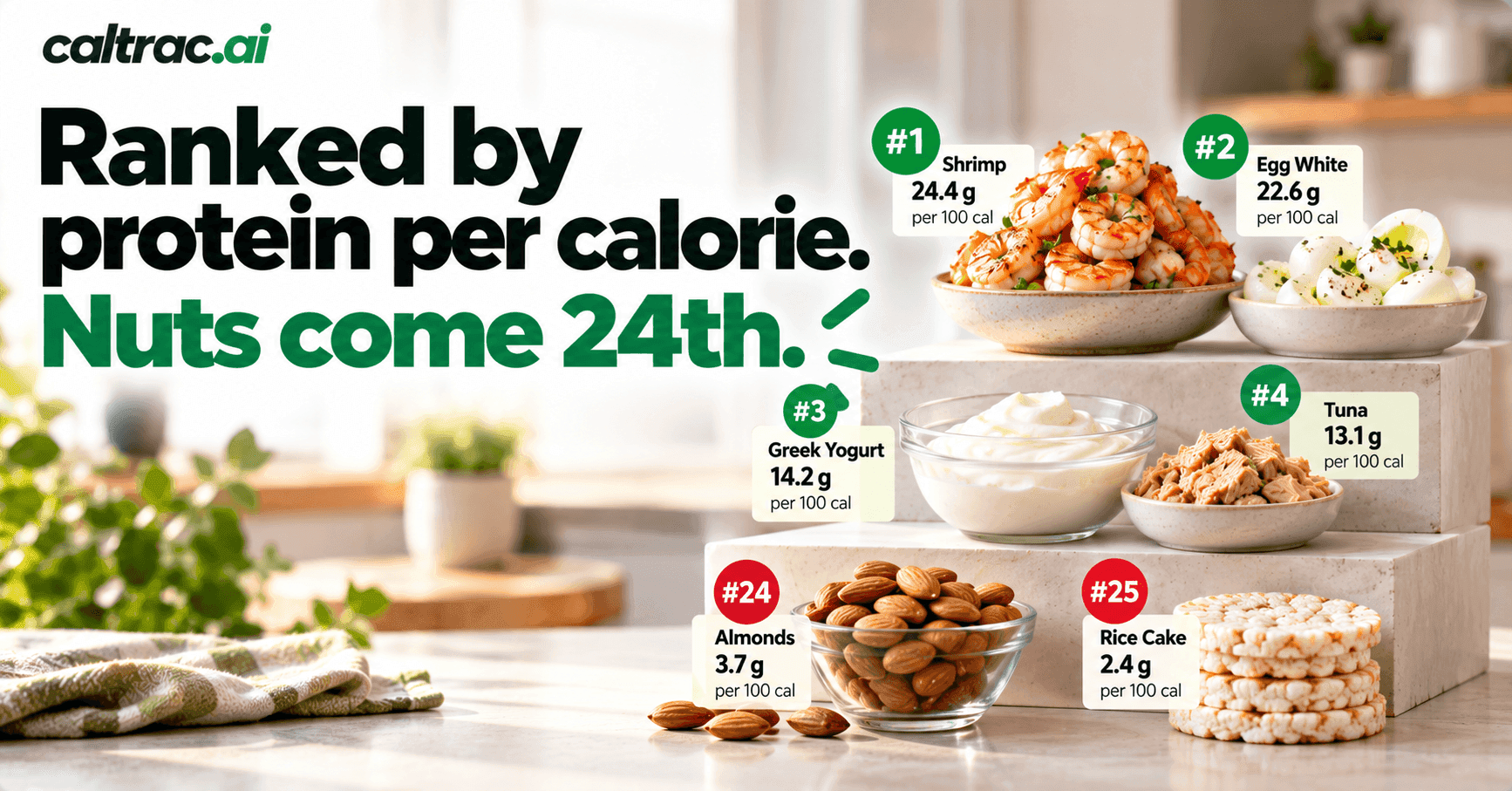
A snack is where a diet is won or lost, and most snacks sold as healthy are carbohydrate and fat with a protein claim on the front. Ranked by the number that matters, protein per 100 calories, the list rearranges itself: shrimp, egg whites, deli turkey and tuna sit at the top, Greek yogurt and cottage cheese follow, nuts and nut butters land near the bottom despite their reputation, and protein bars are not on it at all because the honest versions are just the foods below in a wrapper. This article ranks 30 snacks from USDA data, gives a real portion for each, and explains why protein at snack time changes what happens at the next meal.
Why Protein at Snack Time
Protein is the most satiating macronutrient per calorie [1]. When people raised protein from 15 to 30% of calories with no other instruction, they ate about 441 fewer calories a day and lost 4.9 kg in twelve weeks, with the effect holding across the whole period [2]. The practical threshold is 20 to 30 g per eating occasion, roughly 0.4 g per kilogram of body weight, which is the dose that maximally stimulates muscle protein synthesis [3], and spreading protein evenly across the day produced 25% more muscle protein synthesis than loading it at dinner [4]. A snack with 10 to 20 g of protein is how a day gets from two protein meals to the four that research favours.
Fibre reinforces the effect, with higher-fibre foods consistently more satiating in a review of 38 trials [5], and fibre intake predicted weight loss and adherence better than any other dietary factor in a six-month trial [6]. The snacks that fail are the ones with neither: in the inpatient trial where ultra-processed menus led to 508 extra calories a day, the surplus came largely from fast-eaten, energy-dense snack foods [7] [8].
30 Snacks Ranked by Protein per 100 Calories
USDA FoodData Central values. The "snack portion" is a realistic serving with its calories and protein; the ranking column is protein per 100 kcal of the food itself.
| Rank | Snack | Snack portion | Calories | Protein | Protein per 100 kcal |
|---|---|---|---|---|---|
| 1 | Cooked shrimp, chilled [9] | 100 g | 99 | 24 g | 24.2 g |
| 2 | Egg whites, boiled or as a wrap [10] | 4 whites, 132 g | 69 | 14.4 g | 21.0 g |
| 3 | Turkey breast, deli slices [11] | 60 g | 65 | 13 g | 20.0 g |
| 4 | Tuna, canned in water [12] | Half a tin, 60 g | 77 | 14.2 g | 18.4 g |
| 5 | Greek yogurt, nonfat [13] | 170 g pot | 92 | 16.2 g | 17.6 g |
| 6 | Whey protein shake [14] | 30 g in water | 108 | 17.4 g | 16.2 g |
| 7 | Soya chunks, boiled [15] | 30 g dry | 104 | 15.6 g | 15.1 g |
| 8 | Salmon, canned [16] | 60 g | 92 | 12.4 g | 13.5 g |
| 9 | Cottage cheese, 2% [17] | 150 g | 122 | 15.6 g | 12.8 g |
| 10 | Tofu, firm, cubed [18] | 100 g | 144 | 17.3 g | 12.0 g |
| 11 | Edamame, in pods [19] | 100 g shelled | 121 | 11.9 g | 9.8 g |
| 12 | Skim milk [20] | 250 ml | 93 | 8.9 g | 9.6 g |
| 13 | Mozzarella, part skim (string cheese) [21] | 30 g stick | 76 | 7.3 g | 9.6 g |
| 14 | Greek yogurt, whole milk [22] | 170 g pot | 165 | 15.3 g | 9.3 g |
| 15 | Hard-boiled eggs [23] | 2 eggs, 100 g | 155 | 12.6 g | 8.1 g |
| 16 | Beef jerky [24] | 30 g | 123 | 10 g | 8.1 g |
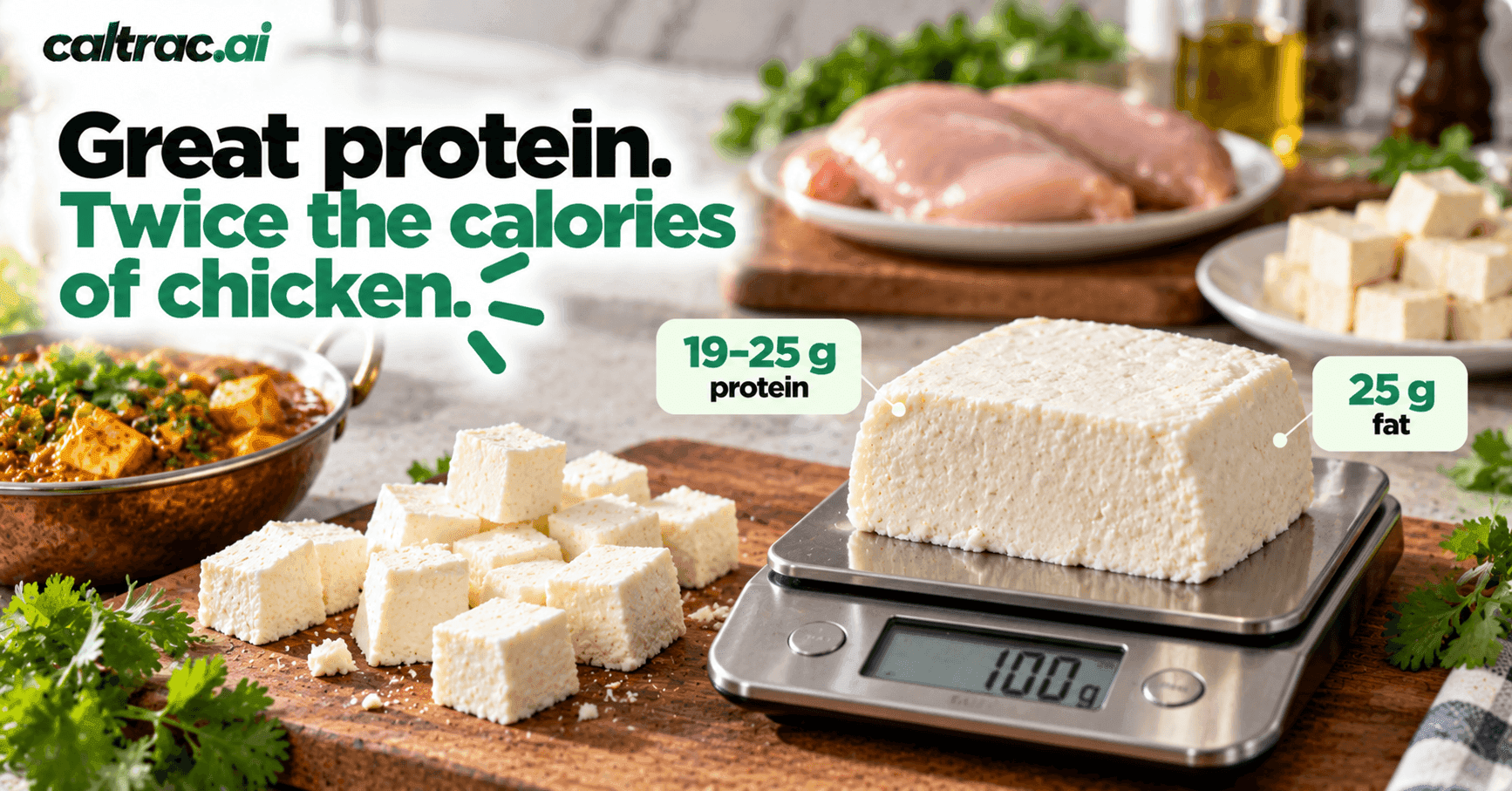
| 17 | Paneer, cubed [25] | 50 g | 161 | 12.5 g | 7.8 g |
| 18 | Sprouted moong, boiled [26] | 150 g | 158 | 10.5 g | 6.7 g |
| 19 | Black beans, seasoned [27] | 150 g | 198 | 13.3 g | 6.7 g |
| 20 | Besan chilla [28] | 1 chilla, 30 g besan | 116 | 6.7 g | 5.8 g |
| 21 | Roasted chana (chickpeas) [29] | 100 g cooked weight | 164 | 8.9 g | 5.4 g |
| 22 | Pumpkin seeds [30] | 30 g | 168 | 9.1 g | 5.4 g |
| 23 | Peanuts [31] | 30 g | 170 | 7.7 g | 4.6 g |
| 24 | Almonds [32] | 30 g | 174 | 6.4 g | 3.7 g |
| 25 | Peanut butter on apple [33] [34] | 20 g PB, 150 g apple | 198 | 4.9 g | 3.7 g (PB alone) |
| 26 | Chia pudding [35] | 20 g chia in 150 ml skim milk | 153 | 8.6 g | 3.4 g (chia alone) |
| 27 | Hummus with carrots [36] [37] | 60 g hummus, 100 g carrots | 183 | 5.6 g | 3.3 g (hummus alone) |
| 28 | Popcorn, air-popped [38] | 4 cups, 32 g | 124 | 4.1 g | 3.3 g |
| 29 | Walnuts [39] | 30 g | 196 | 4.6 g | 2.3 g |
| 30 | Rice cakes [40] | 3 cakes | 35 | 0.6 g | 1.8 g |
| 31 | Dark chocolate, 70 to 85% [41] | 20 g | 120 | 1.6 g | 1.3 g |
What the ranking shows:
- The top ten are all animal protein, soya or dairy. Shrimp, egg whites, turkey, tuna, Greek yogurt, whey, soya chunks, canned fish, cottage cheese and tofu deliver 12 to 24 g of protein per 100 kcal. Each portion listed hits the 10 to 17 g range for under 150 calories.
- Nuts are a fat snack with some protein, not a protein snack. Almonds give 3.7 g per 100 kcal, walnuts 2.3 g, which is less than hummus. A 30 g handful of almonds is 174 calories and 6 g of protein; the same calories as cottage cheese is 22 g [32] [17]. Nuts are healthy; they are just not the protein source people think.
- Peanut butter, chia and hummus rank low alone but rescue a snack. Their job is flavour, fat and fibre on top of a protein base: peanut butter on cottage cheese, chia in Greek yogurt, hummus with boiled eggs.
- The Indian snack shelf is in the middle. Roasted chana, sprouted moong, besan chilla and paneer land at 5 to 8 g per 100 kcal. Soya chunks are the exception and the best vegetarian option on the list, at 15 g per 100 kcal [15].
- Rice cakes and dark chocolate are not protein snacks, and nor are most "protein" bars, biscuits and chips, which typically add 5 to 10 g of protein to a product that is still mostly refined carbohydrate and fat. Read the label and work out protein per 100 kcal; anything under 8 g is a treat with a marketing budget.
Twelve Snacks at 150 to 200 Calories With 15 g or More of Protein
Built from the table, each a single portion:
- Greek yogurt, 200 g, with 50 g blueberries: 137 kcal, 19 g protein [13].
- Cottage cheese, 150 g, with cucumber and black pepper: 137 kcal, 16 g [17] [42].
- Tuna, 100 g, with lemon on 100 g cucumber: 143 kcal, 24 g [12] [42].
- Two hard-boiled eggs with mustard: 155 kcal, 13 g, or add two egg whites for 189 kcal and 20 g [23] [10].
- Shrimp, 100 g, with chilli and lime: 99 kcal, 24 g [9].
- Turkey slices, 60 g, rolled around 30 g mozzarella: 141 kcal, 20 g [11] [21].
- Whey, 30 g, shaken into 250 ml skim milk: 201 kcal, 26 g [14] [20].
- Soya chunks, 40 g dry, boiled and tossed with chaat masala: 138 kcal, 21 g [15].
- Tofu, 100 g, pan-seared with soy sauce: 144 kcal, 17 g [18].
- Edamame, 150 g, with salt: 182 kcal, 18 g, 8 g fibre [19].
- Paneer, 50 g, grilled, with 100 g of capsicum: 185 kcal, 13.5 g [25].
- Sprouted moong, 150 g, with onion, tomato, lemon and one boiled egg: 236 kcal, 17 g, 11 g fibre [26] [23].
When to Snack and When Not To
Snacking is not required for weight loss; eating frequency has no effect on weight at equal calories, and many people do better with three meals. The case for a protein snack is specific: it bridges a gap of more than five hours between meals, it moves a day with two protein servings to three or four [4], and it replaces the biscuit or samosa that would otherwise fill the gap. A snack that adds calories to an already adequate day is just more food. One that replaces 300 calories of refined carbohydrate with 150 calories of protein is a 150 calorie deficit and a quieter appetite [2].
The deficit rule still applies: 500 to 750 kcal a day below maintenance [43]. Set that number with the calorie calculator, and the protein target with the macro calculator; then a 150 kcal, 15 g snack is about 9% of a 1,700 kcal day and 12 to 15% of the protein.
That is where tracking earns its keep. The difference between a snack that works and one that does not is a number you cannot see on the packet. Snap a photo of the yogurt pot or type "30 g almonds" and track it automatically with Caltrac. You will see the protein per snack against the day's target, and your Apple Health-powered net calorie count shows whether the snack fit or spilled over. Choose from the top of the table; let the app keep the score.
Frequently Asked Questions
What is the highest protein snack? Per calorie, cooked shrimp at 24 g of protein per 100 kcal, then egg whites, deli turkey and canned tuna at 18 to 21 g [9] [10] [11] [12]. Among vegetarian options, Greek yogurt, whey and soya chunks at 15 to 18 g.
Are nuts a good protein snack? They are a good snack and a poor protein source: almonds deliver 3.7 g of protein per 100 kcal, less than hummus, and a 30 g handful is 174 calories for 6 g [32].
How much protein should a snack have? Ten to twenty grams, enough to bring the day's protein to three or four servings of 25 to 30 g [3] [4].
Do high-protein snacks help with weight loss? Protein reduces appetite and spontaneous intake: raising protein to 30% of calories cut daily intake by about 441 kcal in a controlled study [2]. The snack helps if it replaces a lower-protein one, not if it is added on top.
What are good Indian high-protein snacks? Boiled soya chunks with chaat masala (21 g per 40 g dry), sprouted moong with a boiled egg, roasted chana, besan chilla, grilled paneer and plain curd or Greek yogurt [15] [26] [29] [28] [25].
Is Greek yogurt or cottage cheese better? Nonfat Greek yogurt has more protein per calorie, 17.6 g against 12.8 g per 100 kcal, and less sodium; both are excellent [13] [17].
References
- Leidy HJ, et al. The role of protein in weight loss and maintenance. American Journal of Clinical Nutrition. 2015;101(6):1320S-1329S. pubmed.ncbi.nlm.nih.gov
- Weigle DS, et al. A high-protein diet induces sustained reductions in appetite, ad libitum caloric intake, and body weight despite compensatory changes in diurnal plasma leptin and ghrelin concentrations. American Journal of Clinical Nutrition. 2005;82(1):41-48. pubmed.ncbi.nlm.nih.gov
- Schoenfeld BJ, Aragon AA. How much protein can the body use in a single meal for muscle-building? Implications for daily protein distribution. Journal of the International Society of Sports Nutrition. 2018;15:10. pubmed.ncbi.nlm.nih.gov
- Mamerow MM, et al. Dietary protein distribution positively influences 24-h muscle protein synthesis in healthy adults. Journal of Nutrition. 2014;144(6):876-880. pubmed.ncbi.nlm.nih.gov
- Clark MJ, Slavin JL. The effect of fiber on satiety and food intake: a systematic review. Journal of the American College of Nutrition. 2013;32(3):200-211. pubmed.ncbi.nlm.nih.gov
- Miketinas DC, et al. Fiber Intake Predicts Weight Loss and Dietary Adherence in Adults Consuming Calorie-Restricted Diets: The POUNDS Lost Study. Journal of Nutrition. 2019;149(10):1742-1748. pubmed.ncbi.nlm.nih.gov
- Hall KD, et al. Ultra-Processed Diets Cause Excess Calorie Intake and Weight Gain: An Inpatient Randomized Controlled Trial of Ad Libitum Food Intake. Cell Metabolism. 2019;30(1):67-77. pubmed.ncbi.nlm.nih.gov
- Forde CG, Mars M, de Graaf K. Ultra-Processing or Oral Processing? A Role for Energy Density and Eating Rate in Moderating Energy Intake from Processed Foods. Current Developments in Nutrition. 2020;4(3):nzaa019. pubmed.ncbi.nlm.nih.gov
- USDA FoodData Central. Crustaceans, shrimp, cooked: 99 kcal, 24 g protein per 100 g. SR Legacy 175180. fdc.nal.usda.gov
- USDA FoodData Central. Egg, white, raw: 52 kcal, 10.9 g protein per 100 g; 1 white 33 g. SR Legacy 172183. fdc.nal.usda.gov
- USDA FoodData Central. Turkey breast, low salt, deli luncheon meat: 109 kcal, 21.8 g protein, 772 mg sodium per 100 g. SR Legacy 174572. fdc.nal.usda.gov
- USDA FoodData Central. Tuna, white, canned in water, drained: 128 kcal, 23.6 g protein per 100 g. SR Legacy 175158. fdc.nal.usda.gov
- USDA FoodData Central. Yogurt, Greek, nonfat, plain: 54 kcal, 9.5 g protein per 100 g. SR Legacy 171312. fdc.nal.usda.gov
- USDA FoodData Central. Beverages, whey protein powder isolate: 359 kcal, 58.1 g protein per 100 g. SR Legacy 173177. fdc.nal.usda.gov
- Nutrela soya chunks pack nutritional facts per 100 g dry (345 kcal, 52 g protein), as reproduced in a retailer listing. thedesifood.com
- USDA FoodData Central. Salmon, sockeye, canned, total can contents: 153 kcal, 20.6 g protein per 100 g. SR Legacy 175174. fdc.nal.usda.gov
- USDA FoodData Central. Cheese, cottage, 2% milkfat: 81 kcal, 10.4 g protein per 100 g. SR Legacy 172182. fdc.nal.usda.gov
- USDA FoodData Central. Tofu, firm: 144 kcal, 17.3 g protein per 100 g. SR Legacy 172475. fdc.nal.usda.gov
- USDA FoodData Central. Edamame, frozen, prepared: 121 kcal, 11.9 g protein, 5.2 g fibre per 100 g. SR Legacy 168411. fdc.nal.usda.gov
- USDA FoodData Central. Milk, nonfat (skim): 37 kcal, 3.6 g protein per 100 g. SR Legacy 171270. fdc.nal.usda.gov
- USDA FoodData Central. Cheese, mozzarella, part skim: 254 kcal, 24.3 g protein, 619 mg sodium per 100 g. SR Legacy 170847. fdc.nal.usda.gov
- USDA FoodData Central. Yogurt, Greek, plain, whole milk: 97 kcal, 9 g protein per 100 g. SR Legacy 171304. fdc.nal.usda.gov
- USDA FoodData Central. Egg, whole, hard-boiled: 155 kcal, 12.6 g protein per 100 g; 1 large 50 g. SR Legacy 173424. fdc.nal.usda.gov
- USDA FoodData Central, FNDDS. Beef jerky: 410 kcal, 33.2 g protein, 1,785 mg sodium per 100 g; 1 serving 30 g. FDC ID 2705860. fdc.nal.usda.gov
- USDA FoodData Central, Branded. Karoun Dairies Paneer: 321 kcal, 25 g protein, 25 g fat per 100 g. FDC ID 2429587. fdc.nal.usda.gov
- USDA FoodData Central. Mung beans, cooked: 105 kcal, 7 g protein, 7.6 g fibre per 100 g. SR Legacy 174257. fdc.nal.usda.gov
- USDA FoodData Central. Beans, black, cooked: 132 kcal, 8.9 g protein, 8.7 g fibre per 100 g. SR Legacy 173735. fdc.nal.usda.gov
- USDA FoodData Central. Chickpea flour (besan): 387 kcal, 22.4 g protein, 10.8 g fibre per 100 g. SR Legacy 174288. fdc.nal.usda.gov
- USDA FoodData Central. Chickpeas, cooked: 164 kcal, 8.9 g protein, 7.6 g fibre per 100 g. SR Legacy 173757. fdc.nal.usda.gov
- USDA FoodData Central. Seeds, pumpkin and squash seed kernels, dried: 559 kcal, 30.2 g protein per 100 g. SR Legacy 170556. fdc.nal.usda.gov
- USDA FoodData Central. Peanuts, all types, raw: 567 kcal, 25.8 g protein, 8.5 g fibre per 100 g. SR Legacy 172430. fdc.nal.usda.gov
- USDA FoodData Central. Nuts, almonds: 579 kcal, 21.2 g protein, 12.5 g fibre per 100 g. SR Legacy 170567. fdc.nal.usda.gov
- USDA FoodData Central. Peanut butter, smooth: 598 kcal, 22.2 g protein per 100 g. SR Legacy 172470. fdc.nal.usda.gov
- USDA FoodData Central. Apples, raw, with skin: 52 kcal, 0.3 g protein per 100 g. SR Legacy 171688. fdc.nal.usda.gov
- USDA FoodData Central. Seeds, chia seeds, dried: 486 kcal, 16.5 g protein, 34.4 g fibre per 100 g. SR Legacy 170554. fdc.nal.usda.gov
- USDA FoodData Central. Hummus, commercial: 237 kcal, 7.8 g protein, 5.5 g fibre per 100 g. SR Legacy 174289. fdc.nal.usda.gov
- USDA FoodData Central. Carrots, raw: 41 kcal per 100 g. SR Legacy 170393. fdc.nal.usda.gov
- USDA FoodData Central. Snacks, popcorn, air-popped: 387 kcal, 12.9 g protein, 14.5 g fibre per 100 g. SR Legacy 167959. fdc.nal.usda.gov
- USDA FoodData Central. Nuts, walnuts, English: 654 kcal, 15.2 g protein per 100 g. SR Legacy 170187. fdc.nal.usda.gov
- USDA FoodData Central, FNDDS. Rice cake: 392 kcal, 7.1 g protein per 100 g. FDC ID 2708162. fdc.nal.usda.gov
- USDA FoodData Central. Chocolate, dark, 70-85% cacao solids: 598 kcal, 7.8 g protein per 100 g. SR Legacy 170273. fdc.nal.usda.gov
- USDA FoodData Central. Cucumber, with peel, raw: 15 kcal per 100 g. SR Legacy 168409. fdc.nal.usda.gov
- Jensen MD, et al. 2013 AHA/ACC/TOS guideline for the management of overweight and obesity in adults. Circulation. 2014;129(25 Suppl 2):S102-S138. pubmed.ncbi.nlm.nih.gov