


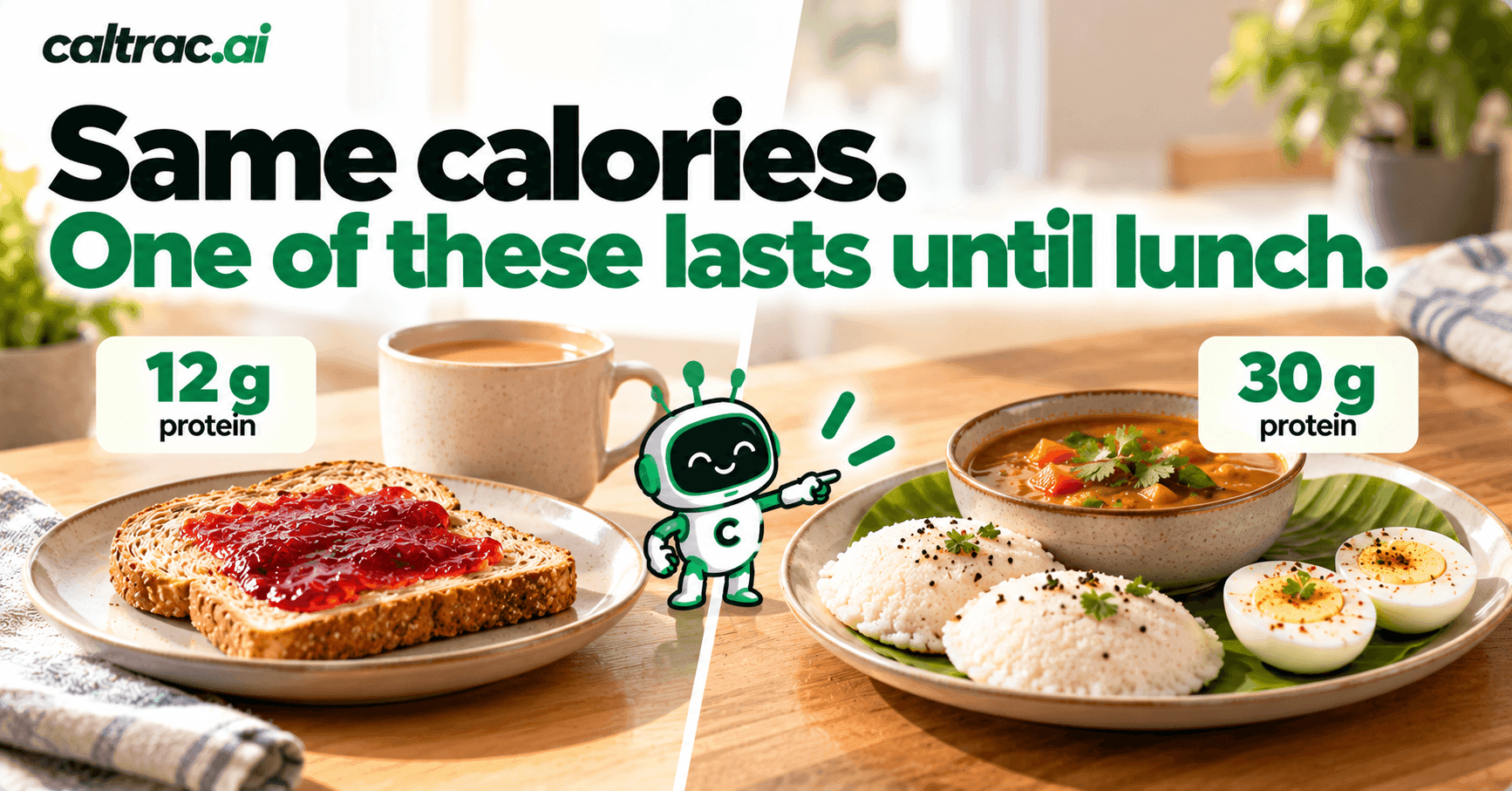
The average breakfast is 10 to 13 g of protein: cereal and milk, toast and jam, poha, two biscuits with chai. The research says that number should be closer to 30, and that getting it there changes appetite for the rest of the day. Below are fifteen breakfasts, each under 400 calories and each delivering 20 to 36 g of protein, built from USDA data so the macros are real rather than optimistic. Half are Western, half are Indian, and all of them take under ten minutes or none at all.
What the Research Says About Protein at Breakfast
Whether you eat breakfast is not the point. A meta-analysis of 13 randomised trials found breakfast eaters consumed about 260 more calories a day and weighed slightly more than skippers [1]; breakfast is not a metabolic switch. What you put in it is different. In a controlled trial, young women who ate a 350 kcal breakfast with 35 g of protein, rather than the same calories with 13 g, reported greater fullness through the morning, had lower ghrelin and higher PYY, the hormones of hunger and satiety, and snacked less on high-fat food in the evening [2]. In teenagers given identical-calorie breakfasts of differing glycaemic index, intake over the next five hours was 53% higher after the high-GI meal than the medium and 81% higher than the low [3]. A refined-carbohydrate breakfast is not just low in protein; it schedules the eleven o'clock hunger.
The target is 25 to 35 g, about 0.4 g per kilogram of body weight, the per-meal dose that maximally stimulates muscle protein synthesis [4]. Eating protein evenly across three meals produced 25% more muscle protein synthesis over 24 hours than concentrating it at dinner [5], and breakfast is where almost everyone is furthest from even. Daily totals of 1.2 to 1.6 g/kg preserve muscle and control appetite during weight loss [6].
Fifteen High-Protein Breakfasts Under 400 Calories
All values from USDA FoodData Central, summed from the listed quantities. Vegetables and spices beyond those listed add 10 to 30 kcal.
| # | Breakfast | Calories | Protein | Fibre | Time |
|---|---|---|---|---|---|
| 1 | Tofu scramble: 200 g firm tofu, 50 g spinach, 1 tsp oil, turmeric, chilli [7] [8] [9] | 340 | 36 g | 3 g | 8 min |
| 2 | Chicken and roti: 100 g leftover roast chicken breast, 1 roti, green chutney [10] [11] | 285 | 34 g | 4 g | 3 min |
| 3 | Protein oats: 40 g oats cooked in 250 ml skim milk, 25 g whey stirred in after cooking [12] [13] [14] | 335 | 29 g | 4 g | 6 min |
| 4 | Egg-white omelette: 200 g egg whites plus 1 whole egg, 100 g mushrooms and tomato, 1 tsp oil [15] [16] [9] | 275 | 29 g | 1 g | 8 min |
| 5 | Turkey and egg wrap: 1 whole-wheat tortilla, 2 eggs scrambled without fat, 50 g turkey slices, salad [17] [16] [18] | 338 | 28 g | 4 g | 7 min |
| 6 | Whey smoothie: 250 ml skim milk, 100 g banana, 25 g whey, 10 g chia [13] [19] [14] [20] | 321 | 26 g | 6 g | 3 min |
| 7 | Idli sambar plus: 3 idli, 1 cup sambar, 2 egg whites boiled or stirred into the sambar [21] [22] [15] | 393 | 25 g | 17 g | 10 min |
| 8 | Cottage cheese toast: 200 g 2% cottage cheese, 1 slice whole-wheat toast, 100 g sliced tomato, black pepper [23] [24] [25] | 256 | 25 g | 3 g | 3 min |
| 9 | Greek yogurt bowl: 200 g nonfat Greek yogurt, 30 g oats, 100 g strawberries [26] [12] [27] | 254 | 24 g | 5 g | 2 min |
| 10 | Salmon toast: 100 g canned salmon, 1 slice whole-wheat toast, 100 g cucumber, lemon [28] [24] [29] | 245 | 24 g | 2 g | 4 min |
| 11 | Sprouted moong chaat: 150 g boiled moong sprouts, 1 boiled egg, 2 egg whites, onion, tomato, lemon [30] [31] [15] | 310 | 24 g | 11 g | 5 min |
| 12 | Overnight oats: 40 g oats, 150 g nonfat Greek yogurt, 100 ml skim milk, 50 g blueberries [12] [26] [13] [32] | 299 | 24 g | 5 g | 0 min |
| 13 | Besan chilla with curd: 2 chillas (60 g besan, 1 tsp oil), 100 g nonfat Greek yogurt or hung curd [33] [9] [26] | 326 | 23 g | 6 g | 10 min |
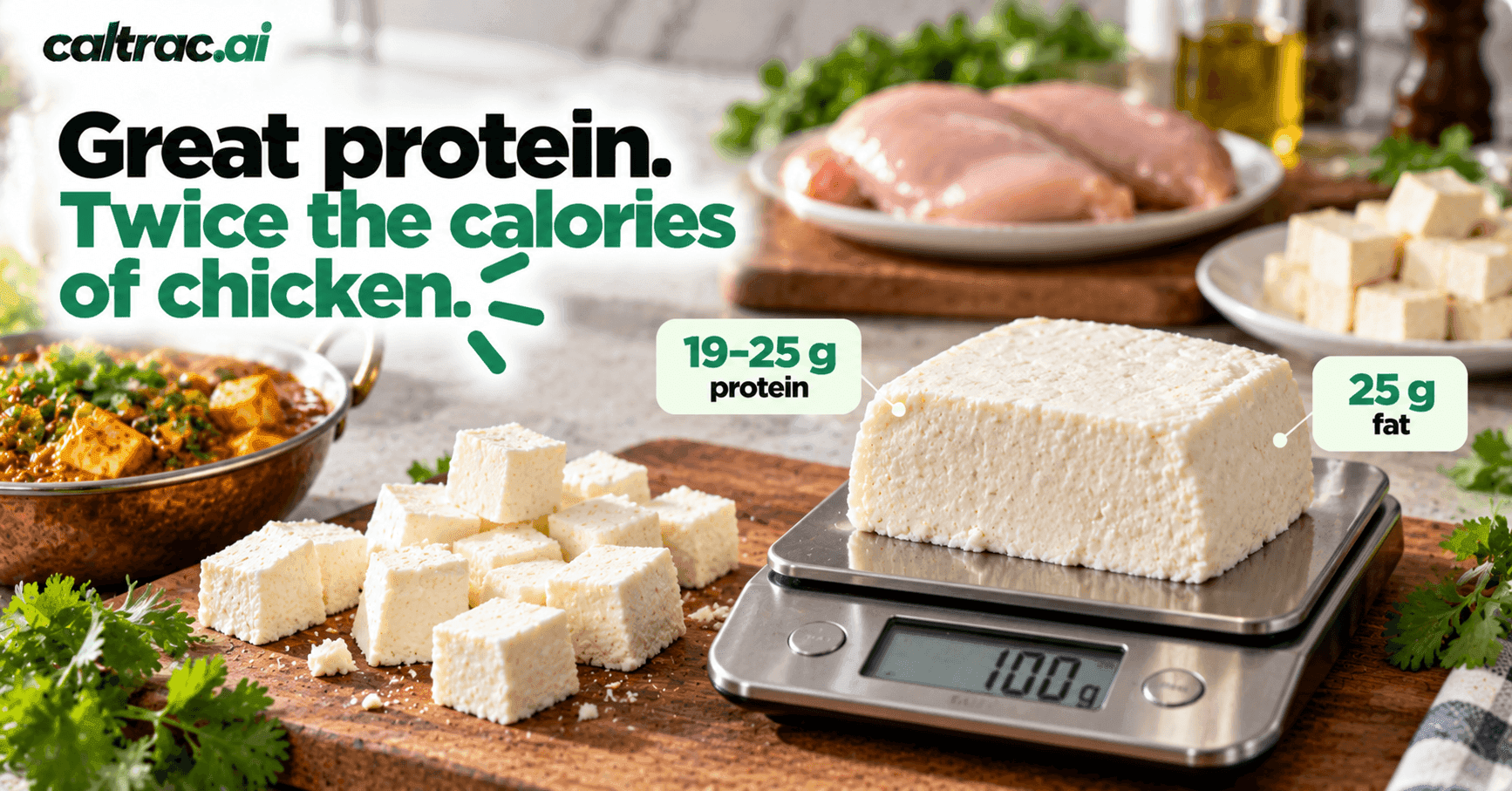
| 14 | Paneer bhurji roti: 75 g paneer crumbled with onion, tomato and chilli, 1 roti [34] [11] | 361 | 22 g | 4 g | 8 min |
| 15 | Three-egg omelette on toast: 3 eggs cooked without added fat, 1 slice whole-wheat toast [16] [24] | 291 | 22 g | 2 g | 6 min |
Patterns Worth Noticing
Egg whites are the cheapest upgrade in the kitchen. At 52 kcal and 10.9 g of protein per 100 g [15], two whites add 7 g of protein for 34 calories to anything: sambar, upma, a smoothie, an omelette. Three of the fifteen breakfasts above reach 25 g only because of them.
The Indian breakfasts need a protein added on purpose. Idli, chilla, moong and paneer bhurji all appear, but each has been paired with egg, curd or extra dal to reach the target, because the traditional versions deliver 7 to 13 g on their own. The grain or lentil base is fine; the protein has to be deliberate.
Fibre comes with the pulses, not the eggs. The idli sambar and moong chaat breakfasts carry 11 to 17 g of fibre, half a day's target, while the egg and dairy breakfasts carry 1 to 3 g. Fibre predicted weight loss and adherence better than any other dietary factor in a six-month trial [35], so if your breakfast is eggs, make lunch the pulses.
Whey is a food, not a cheat. Twenty-five grams stirred into oats or a smoothie adds 14.5 g of protein for 90 calories [14]. It is the fastest route to 30 g for people who cannot face eggs at seven in the morning.
Eggs are back on the menu. For most people, up to one egg a day shows no association with cardiovascular disease across three large cohorts and a meta-analysis of 28 studies [36]. Three breakfasts above use two or three whole eggs; if you have been told to limit cholesterol, the egg-white versions deliver the same protein without it.
Making It Stick
Pick three of the fifteen and rotate them. The two-minute options, the Greek yogurt bowl, overnight oats and the cottage cheese toast, cover weekday mornings; the omelettes, chillas and bhurji cover weekends. Every one of them lands at 250 to 400 kcal, a fifth of a 1,500 to 1,900 kcal day, with 20 to 36 g of the 90 to 120 g of protein most adults losing weight should eat [6] [37]. Set the daily protein figure in the macro calculator and the calorie target in the calorie calculator, and these breakfasts become the first third of the answer.
That is where tracking earns its keep. The difference between a 12 g breakfast and a 28 g one is invisible on the plate and obvious by eleven. Snap a photo of the bowl or type "200 g Greek yogurt, 30 g oats, strawberries" and track it automatically with Caltrac. You will see the protein number before the hunger does, and your Apple Health-powered net calorie count shows how the day builds from it. Eat the protein; let the app confirm you did.
Frequently Asked Questions
How much protein should I eat at breakfast? About 25 to 35 g, or 0.4 g per kilogram of body weight, the per-meal dose that maximises muscle protein synthesis [4]. A 35 g protein breakfast reduced evening snacking in a controlled trial [2].
What is the highest protein breakfast under 400 calories? From the table, a 200 g tofu scramble at 340 kcal and 36 g, or 100 g of chicken breast with a roti at 285 kcal and 34 g [7] [10] [11].
Is skipping breakfast bad for weight loss? No. Breakfast eaters consumed about 260 more calories a day in a meta-analysis of trials [1]. If you eat breakfast, make it protein; if you skip it, put the protein in your first meal.
What are high-protein Indian breakfasts? Idli with sambar and egg whites (25 g), besan chilla with curd (23 g), paneer bhurji with roti (22 g) and sprouted moong chaat with eggs (24 g), each under 400 kcal [21] [33] [34] [30].
Are eggs every day safe? Up to one egg a day was not associated with cardiovascular disease in three large cohorts and a 28-study meta-analysis [36]. Egg whites carry the protein without the cholesterol.
Can I get 30 g of protein at breakfast without eggs or meat? Yes: protein oats with whey (29 g), the tofu scramble (36 g), or Greek yogurt with oats and 15 g of whey (about 33 g) [14] [7] [26].
References
- Sievert K, et al. Effect of breakfast on weight and energy intake: systematic review and meta-analysis of randomised controlled trials. BMJ. 2019;364:l42. pubmed.ncbi.nlm.nih.gov
- Leidy HJ, Ortinau LC, Douglas SM, Hoertel HA. Beneficial effects of a higher-protein breakfast on the appetitive, hormonal, and neural signals controlling energy intake regulation in overweight/obese, "breakfast-skipping," late-adolescent girls. American Journal of Clinical Nutrition. 2013;97(4):677-688. pubmed.ncbi.nlm.nih.gov
- Ludwig DS, et al. High glycemic index foods, overeating, and obesity. Pediatrics. 1999;103(3):E26. pubmed.ncbi.nlm.nih.gov
- Schoenfeld BJ, Aragon AA. How much protein can the body use in a single meal for muscle-building? Implications for daily protein distribution. Journal of the International Society of Sports Nutrition. 2018;15:10. pubmed.ncbi.nlm.nih.gov
- Mamerow MM, et al. Dietary protein distribution positively influences 24-h muscle protein synthesis in healthy adults. Journal of Nutrition. 2014;144(6):876-880. pubmed.ncbi.nlm.nih.gov
- Leidy HJ, et al. The role of protein in weight loss and maintenance. American Journal of Clinical Nutrition. 2015;101(6):1320S-1329S. pubmed.ncbi.nlm.nih.gov
- USDA FoodData Central. Tofu, firm: 144 kcal, 17.3 g protein per 100 g. SR Legacy 172475. fdc.nal.usda.gov
- USDA FoodData Central. Spinach, raw: 23 kcal, 2.9 g protein per 100 g. SR Legacy 168462. fdc.nal.usda.gov
- USDA FoodData Central. Oil, olive, salad or cooking: 884 kcal per 100 g; 1 teaspoon about 4.5 g, 40 kcal. SR Legacy 171413. fdc.nal.usda.gov
- USDA FoodData Central. Chicken breast, meat only, roasted: 165 kcal, 31 g protein per 100 g. SR Legacy 171477. fdc.nal.usda.gov
- USDA FoodData Central, FNDDS. Bread, chapatti or roti: 299 kcal, 7.9 g protein, 9.7 g fibre per 100 g; 1 medium 40 g. FDC ID 2707713. fdc.nal.usda.gov
- USDA FoodData Central. Cereals, oats, regular and quick, dry: 379 kcal, 13.2 g protein, 10.1 g fibre per 100 g. SR Legacy 173904. fdc.nal.usda.gov
- USDA FoodData Central. Milk, nonfat (skim): 37 kcal, 3.6 g protein per 100 g. SR Legacy 171270. fdc.nal.usda.gov
- USDA FoodData Central. Beverages, whey protein powder isolate: 359 kcal, 58.1 g protein per 100 g. SR Legacy 173177. fdc.nal.usda.gov
- USDA FoodData Central. Egg, white, raw: 52 kcal, 10.9 g protein per 100 g; 1 white 33 g. SR Legacy 172183. fdc.nal.usda.gov
- USDA FoodData Central, FNDDS. Egg omelet or scrambled egg, no added fat: 143 kcal, 12.4 g protein per 100 g; 1 egg 50 g. FDC ID 2707205. fdc.nal.usda.gov
- USDA FoodData Central, FNDDS. Tortilla, whole wheat: 310 kcal, 9.8 g protein, 9.8 g fibre per 100 g; 1 medium 45 g. FDC ID 2707825. fdc.nal.usda.gov
- USDA FoodData Central. Turkey breast, low salt, deli luncheon meat: 109 kcal, 21.8 g protein per 100 g. SR Legacy 174572. fdc.nal.usda.gov
- USDA FoodData Central. Bananas, raw: 89 kcal, 1.1 g protein per 100 g. SR Legacy 173944. fdc.nal.usda.gov
- USDA FoodData Central. Seeds, chia seeds, dried: 486 kcal, 16.5 g protein, 34.4 g fibre per 100 g. SR Legacy 170554. fdc.nal.usda.gov
- USDA FoodData Central, FNDDS. Idli: 128 kcal, 6.4 g protein, 5.8 g fibre per 100 g; 1 idli 38 g. FDC ID 2708346. fdc.nal.usda.gov
- USDA FoodData Central, FNDDS. Sambar, vegetable stew: 86 kcal, 4.3 g protein, 4.0 g fibre per 100 g; 1 cup 248 g. FDC ID 2707430. fdc.nal.usda.gov
- USDA FoodData Central. Cheese, cottage, 2% milkfat: 81 kcal, 10.4 g protein per 100 g. SR Legacy 172182. fdc.nal.usda.gov
- USDA FoodData Central. Bread, whole-wheat: 252 kcal, 12.4 g protein, 6.0 g fibre per 100 g; 1 slice about 30 g. SR Legacy 172688. fdc.nal.usda.gov
- USDA FoodData Central. Tomatoes, red, ripe, raw: 18 kcal per 100 g. SR Legacy 170457. fdc.nal.usda.gov
- USDA FoodData Central. Yogurt, Greek, nonfat, plain: 54 kcal, 9.5 g protein per 100 g. SR Legacy 171312. fdc.nal.usda.gov
- USDA FoodData Central. Strawberries, raw: 32 kcal per 100 g. SR Legacy 167762. fdc.nal.usda.gov
- USDA FoodData Central. Salmon, sockeye, canned, total can contents: 153 kcal, 20.6 g protein per 100 g. SR Legacy 175174. fdc.nal.usda.gov
- USDA FoodData Central. Cucumber, with peel, raw: 15 kcal per 100 g. SR Legacy 168409. fdc.nal.usda.gov
- USDA FoodData Central. Mung beans, cooked: 105 kcal, 7 g protein, 7.6 g fibre per 100 g. SR Legacy 174257. fdc.nal.usda.gov
- USDA FoodData Central. Egg, whole, hard-boiled: 155 kcal, 12.6 g protein per 100 g; 1 large 50 g. SR Legacy 173424. fdc.nal.usda.gov
- USDA FoodData Central. Blueberries, raw: 57 kcal, 2.4 g fibre per 100 g. SR Legacy 171711. fdc.nal.usda.gov
- USDA FoodData Central. Chickpea flour (besan): 387 kcal, 22.4 g protein, 10.8 g fibre per 100 g. SR Legacy 174288. fdc.nal.usda.gov
- USDA FoodData Central, Branded. Karoun Dairies Paneer: 321 kcal, 25 g protein, 25 g fat per 100 g. FDC ID 2429587. fdc.nal.usda.gov
- Miketinas DC, et al. Fiber Intake Predicts Weight Loss and Dietary Adherence in Adults Consuming Calorie-Restricted Diets: The POUNDS Lost Study. Journal of Nutrition. 2019;149(10):1742-1748. pubmed.ncbi.nlm.nih.gov
- Drouin-Chartier JP, et al. Egg consumption and risk of cardiovascular disease: three large prospective US cohort studies, systematic review, and updated meta-analysis. BMJ. 2020;368:m513. pubmed.ncbi.nlm.nih.gov
- Jensen MD, et al. 2013 AHA/ACC/TOS guideline for the management of overweight and obesity in adults. Circulation. 2014;129(25 Suppl 2):S102-S138. pubmed.ncbi.nlm.nih.gov