


Fibre is the nutrient almost everyone is short of and almost nobody is tracking. The recommended intake is 25 g a day for women and 38 g for men [1]; the average American gets about 16 g, and only around 5% of the population reaches the target [2] [3]. That gap matters more for weight than most people realise. In the largest calorie-restriction trial to analyse it, fibre intake was the single strongest predictor of how much weight people lost, ahead of every macronutrient [4].
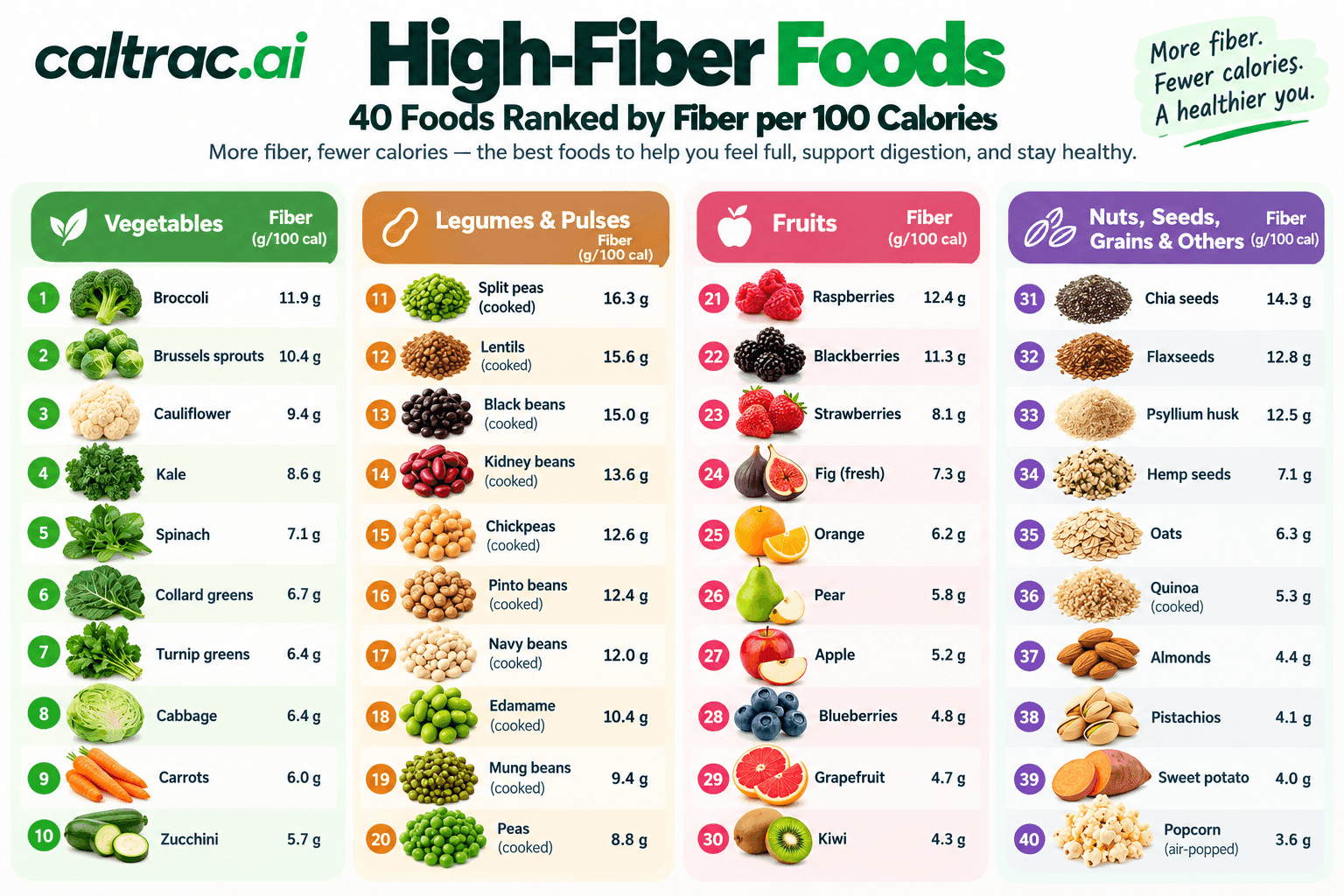
This article ranks 40 high-fibre foods, but not the usual way. Most lists rank by grams per 100 g, which puts almonds and dried figs near the top and quietly steers dieters toward calorie-dense food. The ranking below is fibre per 100 calories, which is the figure that matters when you are trying to eat more fibre inside a calorie budget. It changes the list completely.
Why Fibre Matters for Weight
Four findings make the case.
It predicts weight loss. In the POUNDS Lost trial, 345 adults ate 750 kcal a day below maintenance for six months across four different macronutrient diets. Fibre intake was the most influential predictor of weight loss, independent of calories and macronutrients, and it also predicted how well people stuck to the diet [4].
It reduces intake. A review of controlled studies found that eating an additional 14 g of fibre a day was associated with a 10% drop in energy intake and 1.9 kg of weight loss over about four months, with larger effects in obese participants [5]. Fibre adds bulk, slows eating and digestion, and shifts gut hormones toward fullness. The honest caveat: in acute studies, only about 39% of fibre treatments reduced appetite and 22% reduced intake, so not every fibre works and the effect is modest meal to meal [6].
It helps even in supplement form. Across 62 randomised trials of viscous fibre supplements with no calorie restriction, body weight fell by a modest 0.33 kg [7]. Food beats supplements, but the direction is consistent.
It is tied to living longer. A series of meta-analyses covering 135 million person-years found that the highest fibre consumers had 15 to 30% lower all-cause and cardiovascular mortality and lower rates of heart disease, stroke, type 2 diabetes and colorectal cancer than the lowest, with the greatest benefit at 25 to 29 g a day and more at higher intakes [8].
40 High-Fibre Foods Ranked by Fibre per 100 Calories
All values from USDA FoodData Central, per 100 g as eaten. The right-hand column is the ranking column.
| Rank | Food | Calories per 100 g | Fibre per 100 g | Fibre per 100 kcal |
|---|---|---|---|---|
| 1 | Wheat bran [9] | 216 | 42.8 g | 19.8 g |
| 2 | Okra, cooked [10] | 22 | 2.5 g | 11.4 g |
| 3 | Raspberries [11] | 57 | 6.5 g | 11.4 g |
| 4 | Artichoke, cooked [12] | 51 | 5.7 g | 11.2 g |
| 5 | Kale, raw [13] | 35 | 4.1 g | 11.7 g |
| 6 | Blackberries [14] | 43 | 5.3 g | 12.3 g |
| 7 | Spinach, cooked [15] | 23 | 2.4 g | 10.4 g |
| 8 | Guava [16] | 68 | 5.4 g | 7.9 g |
| 9 | Broccoli, raw [17] | 34 | 2.6 g | 7.6 g |
| 10 | Navy beans, cooked [18] | 140 | 10.5 g | 7.5 g |
| 11 | Mung beans (moong), cooked [19] | 105 | 7.6 g | 7.2 g |
| 12 | Split peas, cooked [20] | 118 | 8.3 g | 7.0 g |
| 13 | Chia seeds [21] | 486 | 34.4 g | 7.1 g |
| 14 | Carrots, raw [22] | 41 | 2.8 g | 6.8 g |
| 15 | Lentils (dal), cooked [23] | 116 | 7.9 g | 6.8 g |
| 16 | Black beans, cooked [24] | 132 | 8.7 g | 6.6 g |
| 17 | Green peas, cooked [25] | 84 | 5.5 g | 6.5 g |
| 18 | Pinto beans, cooked [26] | 143 | 9.0 g | 6.3 g |
| 19 | Pear [27] | 57 | 3.1 g | 5.4 g |
| 20 | Bulgur, cooked [28] | 83 | 4.5 g | 5.4 g |
| 21 | Flaxseed [29] | 534 | 27.3 g | 5.1 g |
| 22 | Dal, as prepared [30] | 145 | 7.5 g | 5.2 g |
| 23 | Kidney beans (rajma), cooked [31] | 127 | 6.4 g | 5.0 g |
| 24 | Chickpeas (chana), cooked [32] | 164 | 7.6 g | 4.6 g |
| 25 | Apple, with skin [33] | 52 | 2.4 g | 4.6 g |
| 26 | Edamame [34] | 121 | 5.2 g | 4.3 g |
| 27 | Avocado [35] | 167 | 6.8 g | 4.1 g |
| 28 | Whole-wheat flour (atta) [36] | 332 | 13.1 g | 3.9 g |
| 29 | Figs, dried [37] | 249 | 9.8 g | 3.9 g |
| 30 | Popcorn, air-popped [38] | 387 | 14.5 g | 3.7 g |
| 31 | Sweet potato, baked [39] | 90 | 3.3 g | 3.7 g |
| 32 | Roti (whole wheat) [40] | 299 | 9.7 g | 3.2 g |
| 33 | Barley, cooked [41] | 123 | 3.8 g | 3.1 g |
| 34 | Banana [42] | 89 | 2.6 g | 2.9 g |
| 35 | Chickpea flour (besan) [43] | 387 | 10.8 g | 2.8 g |
| 36 | Oats, dry [44] | 379 | 10.1 g | 2.7 g |
| 37 | Whole-wheat bread [45] | 252 | 6.0 g | 2.4 g |
| 38 | Almonds [46] | 579 | 12.5 g | 2.2 g |
| 39 | Brown rice, cooked [47] | 123 | 1.6 g | 1.3 g |
| 40 | White rice, cooked [48] | 130 | 0.4 g | 0.3 g |
The table rearranges the conventional wisdom.
- Vegetables and berries dominate. Okra, raspberries, artichoke, kale, blackberries and spinach deliver 10 to 12 g of fibre for every 100 calories. You cannot eat enough of them to get fat, and a large plate of them is 100 calories.
- Pulses are the workhorses. Navy beans, moong, split peas, lentils and black beans sit at 6.5 to 7.5 g per 100 kcal, and unlike vegetables they bring 7 to 10 g of protein per 100 g with them. A cup of dal is 18 g of fibre and 20 g of protein.
- The famous "high-fibre" foods fall. Almonds, oats and dried figs have impressive fibre per 100 g and modest fibre per calorie, because they are calorie-dense. They are good foods. They are not an efficient way to buy fibre on a diet.
- Whole grains are mid-table, not top. A whole-wheat roti carries 3.9 g of fibre per piece, which is useful; brown rice carries four times the fibre of white rice but still only 1.6 g per 100 g [47] [48]. The rice-versus-roti fibre difference is real and small.
- Chia and flax are the exceptions among seeds. At 7.1 and 5.1 g per 100 kcal they are genuinely fibre-efficient, which is why a tablespoon of chia is 4 g of fibre for 58 kcal.
How to Get to 25 to 38 g a Day
Here is what a 30 g day looks like built from the top half of the table, with calories:
| Meal | Food | Fibre | Calories |
|---|---|---|---|
| Breakfast | 40 g oats [44] with 1 tbsp chia [21] and 100 g raspberries [11] | 14.6 g | 267 |
| Lunch | 200 g cooked lentils [23] with 100 g spinach [15] | 18.2 g | 255 |
| Snack | 1 pear [27], about 180 g | 5.6 g | 103 |
| Dinner | 150 g broccoli [17] with any protein | 3.9 g | 51 |
| Total | 42 g | ~680 kcal |
That is more than the men's target, for about 680 calories, with 35 g of protein from the lentils and oats before the dinner protein is counted. Building the day from the bottom of the table instead, with almonds, whole-wheat bread and brown rice, gets to about 15 g for the same calories.
Three practical rules:
- Pulses at one meal a day is the single biggest lever. Dal, rajma, chana, black beans or lentil soup.
- Vegetables or berries at every meal, by volume. Half the plate.
- Increase slowly. Going from 15 g to 35 g in a week causes gas and bloating. Add 5 g a week and drink water alongside it.
A Word on Fibermaxxing
The social-media trend of "fibermaxxing," pushing 50 to 70 g a day, drew attention to a real deficit: more than 90% of women and 97% of men fall short of the recommendation [49], and roughly 19 in 20 Americans rarely reach it [50]. The target itself is well supported, and benefits continue above 29 g [8]. The trend's excess is the rate of change and the ceiling: dietitians quoted in the coverage note that jumping to 70 g overnight brings bloating and can crowd out other nutrients [49]. Aim for the 25 to 38 g range, and if you are on a GLP-1 medication, where constipation is common, the expert consensus sets fibre at 25 g for women and 30 g for men specifically to manage it [51].
Fibre and Your Calorie Budget
Fibre is the rare case where more is better on both sides of the ledger: it adds almost no usable calories and it reduces how much else you eat [5]. On a weight-loss target from the calorie calculator, filling half the plate from the top of the table costs 100 to 200 calories and does more for fullness than any other change. The macro calculator gives you the protein target that pulses help you hit at the same time.
That is where tracking earns its keep. Snap a photo of your dal and salad or type "200 g lentils, 100 g spinach" and track it automatically with Caltrac. You will see fibre logged alongside protein and calories, so a day that reads 12 g at dinner time is still fixable, and your Apple Health-powered net calorie count shows how little the extra vegetables cost. Eat the plants; let the app count the fibre.
Frequently Asked Questions
How much fibre should I eat per day? 25 g for women and 38 g for men aged 19 to 50, falling to 21 g and 30 g after 50 [1]. WHO recommends at least 25 g [52]. Mortality benefit is greatest at 25 to 29 g and continues above that [8].
What foods are highest in fibre? Per 100 g, wheat bran, chia, flax, popcorn and whole-wheat flour. Per calorie, okra, raspberries, artichoke, kale, blackberries and spinach, followed by pulses [9] [21] [10] [11].
Does fibre help with weight loss? Yes. Fibre intake was the strongest predictor of weight loss and adherence in a six-month calorie-restriction trial [4], and an extra 14 g a day is associated with 10% lower intake and about 1.9 kg of loss over four months [5].
Which has more fibre, rice or roti? Roti, by a wide margin: 9.7 g per 100 g versus 0.4 g for white rice and 1.6 g for brown rice [40] [48] [47]. One 40 g roti carries about 3.9 g.
Are fibre supplements as good as food? They help modestly, with about 0.33 kg of weight loss across 62 trials of viscous fibre supplements [7], but they lack the protein, volume and micronutrients of pulses and vegetables.
Can you eat too much fibre? Very high intakes can cause bloating and may interfere with mineral absorption; the practical problem is increasing too fast. Add about 5 g a week and drink enough water [49].
References
- National Academies, Food and Nutrition Board. Dietary Reference Intakes: Recommended Dietary Allowances and Adequate Intakes, Total Water and Macronutrients (fiber AI 38 g men 19 to 50, 25 g women 19 to 50). nationalacademies.org
- National Center for Health Statistics. NCHS Nutrition Data fact sheet, March 2017 (mean fiber intake 16 g; men 18 g, women 15 g). stacks.cdc.gov
- Slavin JL. Position of the American Dietetic Association: health implications of dietary fiber. Journal of the American Dietetic Association. 2008;108(10):1716-1731. pubmed.ncbi.nlm.nih.gov
- Miketinas DC, et al. Fiber Intake Predicts Weight Loss and Dietary Adherence in Adults Consuming Calorie-Restricted Diets: The POUNDS Lost Study. Journal of Nutrition. 2019;149(10):1742-1748. pubmed.ncbi.nlm.nih.gov
- Howarth NC, Saltzman E, Roberts SB. Dietary fiber and weight regulation. Nutrition Reviews. 2001;59(5):129-139. pubmed.ncbi.nlm.nih.gov
- Clark MJ, Slavin JL. The effect of fiber on satiety and food intake: a systematic review. Journal of the American College of Nutrition. 2013;32(3):200-211. pubmed.ncbi.nlm.nih.gov
- Jovanovski E, et al. Can dietary viscous fiber affect body weight independently of an energy-restrictive diet? A systematic review and meta-analysis of randomized controlled trials. American Journal of Clinical Nutrition. 2020;111(2):471-485. pubmed.ncbi.nlm.nih.gov
- Reynolds A, Mann J, Cummings J, Winter N, Mete E, Te Morenga L. Carbohydrate quality and human health: a series of systematic reviews and meta-analyses. Lancet. 2019;393(10170):434-445. pubmed.ncbi.nlm.nih.gov
- USDA FoodData Central. Wheat bran, crude: 216 kcal, 42.8 g fibre per 100 g. SR Legacy 169722. fdc.nal.usda.gov
- USDA FoodData Central. Okra, cooked: 22 kcal, 2.5 g fibre per 100 g. SR Legacy 169261. fdc.nal.usda.gov
- USDA FoodData Central, FNDDS. Raspberries, raw: 57 kcal, 6.5 g fibre per 100 g; 1 cup 150 g. FDC ID 2709281. fdc.nal.usda.gov
- USDA FoodData Central. Artichokes, cooked: 51 kcal, 5.7 g fibre per 100 g. SR Legacy 169311. fdc.nal.usda.gov
- USDA FoodData Central. Kale, raw: 35 kcal, 4.1 g fibre per 100 g. SR Legacy 168421. fdc.nal.usda.gov
- USDA FoodData Central. Blackberries, raw: 43 kcal, 5.3 g fibre per 100 g. SR Legacy 173946. fdc.nal.usda.gov
- USDA FoodData Central. Spinach, cooked: 23 kcal, 2.4 g fibre per 100 g. SR Legacy 168463. fdc.nal.usda.gov
- USDA FoodData Central. Guavas, common, raw: 68 kcal, 5.4 g fibre per 100 g. SR Legacy 173044. fdc.nal.usda.gov
- USDA FoodData Central. Broccoli, raw: 34 kcal, 2.6 g fibre per 100 g. SR Legacy 170379. fdc.nal.usda.gov
- USDA FoodData Central. Beans, navy, cooked: 140 kcal, 10.5 g fibre, 8.2 g protein per 100 g. SR Legacy 173794. fdc.nal.usda.gov
- USDA FoodData Central. Mung beans, cooked: 105 kcal, 7.6 g fibre, 7.0 g protein per 100 g. SR Legacy 174257. fdc.nal.usda.gov
- USDA FoodData Central. Peas, split, cooked: 118 kcal, 8.3 g fibre, 8.3 g protein per 100 g. SR Legacy 172429. fdc.nal.usda.gov
- USDA FoodData Central. Seeds, chia seeds, dried: 486 kcal, 34.4 g fibre per 100 g. SR Legacy 170554. fdc.nal.usda.gov
- USDA FoodData Central. Carrots, raw: 41 kcal, 2.8 g fibre per 100 g. SR Legacy 170393. fdc.nal.usda.gov
- USDA FoodData Central. Lentils, cooked: 116 kcal, 7.9 g fibre, 9.0 g protein per 100 g. SR Legacy 172421. fdc.nal.usda.gov
- USDA FoodData Central. Beans, black, cooked: 132 kcal, 8.7 g fibre, 8.9 g protein per 100 g. SR Legacy 173735. fdc.nal.usda.gov
- USDA FoodData Central. Peas, green, cooked: 84 kcal, 5.5 g fibre, 5.4 g protein per 100 g. SR Legacy 170420. fdc.nal.usda.gov
- USDA FoodData Central. Beans, pinto, cooked: 143 kcal, 9.0 g fibre, 9.0 g protein per 100 g. SR Legacy 175200. fdc.nal.usda.gov
- USDA FoodData Central. Pears, raw: 57 kcal, 3.1 g fibre per 100 g. SR Legacy 169118. fdc.nal.usda.gov
- USDA FoodData Central. Bulgur, cooked: 83 kcal, 4.5 g fibre per 100 g. SR Legacy 170287. fdc.nal.usda.gov
- USDA FoodData Central. Seeds, flaxseed: 534 kcal, 27.3 g fibre per 100 g. SR Legacy 169414. fdc.nal.usda.gov
- USDA FoodData Central, FNDDS. Dal, as prepared: 145 kcal, 7.5 g fibre, 8.6 g protein per 100 g. FDC ID 2707427. fdc.nal.usda.gov
- USDA FoodData Central. Beans, kidney, cooked: 127 kcal, 6.4 g fibre, 8.7 g protein per 100 g. SR Legacy 173740. fdc.nal.usda.gov
- USDA FoodData Central. Chickpeas, cooked: 164 kcal, 7.6 g fibre, 8.9 g protein per 100 g. SR Legacy 173757. fdc.nal.usda.gov
- USDA FoodData Central. Apples, raw, with skin: 52 kcal, 2.4 g fibre per 100 g. SR Legacy 171688. fdc.nal.usda.gov
- USDA FoodData Central. Edamame, frozen, prepared: 121 kcal, 5.2 g fibre, 11.9 g protein per 100 g. SR Legacy 168411. fdc.nal.usda.gov
- USDA FoodData Central. Avocados, raw, California: 167 kcal, 6.8 g fibre per 100 g. SR Legacy 171706. fdc.nal.usda.gov
- USDA FoodData Central. Wheat flour, whole-grain: 332 kcal, 13.1 g fibre per 100 g. SR Legacy 168944. fdc.nal.usda.gov
- USDA FoodData Central. Figs, dried: 249 kcal, 9.8 g fibre per 100 g. SR Legacy 174665. fdc.nal.usda.gov
- USDA FoodData Central. Snacks, popcorn, air-popped: 387 kcal, 14.5 g fibre per 100 g. SR Legacy 167959. fdc.nal.usda.gov
- USDA FoodData Central. Sweet potato, baked in skin: 90 kcal, 3.3 g fibre per 100 g. SR Legacy 170134. fdc.nal.usda.gov
- USDA FoodData Central, FNDDS. Bread, chapatti or roti: 299 kcal, 9.7 g fibre, 7.9 g protein per 100 g; 1 medium 40 g. FDC ID 2707713. fdc.nal.usda.gov
- USDA FoodData Central. Barley, pearled, cooked: 123 kcal, 3.8 g fibre per 100 g. SR Legacy 170285. fdc.nal.usda.gov
- USDA FoodData Central. Bananas, raw: 89 kcal, 2.6 g fibre per 100 g. SR Legacy 173944. fdc.nal.usda.gov
- USDA FoodData Central. Chickpea flour (besan): 387 kcal, 10.8 g fibre, 22.4 g protein per 100 g. SR Legacy 174288. fdc.nal.usda.gov
- USDA FoodData Central. Cereals, oats, regular and quick, dry: 379 kcal, 10.1 g fibre, 13.2 g protein per 100 g. SR Legacy 173904. fdc.nal.usda.gov
- USDA FoodData Central. Bread, whole-wheat: 252 kcal, 6.0 g fibre per 100 g. SR Legacy 172688. fdc.nal.usda.gov
- USDA FoodData Central. Nuts, almonds: 579 kcal, 12.5 g fibre per 100 g. SR Legacy 170567. fdc.nal.usda.gov
- USDA FoodData Central. Rice, brown, long-grain, cooked: 123 kcal, 1.6 g fibre per 100 g. SR Legacy 169704. fdc.nal.usda.gov
- USDA FoodData Central. Rice, white, long-grain, cooked: 130 kcal, 0.4 g fibre per 100 g. SR Legacy 168878. fdc.nal.usda.gov
- UCLA Health. Is 'fibermaxxing' a sound nutrition trend? 6 January 2026. uclahealth.org
- University of Colorado Anschutz Medical Campus. Can a Fibermaxxing Social Media Trend Reverse America's 'Abysmal' Intake? 26 January 2026. news.cuanschutz.edu
- Sievenpiper JL, et al. Nutritional and lifestyle supportive care recommendations for management of obesity with GLP-1-based therapies: An expert consensus statement using a modified Delphi approach. Obesity Pillars. 2025;17:100228. pubmed.ncbi.nlm.nih.gov
- World Health Organization. Healthy diet (fact sheet): at least 25 g of dietary fibre a day. who.int