



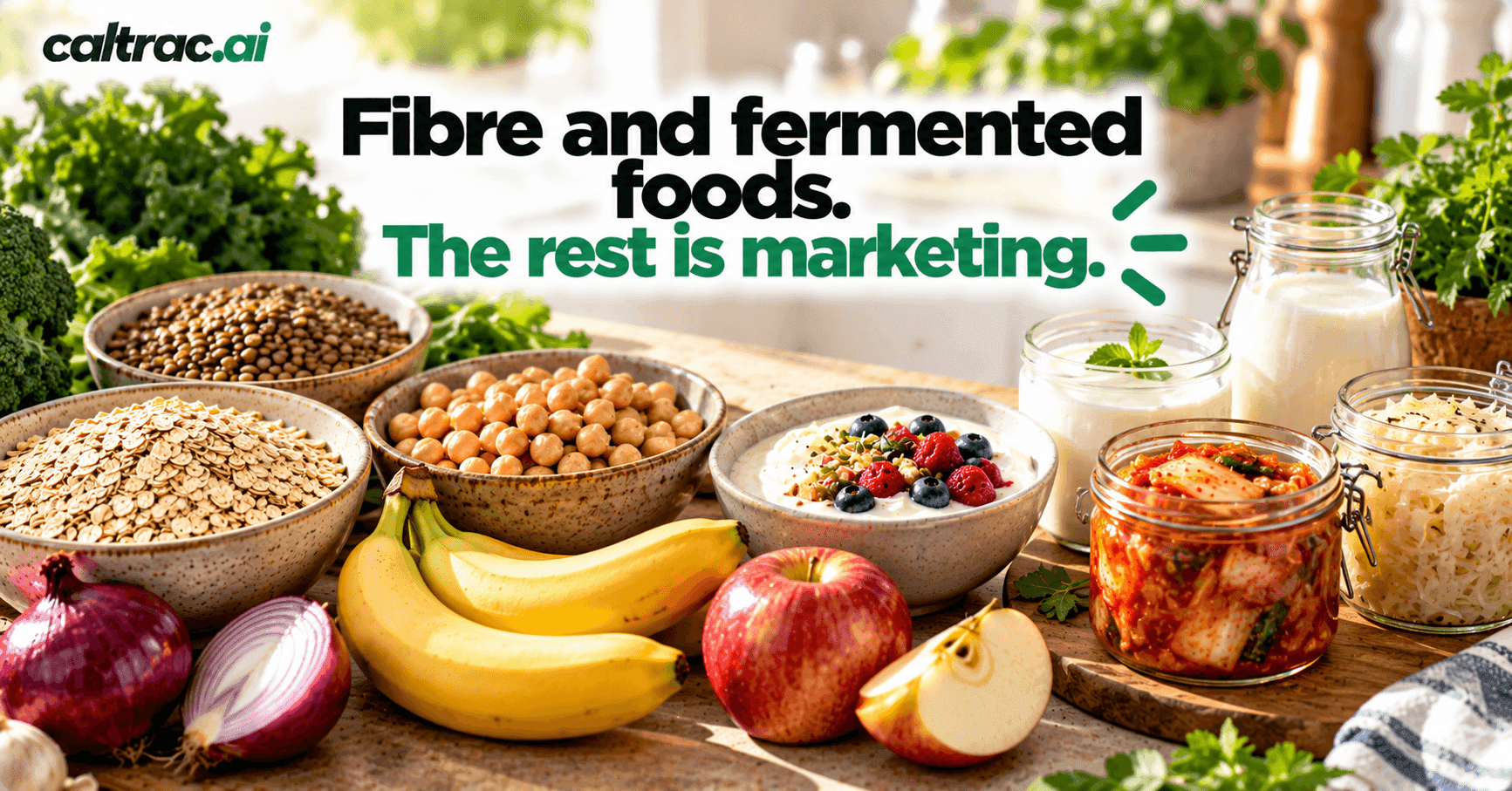
"Gut health" is the vaguest phrase in nutrition and one of the most marketed, so it is worth being precise about what the evidence supports. Dietary fibre reliably changes the gut microbiome, feeding the bacteria that make short-chain fatty acids and increasing specific beneficial groups. Fermented foods, in the one controlled trial that tested them against fibre, increased microbial diversity and lowered inflammation markers. Yogurt, uniquely among foods, predicts less weight gain over decades. Probiotic supplements produce a weight effect so small it is barely worth measuring. This article covers the foods, the trials and the numbers, with USDA data for each, and is clear about where the marketing outruns the science.
Fibre: The Food Your Bacteria Eat
The large intestine holds trillions of bacteria, and what they eat is the fibre you cannot digest. Fibres that reach the colon are fermented into short-chain fatty acids, which feed the gut lining, influence immune function and appetite signalling, and are the main mechanism by which diet shapes the microbiome [1]. A prebiotic, formally, is "a substrate that is selectively utilized by host microorganisms conferring a health benefit" [2], and most prebiotics are fibres: fructans in onion, garlic, leek, asparagus and wheat; galacto-oligosaccharides in pulses; beta-glucan in oats and barley; resistant starch in cooled potatoes and rice.
What fibre does to the microbiome is measured. Across 64 trials in 2,099 healthy adults, fibre supplementation increased Bifidobacterium and Lactobacillus abundance and raised faecal butyrate, with fructans and galacto-oligosaccharides the most effective types; it did not increase overall species diversity [3]. The diversity question matters because of what happens without fibre: in mice carrying a human microbiome, a low-fibre diet caused a loss of bacterial species that was reversible within a generation but became permanent after several generations on the same diet [4]. That is animal evidence and should be read as a warning rather than a human finding.
For weight, fibre's record is the strongest of anything here. Fibre intake predicted weight loss and adherence better than any other dietary factor in a six-month calorie-restricted trial [5]; viscous fibre alone, without calorie restriction, reduced weight by 0.33 kg and waist by 0.63 cm across 62 trials [6]; and across 185 prospective studies, each 8 g a day of fibre was associated with lower weight, blood pressure and cholesterol, and with 5 to 27% lower incidence of heart disease, diabetes and colorectal cancer [7]. Most adults eat about 16 g [8] against a target of 25 g for women and 38 g for men [9].
Fermented Foods: One Good Trial
The best human evidence on fermented foods is a 17-week Stanford trial of 36 healthy adults randomised to a high-fibre diet or a high-fermented-food diet. The fermented-food diet "steadily increased microbiota diversity and decreased inflammatory markers"; the high-fibre diet increased the bacterial enzymes that digest carbohydrate but did not change diversity over the period [10]. It is one trial with 18 people per arm, so it is a strong signal rather than a settled answer, but it is the trial that made yogurt, kefir, kimchi and sauerkraut more than folklore.
Yogurt has its own evidence. Across three cohorts of 120,877 US adults followed for up to 20 years, each additional daily serving of yogurt was associated with 0.82 lb less weight gain per four-year period, the strongest inverse association of any food studied, ahead of nuts, fruit and whole grains; potato chips, potatoes and sugary drinks were the strongest positive associations [11]. Observational data cannot prove yogurt causes the difference, but the signal is consistent and the mechanism, protein plus live cultures, is plausible.
Probiotic supplements are the weak link. Across 15 trials in overweight adults, probiotics reduced weight by 0.60 kg and body fat percentage by 0.6 points, effects the authors called small [12]; a 25-trial meta-analysis found 0.59 kg [13]; and in people with metabolic disease the weight effect was not significant, though BMI and waist improved slightly [14]. Half a kilogram is the honest size of the probiotic effect on weight, which is less than a week of a modest deficit.
The Gut Health Food List
USDA data; the "gut role" column is what each food contributes.
| Food | Portion | Calories | Fibre or culture | Gut role |
|---|---|---|---|---|
| Lentils [15] | 150 g cooked | 174 | 12 g fibre | Galacto-oligosaccharides, resistant starch |
| Chickpeas [16] | 150 g cooked | 246 | 11 g fibre | Galacto-oligosaccharides |
| Black beans [17] | 150 g cooked | 198 | 13 g fibre | Galacto-oligosaccharides, resistant starch |
| Oats [18] | 50 g dry | 190 | 5 g fibre | Beta-glucan |
| Barley [19] | 150 g cooked | 185 | 6 g fibre | Beta-glucan, resistant starch |
| Onion, garlic, leek [20] | 100 g | 40 | 1.7 g fibre | Fructans, the most effective prebiotic type in trials [3] |
| Banana [21] | 1 medium, 120 g | 107 | 3 g fibre | Fructans, resistant starch when green |
| Apple with skin [22] | 1 medium, 180 g | 94 | 4 g fibre | Pectin |
| Ground flaxseed [23] | 15 g | 80 | 4 g fibre | Viscous fibre, lignans |
| Chia [24] | 15 g | 73 | 5 g fibre | Viscous fibre |
| Broccoli [25] | 150 g | 51 | 4 g fibre | Mixed fibre, glucosinolates |
| Whole-wheat bread [26] | 2 slices | 151 | 3.6 g fibre | Fructans, arabinoxylan |
| Plain yogurt, live cultures [27] | 200 g | 122 | Live cultures | Fermented dairy; the yogurt cohort signal [11] |
| Greek yogurt, nonfat [28] | 200 g | 108 | Live cultures, 19 g protein | Fermented dairy, protein |
| Kefir [29] | 250 ml | 130 | Live cultures | Fermented dairy, broader culture mix |
| Kimchi [30] | 100 g | 15 | Live cultures, 1.6 g fibre | Fermented vegetable; 498 mg sodium |
| Sauerkraut, unpasteurised [31] | 100 g | 40 | Live cultures, 2.8 g fibre | Fermented vegetable; 659 mg sodium |
| Tempeh [32] | 100 g | 195 | Fermented soy, 20 g protein | Fermented legume, protein |
Two cautions. Fermented vegetables are salty, at 500 to 660 mg of sodium per 100 g, so a tablespoon or two is the serving, not a bowl. And pasteurised sauerkraut and pickles in vinegar carry no live cultures; the jar needs to say unpasteurised or live.
A Gut-Friendly Day That Also Fits a Deficit
The overlap between "good for the microbiome" and "good for weight loss" is almost total, because both come down to fibre, pulses, vegetables, fermented dairy and whole grains. A day built from the table: oats with Greek yogurt and a banana at breakfast (about 400 kcal, 14 g fibre); a lentil and vegetable salad with onion and a slice of whole-wheat bread at lunch (about 400 kcal, 16 g fibre); kefir and an apple as a snack (about 225 kcal, 4 g fibre); and tempeh or fish with barley, broccoli and a spoon of kimchi at dinner (about 500 kcal, 12 g fibre). That is roughly 1,500 kcal, 46 g of fibre, three fermented foods and 90 g or more of protein, and it looks like a weight-loss day because it is one.
What to Expect, and What Not To
- Build fibre up over two to three weeks. Going from 15 g to 40 g in a day produces gas and bloating; the bacteria adapt, but not overnight.
- Expect no quick weight loss from the gut itself. The probiotic effect is about half a kilogram [12] [13]; the fibre effect on adherence and fullness is where weight loss comes from [5].
- Skip the expensive products. The trial that moved diversity used yogurt, kefir, kimchi, sauerkraut and kombucha from the shop, not supplements [10]. A probiotic capsule is a single strain at a dose the food matches or beats.
- Variety matters more than any one food. Fructans, galacto-oligosaccharides, beta-glucan, pectin and resistant starch feed different bacteria [3] [1]; a diet with pulses, oats, onions, fruit and vegetables covers all of them.
Set your calorie target in the calorie calculator and your protein in the macro calculator; the gut-friendly day above sits inside both for most adults.
That is where tracking earns its keep. Fibre is the nutrient nobody can estimate by eye, and 16 g and 35 g look the same on a plate. Snap a photo of the bowl or type "150 g lentils, onion, 2 slices wholewheat" and track it automatically with Caltrac. You will see the day's fibre against the 25 or 38 g target, and your Apple Health-powered net calorie count shows that a gut-friendly day is also a deficit day. Feed the bacteria; let the app count the grams.
Frequently Asked Questions
What foods are best for gut health? Fibre-rich foods, especially pulses, oats, barley, onions, garlic, fruit and vegetables, which increased beneficial bacteria and butyrate across 64 trials [3], and fermented foods like yogurt, kefir, kimchi and sauerkraut, which increased microbial diversity in a 17-week trial [10].
Do probiotics help with weight loss? Marginally: about 0.6 kg across 15 trials in overweight adults [12] and 0.59 kg across 25 trials [13].
Is yogurt good for weight loss? Each daily serving was associated with 0.82 lb less weight gain per four years across 120,877 adults, the strongest protective association of any food studied [11].
How much fibre do I need for gut health? The intake targets are 25 g for women and 38 g for men [9]; most adults eat about 16 g [8]. Each extra 8 g a day was associated with lower weight and disease risk across 185 studies [7].
Is kimchi or sauerkraut good for you? Both carry live cultures and fibre, and fermented vegetables were part of the diet that increased diversity in the Stanford trial [10]. They are high in sodium, 500 to 660 mg per 100 g, so a small serving is the right one [30] [31].
What are prebiotic foods? Foods carrying fibres that gut bacteria selectively ferment [2]: onion, garlic, leek, asparagus, wheat and bananas for fructans; lentils, chickpeas and beans for galacto-oligosaccharides; oats and barley for beta-glucan; apples for pectin [3] [1].
References
- Makki K, Deehan EC, Walter J, Bäckhed F. The Impact of Dietary Fiber on Gut Microbiota in Host Health and Disease. Cell Host & Microbe. 2018;23(6):705-715. pubmed.ncbi.nlm.nih.gov
- Gibson GR, et al. Expert consensus document: The International Scientific Association for Probiotics and Prebiotics (ISAPP) consensus statement on the definition and scope of prebiotics. Nature Reviews Gastroenterology & Hepatology. 2017;14(8):491-502. pubmed.ncbi.nlm.nih.gov
- So D, et al. Dietary fiber intervention on gut microbiota composition in healthy adults: a systematic review and meta-analysis. American Journal of Clinical Nutrition. 2018;107(6):965-983. pubmed.ncbi.nlm.nih.gov
- Sonnenburg ED, et al. Diet-induced extinctions in the gut microbiota compound over generations. Nature. 2016;529(7585):212-215. pubmed.ncbi.nlm.nih.gov
- Miketinas DC, et al. Fiber Intake Predicts Weight Loss and Dietary Adherence in Adults Consuming Calorie-Restricted Diets: The POUNDS Lost Study. Journal of Nutrition. 2019;149(10):1742-1748. pubmed.ncbi.nlm.nih.gov
- Jovanovski E, et al. Can dietary viscous fiber affect body weight independently of an energy-restrictive diet? A systematic review and meta-analysis of randomized controlled trials. American Journal of Clinical Nutrition. 2020;111(2):471-485. pubmed.ncbi.nlm.nih.gov
- Reynolds A, Mann J, Cummings J, Winter N, Mete E, Te Morenga L. Carbohydrate quality and human health: a series of systematic reviews and meta-analyses. Lancet. 2019;393(10170):434-445. pubmed.ncbi.nlm.nih.gov
- National Center for Health Statistics. NCHS Nutrition Data fact sheet, March 2017 (mean fiber intake 16 g; men 18 g, women 15 g). stacks.cdc.gov
- National Academies, Food and Nutrition Board. Dietary Reference Intakes: Recommended Dietary Allowances and Adequate Intakes, Total Water and Macronutrients (fiber AI 38 g men 19 to 50, 25 g women 19 to 50). nationalacademies.org
- Wastyk HC, et al. Gut-microbiota-targeted diets modulate human immune status. Cell. 2021;184(16):4137-4153. pubmed.ncbi.nlm.nih.gov
- Mozaffarian D, Hao T, Rimm EB, Willett WC, Hu FB. Changes in diet and lifestyle and long-term weight gain in women and men. New England Journal of Medicine. 2011;364(25):2392-2404. pubmed.ncbi.nlm.nih.gov
- Borgeraas H, Johnson LK, Skattebu J, Hertel JK, Hjelmesaeth J. Effects of probiotics on body weight, body mass index, fat mass and fat percentage in subjects with overweight or obesity: a systematic review and meta-analysis of randomized controlled trials. Obesity Reviews. 2018;19(2):219-232. pubmed.ncbi.nlm.nih.gov
- Zhang Q, Wu Y, Fei X. Effect of probiotics on body weight and body-mass index: a systematic review and meta-analysis of randomized, controlled trials. International Journal of Food Sciences and Nutrition. 2016;67(5):571-580. pubmed.ncbi.nlm.nih.gov
- Perna S, et al. Is Probiotic Supplementation Useful for the Management of Body Weight and Other Anthropometric Measures in Adults Affected by Overweight and Obesity with Metabolic Related Diseases? A Systematic Review and Meta-Analysis. Nutrients. 2021;13(2):666. pubmed.ncbi.nlm.nih.gov
- USDA FoodData Central. Lentils, cooked: 116 kcal, 9 g protein, 7.9 g fibre per 100 g. SR Legacy 172421. fdc.nal.usda.gov
- USDA FoodData Central. Chickpeas, cooked: 164 kcal, 8.9 g protein, 7.6 g fibre per 100 g. SR Legacy 173757. fdc.nal.usda.gov
- USDA FoodData Central. Beans, black, cooked: 132 kcal, 8.9 g protein, 8.7 g fibre per 100 g. SR Legacy 173735. fdc.nal.usda.gov
- USDA FoodData Central. Cereals, oats, dry: 379 kcal, 13.2 g protein, 10.1 g fibre per 100 g. SR Legacy 173904. fdc.nal.usda.gov
- USDA FoodData Central. Barley, pearled, cooked: 123 kcal, 3.8 g fibre per 100 g. SR Legacy 170285. fdc.nal.usda.gov
- USDA FoodData Central. Onions, raw: 40 kcal, 1.7 g fibre per 100 g. SR Legacy 170000. fdc.nal.usda.gov
- USDA FoodData Central. Bananas, raw: 89 kcal, 2.6 g fibre per 100 g. SR Legacy 173944. fdc.nal.usda.gov
- USDA FoodData Central. Apples, raw, with skin: 52 kcal, 2.4 g fibre per 100 g. SR Legacy 171688. fdc.nal.usda.gov
- USDA FoodData Central. Seeds, flaxseed: 534 kcal, 27.3 g fibre per 100 g. SR Legacy 169414. fdc.nal.usda.gov
- USDA FoodData Central. Seeds, chia seeds, dried: 486 kcal, 34.4 g fibre per 100 g. SR Legacy 170554. fdc.nal.usda.gov
- USDA FoodData Central. Broccoli, raw: 34 kcal, 2.6 g fibre per 100 g. SR Legacy 170379. fdc.nal.usda.gov
- USDA FoodData Central. Bread, whole-wheat: 252 kcal, 6 g fibre per 100 g; 1 slice about 30 g. SR Legacy 172688. fdc.nal.usda.gov
- USDA FoodData Central. Yogurt, plain, whole milk: 61 kcal, 3.5 g protein per 100 g. SR Legacy 171284. fdc.nal.usda.gov
- USDA FoodData Central. Yogurt, Greek, nonfat, plain: 54 kcal, 9.5 g protein per 100 g. SR Legacy 171312. fdc.nal.usda.gov
- USDA FoodData Central, FNDDS. Kefir: 52 kcal, 3.6 g protein, 6.9 g sugar per 100 g; 1 cup 244 g. FDC ID 2705394. fdc.nal.usda.gov
- USDA FoodData Central, FNDDS. Kimchi: 15 kcal, 1.6 g fibre, 498 mg sodium per 100 g; 1 cup 150 g. FDC ID 2710077. fdc.nal.usda.gov
- USDA FoodData Central, FNDDS. Sauerkraut: 40 kcal, 2.8 g fibre, 659 mg sodium per 100 g; 1 cup 140 g. FDC ID 2709982. fdc.nal.usda.gov
- USDA FoodData Central. Tempeh, cooked: 195 kcal, 19.9 g protein per 100 g. SR Legacy 172467. fdc.nal.usda.gov