


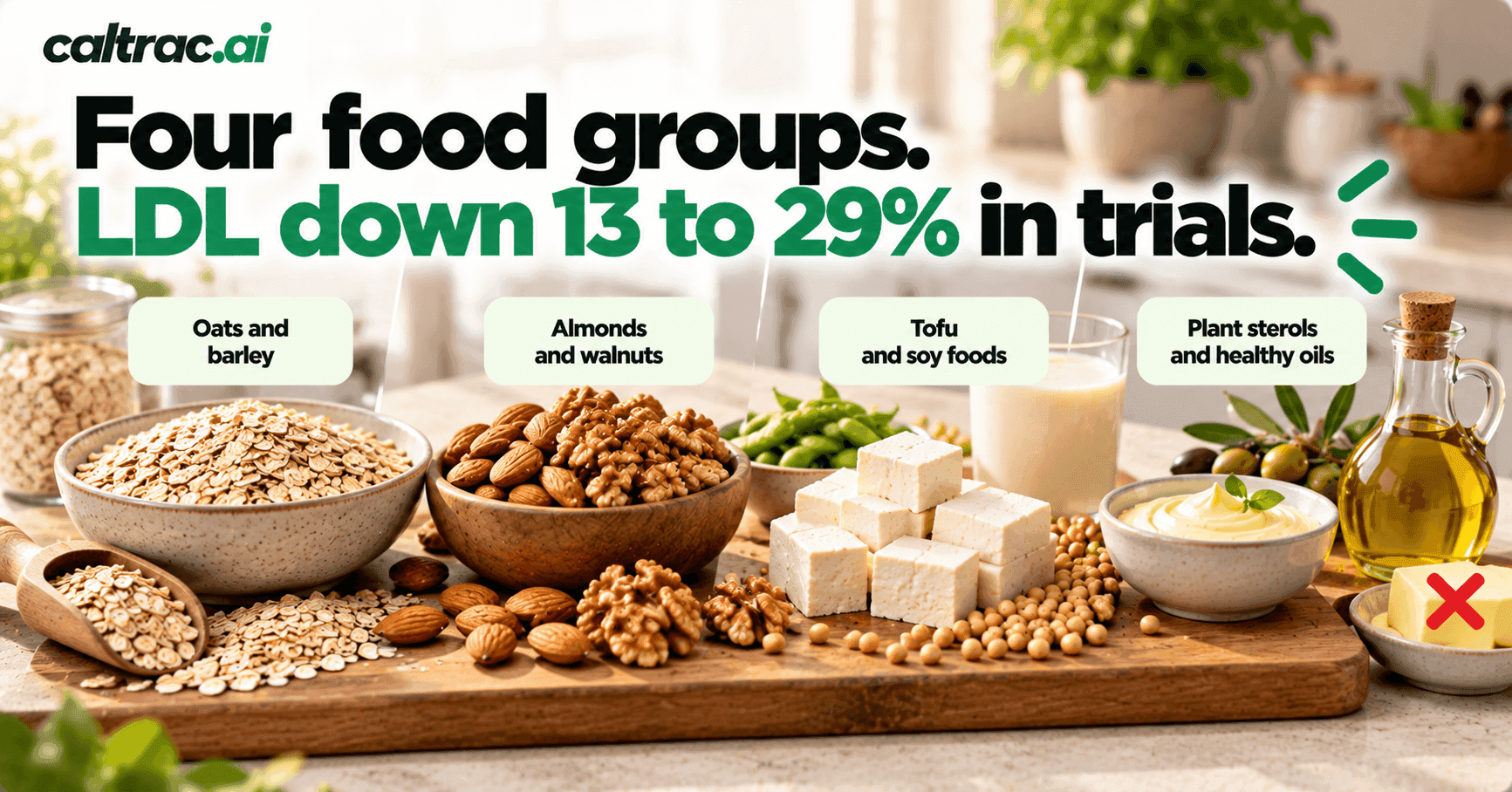
Food can lower LDL cholesterol by amounts that matter, and the evidence is unusually good because the outcomes are measured in blood rather than inferred. A combination of four food groups, eaten together, lowered LDL by 29% in a month in a controlled trial, within a point of a starting-dose statin. The same combination in the real world, with people shopping and cooking for themselves, managed about 13%. Each component on its own, oats, nuts, soy, plant sterols, and the swap of saturated for unsaturated fat, has its own trials with its own number. This article lays out those numbers, builds a shopping list from USDA data, and is honest about what food cannot do.
This is general nutrition information, not medical advice. Cholesterol targets and medication are decisions for you and your doctor; the foods below work alongside treatment, not instead of it.
The Portfolio Diet: The Strongest Evidence
In 2003, 46 adults with high cholesterol spent a month on one of three regimens: a low-saturated-fat control diet, the same diet plus 20 mg of lovastatin, or a "dietary portfolio" that added plant sterols, soy protein, viscous fibre and almonds. LDL fell 8% on the control diet, 30.9% on the statin and 28.6% on the portfolio, and the authors reported no significant difference between the statin and the food [1]. The food was supplied and the diet was tightly controlled.
The follow-up asked what happens when people do it themselves. In 351 participants across four Canadian centres for six months, with self-selected diets and either intensive or routine dietary advice, LDL fell 13.8% and 13.1% on the two portfolio arms against 3% on the control diet [2]. A 2018 meta-analysis of seven controlled trials put the pooled effect at about 17%, with high-certainty evidence for LDL and additional reductions in blood pressure, triglycerides and C-reactive protein [3]. Thirteen to seventeen percent is the realistic number for people living normal lives, and it is a large effect for food.
The four components, and the trial doses per 1,000 kcal, were plant sterols 1 g, soy protein 21 g, viscous fibre 10 g and almonds 14 g [1]. On a 2,000 kcal day that is 2 g of sterols, about 40 g of soy protein, 20 g of viscous fibre and 28 g of almonds.
Each Food, With Its Own Evidence
Oats, barley and viscous fibre. The soluble fibre in oats, beta-glucan, lowered LDL by 0.25 mmol/L, about 10 mg/dL, at doses of 3 g a day or more across 28 randomised trials, with larger effects in people with higher starting LDL [4]. Oats are 10 g of total fibre per 100 g [5], barley 3.8 g per 100 g cooked [6]. Psyllium, okra, aubergine and apples carry viscous fibre too.
Nuts. Pooling individual data from 25 trials, a mean of 67 g of nuts a day lowered LDL by 10.2 mg/dL, 7.4%, with the effect dose-dependent and independent of the type of nut [7]. A larger meta-analysis of 61 trials found 4.8 mg/dL per 28 g daily serving, with stronger effects at 60 g or more [8]. Almonds, 579 kcal per 100 g with 12.5 g of fibre [9], and walnuts, 654 kcal [10], are both calorie-dense: the 28 g serving is the one that fits a weight-loss day, at 160 to 185 kcal.
Soy protein. Across the 46 trials the FDA used for its soy health claim, soy protein lowered LDL by 4 to 7 mg/dL, an effect that was present in 1999 and has held in every cumulative update since [11]. Tofu at 17 g of protein per 100 g [12], soy milk, soya chunks, edamame and tempeh deliver it.
Plant sterols and stanols. These occur naturally in nuts, seeds and oils and are added to some margarines and yogurt drinks. Across 124 studies, intakes from 0.6 to 3.3 g a day lowered LDL by 6 to 12%, with the effect plateauing at about 3 g and an average of 12% at that dose [13]. Reaching 2 g from food alone is difficult; it is the one portfolio component that usually comes from a fortified product.
Replacing saturated fat. A Cochrane review of 15 trials in 56,675 people found that reducing saturated fat cut combined cardiovascular events by 17%, with the benefit seen when it was replaced by polyunsaturated fat or carbohydrate [14]. The WHO's regression of 84 controlled feeding studies quantified the lipid effect: for each 1% of energy moved from saturated fat to polyunsaturated fat, LDL fell by 0.055 mmol/L, to monounsaturated fat 0.042, and to carbohydrate 0.033 [15]. Five percent of energy, about 11 g of saturated fat on a 2,000 kcal day, swapped to olive oil, nuts and fish lowers LDL by roughly 0.2 to 0.27 mmol/L, 8 to 10 mg/dL. The sources to swap out are the concentrated ones: butter is 51 g of saturated fat per 100 g [16] and ghee 62 g [17], against 14 g for olive oil [18] and 2.4 g for salmon [19].
Eggs. Dietary cholesterol has a smaller effect on blood cholesterol than saturated fat, and the cohort evidence is reassuring: up to one egg a day was not associated with cardiovascular disease across 1.7 million people, with the authors flagging people with diabetes as a group to be cautious [20]. Eggs are not on the shopping list below, but they do not need to come off it for most people.
Weight loss itself. The obesity guideline notes that sustained loss of even 3 to 5% of body weight produces clinically meaningful improvements in cardiovascular risk factors [21]. Several of the foods below also predict weight loss through fibre and satiety [22], so the portfolio and a deficit pull in the same direction.
The Shopping List
Built from USDA data; portions are those that fit a 1,600 to 2,000 kcal day.
| Food | Daily portion | Calories | What it supplies |
|---|---|---|---|
| Oats [5] | 50 g dry | 190 | 5 g fibre including beta-glucan; protein |
| Barley [6] | 150 g cooked | 185 | 5.7 g fibre including beta-glucan |
| Almonds [9] | 28 g | 162 | Unsaturated fat, 3.5 g fibre, plant sterols |
| Walnuts [10] | 28 g | 183 | Polyunsaturated fat |
| Ground flaxseed [23] | 15 g | 80 | 4 g fibre, omega-3 fat |
| Chickpeas, lentils or beans [24] [25] [26] | 150 g cooked | 175 to 245 | 10 to 12 g fibre, 13 g protein |
| Tofu [12] | 150 g | 216 | 26 g soy protein |
| Unsweetened soy milk [27] | 250 ml | 95 | 9 g soy protein |
| Olive oil, in place of butter or ghee [18] | 1 tablespoon | 119 | Monounsaturated fat replacing saturated |
| Avocado [28] | 75 g | 120 | Monounsaturated fat, 5 g fibre |
| Oily fish [19] | 120 g, twice a week | 247 | Omega-3 fat replacing saturated |
| Apples and other pectin fruit [29] | 1 to 2 a day | 80 to 160 | Viscous fibre |
| Sterol-fortified spread or drink | As labelled, about 2 g sterols | Varies | Plant sterols [13] |
The full list is around 1,400 kcal before vegetables, which is why nobody eats all of it every day; the portfolio in practice is oats or barley for breakfast, a handful of nuts, a pulse or soy food at one meal, olive oil instead of butter, and a fortified spread if sterols are wanted. That is close to the pattern the six-month trial participants followed for a 13% fall [2].
What to Expect
- Four to six weeks for the full effect of a dietary change on LDL; the one-month trial saw the whole 29% in that time [1].
- 10 to 17% is the realistic range for a self-managed portfolio [2] [3]; single components deliver 3 to 10% each [4] [7] [11].
- More if your starting LDL is high, since the oat and nut effects scaled with baseline [4] [7].
- Not a replacement for medication where it is indicated. The 2003 trial matched a starting statin dose under tightly controlled conditions; the real-world result was less than half of that, and higher-intensity statins lower LDL by 50% or more. The portfolio adds to treatment; it does not substitute for it.
- A weight-loss bonus. Oats, pulses, nuts, fish and olive oil are the same foods that predict adherence and fullness in diet trials [22]. Set a modest deficit in the calorie calculator and the portfolio fits inside it; nuts and oil are the two items to measure.
That is where tracking earns its keep. The portfolio works on daily doses, 28 g of nuts, a pulse at one meal, oats most mornings, and a tablespoon of olive oil in place of butter, and daily doses are what a log shows. Snap a photo of the bowl or type "50 g oats, 28 g almonds, 250 ml soy milk" and track it automatically with Caltrac. You will see the fibre and saturated fat for the day against your targets, and your Apple Health-powered net calorie count keeps the nuts and oil inside the budget. Eat the portfolio; let the app confirm the doses.
Frequently Asked Questions
What foods lower cholesterol the most? Together, oats and other viscous fibre, nuts, soy protein and plant sterols lowered LDL by 29% in a controlled month and by about 13% in a six-month real-world trial [1] [2]. Individually, nuts gave about 7%, oat beta-glucan about 10 mg/dL, and sterols up to 12% [7] [4] [13].
How much oatmeal a day lowers cholesterol? Trials used at least 3 g of oat beta-glucan a day, which lowered LDL by 0.25 mmol/L [4]. A 50 g bowl of oats each morning, with barley or oat bran elsewhere, is the usual way to reach it.
Do nuts raise cholesterol because of the fat? No. A mean of 67 g a day lowered LDL by 7.4% across 25 trials, with no difference by type of nut [7]. The fat is mostly unsaturated.
Can I eat eggs if I have high cholesterol? For most people, up to one a day was not associated with cardiovascular disease across 1.7 million people [20]. People with diabetes should follow medical advice. Saturated fat affects LDL more than dietary cholesterol does [15].
Is ghee bad for cholesterol? Ghee is 62 g of saturated fat per 100 g and butter 51 g [17] [16]. Replacing saturated with unsaturated fat lowers LDL [15] and reduced cardiovascular events by 17% in trials [14]; olive oil at 14 g per 100 g is the swap.
How long does it take for diet to lower cholesterol? About a month for the full effect: the 2003 portfolio trial measured its 28.6% reduction at four weeks [1].
References
- Jenkins DJ, et al. Effects of a dietary portfolio of cholesterol-lowering foods vs lovastatin on serum lipids and C-reactive protein. JAMA. 2003;290(4):502-510. pubmed.ncbi.nlm.nih.gov
- Jenkins DJ, et al. Effect of a dietary portfolio of cholesterol-lowering foods given at 2 levels of intensity of dietary advice on serum lipids in hyperlipidemia: a randomized controlled trial. JAMA. 2011;306(8):831-839. pubmed.ncbi.nlm.nih.gov
- Chiavaroli L, et al. Portfolio Dietary Pattern and Cardiovascular Disease: A Systematic Review and Meta-analysis of Controlled Trials. Progress in Cardiovascular Diseases. 2018;61(1):43-53. pubmed.ncbi.nlm.nih.gov
- Whitehead A, Beck EJ, Tosh S, Wolever TM. Cholesterol-lowering effects of oat β-glucan: a meta-analysis of randomized controlled trials. American Journal of Clinical Nutrition. 2014;100(6):1413-1421. pubmed.ncbi.nlm.nih.gov
- USDA FoodData Central. Cereals, oats, regular and quick, dry: 379 kcal, 13.2 g protein, 10.1 g fibre, 1.1 g saturated fat per 100 g. SR Legacy 173904. fdc.nal.usda.gov
- USDA FoodData Central. Barley, pearled, cooked: 123 kcal, 3.8 g fibre per 100 g. SR Legacy 170285. fdc.nal.usda.gov
- Sabaté J, Oda K, Ros E. Nut consumption and blood lipid levels: a pooled analysis of 25 intervention trials. Archives of Internal Medicine. 2010;170(9):821-827. pubmed.ncbi.nlm.nih.gov
- Del Gobbo LC, Falk MC, Feldman R, Lewis K, Mozaffarian D. Effects of tree nuts on blood lipids, apolipoproteins, and blood pressure: systematic review, meta-analysis, and dose-response of 61 controlled intervention trials. American Journal of Clinical Nutrition. 2015;102(6):1347-1356. pubmed.ncbi.nlm.nih.gov
- USDA FoodData Central. Nuts, almonds: 579 kcal, 21.2 g protein, 12.5 g fibre, 3.8 g saturated fat per 100 g. SR Legacy 170567. fdc.nal.usda.gov
- USDA FoodData Central. Nuts, walnuts, English: 654 kcal, 15.2 g protein, 6.7 g fibre per 100 g. SR Legacy 170187. fdc.nal.usda.gov
- Jenkins DJA, et al. Cumulative Meta-Analysis of the Soy Effect Over Time. Journal of the American Heart Association. 2019;8(13):e012458. pubmed.ncbi.nlm.nih.gov
- USDA FoodData Central. Tofu, firm: 144 kcal, 17.3 g protein per 100 g. SR Legacy 172475. fdc.nal.usda.gov
- Ras RT, Geleijnse JM, Trautwein EA. LDL-cholesterol-lowering effect of plant sterols and stanols across different dose ranges: a meta-analysis of randomised controlled studies. British Journal of Nutrition. 2014;112(2):214-219. pubmed.ncbi.nlm.nih.gov
- Hooper L, et al. Reduction in saturated fat intake for cardiovascular disease. Cochrane Database of Systematic Reviews. 2020;5:CD011737. pubmed.ncbi.nlm.nih.gov
- Mensink RP; World Health Organization. Effects of saturated fatty acids on serum lipids and lipoproteins: a systematic review and regression analysis. Geneva: WHO; 2016. ISBN 9789241565349. iris.who.int
- USDA FoodData Central. Butter, salted: 717 kcal, 51.4 g saturated fat per 100 g; 1 tablespoon 14.2 g. SR Legacy 173410. fdc.nal.usda.gov
- USDA FoodData Central, FNDDS. Ghee, clarified butter: 876 kcal, 61.9 g saturated fat per 100 g; 1 tablespoon 14 g. FDC ID 2710168. fdc.nal.usda.gov
- USDA FoodData Central. Oil, olive: 884 kcal, 13.8 g saturated fat per 100 g; 1 tablespoon 13.5 g. SR Legacy 171413. fdc.nal.usda.gov
- USDA FoodData Central. Salmon, Atlantic, farmed, cooked: 206 kcal, 22.1 g protein, 2.4 g saturated fat per 100 g. SR Legacy 175168. fdc.nal.usda.gov
- Drouin-Chartier JP, et al. Egg consumption and risk of cardiovascular disease: three large prospective US cohort studies, systematic review, and updated meta-analysis. BMJ. 2020;368:m513. pubmed.ncbi.nlm.nih.gov
- Jensen MD, et al. 2013 AHA/ACC/TOS guideline for the management of overweight and obesity in adults. Circulation. 2014;129(25 Suppl 2):S102-S138. pubmed.ncbi.nlm.nih.gov
- Miketinas DC, et al. Fiber Intake Predicts Weight Loss and Dietary Adherence in Adults Consuming Calorie-Restricted Diets: The POUNDS Lost Study. Journal of Nutrition. 2019;149(10):1742-1748. pubmed.ncbi.nlm.nih.gov
- USDA FoodData Central. Seeds, flaxseed: 534 kcal, 18.3 g protein, 27.3 g fibre per 100 g. SR Legacy 169414. fdc.nal.usda.gov
- USDA FoodData Central. Chickpeas, cooked: 164 kcal, 8.9 g protein, 7.6 g fibre, 0.3 g saturated fat per 100 g. SR Legacy 173757. fdc.nal.usda.gov
- USDA FoodData Central. Lentils, cooked: 116 kcal, 9 g protein, 7.9 g fibre per 100 g. SR Legacy 172421. fdc.nal.usda.gov
- USDA FoodData Central. Beans, kidney, cooked: 127 kcal, 8.7 g protein, 6.4 g fibre per 100 g. SR Legacy 173740. fdc.nal.usda.gov
- USDA FoodData Central, FNDDS. Soy milk, unsweetened: 38 kcal, 3.6 g protein per 100 g; 1 cup 244 g. FDC ID 2705405. fdc.nal.usda.gov
- USDA FoodData Central. Avocados, raw, all commercial varieties: 160 kcal, 6.7 g fibre per 100 g. SR Legacy 171705. fdc.nal.usda.gov
- USDA FoodData Central. Apples, raw, with skin: 52 kcal, 2.4 g fibre per 100 g. SR Legacy 171688. fdc.nal.usda.gov