


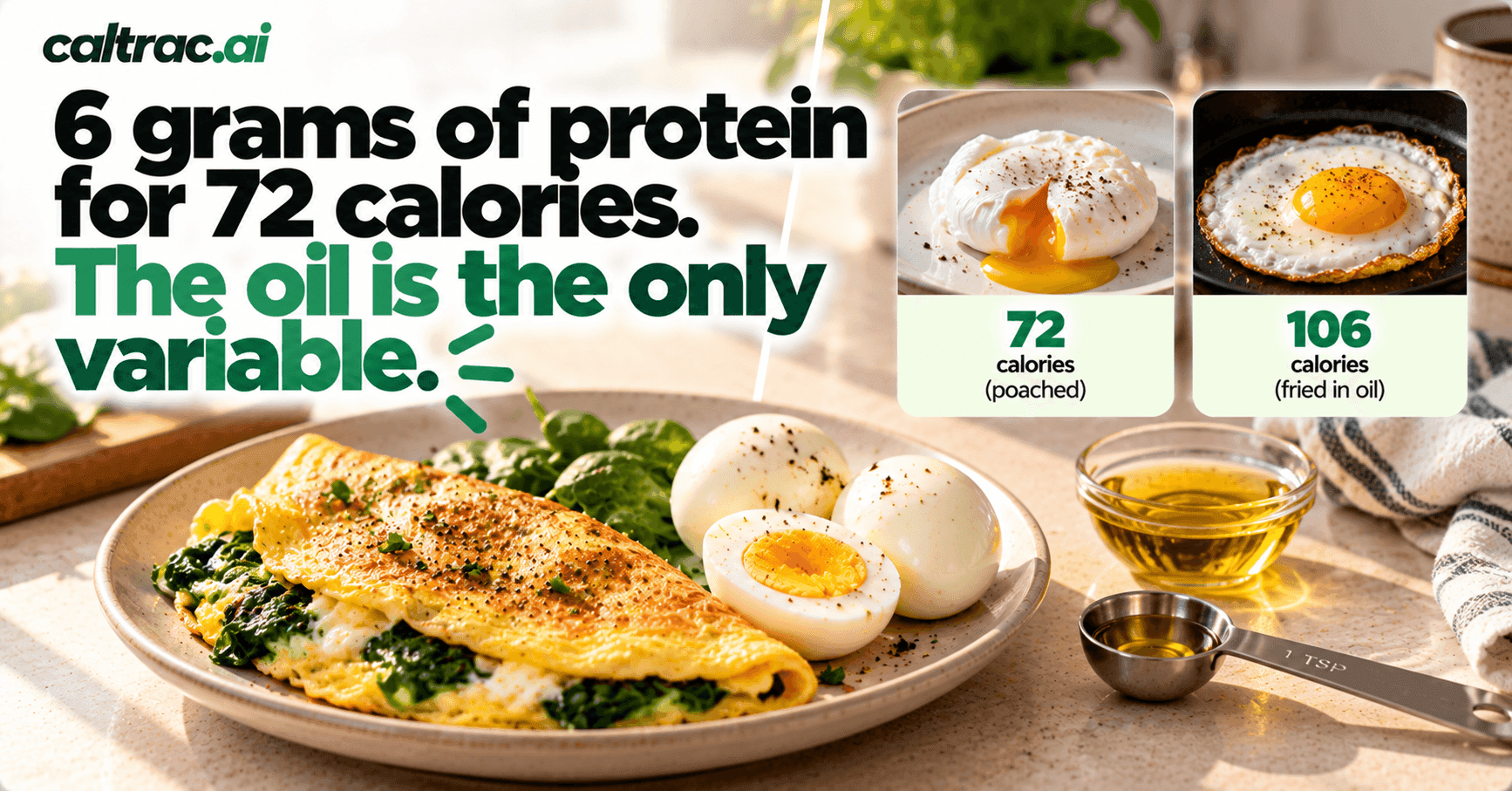
An egg is 72 calories and 6.3 g of the best protein in the kitchen, and almost nothing you do to it changes that. What changes is the fat it is cooked in: a poached egg and an egg fried in oil differ by 34 calories, and three eggs a day cooked two different ways differ by 100. This article takes one large egg through ten cooking methods using USDA data, shows what each adds, then puts eggs through the research on satiety, weight loss and heart health, and finishes with eight egg meals under 350 calories.
One Egg, Ten Ways
USDA values for a large egg, about 50 g. The "added" column is the difference from a boiled egg.
| Method | Calories per egg | Protein | Fat | Added |
|---|---|---|---|---|
| Raw [1] | 72 | 6.3 g | 4.8 g | 0 |
| Poached [2] | 72 | 6.3 g | 4.7 g | 0 |
| Soft or hard-boiled [3] | 78 | 6.3 g | 5.3 g | 0 |
| Scrambled or omelette, no added fat [4] | 72 | 6.2 g | 5.0 g | 0 |
| Fried with cooking spray [5] | 75 | 6.1 g | 5.3 g | +3 |
| Scrambled with milk and fat, standard recipe [6] | 91 | 6.1 g | 6.7 g | +13 |
| Omelette made with butter [7] | 100 | 6.4 g | 8.1 g | +22 |
| Fried with butter [8] | 100 | 6.4 g | 8.1 g | +22 |
| Fried with oil [9] | 106 | 6.4 g | 8.7 g | +28 |
| Egg whites only, 2 whites [10] | 34 | 7.2 g | 0.1 g | n/a |
The boiled egg reads a few calories higher than raw because it loses a little water through the shell, so each gram is denser; the egg itself is unchanged. Everything above 78 calories is cooking fat: butter at 36 kcal a teaspoon [11], oil at 40 [12]. Two egg whites deliver more protein than a whole egg for less than half the calories and no fat or cholesterol [10], which is why the whole-egg-plus-whites omelette is the most efficient protein dish on any breakfast table.
On raw eggs. Beyond the salmonella risk, raw egg is poor nutrition: in a stable-isotope study, the true digestibility of egg protein was 91% cooked and 51% raw [13]. The FDA's instruction is to cook eggs until yolk and white are firm and egg dishes to 160°F, and to use pasteurised eggs for any recipe that stays raw [14].
Eggs and Appetite
Eggs are the most studied single breakfast food, and the findings are consistent. Thirty women given an egg breakfast or a bagel breakfast matched for calories and weight ate 22% less at lunch three and a half hours later, and their intake stayed lower for the rest of the day and the following 36 hours [15]. Thirty men given eggs on toast, cornflakes with milk and toast, or a croissant with orange juice, all matched for calories, reported more fullness after the eggs and ate about 160 fewer calories at lunch and about 300 fewer at the evening meal than after the cereal [16]. In overweight teenagers, a 350 kcal breakfast with 35 g of protein from eggs and lean beef, against 13 g from cereal, raised fullness, lowered ghrelin, raised PYY and reduced evening snacking on high-fat food [17].
The mechanism is protein: eggs deliver 6 g per 72 kcal, and the breakfast with 25 to 30 g of protein is the one that suppresses appetite through the day [18] [19]. Two eggs and two whites is 26 g.
Eggs and Weight Loss
The appetite effect translates into weight loss when, and only when, calories are also controlled. In an eight-week trial of 152 adults, an egg breakfast combined with a 1,000 kcal deficit produced 65% more weight loss than a bagel breakfast with the same deficit, 2.6 kg against 1.6, and a 61% greater fall in BMI; among people eating freely with no diet, the egg breakfast made no difference to weight [20]. The egg is a tool for holding a deficit, not a substitute for one.
Eggs and Cholesterol
One large egg carries about 186 mg of cholesterol [1], which is the origin of decades of caution. The evidence has moved. Across three cohorts of 215,000 US adults followed for up to 32 years, eating at least one egg a day was not associated with cardiovascular disease compared with less than one a month; a meta-analysis of 33 estimates covering 1.7 million people found a pooled relative risk of 0.98 per additional egg a day, and in Asian cohorts a slightly lower risk [21]. The authors' conclusion is that moderate consumption, up to one egg a day, is not associated with cardiovascular risk overall. Blood lipids did not differ between egg and bagel breakfasts in the eight-week trial either [20].
People with diabetes or familial hypercholesterolaemia are the exception the cohort authors flag, and should follow medical advice. For everyone else, the fat the egg is fried in matters more than the egg: butter is mostly saturated fat, and a teaspoon of it on each of three eggs a day is more saturated fat than the eggs themselves.
Eight Egg Meals Under 350 Calories
Built from the table and USDA data for the additions. Each delivers 20 g of protein or more.
| # | Meal | Calories | Protein |
|---|---|---|---|
| 1 | Two eggs plus two whites, scrambled without fat, with 100 g spinach [4] [10] [22] | 201 | 22 g |
| 2 | Masala omelette: 2 eggs, 2 whites, 50 g onion, 50 g tomato, chilli, coriander, 1 tsp oil [4] [10] [23] [24] [12] | 247 | 22 g |
| 3 | Egg bhurji and roti: 2 eggs scrambled without fat with 50 g onion and 50 g tomato, 1 roti [4] [23] [24] [25] | 293 | 16 g, 23 g with 2 whites |
| 4 | Eggs on toast: 2 poached eggs, 1 slice whole-wheat toast, 100 g tomato [2] [26] [24] | 237 | 17 g, 24 g with 2 whites |
| 5 | Mushroom and mozzarella omelette: 2 eggs, 100 g mushrooms, 30 g part-skim mozzarella, cooking spray [5] [27] [28] | 248 | 22 g |
| 6 | Three-egg omelette with spinach, cooked in 1 tsp butter [4] [22] [11] | 274 | 21 g |
| 7 | Egg salad: 2 boiled eggs chopped into 100 g nonfat Greek yogurt with mustard and chives, on 1 slice whole-wheat toast [3] [29] [26] | 286 | 26 g |
| 8 | Shakshuka: 2 eggs poached in 200 g tomato and 50 g onion with cumin and paprika, 1 tsp oil [2] [24] [23] [12] | 240 | 14 g, 21 g with 2 whites |
The pattern in the table is the pattern of the whole article: two whole eggs are 145 calories and 13 g of protein, two whites add 7 g for 34, and the cooking fat is the only variable worth watching. A tablespoon of butter in the pan is 100 calories, more than an extra egg.
How Many Eggs a Day?
The cohort evidence supports up to one a day as neutral for heart health in the general population [21]; the trials used two a day with a deficit for weight loss [20]; and nothing in the research sets a hard ceiling for healthy adults. The practical answer is two or three whole eggs plus whites as needed to reach 25 to 30 g per meal, cooked in a measured teaspoon of fat or none, inside a 500 to 750 kcal deficit [30]. Set that deficit with the calorie calculator and the protein target with the macro calculator.
That is where tracking earns its keep. Two fried eggs and two poached eggs are the same eggs and differ by 56 calories of oil. Snap a photo of the plate or type "2 eggs fried in butter, 1 toast" and track it automatically with Caltrac. You will see the cooking fat counted alongside the protein, and your Apple Health-powered net calorie count shows how breakfast set up the day. Eat the eggs; let the app count the butter.
Frequently Asked Questions
How many calories in an egg? About 72 for a large raw or poached egg, 78 boiled, 75 fried with spray, 100 fried in butter, 106 fried in oil [1] [3] [8] [9].
Is it OK to eat eggs every day? Up to one a day was not associated with cardiovascular disease across three large cohorts and a meta-analysis of 1.7 million people [21]. People with diabetes should follow medical advice.
Do eggs help with weight loss? With a calorie deficit, yes: an egg breakfast produced 65% more weight loss than a bagel breakfast over eight weeks on the same diet [20], and egg breakfasts reduced intake at later meals in controlled trials [15] [16].
Which is the healthiest way to cook eggs? Boiled, poached or scrambled without fat adds nothing; frying in butter or oil adds 22 to 28 kcal per egg [8] [9]. Cooking also raises protein digestibility from 51% to 91% [13].
How much protein is in two eggs? About 12.6 g, or 20 g with two added whites [1] [10].
Are egg whites healthier than whole eggs? They have more protein per calorie and no fat or cholesterol [10], but the yolk carries the choline, vitamins and most of the flavour [1]. Two whole eggs plus whites gets both.
References
- USDA FoodData Central. Egg, whole, raw, fresh: 143 kcal, 12.6 g protein, 9.5 g fat, 372 mg cholesterol, 294 mg choline per 100 g; 1 large 50 g. SR Legacy 171287. fdc.nal.usda.gov
- USDA FoodData Central. Egg, whole, cooked, poached: 143 kcal, 12.5 g protein, 9.5 g fat per 100 g; 1 large 50 g. SR Legacy 172186. fdc.nal.usda.gov
- USDA FoodData Central. Egg, whole, cooked, hard-boiled: 155 kcal, 12.6 g protein, 10.6 g fat per 100 g; 1 large 50 g. SR Legacy 173424. fdc.nal.usda.gov
- USDA FoodData Central, FNDDS. Egg omelet or scrambled egg, no added fat: 143 kcal, 12.4 g protein, 9.9 g fat per 100 g; 1 egg 50 g. FDC ID 2707205. fdc.nal.usda.gov
- USDA FoodData Central, FNDDS. Egg, whole, fried with cooking spray: 149 kcal, 12.2 g protein, 10.6 g fat per 100 g; 1 egg 50 g. FDC ID 2707161. fdc.nal.usda.gov
- USDA FoodData Central. Egg, whole, cooked, scrambled (with milk and fat): 149 kcal, 10 g protein, 11 g fat per 100 g; 1 large egg yields 61 g. SR Legacy 172187. fdc.nal.usda.gov
- USDA FoodData Central, FNDDS. Egg omelet or scrambled egg, made with butter: 182 kcal, 11.6 g protein, 14.6 g fat per 100 g; 1 egg 55 g. FDC ID 2707201. fdc.nal.usda.gov
- USDA FoodData Central, FNDDS. Egg, whole, fried with butter: 182 kcal, 11.6 g protein, 14.6 g fat per 100 g; 1 egg 55 g. FDC ID 2707159. fdc.nal.usda.gov
- USDA FoodData Central, FNDDS. Egg, whole, fried with oil: 192 kcal, 11.6 g protein, 15.8 g fat per 100 g; 1 egg 55 g. FDC ID 2707158. fdc.nal.usda.gov
- USDA FoodData Central. Egg, white, raw: 52 kcal, 10.9 g protein, 0.2 g fat, 0 mg cholesterol per 100 g; 1 white 33 g. SR Legacy 172183. fdc.nal.usda.gov
- USDA FoodData Central. Butter, salted: 717 kcal per 100 g; 1 teaspoon 5 g, 36 kcal. SR Legacy 173410. fdc.nal.usda.gov
- USDA FoodData Central. Oil, olive, salad or cooking: 884 kcal per 100 g; 1 teaspoon 4.5 g, 40 kcal. SR Legacy 171413. fdc.nal.usda.gov
- Evenepoel P, Geypens B, Luypaerts A, Hiele M, Ghoos Y, Rutgeerts P. Digestibility of cooked and raw egg protein in humans as assessed by stable isotope techniques. Journal of Nutrition. 1998;128(10):1716-1722. pubmed.ncbi.nlm.nih.gov
- US Food and Drug Administration. What You Need to Know About Egg Safety (cook until yolk and white are firm; egg dishes to 160°F). fda.gov
- Vander Wal JS, Marth JM, Khosla P, Jen KL, Dhurandhar NV. Short-term effect of eggs on satiety in overweight and obese subjects. Journal of the American College of Nutrition. 2005;24(6):510-515. pubmed.ncbi.nlm.nih.gov
- Fallaize R, Wilson L, Gray J, Morgan LM, Griffin BA. Variation in the effects of three different breakfast meals on subjective satiety and subsequent intake of energy at lunch and evening meal. European Journal of Nutrition. 2013;52(4):1353-1359. pubmed.ncbi.nlm.nih.gov
- Leidy HJ, Ortinau LC, Douglas SM, Hoertel HA. Beneficial effects of a higher-protein breakfast on the appetitive, hormonal, and neural signals controlling energy intake regulation in overweight/obese, "breakfast-skipping," late-adolescent girls. American Journal of Clinical Nutrition. 2013;97(4):677-688. pubmed.ncbi.nlm.nih.gov
- Leidy HJ, et al. The role of protein in weight loss and maintenance. American Journal of Clinical Nutrition. 2015;101(6):1320S-1329S. pubmed.ncbi.nlm.nih.gov
- Schoenfeld BJ, Aragon AA. How much protein can the body use in a single meal for muscle-building? Implications for daily protein distribution. Journal of the International Society of Sports Nutrition. 2018;15:10. pubmed.ncbi.nlm.nih.gov
- Vander Wal JS, Gupta A, Khosla P, Dhurandhar NV. Egg breakfast enhances weight loss. International Journal of Obesity. 2008;32(10):1545-1551. pubmed.ncbi.nlm.nih.gov
- Drouin-Chartier JP, et al. Egg consumption and risk of cardiovascular disease: three large prospective US cohort studies, systematic review, and updated meta-analysis. BMJ. 2020;368:m513. pubmed.ncbi.nlm.nih.gov
- USDA FoodData Central. Spinach, raw: 23 kcal, 2.9 g protein per 100 g. SR Legacy 168462. fdc.nal.usda.gov
- USDA FoodData Central. Onions, raw: 40 kcal per 100 g. SR Legacy 170000. fdc.nal.usda.gov
- USDA FoodData Central. Tomatoes, red, ripe, raw: 18 kcal per 100 g. SR Legacy 170457. fdc.nal.usda.gov
- USDA FoodData Central, FNDDS. Bread, chapatti or roti: 299 kcal, 7.9 g protein per 100 g; 1 medium 40 g. FDC ID 2707713. fdc.nal.usda.gov
- USDA FoodData Central. Bread, whole-wheat: 252 kcal, 12.4 g protein per 100 g; 1 slice about 30 g. SR Legacy 172688. fdc.nal.usda.gov
- USDA FoodData Central. Mushrooms, white, raw: 22 kcal, 3.1 g protein per 100 g. SR Legacy 169251. fdc.nal.usda.gov
- USDA FoodData Central. Cheese, mozzarella, part skim: 254 kcal, 24.3 g protein per 100 g. SR Legacy 170847. fdc.nal.usda.gov
- USDA FoodData Central. Yogurt, Greek, nonfat, plain: 54 kcal, 9.5 g protein per 100 g. SR Legacy 171312. fdc.nal.usda.gov
- Jensen MD, et al. 2013 AHA/ACC/TOS guideline for the management of overweight and obesity in adults. Circulation. 2014;129(25 Suppl 2):S102-S138. pubmed.ncbi.nlm.nih.gov