


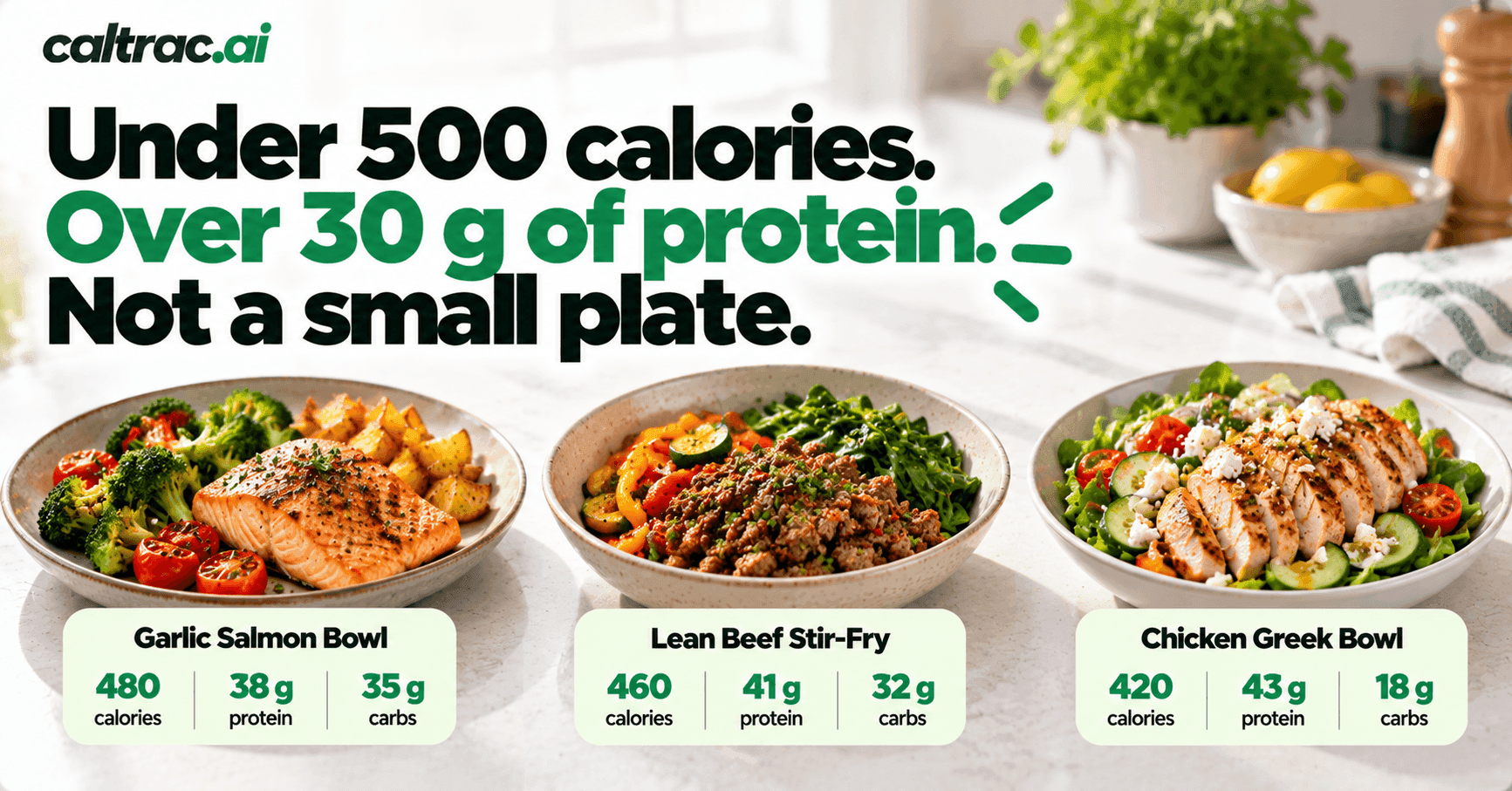
Dinner is where most weight-loss days are decided, because it is the meal with the least structure, the most hunger behind it and the most calories on offer. A dinner under 500 calories is not a small dinner if it is built correctly: 30 g or more of protein, a plate of vegetables for volume and fibre, a measured carbohydrate and a teaspoon of fat. Below are twelve such dinners, built from USDA nutrient data so the numbers are real, half of them Indian, all of them cookable in under thirty minutes.
The Design Rules
Protein first, 30 g or more. Protein is the most satiating macronutrient per calorie, and 25 to 30 g per meal is the dose that controls appetite and protects muscle during weight loss [1] [2]. Every dinner below clears 30 g.
Low energy density, high volume. People eat a roughly constant weight of food, so a plate that is half vegetables delivers fullness at fewer calories [3]. In the PREMIER trial, the participants who reduced the energy density of their diet most ate 300 g more food a day, took in 500 fewer calories, and lost 5.9 kg against 2.4 kg for those who reduced it least [4]. In a year-long trial, women who added fruit and vegetables while cutting fat lost 7.9 kg against 6.4 for cutting fat alone, with less hunger [5].
Fibre. Fibre predicted weight loss and adherence better than any other dietary factor in a six-month calorie-restricted trial [6]. The vegetables and pulses below carry 8 to 20 g per dinner.
Measured fat. One teaspoon of oil is 40 kcal [7]; it is the only ingredient on these plates that costs more than it fills.
Twelve Dinners Under 500 Calories
All values from USDA FoodData Central, summed from the listed quantities. Herbs, spices, lemon, vinegar, garlic and chilli are counted as free.
| # | Dinner | Calories | Protein | Fibre |
|---|---|---|---|---|
| 1 | Shrimp stir-fry: 200 g cooked shrimp, 150 g broccoli, 100 g mushrooms, 50 g onion, 1 tsp oil, soy sauce, 100 g cooked rice [8] [9] [10] [11] [7] [12] | 461 | 59 g | 7 g |
| 2 | Grilled chicken plate: 150 g chicken breast, 150 g baked sweet potato, 150 g broccoli, 1 tsp oil [13] [14] [9] [7] | 474 | 54 g | 9 g |
| 3 | Burrito bowl: 120 g chicken breast, 150 g black beans, lettuce, 50 g tomato, salsa, lime [13] [15] [16] | 436 | 50 g | 14 g |
| 4 | Chicken curry and roti: 150 g chicken breast simmered with 100 g tomato, 50 g onion, 1 tsp oil and spices; 1 roti [13] [16] [11] [7] [17] | 446 | 50 g | 6 g |
| 5 | Cod, potato and greens: 200 g grilled cod, 200 g baked potato, 150 g broccoli, 1 tsp oil, lemon [18] [19] [9] [7] | 493 | 48 g | 8 g |
| 6 | Chicken pasta: 150 g cooked pasta, 100 g chicken breast, 150 g tomatoes cooked down with garlic, 1 tsp oil [20] [13] [16] [7] | 469 | 41 g | 5 g |
| 7 | Tofu and cauliflower curry: 180 g firm tofu, 150 g cauliflower, 100 g tomato, 1 tsp oil, spices; 1 roti [21] [22] [16] [7] [17] | 475 | 38 g | 8 g |
| 8 | Salmon and quinoa: 120 g salmon, 100 g cooked quinoa, 150 g spinach wilted in 1 tsp oil [23] [24] [25] [7] | 442 | 35 g | 6 g |
| 9 | Paneer tikka: 120 g paneer grilled with 200 g capsicum and onion, lemon, chaat masala [26] [11] | 465 | 32 g | 4 g |
| 10 | Soya chunk masala: 50 g dry soya chunks, 100 g tomato, 50 g onion, 1 tsp oil; 1 roti [27] [16] [11] [7] [17] | 371 | 32 g | 8 g |
| 11 | Lentil and egg salad: 200 g cooked lentils, 2 boiled eggs, 150 g cucumber and tomato, 1 tsp oil, lemon [28] [29] [30] [7] | 452 | 31 g | 17 g |
| 12 | Egg bhurji and roti: 3 eggs plus 2 egg whites scrambled without fat with 100 g tomato and onion; 1 roti [31] [32] [16] [17] | 405 | 30 g | 5 g |
And one that shows the arithmetic of the Indian plate: dal, rice and raita, 200 g dal, 80 g cooked rice, 100 g nonfat Greek yogurt as raita with cucumber, 150 g sabzi, comes to 488 kcal and 29 g of protein with 19 g of fibre [33] [12] [34]. It lands just under the protein line because dal is a moderate protein source; adding 50 g of paneer or an egg to the plate gets it to 40 g.
What the Table Shows
Seafood is the easiest way to hit 30 g under 500. Shrimp at 24 g of protein per 100 kcal and cod at 18 g leave so much room that the plate fills with vegetables and starch before it reaches the limit [8] [18]. Dinner 1 is 59 g of protein and a cup of rice for 461 kcal.
The Indian dinners work when protein is deliberate. Chicken curry, egg bhurji, soya masala, paneer tikka and tofu curry all clear 30 g with a roti because the protein was weighed first. The traditional dal-rice plate does not quite, and the fix is a protein added to it, not less rice.
One roti, one cup of rice, 150 g of pasta or 200 g of potato is the carbohydrate budget. Each is 120 to 240 kcal; two of any of them pushes the plate past 500. The vegetables are what make the single portion feel like enough [3].
The oil is a teaspoon, every time. Twelve dinners, twelve teaspoons, 480 kcal across the week. The same dinners cooked with a tablespoon each would be 960 kcal more, and that is the difference between a deficit and maintenance [7].
Making Dinner Smaller Without Noticing
Three habits from the trials:
- Start with the vegetables. A large, low-energy-density salad or a plate of vegetables before the main course cut total meal intake by 12% in a controlled study; the same salad with cheese and dressing increased it by 17% [35].
- Serve the protein and vegetables first, then the carbohydrate. It is the order the plate fills in the table above, and it means the rice or roti is added to a plate that is already substantial.
- Eat dinner earlier if you can. In a controlled crossover, eating the same meals four hours later increased hunger, lowered leptin and reduced energy expenditure the next day [36]. The calories do not change with the clock, but the hunger that follows does.
A 450 to 500 kcal dinner is about 30% of a 1,600 kcal day and a third of its protein. Find your own target with the calorie calculator and your protein figure with the macro calculator; the dinners above scale by adjusting the protein and carbohydrate portions, not the vegetables.
That is where tracking earns its keep. Dinner is the meal most often estimated and least often weighed. Snap a photo of the plate or type "150 g chicken, 1 roti, sabzi" and track it automatically with Caltrac. You will see whether the protein cleared 30 g and the oil stayed at a teaspoon, and your Apple Health-powered net calorie count shows what the day finished at. Cook the plate; let the app check the arithmetic.
Frequently Asked Questions
What is a good dinner under 500 calories for weight loss? A palm-sized protein portion of 120 to 200 g, 150 to 300 g of vegetables, one portion of carbohydrate and a teaspoon of oil: for example 150 g chicken breast with 150 g sweet potato and 150 g broccoli at 474 kcal and 54 g of protein [13] [14] [9].
How much protein should dinner have? At least 25 to 30 g, the per-meal dose that controls appetite and supports muscle [1] [2].
What are low-calorie Indian dinners? Chicken curry with one roti (446 kcal, 50 g protein), egg bhurji with roti (405 kcal, 30 g), soya chunk masala with roti (371 kcal, 32 g) and paneer tikka with vegetables (465 kcal, 32 g), all from USDA values [13] [31] [27] [26].
Is eating dinner late bad for weight loss? The calories are the same, but eating the same meals four hours later increased hunger and reduced next-day energy expenditure in a controlled trial [36].
How do I make dinner more filling without more calories? Lower its energy density: more vegetables, a salad first, and lean protein. People who cut energy density most lost 5.9 kg against 2.4 kg while eating 300 g more food a day [4].
Can I have rice or roti at dinner and still lose weight? Yes, one portion: 100 g of cooked rice is 130 kcal and one roti about 120 [12] [17]. Every dinner in the table includes a carbohydrate and stays under 500.
References
- Leidy HJ, et al. The role of protein in weight loss and maintenance. American Journal of Clinical Nutrition. 2015;101(6):1320S-1329S. pubmed.ncbi.nlm.nih.gov
- Schoenfeld BJ, Aragon AA. How much protein can the body use in a single meal for muscle-building? Implications for daily protein distribution. Journal of the International Society of Sports Nutrition. 2018;15:10. pubmed.ncbi.nlm.nih.gov
- Rolls BJ. The relationship between dietary energy density and energy intake. Physiology & Behavior. 2009;97(5):609-615. pubmed.ncbi.nlm.nih.gov
- Ledikwe JH, et al. Reductions in dietary energy density are associated with weight loss in overweight and obese participants in the PREMIER trial. American Journal of Clinical Nutrition. 2007;85(5):1212-1221. pubmed.ncbi.nlm.nih.gov
- Ello-Martin JA, Roe LS, Ledikwe JH, Beach AM, Rolls BJ. Dietary energy density in the treatment of obesity: a year-long trial comparing 2 weight-loss diets. American Journal of Clinical Nutrition. 2007;85(6):1465-1477. pubmed.ncbi.nlm.nih.gov
- Miketinas DC, et al. Fiber Intake Predicts Weight Loss and Dietary Adherence in Adults Consuming Calorie-Restricted Diets: The POUNDS Lost Study. Journal of Nutrition. 2019;149(10):1742-1748. pubmed.ncbi.nlm.nih.gov
- USDA FoodData Central. Oil, olive, salad or cooking: 884 kcal per 100 g; 1 teaspoon about 4.5 g, 40 kcal. SR Legacy 171413. fdc.nal.usda.gov
- USDA FoodData Central. Crustaceans, shrimp, cooked: 99 kcal, 24 g protein per 100 g. SR Legacy 175180. fdc.nal.usda.gov
- USDA FoodData Central. Broccoli, raw: 34 kcal, 2.8 g protein, 2.6 g fibre per 100 g. SR Legacy 170379. fdc.nal.usda.gov
- USDA FoodData Central. Mushrooms, white, raw: 22 kcal, 3.1 g protein per 100 g. SR Legacy 169251. fdc.nal.usda.gov
- USDA FoodData Central. Onions, raw: 40 kcal, 1.7 g fibre per 100 g. SR Legacy 170000. fdc.nal.usda.gov
- USDA FoodData Central. Rice, white, long-grain, cooked: 130 kcal, 2.7 g protein per 100 g. SR Legacy 168878. fdc.nal.usda.gov
- USDA FoodData Central. Chicken breast, meat only, roasted: 165 kcal, 31 g protein per 100 g. SR Legacy 171477. fdc.nal.usda.gov
- USDA FoodData Central. Sweet potato, baked in skin: 90 kcal, 2 g protein, 3.3 g fibre per 100 g. SR Legacy 170134. fdc.nal.usda.gov
- USDA FoodData Central. Beans, black, cooked: 132 kcal, 8.9 g protein, 8.7 g fibre per 100 g. SR Legacy 173735. fdc.nal.usda.gov
- USDA FoodData Central. Tomatoes, red, ripe, raw: 18 kcal, 0.9 g protein per 100 g. SR Legacy 170457. fdc.nal.usda.gov
- USDA FoodData Central, FNDDS. Bread, chapatti or roti: 299 kcal, 7.9 g protein, 9.7 g fibre per 100 g; 1 medium 40 g. FDC ID 2707713. fdc.nal.usda.gov
- USDA FoodData Central, FNDDS. Fish, cod, grilled: 108 kcal, 19.4 g protein per 100 g. FDC ID 2706242. fdc.nal.usda.gov
- USDA FoodData Central. Potatoes, baked, flesh and skin: 93 kcal, 2.5 g protein, 2.2 g fibre per 100 g. SR Legacy 170093. fdc.nal.usda.gov
- USDA FoodData Central. Pasta, cooked, enriched: 158 kcal, 5.8 g protein per 100 g. SR Legacy 169737. fdc.nal.usda.gov
- USDA FoodData Central. Tofu, firm: 144 kcal, 17.3 g protein per 100 g. SR Legacy 172475. fdc.nal.usda.gov
- USDA FoodData Central. Cauliflower, raw: 25 kcal, 1.9 g protein, 2 g fibre per 100 g. SR Legacy 169986. fdc.nal.usda.gov
- USDA FoodData Central. Salmon, Atlantic, farmed, cooked: 206 kcal, 22.1 g protein per 100 g. SR Legacy 175168. fdc.nal.usda.gov
- USDA FoodData Central. Quinoa, cooked: 120 kcal, 4.4 g protein, 2.8 g fibre per 100 g. SR Legacy 168917. fdc.nal.usda.gov
- USDA FoodData Central. Spinach, raw: 23 kcal, 2.9 g protein, 2.2 g fibre per 100 g. SR Legacy 168462. fdc.nal.usda.gov
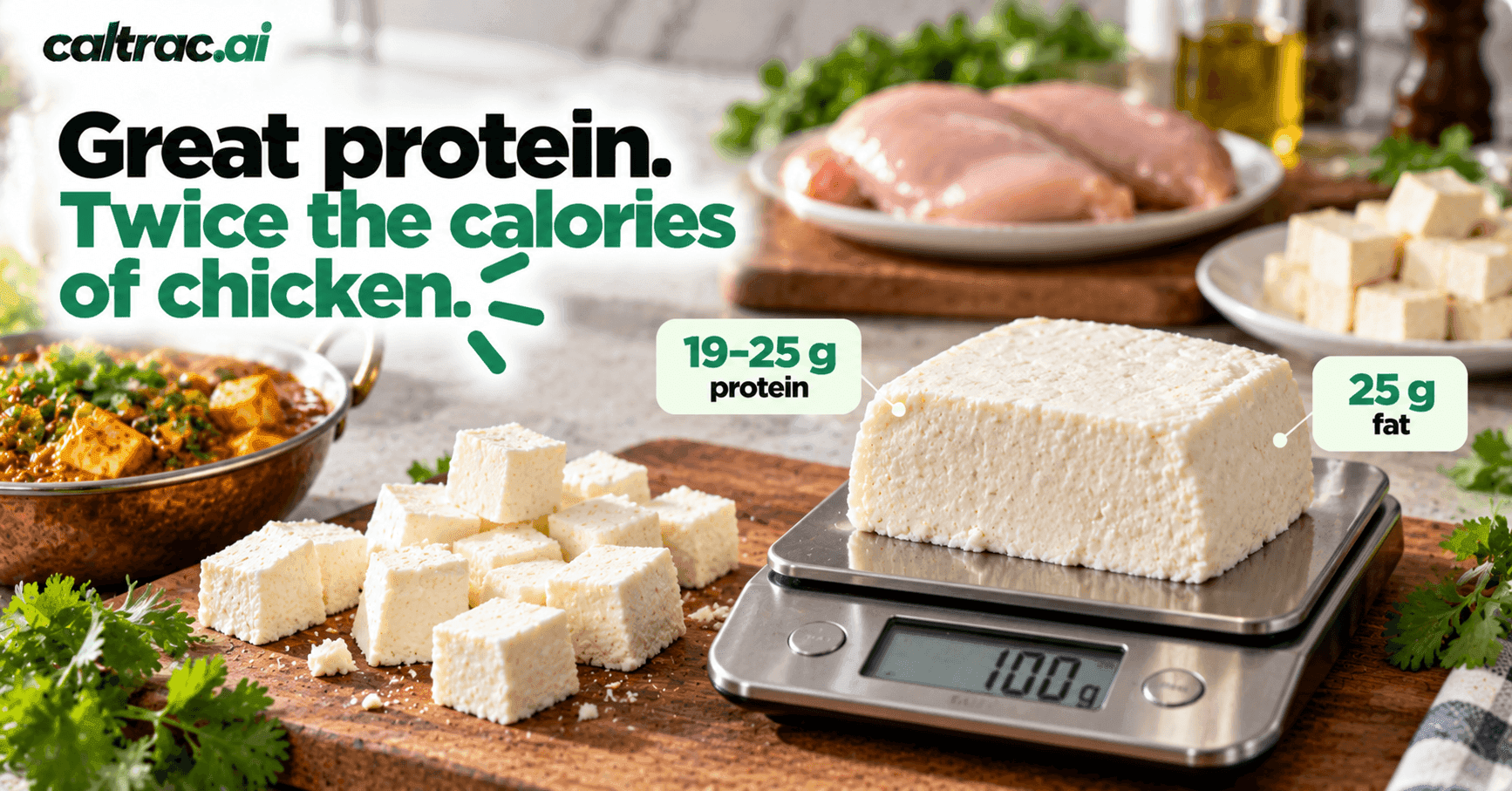
- USDA FoodData Central, Branded. Karoun Dairies Paneer: 321 kcal, 25 g protein, 25 g fat per 100 g. FDC ID 2429587. fdc.nal.usda.gov
- Nutrela soya chunks pack nutritional facts per 100 g dry (345 kcal, 52 g protein), as reproduced in a retailer listing. thedesifood.com
- USDA FoodData Central. Lentils, cooked: 116 kcal, 9 g protein, 7.9 g fibre per 100 g. SR Legacy 172421. fdc.nal.usda.gov
- USDA FoodData Central. Egg, whole, hard-boiled: 155 kcal, 12.6 g protein per 100 g; 1 large 50 g. SR Legacy 173424. fdc.nal.usda.gov
- USDA FoodData Central. Cucumber, with peel, raw: 15 kcal per 100 g. SR Legacy 168409. fdc.nal.usda.gov
- USDA FoodData Central, FNDDS. Egg omelet or scrambled egg, no added fat: 143 kcal, 12.4 g protein per 100 g; 1 egg 50 g. FDC ID 2707205. fdc.nal.usda.gov
- USDA FoodData Central. Egg, white, raw: 52 kcal, 10.9 g protein per 100 g; 1 white 33 g. SR Legacy 172183. fdc.nal.usda.gov
- USDA FoodData Central, FNDDS. Dal (as prepared): 145 kcal, 8.6 g protein, 7.5 g fibre per 100 g; 1 cup 240 g. FDC ID 2707427. fdc.nal.usda.gov
- USDA FoodData Central. Yogurt, Greek, nonfat, plain: 54 kcal, 9.5 g protein per 100 g. SR Legacy 171312. fdc.nal.usda.gov
- Rolls BJ, Roe LS, Meengs JS. Salad and satiety: energy density and portion size of a first-course salad affect energy intake at lunch. Journal of the American Dietetic Association. 2004;104(10):1570-1576. pubmed.ncbi.nlm.nih.gov
- Vujović N, et al. Late isocaloric eating increases hunger, decreases energy expenditure, and modifies metabolic pathways in adults with overweight and obesity. Cell Metabolism. 2022;34(10):1486-1498. pubmed.ncbi.nlm.nih.gov