


Cooking does not create or destroy calories. Heat changes the weight of food, by driving water out of a chicken breast or into a cup of rice, and it changes what the food carries, by adding the oil it was cooked in. Those two facts explain every confusing number in a food database: why 100 g of cooked chicken has more calories than 100 g of raw, why a boiled egg and a raw egg are the same egg, and why a fried cod fillet has twice the calories of a grilled one with less protein. This article uses USDA records for the same foods cooked different ways, and the handful of trials on air frying, to show exactly what each method does.
Rule One: Cooking Changes Weight, Not Calories
A raw chicken breast is 120 kcal and 22.5 g of protein per 100 g [1]. Roasted, the same meat is 165 kcal and 31 g per 100 g [2]. Nothing was added; water left. USDA's cooking-yield tables exist for this reason: "cooking yields describe changes in food weight due to moisture loss, water absorption or fat gains and losses during food preparation and cooking" [3]. A 150 g raw breast becomes roughly 110 g of roasted chicken, and both weigh in at about 180 kcal.
The same holds for the egg. Raw, 143 kcal per 100 g; hard-boiled, 155 per 100 g [4] [5]. The boiled egg lost a little water through the shell, so each gram is slightly denser, but one large egg is about 72 kcal raw and 78 boiled, a rounding difference.
The practical rule for tracking: log food in the state you weighed it, and use the matching database entry. Weighing raw and logging cooked overstates calories by 30 to 40% for meat; weighing cooked rice and logging it as dry understates by a factor of three. Either way is fine as long as the entry matches the scale.
Rule Two: Added Fat Is the Only Real Calorie Change
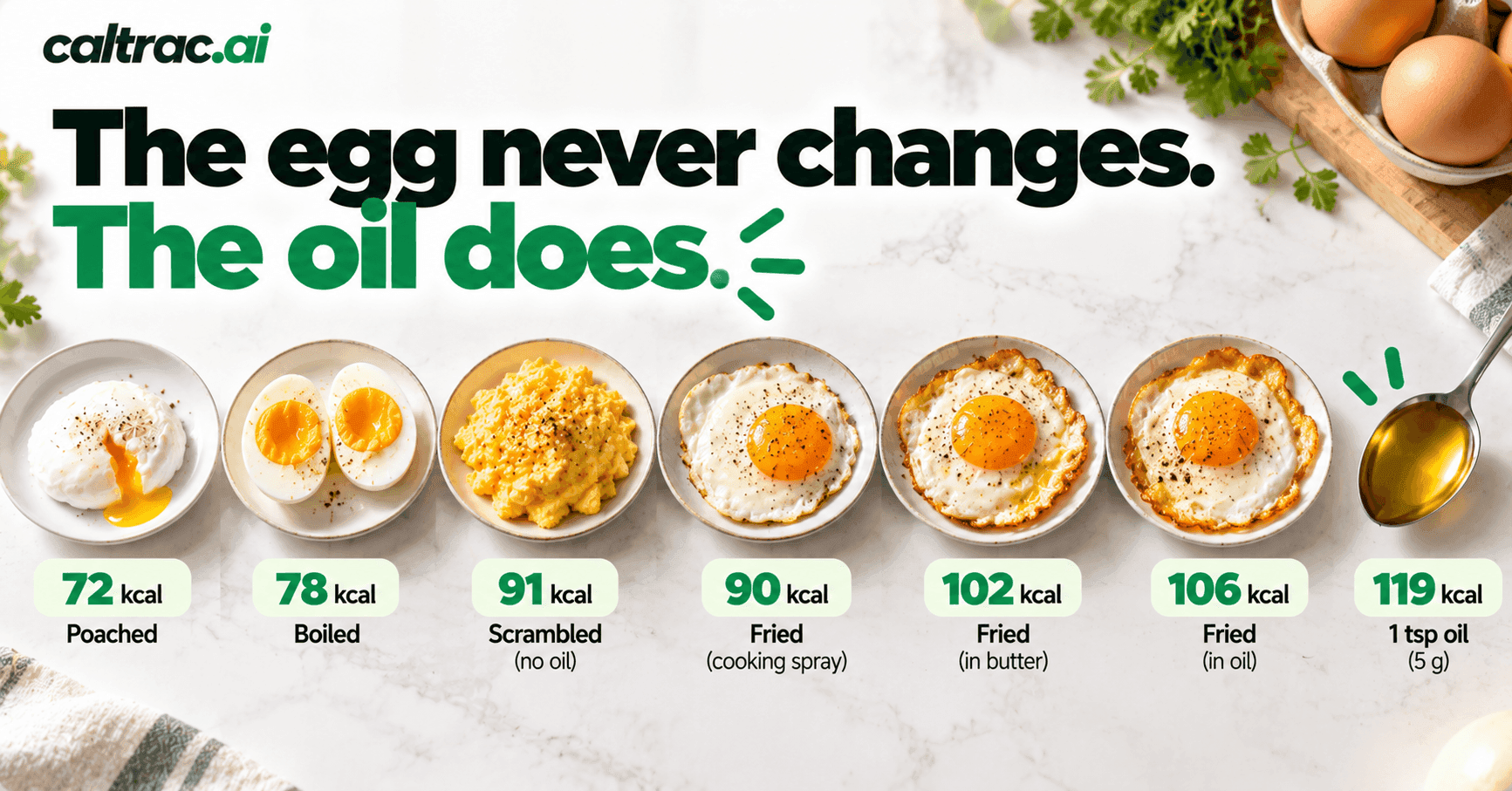
Every cooking method that raises calories does it by adding fat. The egg makes the cleanest demonstration, because USDA's survey database records the same egg cooked with different fats:
| Method | Calories per 100 g | Fat per 100 g | Calories per egg |
|---|---|---|---|
| Boiled or poached [5] | 155 | 10.6 g | 78 |
| Scrambled or omelette, no added fat [6] | 143 | 9.9 g | 72 |
| Fried with cooking spray [7] | 149 | 10.6 g | 75 |
| Fried with butter [8] | 182 | 14.6 g | 100 |
| Omelette made with butter [9] | 182 | 14.6 g | 100 |
| Fried with oil [10] | 192 | 15.8 g | 106 |
The egg itself never changes. The difference between a poached egg and a fried one is 28 calories of oil per egg, which is small, until it is three eggs a day for a year.
The potato shows how far the same principle stretches:
| Method | Calories per 100 g | Fat per 100 g |
|---|---|---|
| Raw [11] | 77 | 0.1 g |
| Baked in skin, no fat [12] | 93 | 0.1 g |
| Roasted with fat [13] | 126 | 4.3 g |
| Restaurant french fries [14] | 289 | 14 g |
Baking concentrates the potato by driving off water, so 100 g baked is about 120 g raw; the calories per potato are unchanged. Roasting adds about 35% more calories than baking, all from the oil. Deep frying adds 14 g of fat per 100 g, nearly tripling the energy of the same potato, and a medium order of fries is 145 g, or 420 kcal [14].
Chicken and fish follow the pattern:
| Food | Grilled or roasted, no skin | Roasted with skin | Battered and fried |
|---|---|---|---|
| Chicken breast, per 100 g | 165 kcal, 31 g protein [2] | 197 kcal, 29.8 g protein [15] | 260 kcal, 24.8 g protein, 9 g carbohydrate [16] |
| Cod, per 100 g | 108 kcal, 19.4 g protein [17] | 126 kcal, 19 g protein, baked with fat [18] | 217 kcal, 13.5 g protein, 11.7 g carbohydrate [19] |
Battering and frying doubles the calories of cod and cuts the protein per 100 g by nearly a third, because the batter and absorbed oil displace fish. A fried chicken breast carries 58% more calories than a roasted one with less protein per gram.
The Fat You Add Is the Number to Measure
Since added fat is the only lever, measuring it is the whole skill. One teaspoon of oil is 40 kcal and one tablespoon is 119 [20]; a tablespoon of butter is 102 [21]. A "glug" from a bottle is typically one to two tablespoons, which turns a 300 kcal stir-fry into a 500 kcal one. Rules that work:
- Measure oil with a spoon, not the bottle. A teaspoon coats a non-stick pan for two eggs or 200 g of vegetables.
- Use spray for eggs and dry-frying. The cooking-spray egg is within 3 calories of a boiled one [7].
- Roast on a tray with a measured tablespoon for the whole tray, not a drizzle per piece. A tablespoon across 500 g of vegetables is 24 kcal per 100 g.
- Count the marinade. Oil in a marinade is mostly absorbed or left in the pan; log half.
- Deep-fried food absorbs oil you cannot see. The only way to log it is to use the fried entry in the database, not the raw food plus a guess.
Air Fryer vs Deep Fryer vs Oven
The air fryer's claim is that it produces fried texture without the oil, and the trials support it with caveats. French fries cooked by air frying had "a substantially lower fat content" than deep-fried fries with similar moisture and colour, but took 21 minutes against 9 [22]. In a 2026 study using an industrial impingement air-fryer prototype, oil absorption was 36% lower in French fries and 39% lower in potato wedges than deep frying, with 80% less energy use [23]. For chicken skin chips, air frying and oven baking both cut lipid content by about 45% compared with deep frying, with protein unchanged [24].
Three honest notes. First, the comparison is against deep frying. An air fryer does not make food lower in calories than an oven; it is an oven with a fan. Second, an air fryer only saves calories if you put less oil in it. Air-fried potatoes tossed in two tablespoons of oil carry the same oil as pan-roasted ones. Third, the fat you save is the fat the food would have absorbed, so the saving is largest for foods that soak up oil, potatoes and battered items, and smallest for foods that do not, like a chicken breast.
Air frying also forms less acrylamide, the compound that forms from sugars and the amino acid asparagine in starchy foods at high cooking temperatures and which caused cancer in animals at very high doses [25]. Air-fried potatoes had about 90% less acrylamide than deep-fried ones at the same 180°C [26]. The FDA's advice applies to every method: cook potatoes and toast to golden yellow rather than brown, soak cut potatoes for 15 to 30 minutes before frying or roasting, and do not store raw potatoes in the fridge, which raises acrylamide on cooking [27]. Boiled and steamed foods contain essentially none [27].
What Cooking Does to Nutrients
Calories are the stable part; vitamins are not. USDA publishes retention factors for 16 vitamins and 8 minerals across about 290 foods and a range of methods, because boiling, baking and frying each lose different amounts [28]. In a controlled comparison of 20 vegetables, the cooking method changed antioxidant capacity substantially, with griddling and microwaving generally preserving the most and boiling and pressure cooking the least, although the effect varied by vegetable [29]. Cooking also improves some things: the true digestibility of egg protein was 91% cooked against 51% raw [30], so the raw-egg protein shake delivers about half the protein its label implies.
The Method Ranking for Weight Loss
Ordered by calories added to the food itself:
- Steaming, boiling, poaching: zero added fat; weight may rise as the food absorbs water. Lowest acrylamide [27].
- Grilling, baking without fat, dry roasting: zero added fat; weight falls as water leaves, so the per-100 g figure rises but the per-portion figure does not [3].
- Air frying with a teaspoon of oil or spray: 40 kcal or less added per batch; the fried texture at roughly a third of the oil of deep frying [23].
- Pan frying or sautéing with measured oil: 40 kcal per teaspoon, 119 per tablespoon [20]. Fine if measured; the main leak if not.
- Roasting with oil: about 35 kcal added per 100 g of potato [13].
- Deep frying, with or without batter: 100 to 180 kcal added per 100 g and a drop in protein density [14] [19].
None of this makes any method forbidden. Food that is fried occasionally and logged accurately fits a 500 to 750 kcal deficit [31]; food that is fried daily and logged as grilled does not. Set your target with the calorie calculator and treat the oil as part of the budget.
That is where tracking earns its keep. The fried egg and the poached egg look identical on a plate and differ by 30 calories; the air-fried and deep-fried fries differ by far more. Snap a photo of the plate and note "fried in 1 tsp oil", or type "2 eggs fried in butter", and track it automatically with Caltrac. You will see the cooking fat counted, and your Apple Health-powered net calorie count shows how the method changed the day. Cook it how you like; let the app count the oil.
Frequently Asked Questions
Does cooking add calories to food? Only through added fat. Heat changes weight by removing or adding water, so a cooked food can have more calories per 100 g than raw, but a portion keeps the same calories unless oil or butter is added [3] [1] [2].
Does an air fryer reduce calories? Compared with deep frying, yes: 36 to 45% less fat absorbed in trials on potatoes and chicken skin [23] [24]. Compared with an oven, no; it is a small convection oven.
Should I weigh food raw or cooked? Either, as long as the database entry matches. Raw-to-cooked weight changes by 25 to 40% for meat, and logging the wrong state is the most common tracking error [3].
How many calories does frying an egg add? About 28 to 34 kcal per egg with butter or oil; near zero with cooking spray [8] [10] [7].
Is fried chicken much worse than grilled? Battered and fried chicken breast has 260 kcal and 24.8 g of protein per 100 g against 165 kcal and 31 g for roasted meat without skin [16] [2].
Does boiling destroy nutrients? It leaches some water-soluble vitamins and reduced antioxidant capacity more than most methods in a 20-vegetable comparison [29], but it adds no fat and forms no acrylamide [27].
References
- USDA FoodData Central. Chicken breast, skinless, boneless, meat only, raw: 120 kcal, 22.5 g protein, 2.6 g fat per 100 g. SR Legacy 171077. fdc.nal.usda.gov
- USDA FoodData Central. Chicken breast, meat only, roasted: 165 kcal, 31 g protein, 3.6 g fat per 100 g. SR Legacy 171477. fdc.nal.usda.gov
- US Department of Agriculture, Agricultural Research Service. USDA Table of Cooking Yields for Meat and Poultry. Nutrient Data Laboratory, December 2012. ars.usda.gov
- USDA FoodData Central. Egg, whole, raw, fresh: 143 kcal, 12.6 g protein, 9.5 g fat per 100 g; 1 large 50 g. SR Legacy 171287. fdc.nal.usda.gov
- USDA FoodData Central. Egg, whole, cooked, hard-boiled: 155 kcal, 12.6 g protein, 10.6 g fat per 100 g; 1 large 50 g. SR Legacy 173424. fdc.nal.usda.gov
- USDA FoodData Central, FNDDS. Egg omelet or scrambled egg, no added fat: 143 kcal, 9.9 g fat per 100 g. FDC ID 2707205. fdc.nal.usda.gov
- USDA FoodData Central, FNDDS. Egg, whole, fried with cooking spray: 149 kcal, 10.6 g fat per 100 g; 1 egg 50 g. FDC ID 2707161. fdc.nal.usda.gov
- USDA FoodData Central, FNDDS. Egg, whole, fried with butter: 182 kcal, 14.6 g fat per 100 g; 1 egg 55 g. FDC ID 2707159. fdc.nal.usda.gov
- USDA FoodData Central, FNDDS. Egg omelet or scrambled egg, made with butter: 182 kcal, 14.6 g fat per 100 g. FDC ID 2707201. fdc.nal.usda.gov
- USDA FoodData Central, FNDDS. Egg, whole, fried with oil: 192 kcal, 15.8 g fat per 100 g; 1 egg 55 g. FDC ID 2707158. fdc.nal.usda.gov
- USDA FoodData Central. Potatoes, flesh and skin, raw: 77 kcal, 0.1 g fat per 100 g. SR Legacy 170026. fdc.nal.usda.gov
- USDA FoodData Central. Potatoes, baked, flesh and skin, without salt: 93 kcal, 0.1 g fat per 100 g. SR Legacy 170093. fdc.nal.usda.gov
- USDA FoodData Central, FNDDS. Potato, roasted: 126 kcal, 4.3 g fat per 100 g. FDC ID 2709402. fdc.nal.usda.gov
- USDA FoodData Central, FNDDS. Potato, french fries, restaurant: 289 kcal, 14 g fat per 100 g; 1 medium order 145 g. FDC ID 2709462. fdc.nal.usda.gov
- USDA FoodData Central. Chicken breast, meat and skin, roasted: 197 kcal, 29.8 g protein, 7.8 g fat per 100 g. SR Legacy 171075. fdc.nal.usda.gov
- USDA FoodData Central. Chicken breast, meat and skin, fried, batter: 260 kcal, 24.8 g protein, 13.2 g fat, 9 g carbohydrate per 100 g. SR Legacy 171475. fdc.nal.usda.gov
- USDA FoodData Central, FNDDS. Fish, cod, grilled: 108 kcal, 19.4 g protein, 2.8 g fat per 100 g. FDC ID 2706242. fdc.nal.usda.gov
- USDA FoodData Central, FNDDS. Fish, cod, baked or broiled: 126 kcal, 19 g protein, 5 g fat per 100 g. FDC ID 2706241. fdc.nal.usda.gov
- USDA FoodData Central, FNDDS. Fish, cod, fried: 217 kcal, 13.5 g protein, 12.5 g fat, 11.7 g carbohydrate per 100 g. FDC ID 2706244. fdc.nal.usda.gov
- USDA FoodData Central. Oil, olive, salad or cooking: 884 kcal per 100 g; 1 teaspoon 4.5 g (40 kcal), 1 tablespoon 13.5 g (119 kcal). SR Legacy 171413. fdc.nal.usda.gov
- USDA FoodData Central. Butter, salted: 717 kcal per 100 g; 1 tablespoon 14.2 g (102 kcal). SR Legacy 173410. fdc.nal.usda.gov
- Teruel MR, Gordon M, Linares MB, Garrido MD, Ahromrit A, Niranjan K. A comparative study of the characteristics of French fries produced by deep fat frying and air frying. Journal of Food Science. 2015;80(2):E349-E358. pubmed.ncbi.nlm.nih.gov
- Can AT, et al. Air Jet Impingement-Assisted Air Frying of Potatoes: Oil Absorption, Lipid Oxidation and Acrylamide Formation for Improved Nutritional Quality. Food Science and Nutrition. 2026;14(6):e72017. pubmed.ncbi.nlm.nih.gov
- Boudechicha HR, et al. Valorization of chicken skin as a by-product into crispy chips: Effect of processing methods on quality, safety, and sensory properties. Food Science and Technology International. 2026 (online ahead of print). pubmed.ncbi.nlm.nih.gov
- US Food and Drug Administration. Acrylamide Questions and Answers. fda.gov
- Sansano M, Juan-Borrás M, Escriche I, Andrés A, Heredia A. Effect of pretreatments and air-frying, a novel technology, on acrylamide generation in fried potatoes. Journal of Food Science. 2015;80(5):T1120-T1128. pubmed.ncbi.nlm.nih.gov
- US Food and Drug Administration. Acrylamide and Diet, Food Storage, and Food Preparation. fda.gov
- US Department of Agriculture, Agricultural Research Service. USDA Table of Nutrient Retention Factors, Release 6. December 2007. ars.usda.gov
- Jiménez-Monreal AM, et al. Influence of cooking methods on antioxidant activity of vegetables. Journal of Food Science. 2009;74(3):H97-H103. pubmed.ncbi.nlm.nih.gov
- Evenepoel P, Geypens B, Luypaerts A, Hiele M, Ghoos Y, Rutgeerts P. Digestibility of cooked and raw egg protein in humans as assessed by stable isotope techniques. Journal of Nutrition. 1998;128(10):1716-1722. pubmed.ncbi.nlm.nih.gov
- Jensen MD, et al. 2013 AHA/ACC/TOS guideline for the management of overweight and obesity in adults. Circulation. 2014;129(25 Suppl 2):S102-S138. pubmed.ncbi.nlm.nih.gov