


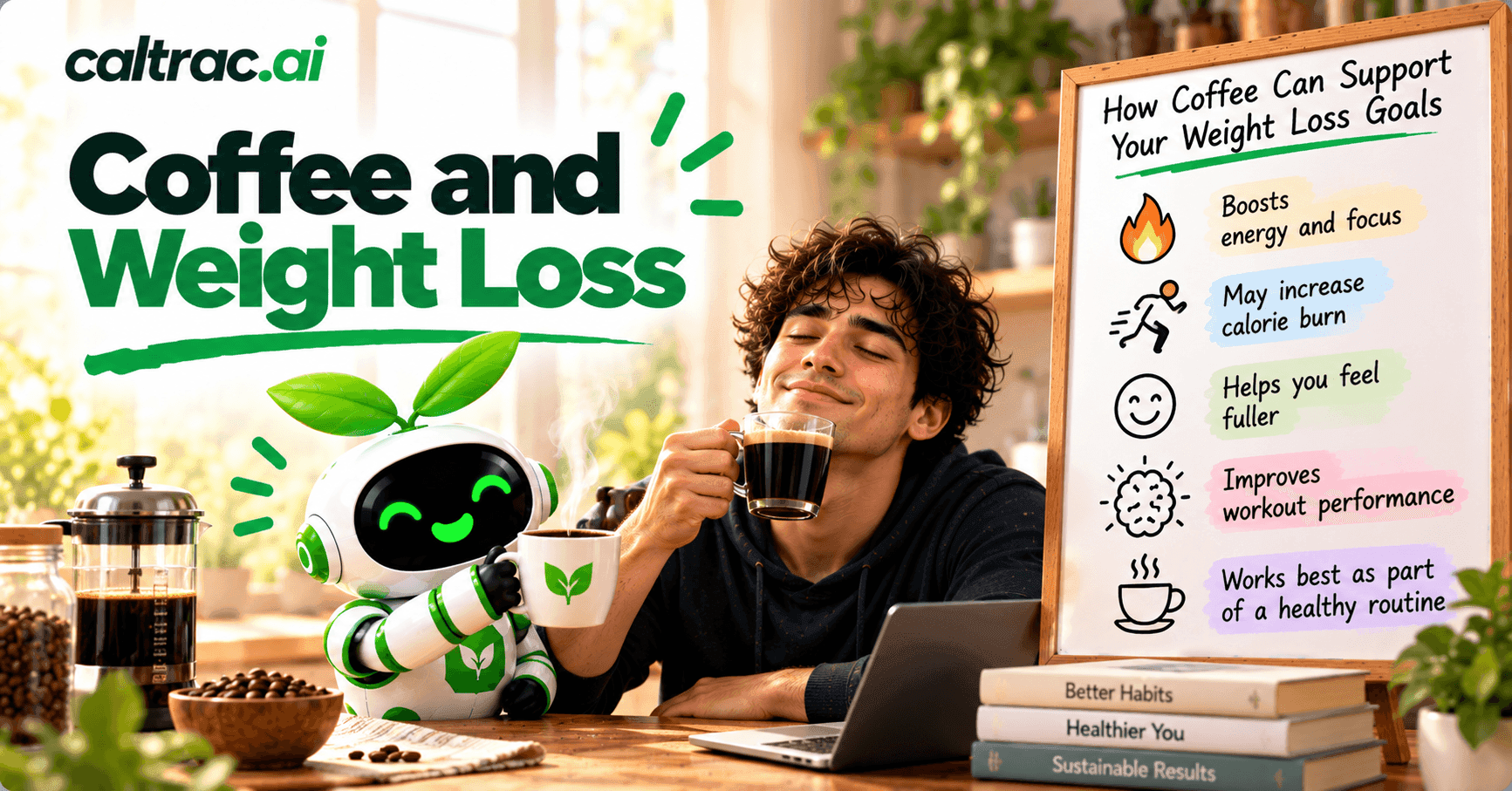
Coffee is the only widely consumed food that genuinely raises your metabolic rate, and it is also one of the easiest places for 300 unnoticed calories to hide in a day. Both facts are true, and the second matters more. The caffeine in a black coffee burns a handful of calories; the milk, syrup and whipped cream in a café order can cost a tenth of your daily budget. This article covers what caffeine does to metabolism and appetite, what the trials show about coffee drinkers' weight, how much is safe, and a calorie chart of coffee drinks from black to frozen mocha.
What Caffeine Does to Metabolism
The thermogenic effect is real and measurable. A single 100 mg dose of caffeine, about one cup of coffee, raised resting metabolic rate by 3 to 4% over the following two and a half hours in both lean and formerly obese volunteers. Repeated doses through the day raised energy expenditure by 8 to 11%, worth about 150 extra calories in lean subjects and 79 in the post-obese [1]. Earlier work showed caffeine also increased fat oxidation, at least in normal-weight people [2].
Those are the honest numbers: a heavy coffee habit may burn 80 to 150 extra calories a day, which is meaningful over a year and trivial next to a single flavoured latte. Caffeine is a small lever, not a fat burner.
What Caffeine Does to Appetite
Less than hoped. A review of the appetite research found that caffeine taken half an hour to four hours before a meal may modestly reduce how much is eaten at it, while coffee drunk three to four and a half hours before a meal had minimal effect; evidence on appetite hormones and hunger ratings was equivocal [3]. Coffee is not an appetite suppressant you can rely on, though a cup before a meal does no harm and may trim it slightly.
What the Trials and Cohorts Show
Caffeine and weight in trials. A dose-response meta-analysis of 13 randomised trials with 606 participants found that each doubling of caffeine intake was associated with a 22% greater reduction in weight, 17% in BMI and 28% in fat mass, with very high variability between studies [4]. Those are relative differences in already-small effects; they support caffeine as a minor aid, not a treatment.
Coffee and body weight in populations. Across twelve observational studies, higher coffee intake was associated with a BMI 0.08 units lower and a waist 0.27 cm smaller, an effect the authors called modest and more evident in men [5]. People who had successfully kept weight off drank significantly more coffee and caffeinated drinks than the general population in a German cohort [6], though whether coffee helped or simply travelled with other habits is unknowable from that design.
Green tea, for comparison. Catechins with caffeine produced about 1.3 kg of extra weight loss across eleven trials, 0.8 kg in Caucasian participants [7]. Small, real, and the same order of magnitude as coffee.
The summary: coffee is weakly, consistently associated with lower body weight, caffeine slightly raises energy expenditure, and the total effect is worth having but will not be visible on a scale against the background noise of everything else you eat.
Where Coffee Actually Changes Your Weight: the Calories In It
This is the part that matters. Black coffee is nearly calorie-free; what people add to it is not. USDA values, by typical serving:
| Drink | Serving | Calories | Sugar | Source |
|---|---|---|---|---|
| Black coffee, brewed | 360 ml mug | 4 kcal | 0 g | [8] |
| Espresso, double | 60 ml | 5 kcal | 0 g | [9] |
| Coffee with 1 tsp sugar and 30 ml whole milk | 360 ml | 34 kcal | 5 g | [10] [11] |
| Cappuccino | 360 ml small | 97 kcal | 9 g | [12] |
| Latte, nonfat milk | 240 ml cup | 72 kcal | 10 g | [13] |
| Indian chai with milk and sugar | 240 ml cup | 122 kcal | 21 g | [14] |
| Iced latte | 480 ml medium | 130 kcal | 12 g | [15] |
| Iced latte, flavoured syrup | 496 ml medium | 198 kcal | 29 g | [16] |
| Café mocha | 372 ml small | 238 kcal | 35 g | [17] |
| Bottled Frappuccino | 411 ml bottle | 300 kcal | 47 g | [18] |
| Frozen mocha | 496 ml medium | 327 kcal | 60 g | [19] |
| Café mocha, large | 620 ml | 397 kcal | 58 g | [17] |
The gap between the first row and the last is about 390 calories, roughly the daily deficit most weight-loss plans prescribe. Two café mochas a day is a 500-calorie habit that reads as "coffee" in most people's mental ledger. Three cups of chai is 366 calories and 63 g of sugar, above WHO's daily free-sugar limit on its own.
The caffeine in all of these is similar. The weight effect is entirely in the milk, sugar, syrup and cream.
How Much Caffeine Is Safe
The FDA considers 400 mg of caffeine a day, about two to three 12-ounce cups of brewed coffee, to be an amount not generally associated with negative effects in healthy adults [20]. The European Food Safety Authority reached the same 400 mg daily figure, with single doses up to 200 mg, and a lower limit of 200 mg a day during pregnancy and breastfeeding [21]. Above those amounts, anxiety, palpitations and disrupted sleep become common.
Sleep is the indirect weight cost of too much coffee. Two nights of four hours' sleep raised hunger by 24% and appetite for calorie-dense carbohydrate by a third or more [22]. A late-afternoon coffee that costs an hour of sleep can undo its own thermogenic effect several times over. For most people, no caffeine after about 2 p.m. protects the night.
Coffee Rules for Weight Loss
- Drink it black, or close to it. Black coffee and espresso are effectively free; a splash of milk is 10 to 20 calories; anything with a syrup pump or whipped cream is a dessert.
- Count the milk. A latte is mostly milk, and the calories are the milk's, not the coffee's. Nonfat milk halves them [13].
- Log every cup. Coffee is the most under-logged item in most food diaries because it does not feel like food. Three chais or two flavoured lattes is a meal.
- Stop by early afternoon. The sleep cost outweighs the metabolic gain.
- Stay under 400 mg [20], and under 200 mg if pregnant [21].
- Do not buy it in pill form for weight loss. The trial effect of caffeine is small [4] and the dose in supplements is often far above the safe daily figure.
Your coffee budget is a share of your calorie target, and the share depends on the target. Caltrac's calorie calculator gives you the daily number; a 240 kcal mocha is 15% of a 1,600 kcal day and 10% of a 2,400 kcal one.
That is where tracking earns its keep. Type "cappuccino" or "chai with sugar" or snap the cup, and track it automatically with Caltrac. You will see the drink logged as the calories it is rather than the coffee it feels like, and your Apple Health-powered net calorie count shows what the day's cups added up to. Enjoy the coffee; let the app count the milk.
Frequently Asked Questions
Does coffee help you lose weight? Slightly. Caffeine raises metabolic rate by 3 to 4% per cup, worth 80 to 150 kcal a day with regular intake [1], and coffee drinkers have marginally lower BMI in population studies [5]. The effect is small and easily erased by milk and sugar.
How many calories are in a cup of coffee? Black brewed coffee has about 4 kcal per mug and espresso about 5 kcal per double shot [8] [9]. A cappuccino is about 97 kcal, a medium flavoured iced latte about 198, and a large café mocha about 397 [12] [16] [17].
Does caffeine suppress appetite? Modestly and inconsistently. Caffeine taken shortly before a meal may reduce intake at that meal; coffee drunk hours earlier has minimal effect [3].
How much coffee is too much? The FDA and EFSA both put the safe daily limit for healthy adults at 400 mg of caffeine, about two to three 12-ounce cups of brewed coffee [20] [21].
Does coffee break a fast? Black coffee contains about 1 kcal per 100 ml [8] and is standard in fasting trials. Milk and sugar add calories and end a strict fast.
Is chai good for weight loss? A cup of milk tea with sugar is about 122 kcal and 21 g of sugar [14], so three cups a day is 366 kcal. Unsweetened or with less milk, it is a reasonable drink; as usually made, it is a snack.
References
- Dulloo AG, Geissler CA, Horton T, Collins A, Miller DS. Normal caffeine consumption: influence on thermogenesis and daily energy expenditure in lean and postobese human volunteers. American Journal of Clinical Nutrition. 1989;49(1):44-50. pubmed.ncbi.nlm.nih.gov
- Acheson KJ, et al. Caffeine and coffee: their influence on metabolic rate and substrate utilization in normal weight and obese individuals. American Journal of Clinical Nutrition. 1980;33(5):989-997. pubmed.ncbi.nlm.nih.gov
- Schubert MM, et al. Caffeine, coffee, and appetite control: a review. International Journal of Food Sciences and Nutrition. 2017;68(8):901-912. pubmed.ncbi.nlm.nih.gov
- Tabrizi R, et al. The effects of caffeine intake on weight loss: a systematic review and dose-response meta-analysis of randomized controlled trials. Critical Reviews in Food Science and Nutrition. 2019;59(16):2688-2696. pubmed.ncbi.nlm.nih.gov
- Lee A, et al. Coffee Intake and Obesity: A Meta-Analysis. Nutrients. 2019;11(6):1274. pubmed.ncbi.nlm.nih.gov
- Icken D, et al. Caffeine intake is related to successful weight loss maintenance. European Journal of Clinical Nutrition. 2016;70(4):532-534. pubmed.ncbi.nlm.nih.gov
- Hursel R, Viechtbauer W, Westerterp-Plantenga MS. The effects of green tea on weight loss and weight maintenance: a meta-analysis. International Journal of Obesity. 2009;33(9):956-961. pubmed.ncbi.nlm.nih.gov
- USDA FoodData Central, FNDDS. Coffee, brewed: 1 kcal per 100 g. FDC ID 2710375. fdc.nal.usda.gov
- USDA FoodData Central, FNDDS. Coffee, espresso: 9 kcal per 100 g; 60 g double shot. FDC ID 2710378. fdc.nal.usda.gov
- USDA FoodData Central. Sugars, granulated: 387 kcal per 100 g (one teaspoon, 4 g, 16 kcal). SR Legacy 169655. fdc.nal.usda.gov
- USDA FoodData Central. Milk, whole, 3.25%: 61 kcal per 100 g. SR Legacy 171265. fdc.nal.usda.gov
- USDA FoodData Central, FNDDS. Coffee, cappuccino: 27 kcal per 100 g; 360 g small. FDC ID 2710472. fdc.nal.usda.gov
- USDA FoodData Central, FNDDS. Coffee, latte, nonfat milk: 30 kcal per 100 g; 240 g cup. FDC ID 2710387. fdc.nal.usda.gov
- USDA FoodData Central, FNDDS. Tea, hot, with milk: 51 kcal, 8.7 g sugar per 100 g; 240 g cup. FDC ID 2710506. fdc.nal.usda.gov
- USDA FoodData Central, FNDDS. Coffee, iced latte: 27 kcal, 2.5 g sugar per 100 g; 480 g medium. FDC ID 2710431. fdc.nal.usda.gov
- USDA FoodData Central, FNDDS. Coffee, iced latte, flavored: 40 kcal, 5.8 g sugar per 100 g; 496 g medium. FDC ID 2710434. fdc.nal.usda.gov
- USDA FoodData Central, FNDDS. Coffee, cafe mocha: 64 kcal, 9.3 g sugar per 100 g; 372 g small, 620 g large. FDC ID 2710410. fdc.nal.usda.gov
- USDA FoodData Central, Branded. Starbucks Frappuccino chilled coffee drink: 73 kcal, 11.4 g sugar per 100 ml; 411 ml bottle. FDC ID 497086. fdc.nal.usda.gov
- USDA FoodData Central, FNDDS. Frozen mocha coffee drink: 66 kcal, 12.2 g sugar per 100 g; 496 g medium. FDC ID 2710416. fdc.nal.usda.gov
- US Food and Drug Administration. Spilling the Beans: How Much Caffeine is Too Much? (400 mg a day for healthy adults). fda.gov
- European Food Safety Authority. Caffeine (summary of the 2015 scientific opinion: 400 mg a day for adults, 200 mg single dose, 200 mg a day in pregnancy). efsa.europa.eu
- Spiegel K, et al. Sleep curtailment in healthy young men is associated with decreased leptin levels, elevated ghrelin levels, and increased hunger and appetite. Annals of Internal Medicine. 2004;141(11):846-850. pubmed.ncbi.nlm.nih.gov