


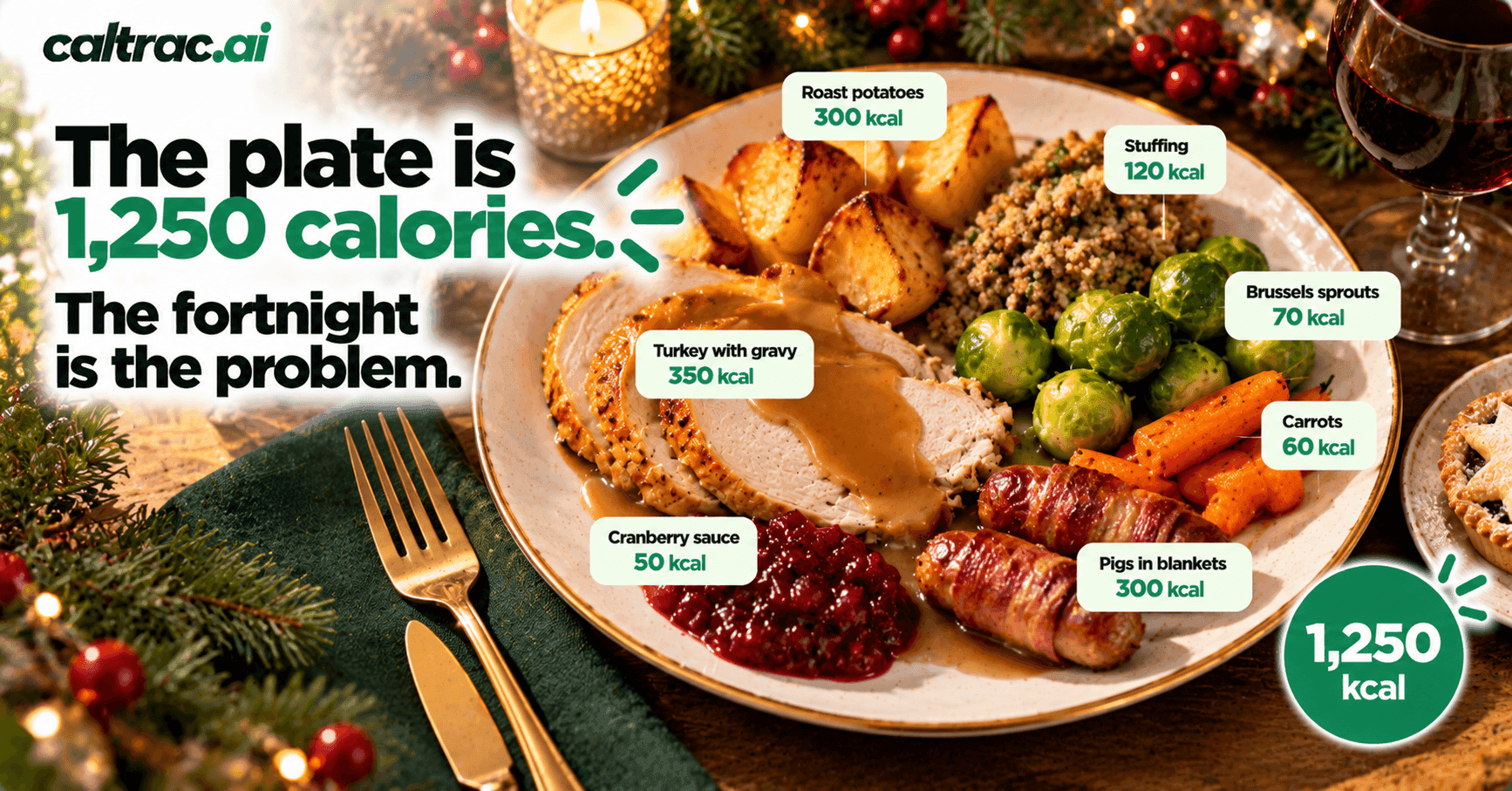
Christmas dinner is the one meal of the year almost everyone over-estimates, and the holiday season is the one stretch of the year almost everyone under-estimates. The plate is 1,200 to 1,800 calories, which is a lot, but it is one plate. The three weeks around it add about half a kilo to the average adult, and that half kilo is the part that tends to stay. This article prices every dish on the table from USDA data, puts the holiday weight-gain studies in one place, and gives the three things the one randomised trial on the subject found actually worked.
How Much Do People Really Gain?
Less than folklore says, and more than they lose afterwards. The classic study weighed 195 adults four times across a year and found the holiday period, mid-November to early January, added 0.37 kg on average, against a popular belief of 2.3 kg; the catch was that the gain was not reversed, leaving a net 0.48 kg by the following spring and no further change by autumn [1]. A review of the literature put the consistent adult figure at 0.4 to 0.9 kg, with people who were already overweight or trying to lose weight gaining toward the top of the range [2], and another concluded the holiday gain was "the major contributor to annual excess weight gain" in adults [3].
The modern version used wireless scales in 2,924 people across three countries. Weight rose within ten days of Christmas by 0.4% in the United States, 0.6% in Germany and 0.5% in Japan; measured from each person's annual low, Americans gained 0.6 kg and Germans 0.8 kg over Christmas and New Year. About half came off quickly; the other half was still there in summer [4].
So the honest number is half a kilo, and the honest problem is that it is cumulative: ten Christmases is five kilos.
Christmas Dinner, Dish by Dish
USDA FoodData Central values for typical servings. A plate is built from these; most plates include a protein, two or three starches, two vegetables, gravy and a sauce before dessert.
| Dish | Typical serving | Calories | Notes |
|---|---|---|---|
| Roast turkey, light meat with skin [5] | 2 slices, 120 g | 203 | 34 g protein; 150 without skin |
| Roast turkey, dark meat with skin [6] | 120 g | 242 | 32 g protein |
| Roast beef [7] | 2 slices, 120 g | 247 | 35 g protein |
| Honey-glazed ham [8] | 100 g | 122 | 900 mg sodium |
| Roast potatoes [9] | 1 medium, 170 g | 214 | 93 kcal per 100 g without fat |
| Mashed potatoes [10] | 1 cup, 250 g | 285 | |
| Bread stuffing [11] | 1 cup, 200 g | 354 | The densest savoury dish on the table |
| Gravy [12] | 60 ml | 31 | 346 mg sodium |
| Cranberry sauce [13] | 1 slice, 50 g | 80 | 16 g sugar |
| Brussels sprouts with fat [14] | 1 cup, 160 g | 107 | 45 kcal plain |
| Glazed carrots [15] | 100 g | 97 | |
| Sweet potato casserole [16] | 1 cup, 250 g | 248 | 20 g sugar |
| Pigs in blankets [17] | 4 cocktail sausages, 40 g, plus bacon | 130 plus about 50 for the bacon | Estimate from components; no USDA record for the dish |
| A typical plate | Turkey with skin, 2 roast potatoes, half a cup of stuffing, gravy, cranberry, sprouts, carrots, 2 pigs in blankets | About 1,250 |
Dessert and drinks:
| Item | Serving | Calories | Sugar |
|---|---|---|---|
| Christmas pudding | 100 g | About 325 | About 27 g; closest USDA match is fruitcake [18] |
| Mince pie, individual | 55 g | 159 | 16 g [19] |
| Pecan pie [20] | 1 slice, 150 g | 674 | 47 g |
| Pumpkin pie [21] | 1 slice, 150 g | 374 | 37 g |
| Eggnog [22] | 1 cup, 256 g | 225 | 21 g |
| Red wine [23] | 1 glass, 180 ml | 153 | |
| Mulled wine | 1 glass, 180 ml | About 200 | Red wine plus sugar; no USDA record |
| Milk chocolate [24] | 50 g | 268 |
The plate above, a slice of pecan pie, two glasses of wine and a handful of chocolate is about 2,500 calories, roughly a full day's intake for most adults in one sitting. With pumpkin pie instead of pecan, one glass of wine and no chocolate it is about 1,800.
Where the Calories Hide
Stuffing and roast potatoes, not the turkey. Turkey breast is one of the leanest proteins in the database at 169 kcal per 100 g with skin and 150 without; a cup of stuffing is 354 and two roast potatoes 430 [5] [11] [9]. The protein on the plate is the part that fills you [25]; the starch is the part that adds up.
The sauce and the glaze. Cranberry sauce is 32 g of sugar per 100 g [13], sweet potato casserole carries 20 g per cup [16], and glazed carrots have more than double the calories of plain ones [15].
Dessert density. Pecan pie at 449 kcal per 100 g is the densest food on the table, nearly as dense as chocolate [20] [24]; a slice is 674 calories. Pumpkin pie at 249 per 100 g is the lightest of the classic desserts [21].
Drinks. Eggnog is 225 kcal a cup, a glass of wine 153 [22] [23], and liquid calories are the ones the body does not register: adults given 450 kcal a day as a sugary drink did not compensate by eating less, while the same calories as solid food were largely offset [26]. Three drinks across the afternoon is 450 to 600 calories that nobody will remember eating.
The Day Itself Does Not Matter; The Three Weeks Do
A single 2,500 kcal meal in a year of 365 is noise. The holiday gain in the studies comes from the stretch of parties, leftovers, chocolate boxes and reduced activity around it [1] [4]. That reframing is useful: eat Christmas dinner, and manage the fortnight on either side.
The one randomised trial on the question tested exactly that. In Birmingham, 272 adults were randomised before Christmas to a brief intervention, regular self-weighing with a goal of gaining no more than 0.5 kg, simple weight-management tips, and a sheet showing how much walking each festive food would take to burn off, or to a leaflet on healthy living. By late January the intervention group had lost 0.13 kg and the leaflet group had gained 0.37 kg, a difference of 0.49 kg [27]. Half a kilo is the whole average holiday gain, prevented by three low-effort habits.
What Works
- Weigh yourself through the season. It was the core of the trial that worked [27], and daily weighing produced about 6 kg more loss over six months than less frequent weighing in a separate trial [28]. The scale on 27 December is information, not judgement.
- Protein and vegetables first on the plate. Turkey, sprouts and carrots, then the starch. The protein fills you before the stuffing does [25], and starting with low-energy-density food reduces total intake [29].
- Pick one starch, not three. Roast potatoes or stuffing or mash. That single choice is 300 to 400 calories.
- Choose dessert by density. Pumpkin pie or a mince pie instead of pecan pie or Christmas pudding is 300 to 500 calories [21] [19] [20].
- Count the drinks as food. One glass of wine with dinner and one eggnog in the evening is 380 calories [23] [22]; the body will not notice them, so the log has to [26].
- Return to normal eating on the 26th. The leftovers and the chocolate box are the season; the dinner is one day.
- Know your maintenance. The guideline deficit for weight loss is 500 to 750 kcal a day [30]; over the holidays the goal is maintenance, which the calorie calculator gives you. A 2,500 kcal dinner inside a 2,000 kcal maintenance week is recoverable; a 2,500 kcal day every day for three weeks is the half kilo that stays.
That is where tracking earns its keep. Christmas dinner is the meal people most under-count and the fortnight around it the one they stop logging. Snap a photo of the plate or type "turkey, 2 roast potatoes, stuffing, gravy, pumpkin pie, 1 glass wine" and track it automatically with Caltrac. You will see the day's total against your maintenance, and your Apple Health-powered net calorie count shows the walking it took to balance it, which is exactly the information that prevented the gain in the trial. Enjoy the dinner; let the app watch the fortnight.
Frequently Asked Questions
How many calories are in a Christmas dinner? A typical plate of turkey, two roast potatoes, stuffing, gravy, cranberry sauce, sprouts, carrots and pigs in blankets is about 1,250 kcal from USDA values; with pecan pie, two glasses of wine and chocolate the meal reaches about 2,500 [5] [11] [20].
How much weight do people gain over Christmas? About half a kilogram: 0.37 kg over the holiday period in the classic US study [1], 0.6 kg in the US and 0.8 kg in Germany measured from each person's annual low on wireless scales [4]. Half of it typically stays.
Is turkey good for weight loss? Yes. Light meat with skin is 169 kcal and 28 g of protein per 100 g, and 150 kcal without skin [5], one of the leanest proteins on any table.
Which Christmas dessert has the fewest calories? A mince pie at about 159 kcal or a slice of pumpkin pie at 374 [19] [21]; pecan pie is 674 a slice [20].
How do I avoid gaining weight over the holidays? Weigh yourself regularly, aim to gain no more than 0.5 kg, and know what each food costs; that three-part intervention prevented the average gain in a randomised trial [27].
How many calories in eggnog and mulled wine? Eggnog is about 225 kcal a cup [22]; a 180 ml glass of red wine is 153 [23], and mulled wine with sugar roughly 200.
References
- Yanovski JA, Yanovski SZ, Sovik KN, Nguyen TT, O'Neil PM, Sebring NG. A prospective study of holiday weight gain. New England Journal of Medicine. 2000;342(12):861-867. pubmed.ncbi.nlm.nih.gov
- Díaz-Zavala RG, et al. Effect of the Holiday Season on Weight Gain: A Narrative Review. Journal of Obesity. 2017;2017:2085136. pubmed.ncbi.nlm.nih.gov
- Schoeller DA. The effect of holiday weight gain on body weight. Physiology & Behavior. 2014;134:66-69. pubmed.ncbi.nlm.nih.gov
- Helander EE, Wansink B, Chieh A. Weight Gain over the Holidays in Three Countries. New England Journal of Medicine. 2016;375(12):1200-1202. pubmed.ncbi.nlm.nih.gov
- USDA FoodData Central, FNDDS. Turkey, light meat, roasted, skin eaten: 169 kcal, 28.3 g protein, 5.6 g fat per 100 g; 1 medium slice 60 g. FDC ID 2706110. fdc.nal.usda.gov
- USDA FoodData Central, FNDDS. Turkey, dark meat, roasted, skin eaten: 202 kcal, 26.5 g protein, 10.2 g fat per 100 g. FDC ID 2706112. fdc.nal.usda.gov
- USDA FoodData Central, FNDDS. Beef, roast: 206 kcal, 29.1 g protein, 9.7 g fat per 100 g; 1 thin slice 60 g. FDC ID 2705847. fdc.nal.usda.gov
- USDA FoodData Central. Ham, honey, smoked, cooked: 122 kcal, 17.9 g protein, 7.3 g carbohydrate, 900 mg sodium per 100 g. SR Legacy 174611. fdc.nal.usda.gov
- USDA FoodData Central, FNDDS. Potato, roasted: 126 kcal, 4.3 g fat per 100 g; 1 medium 170 g. FDC ID 2709402. fdc.nal.usda.gov
- USDA FoodData Central, FNDDS. Potato, mashed: 114 kcal, 4.1 g fat per 100 g; 1 cup 250 g. FDC ID 2709492. fdc.nal.usda.gov
- USDA FoodData Central, FNDDS. Bread stuffing: 177 kcal, 8.5 g fat per 100 g; 1 cup 200 g. FDC ID 2707687. fdc.nal.usda.gov
- USDA FoodData Central. Gravy, turkey, canned: 51 kcal, 577 mg sodium per 100 g; 1 cup 238 g. SR Legacy 171568. fdc.nal.usda.gov
- USDA FoodData Central, FNDDS. Cranberry sauce: 159 kcal, 31.8 g sugar per 100 g; 1 slice 50 g. FDC ID 2709280. fdc.nal.usda.gov
- USDA FoodData Central, FNDDS. Brussels sprouts, cooked (with fat as typically served): 67 kcal, 3.8 g fibre per 100 g; 1 cup 160 g. FDC ID 2709883. fdc.nal.usda.gov
- USDA FoodData Central, FNDDS. Carrots, glazed, cooked: 97 kcal per 100 g. FDC ID 2709677. fdc.nal.usda.gov
- USDA FoodData Central, FNDDS. Sweet potato, casserole or mashed: 99 kcal, 8.1 g sugar per 100 g; 1 cup 250 g. FDC ID 2709708. fdc.nal.usda.gov
- USDA FoodData Central, FNDDS. Pork sausage: 325 kcal, 18.5 g protein, 27.3 g fat per 100 g; 1 cocktail link 10 g. FDC ID 2706191. fdc.nal.usda.gov
- USDA FoodData Central. Cake, fruitcake, commercially prepared: 324 kcal, 27.4 g sugar per 100 g; 1 piece 43 g. SR Legacy 174939. fdc.nal.usda.gov
- USDA FoodData Central. Pie, mince, prepared from recipe: 289 kcal, 28.3 g sugar per 100 g. SR Legacy 175019. fdc.nal.usda.gov
- USDA FoodData Central, FNDDS. Pie, pecan: 449 kcal, 31 g sugar per 100 g; 1 regular slice 150 g. FDC ID 2708015. fdc.nal.usda.gov
- USDA FoodData Central, FNDDS. Pie, pumpkin: 249 kcal, 24.6 g sugar per 100 g; 1 regular slice 150 g. FDC ID 2708011. fdc.nal.usda.gov
- USDA FoodData Central, FNDDS. Eggnog: 88 kcal, 8.1 g sugar per 100 g; 1 cup 256 g. FDC ID 2705502. fdc.nal.usda.gov
- USDA FoodData Central, FNDDS. Wine, red: 85 kcal per 100 g; 1 glass 180 g. FDC ID 2710688. fdc.nal.usda.gov
- USDA FoodData Central. Candies, milk chocolate: 535 kcal per 100 g. SR Legacy 167587. fdc.nal.usda.gov
- Leidy HJ, et al. The role of protein in weight loss and maintenance. American Journal of Clinical Nutrition. 2015;101(6):1320S-1329S. pubmed.ncbi.nlm.nih.gov
- DiMeglio DP, Mattes RD. Liquid versus solid carbohydrate: effects on food intake and body weight. International Journal of Obesity. 2000;24(6):794-800. pubmed.ncbi.nlm.nih.gov
- Mason F, Farley A, Pallan M, Sitch A, Easter C, Daley AJ. Effectiveness of a brief behavioural intervention to prevent weight gain over the Christmas holiday period: randomised controlled trial. BMJ. 2018;363:k4867. pubmed.ncbi.nlm.nih.gov
- Steinberg DM, Bennett GG, Askew S, Tate DF. Weighing every day matters: daily weighing improves weight loss and adoption of weight control behaviors. Journal of the Academy of Nutrition and Dietetics. 2015;115(4):511-518. pubmed.ncbi.nlm.nih.gov
- Rolls BJ. The relationship between dietary energy density and energy intake. Physiology & Behavior. 2009;97(5):609-615. pubmed.ncbi.nlm.nih.gov
- Jensen MD, et al. 2013 AHA/ACC/TOS guideline for the management of overweight and obesity in adults. Circulation. 2014;129(25 Suppl 2):S102-S138. pubmed.ncbi.nlm.nih.gov