



The cheat meal has a theory behind it: a planned break from the diet resets hormones, restarts a stalled metabolism, and makes the rest of the week bearable. Two of those three claims are mostly wrong, one is mostly right, and the research has a far more useful idea in the same territory, the planned diet break, which does reliably improve results. This article separates the three things people mean by cheating, the cheat meal, the weekend, and the structured break, and shows what each one does to the arithmetic of a deficit.
The Arithmetic First
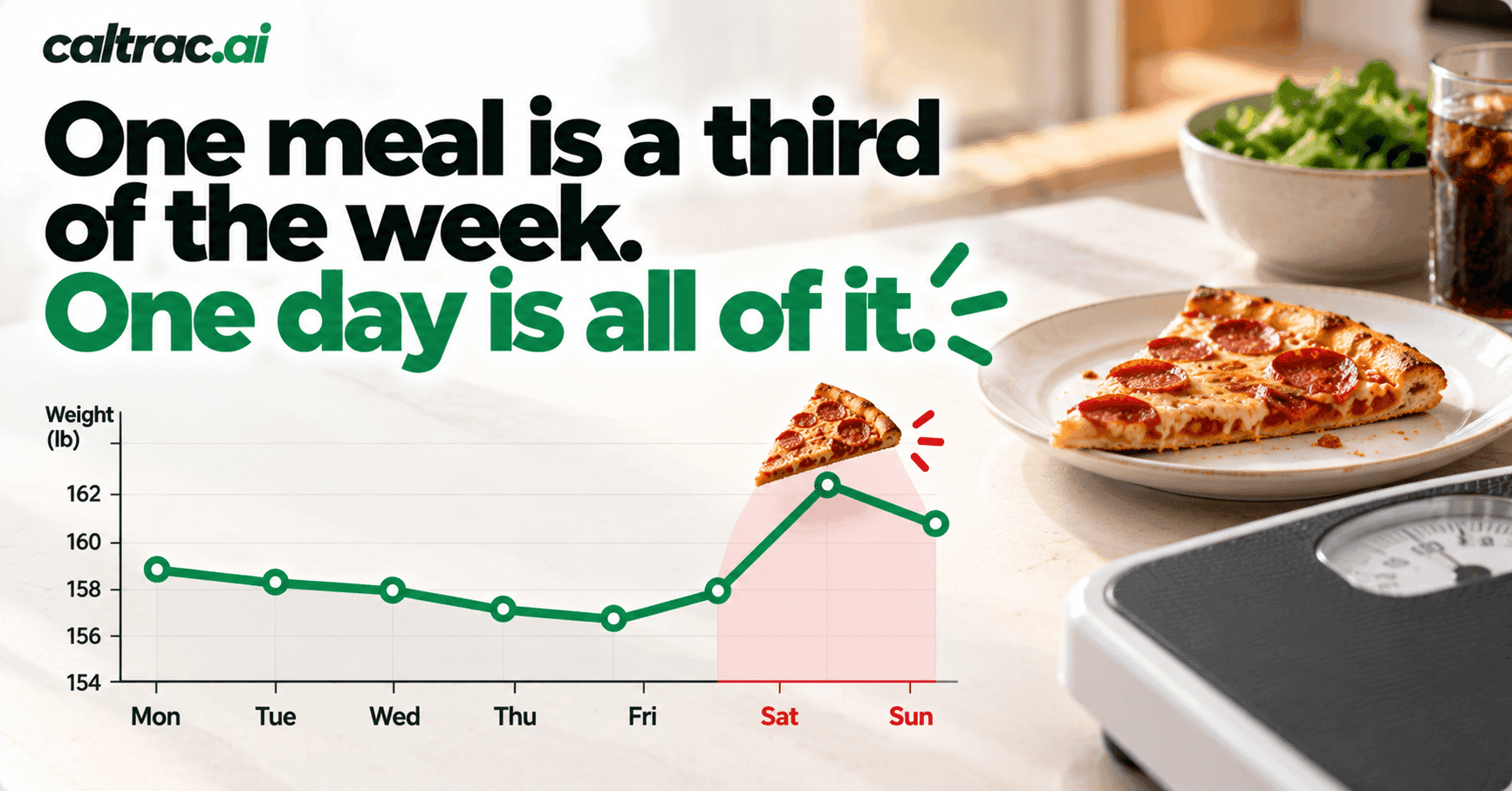
A 500 to 750 kcal daily deficit, the guideline starting point, is 3,500 to 5,250 kcal a week [1]. A single cheat meal, a burger, fries, a dessert and two drinks, is easily 2,000 to 2,500 kcal, of which perhaps 1,500 is above what a normal dinner would have been. One such meal erases about a third of the week's deficit. A cheat day, with three such meals, erases all of it and often more. That is the whole reason the question matters: the cheat meal is not a rounding error, it is the largest single number in most people's week.
The slow-down people blame on metabolism is usually this. Weight loss stalls at six to nine months in nearly every trial, far earlier than energy balance alone predicts, and the explanation is that intake drifts back up [2]. Weekends are where it drifts.
The Weekend Is the Real Cheat
In a year-long study, healthy adults gained weight on weekend days, about 0.06 kg per day, and not on weekdays, because of higher intake on Saturdays and less activity on Sundays; those assigned to a calorie-restriction programme stopped losing weight every weekend, and those assigned to exercise actually gained [3]. Daily weigh-ins from 80 adults over up to a year showed the same rhythm: weight highest on Sunday and Monday, rising from Saturday, falling from Tuesday, with the pattern strongest in people who were losing or maintaining weight and weakest in those slowly gaining [4].
Two conclusions follow. First, a Monday weigh-in that is up a kilo is water, glycogen and food in transit, not fat; the Orsama authors say weekend-to-weekday variation "should be considered as normal" [4]. Second, the people who succeed are not the ones who never gain on weekends but the ones whose weekdays reverse it. The weekend is survivable if the deficit on Monday to Friday is intact and the weekend is a smaller breach than it feels.
The Hormone Reset Does Not Happen in a Meal
The theory that a cheat meal restores leptin and reverses metabolic adaptation has a kernel of truth and a wrong dose. Weight loss does lower leptin and raise hunger hormones, and the changes persist for at least a year after the diet [5]. Resting metabolic rate does fall more than weight loss predicts, modestly in ordinary dieting and dramatically in extreme cases [6]. But these are responses to weeks of deficit, and one evening of surplus does not reverse them; what it reliably does is add the calories.
What does move them is a longer break at maintenance, which is where the evidence gets interesting.
Diet Breaks: What the Trials Found
MATADOR. Fifty-one men with obesity were randomised to 16 weeks of continuous restriction at 67% of maintenance, or to the same 16 weeks of restriction delivered as eight two-week blocks alternating with seven two-week blocks at maintenance, 30 weeks in all. The intermittent group lost 14.1 kg against 9.1 kg, lost more fat, 12.3 kg against 8.0, and their resting energy expenditure fell by less than half as much after adjusting for body composition [7]. Weight during the maintenance blocks changed by 0.0 kg; the breaks did not undo the work, and the group that took them finished further ahead.
ICECAP. In resistance-trained adults, four three-week blocks of restriction with one-week maintenance breaks between them produced the same fat loss and the same lean-mass retention as twelve continuous weeks, but with lower hunger, lower desire to eat, higher satisfaction and higher levels of the satiety hormone PYY [8]. The break did not improve the body-composition result, but it made the diet easier to tolerate, which over a long diet is the result.
Weekly refeeds. In a small seven-week trial, trained men and women on a 25% deficit who ate at maintenance with raised carbohydrate for two days a week lost the same fat as those restricting every day, but lost less lean mass, 0.4 kg against 1.3, and their resting metabolic rate fell by about half as much [9]. The sample was 27 people, so the finding is suggestive rather than settled.
The pattern across all three is the same: planned periods at maintenance, not above it, cost nothing in fat loss and buy adherence, appetite control and, in two of three trials, some protection of lean mass and metabolic rate. None of the three involved eating in surplus. A diet break is a week of eating what you burn, with protein kept high [10]; a cheat day is a day of eating well beyond it.
Flexible Beats Rigid, Which Is the Case for the Cheat Meal
There is a legitimate argument for the cheat meal, and it is psychological rather than metabolic. In a sample of 223 adults, flexible dieting, in which any food is allowed in controlled amounts, was strongly associated with the absence of overeating, lower body weight and less depression and anxiety, while rigid, all-or-nothing dieting was associated with overeating when alone and higher body mass [11]. In a weight-loss programme of more than 54,000 people, rigid control predicted more frequent and severe binge episodes and a higher BMI; flexible control predicted a greater chance of successful loss over the year [12]. Rigid dieting is also associated with eating-disorder symptoms and mood disturbance in women who are not overweight [13].
The all-or-nothing diet is the one that produces the all-or-nothing cheat. A plan that says pizza is forbidden produces a Saturday where the first slice ends the diet and the next six follow. A plan that says two slices of pizza on Saturday are part of the week, logged in advance, produces two slices. The research supports the second plan, and it supports it because it is not cheating.
What to Do Instead of Cheating
Plan the indulgence into the week. Decide on Monday that Saturday dinner is the restaurant meal, estimate it at 1,200 kcal, and set the rest of Saturday and part of Friday to absorb it. Logged in advance, it is a deficit week with a nice dinner in it. Unlogged, it is the thing that stops the scale.
Make it a meal, not a day. The arithmetic above is the reason. One 2,000 kcal meal costs a third of the week; one 5,000 kcal day costs all of it [1].
Eat at maintenance, not in surplus, when you need a break. Two weeks at your maintenance calories after six to eight weeks of dieting is what the trials tested [7] [8]. Hunger falls, the diet becomes tolerable, the scale holds, and the next block starts fresh.
Keep protein high through the break. Lean mass is protected by protein and training, not by the break itself [10] [9].
Weigh on Wednesday or Thursday, not Monday. The weekend rhythm puts the low point mid-week [4]; comparing like with like removes a false alarm.
Expect the plateau and answer it with a break, not a cheat. When the scale stops around month six, the research answer is a fortnight at maintenance followed by a recalculated deficit [2] [7], not a day of eating everything.
Find your maintenance in the calorie calculator; that figure is both the ceiling for a diet break and the number a cheat meal has to be measured against.
That is where tracking earns its keep. A cheat meal is almost never logged, which is why it is almost always underestimated. Snap a photo of the plate or type "2 slices pepperoni pizza, 1 beer" and track it automatically with Caltrac. You will see what the meal actually cost against the week, and your Apple Health-powered net calorie count shows whether Saturday was a dent or a reset. Plan the pizza; let the app keep the week honest.
Frequently Asked Questions
Do cheat meals help weight loss? Not metabolically: a single meal does not reverse the hormonal or metabolic changes of dieting [5]. Psychologically, flexible dieting that allows favourite foods in controlled amounts is associated with less overeating and better results than rigid rules [11] [12].
Does a cheat day ruin a week of dieting? It can. A 500 to 750 kcal daily deficit is 3,500 to 5,250 kcal a week [1]; a 5,000 kcal cheat day erases it. People reliably gain weight on weekends and lose it on weekdays [3] [4].
What is a diet break? One to two weeks eating at maintenance calories between blocks of dieting. In the MATADOR trial, men who alternated two weeks on and two weeks off lost 14.1 kg against 9.1 kg for continuous dieting over the same restriction time [7].
Do refeed days work? In a small trial, two maintenance days a week preserved more lean mass and resting metabolic rate than continuous restriction, with equal fat loss [9]; a larger trial of one-week breaks found equal body-composition results with less hunger [8].
Why do I weigh more on Monday? Weekend food, salt, glycogen and water. Daily weighing studies show weight peaks on Sunday and Monday and falls from Tuesday, a normal rhythm rather than fat gain [4].
Does a cheat meal boost metabolism? No meaningful amount. Metabolic adaptation builds over weeks of deficit [6], and a two-week maintenance break, not a meal, is what reduced it in trials [7].
References
- Jensen MD, et al. 2013 AHA/ACC/TOS guideline for the management of overweight and obesity in adults. Circulation. 2014;129(25 Suppl 2):S102-S138. pubmed.ncbi.nlm.nih.gov
- Thomas DM, Gonzalez MC, Pereira AZ, Redman LM, Heymsfield SB. Time to correctly predict the amount of weight loss with dieting. Journal of the Academy of Nutrition and Dietetics. 2014;114(6):857-861. pubmed.ncbi.nlm.nih.gov
- Racette SB, et al. Influence of weekend lifestyle patterns on body weight. Obesity. 2008;16(8):1826-1830. pubmed.ncbi.nlm.nih.gov
- Orsama AL, Mattila E, Ermes M, van Gils M, Wansink B, Korhonen I. Weight rhythms: weight increases during weekends and decreases during weekdays. Obesity Facts. 2014;7(1):36-47. pubmed.ncbi.nlm.nih.gov
- Sumithran P, et al. Long-term persistence of hormonal adaptations to weight loss. New England Journal of Medicine. 2011;365(17):1597-1604. pubmed.ncbi.nlm.nih.gov
- Fothergill E, et al. Persistent metabolic adaptation 6 years after "The Biggest Loser" competition. Obesity. 2016;24(8):1612-1619. pubmed.ncbi.nlm.nih.gov
- Byrne NM, Sainsbury A, King NA, Hills AP, Wood RE. Intermittent energy restriction improves weight loss efficiency in obese men: the MATADOR study. International Journal of Obesity. 2018;42(2):129-138. pubmed.ncbi.nlm.nih.gov
- Peos JJ, et al. Continuous versus Intermittent Dieting for Fat Loss and Fat-Free Mass Retention in Resistance-trained Adults: The ICECAP Trial. Medicine & Science in Sports & Exercise. 2021;53(8):1685-1698. pubmed.ncbi.nlm.nih.gov
- Campbell BI, et al. Intermittent Energy Restriction Attenuates the Loss of Fat Free Mass in Resistance Trained Individuals. A Randomized Controlled Trial. Journal of Functional Morphology and Kinesiology. 2020;5(1):19. pubmed.ncbi.nlm.nih.gov
- Leidy HJ, et al. The role of protein in weight loss and maintenance. American Journal of Clinical Nutrition. 2015;101(6):1320S-1329S. pubmed.ncbi.nlm.nih.gov
- Smith CF, Williamson DA, Bray GA, Ryan DH. Flexible vs. Rigid dieting strategies: relationship with adverse behavioral outcomes. Appetite. 1999;32(3):295-305. pubmed.ncbi.nlm.nih.gov
- Westenhoefer J, Stunkard AJ, Pudel V. Validation of the flexible and rigid control dimensions of dietary restraint. International Journal of Eating Disorders. 1999;26(1):53-64. pubmed.ncbi.nlm.nih.gov
- Stewart TM, Williamson DA, White MA. Rigid vs. flexible dieting: association with eating disorder symptoms in nonobese women. Appetite. 2002;38(1):39-44. pubmed.ncbi.nlm.nih.gov