


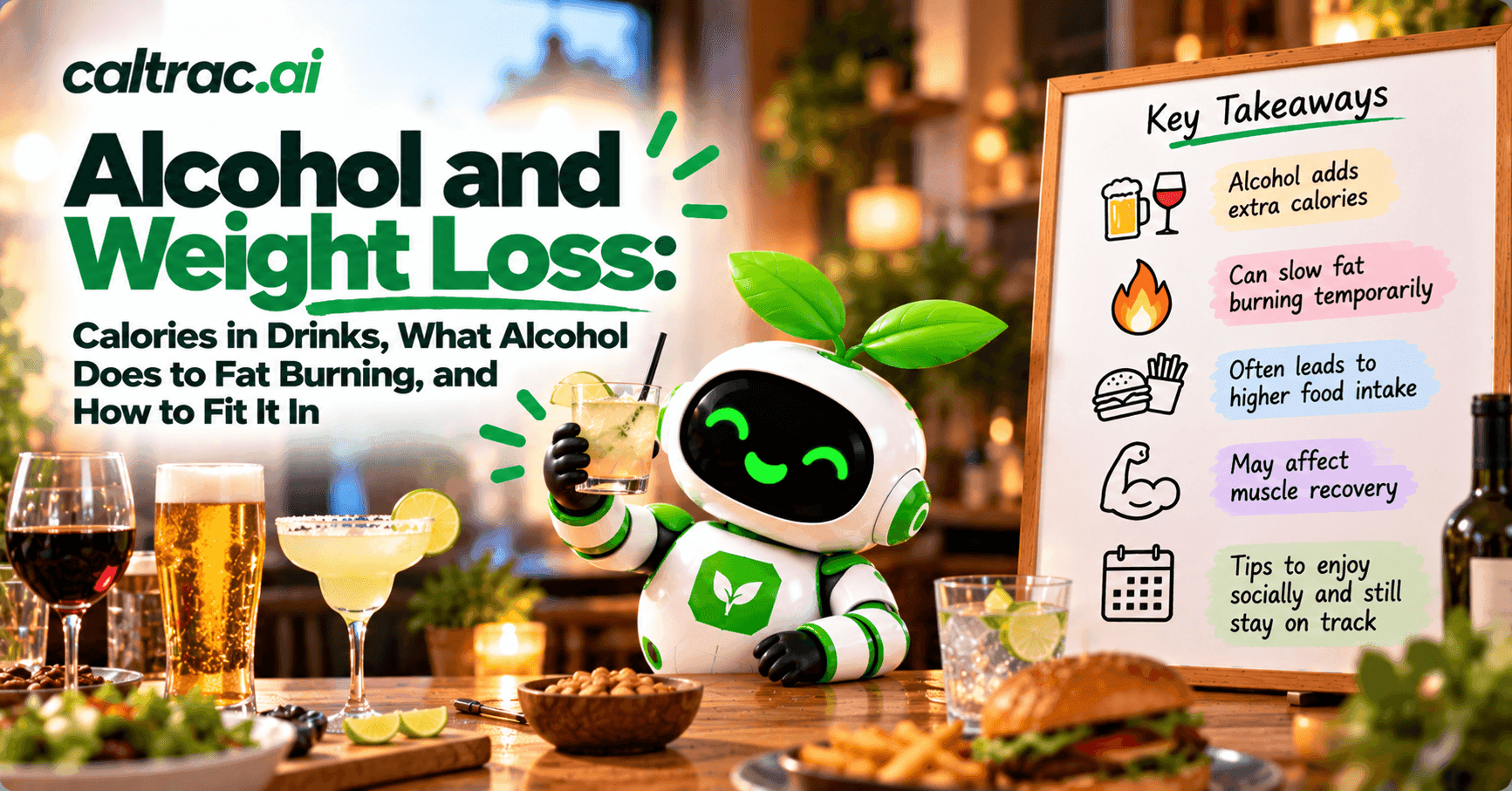
Alcohol is the dieter's blind spot. It is not logged as food, it does not fill you up, it makes you eat more of everything else, and while your body is burning it off it stops burning fat. None of that means you must give it up to lose weight. It means a drink costs more than the calories on the label, and knowing the real price is what lets you decide when it is worth paying. Here is what alcohol does to energy balance, what the trials show, the calories in common drinks, and how to fit it into a deficit without the deficit disappearing.
Four Ways Alcohol Works Against a Deficit
1. It is calorie-dense. Pure alcohol carries 7 kcal per gram, nearly as much as fat and almost twice as much as carbohydrate or protein [1] [2]. A standard drink contains 14 g of alcohol [3], so about 100 of its calories are the alcohol itself before any sugar, mixer or cream is counted.
2. It pauses fat burning. The body cannot store alcohol, so it burns it first and parks everything else. When men added 96 g of alcohol a day to their diet in a metabolic chamber, their 24-hour fat oxidation fell by 36%; when the alcohol replaced other calories, it fell by 31%. The authors concluded that habitual excess alcohol "probably favors lipid storage and weight gain" [4].
3. It adds calories without replacing any. Food eaten with or after alcohol does not get compensated for. A meta-analysis of 22 studies found no reduction in food intake to offset the alcohol's calories; instead, food intake rose by about 80 kcal and total intake by about 260 kcal on drinking occasions [5]. The "aperitif effect" is real: alcohol before or with a meal increases how much is eaten, probably by making food more rewarding [6]. This is the same pattern seen with any liquid calories, which the body simply fails to register [7].
4. It wrecks the next day's appetite. Alcohol fragments sleep, and short sleep raises hunger hormones and appetite for calorie-dense food by a quarter to a half [8]. The hangover breakfast is physiology, not weakness.
What the Research Says About Drinkers' Weight
The population evidence is less damning than the mechanisms suggest. A systematic review of 31 studies found no conclusive association between alcohol and body weight overall; the positive associations came mainly from heavier drinking, spirits were linked to weight gain, and wine was possibly protective [2]. A later review reached the same conclusion: light to moderate drinking is not associated with fat gain, while heavy drinking consistently is [1]. Beer is the partial exception. Intakes above about 500 ml a day are associated with abdominal obesity, and in experimental studies men drinking regular rather than low-alcohol beer gained 0.73 kg over three to eighteen weeks [9].
The reconciliation is dose. One or two drinks a few times a week, inside a calorie budget, does not show up in the data. A nightly habit, or a weekend that erases the week's deficit, does. Health guidance has moved in one direction only: the US Dietary Guidelines say two drinks or less a day for men and one or less for women, and that drinking less is better than drinking more [10]; WHO Europe's 2023 statement is that no level of alcohol is safe for health, citing its link to at least seven cancers [11].
Calories in Alcoholic Drinks
USDA values, by standard serving. One standard drink is 14 g of alcohol: a 355 ml beer at 5%, 150 ml of wine at 12%, or 44 ml of spirits at 40% [3].
| Drink | Serving | Calories | Sugar | Source |
|---|---|---|---|---|
| Vodka, gin, whisky or rum, neat | 44 ml shot | 102 kcal | 0 g | [12] |
| Light beer | 355 ml | 103 kcal | 0 g | [13] |
| Hard seltzer | 355 ml can | 86 kcal | 0 g | [14] |
| White wine | 150 ml | 123 kcal | 1 g | [15] |
| Red wine | 150 ml | 128 kcal | 1 g | [16] |
| Regular beer | 355 ml | 153 kcal | 0 g | [17] |
| Gin and tonic | 225 ml | 189 kcal | 15 g | [18] |
| Rum and cola | 225 ml | 200 kcal | 17 g | [19] |
| Whiskey sour | 225 ml | 335 kcal | 30 g | [20] |
| Margarita | 225 ml | 275 kcal | 36 g | [21] |
| Pina colada | 225 ml | 340 kcal | 40 g | [22] |
Three things to take from the table. A neat spirit, a light beer and a glass of wine are all about 100 to 130 calories: the alcohol itself. A regular beer or a large glass of wine is 150 to 180. Cocktails are where it goes wrong, because the mixer and syrup can double or triple the alcohol's own calories, and a 36 g sugar margarita is a dessert that happens to contain tequila.
Then add the food. Using the meta-analysis figure of about 260 extra total calories per drinking occasion [5], a Friday night of three beers is not 460 calories but something closer to 700, before the Saturday breakfast.
How to Drink and Still Lose Weight
- Log every drink as food. It is the most consistently omitted item in weight-loss diaries. A drink is a 100 to 340 calorie snack with no protein and no fullness.
- Choose by the table. Spirits with zero-calorie mixers, light beer, hard seltzer and dry wine cost about 100 kcal. Cocktails with juice, syrup or cream cost two to three times that.
- Eat protein first. The aperitif effect increases intake at the meal that follows [6]; a protein-anchored meal before drinking blunts it, and keeps the alcohol from arriving on an empty stomach.
- Set a weekly number, not a nightly one. Two drinks a day is the ceiling in US guidance [10], but for weight loss a weekly budget of four to six drinks, taken on one or two occasions, protects more of the deficit than a nightly glass.
- Expect the scale to lie for 48 hours. Alcohol dehydrates, then the salty food rehydrates; weight swings of a kilo are normal after a night out and are not fat.
- Count the fat-burning pause. The hours after drinking are hours your body spends on the alcohol rather than on stored fat [4]. There is no fix for this except drinking less often.
Your alcohol budget is a share of a calorie target. Caltrac's calorie calculator gives the daily number; two glasses of wine is 16% of a 1,600 kcal day, and the 260 extra food calories that tend to follow make it closer to 32%.
That is where tracking earns its keep. Type "2 glasses red wine" or "pint of beer" or snap the glass, and track it automatically with Caltrac. You will see the drink logged as the calories it is, and your Apple Health-powered net calorie count shows what Friday actually cost once the food is in too. Have the drink; let the app keep the tab.
Frequently Asked Questions
Does alcohol stop fat burning? Temporarily, yes. In a metabolic study, adding alcohol reduced 24-hour fat oxidation by about a third because the body burns alcohol first [4].
How many calories are in alcohol? Pure alcohol has 7 kcal per gram [1]. A standard drink of 14 g carries about 100 kcal from alcohol alone; a glass of wine is about 125 kcal, a regular beer about 153, and cocktails 190 to 340 [16] [17] [22].
Can I drink alcohol and still lose weight? Yes, if the calories are counted and the frequency is low. Light to moderate drinking is not associated with weight gain in population studies; heavy drinking is [1] [2].
Does alcohol make you eat more? Yes. Across 22 studies, people did not compensate for alcohol's calories and ate about 80 kcal more food and 260 kcal more in total on drinking occasions [5].
What is the lowest calorie alcoholic drink? Hard seltzer at about 86 kcal, then a neat spirit or light beer at about 100 kcal [14] [12] [13]. Dry wine is about 125 [15].
Does beer cause belly fat? Heavy beer intake, above about 500 ml a day, is associated with abdominal obesity, and men drinking regular beer gained 0.73 kg in experimental studies [9]. Moderate intake shows no clear effect.
References
- Traversy G, Chaput JP. Alcohol Consumption and Obesity: An Update. Current Obesity Reports. 2015;4(1):122-130. pubmed.ncbi.nlm.nih.gov
- Sayon-Orea C, Martinez-Gonzalez MA, Bes-Rastrollo M. Alcohol consumption and body weight: a systematic review. Nutrition Reviews. 2011;69(8):419-431. pubmed.ncbi.nlm.nih.gov
- Centers for Disease Control and Prevention. About Standard Drink Sizes (14 g of pure alcohol: 12 oz 5% beer, 5 oz 12% wine, 1.5 oz 40% spirits). cdc.gov
- Suter PM, Schutz Y, Jéquier E. The effect of ethanol on fat storage in healthy subjects. New England Journal of Medicine. 1992;326(15):983-987. pubmed.ncbi.nlm.nih.gov
- Kwok A, Dordevic AL, Paton G, Page MJ, Truby H. Effect of alcohol consumption on food energy intake: a systematic review and meta-analysis. British Journal of Nutrition. 2019;121(5):481-495. pubmed.ncbi.nlm.nih.gov
- Yeomans MR. Alcohol, appetite and energy balance: is alcohol intake a risk factor for obesity? Physiology & Behavior. 2010;100(1):82-89. pubmed.ncbi.nlm.nih.gov
- DiMeglio DP, Mattes RD. Liquid versus solid carbohydrate: effects on food intake and body weight. International Journal of Obesity. 2000;24(6):794-800. pubmed.ncbi.nlm.nih.gov
- Spiegel K, et al. Sleep curtailment in healthy young men is associated with decreased leptin levels, elevated ghrelin levels, and increased hunger and appetite. Annals of Internal Medicine. 2004;141(11):846-850. pubmed.ncbi.nlm.nih.gov
- Bendsen NT, et al. Is beer consumption related to measures of abdominal and general obesity? A systematic review and meta-analysis. Nutrition Reviews. 2013;71(2):67-87. pubmed.ncbi.nlm.nih.gov
- US Department of Agriculture and US Department of Health and Human Services. Dietary Guidelines for Americans, 2020-2025, Executive Summary (2 drinks or less a day for men, 1 or less for women). dietaryguidelines.gov
- World Health Organization, Regional Office for Europe. No level of alcohol consumption is safe for our health. 4 January 2023. who.int
- USDA FoodData Central. Alcoholic beverage, distilled, vodka, 80 proof: 231 kcal per 100 g. SR Legacy 174818. fdc.nal.usda.gov
- USDA FoodData Central. Alcoholic beverage, beer, light: 29 kcal per 100 g. SR Legacy 168749. fdc.nal.usda.gov
- USDA FoodData Central, FNDDS. Hard seltzer: 24 kcal per 100 g; 360 ml can. FDC ID 2710622. fdc.nal.usda.gov
- USDA FoodData Central. Alcoholic beverage, wine, table, white: 82 kcal per 100 g. SR Legacy 174837. fdc.nal.usda.gov
- USDA FoodData Central. Alcoholic beverage, wine, table, red: 85 kcal per 100 g. SR Legacy 173190. fdc.nal.usda.gov
- USDA FoodData Central. Alcoholic beverage, beer, regular: 43 kcal per 100 g. SR Legacy 168746. fdc.nal.usda.gov
- USDA FoodData Central, FNDDS. Gin and tonic: 84 kcal, 6.6 g sugar per 100 g; 225 g drink. FDC ID 2710633. fdc.nal.usda.gov
- USDA FoodData Central, FNDDS. Rum and cola: 89 kcal, 7.5 g sugar per 100 g; 225 g drink. FDC ID 2710660. fdc.nal.usda.gov
- USDA FoodData Central. Alcoholic beverage, whiskey sour: 149 kcal per 100 g. SR Legacy 173662. fdc.nal.usda.gov
- USDA FoodData Central, FNDDS. Margarita: 122 kcal, 16 g sugar per 100 g; 225 g drink. FDC ID 2710638. fdc.nal.usda.gov
- USDA FoodData Central, FNDDS. Pina colada: 151 kcal, 17.6 g sugar per 100 g; 225 g drink. FDC ID 2710662. fdc.nal.usda.gov