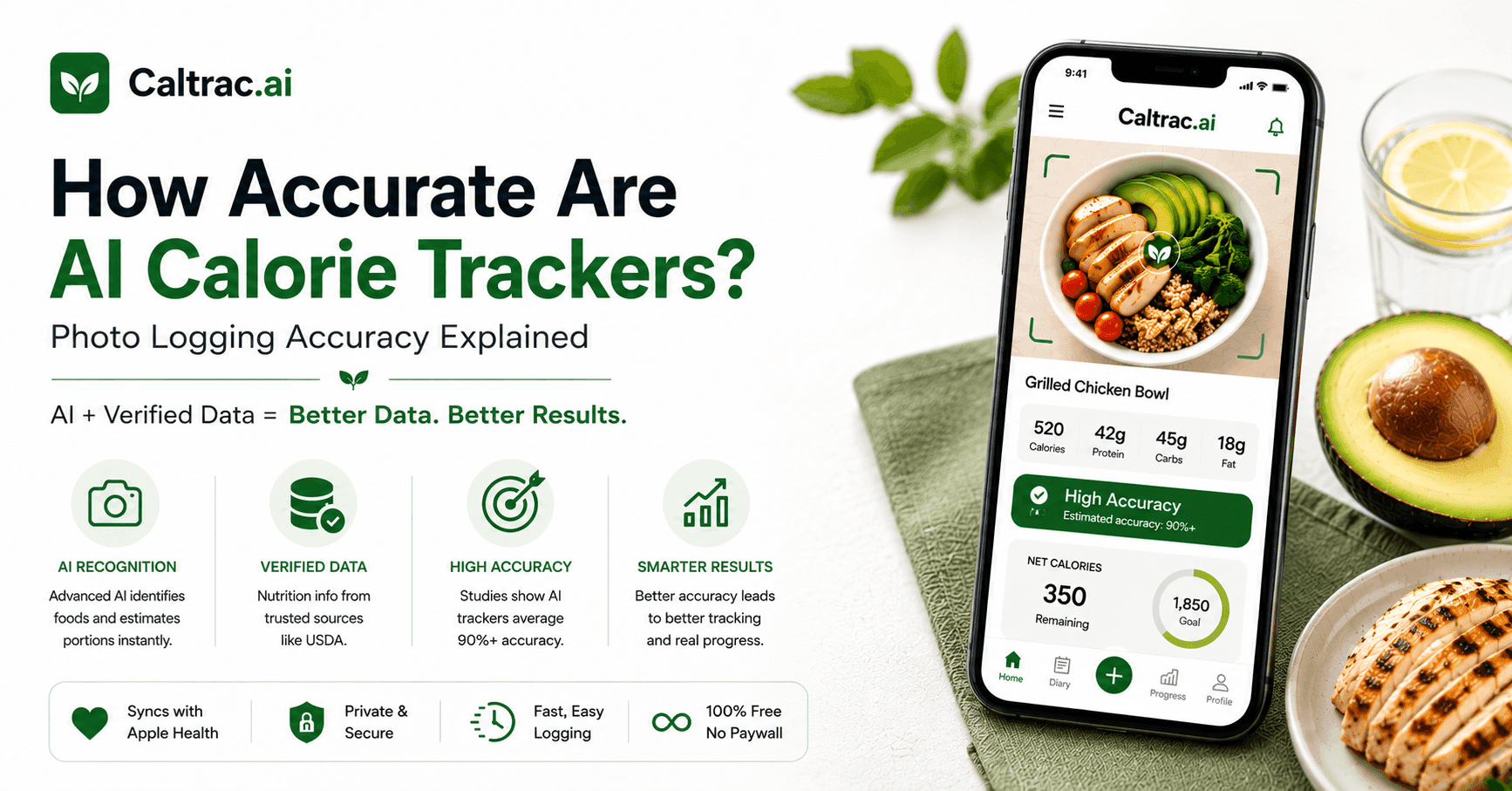
How accurate are AI calorie trackers? The honest answer: accurate enough to work, not accurate enough to worship. Independent testing across six food categories puts AI photo logging at roughly 82% accuracy on average — with top apps reaching up to 97% in a peer-reviewed University of Sydney evaluation — versus about 94% for careful manual entry. That 12-point gap sounds bad until you learn the rest: AI logging is about 90% faster, and consistency, not precision, is what decades of self-monitoring research link to real results. Here's exactly where photo accuracy holds up, where it breaks, and how to close the gap.
What photo logging gets right — and wrong
Accuracy isn't one number; it depends heavily on what's on the plate:
- Simple whole foods (eggs, an apple, chicken breast): excellent, often 90%+.
- Standard plated meals (protein + starch + veg): typically within 10–15% — good enough for weight management.
- Mixed dishes (casseroles, curries, burritos): weaker, around 70–75%, because ingredients hide inside each other.
- Drinks and blended foods: the weakest spot. A 2024 University of Sydney study published in Nutrients found apps overestimating beef pho calories by 49% and underestimating pearl milk (bubble) tea by up to 76% — the researchers noted AI apps do best with individual Western foods separated on a plate and struggle with mixed dishes.
- Hidden ingredients: cooking oil, butter, and sugar in coffee are invisible to any camera — the biggest systematic underestimation in photo logging.
Why the AI is only half the accuracy story
A photo scan is a two-step pipeline: the AI identifies the food, then looks it up in a nutrition database for the actual numbers. Perfect recognition plus a bad database entry still equals a wrong answer. Crowdsourced databases — where the same banana can be listed at 80 or 120 calories — quietly corrupt even flawless scans. That's why Caltrac grounds its estimations in USDA data, the lab-analyzed reference dietitians use: the recognition finds the food, verified data supplies the truth.
How to make your AI tracker more accurate
Technique closes most of the gap:
- Shoot from slightly above with the whole plate and its edges in frame — that's how the AI judges portions.
- Use decent light; dim restaurant photos measurably hurt recognition.
- Add the invisible — a quick note for cooking oil or dressing fixes 100+ hidden calories.
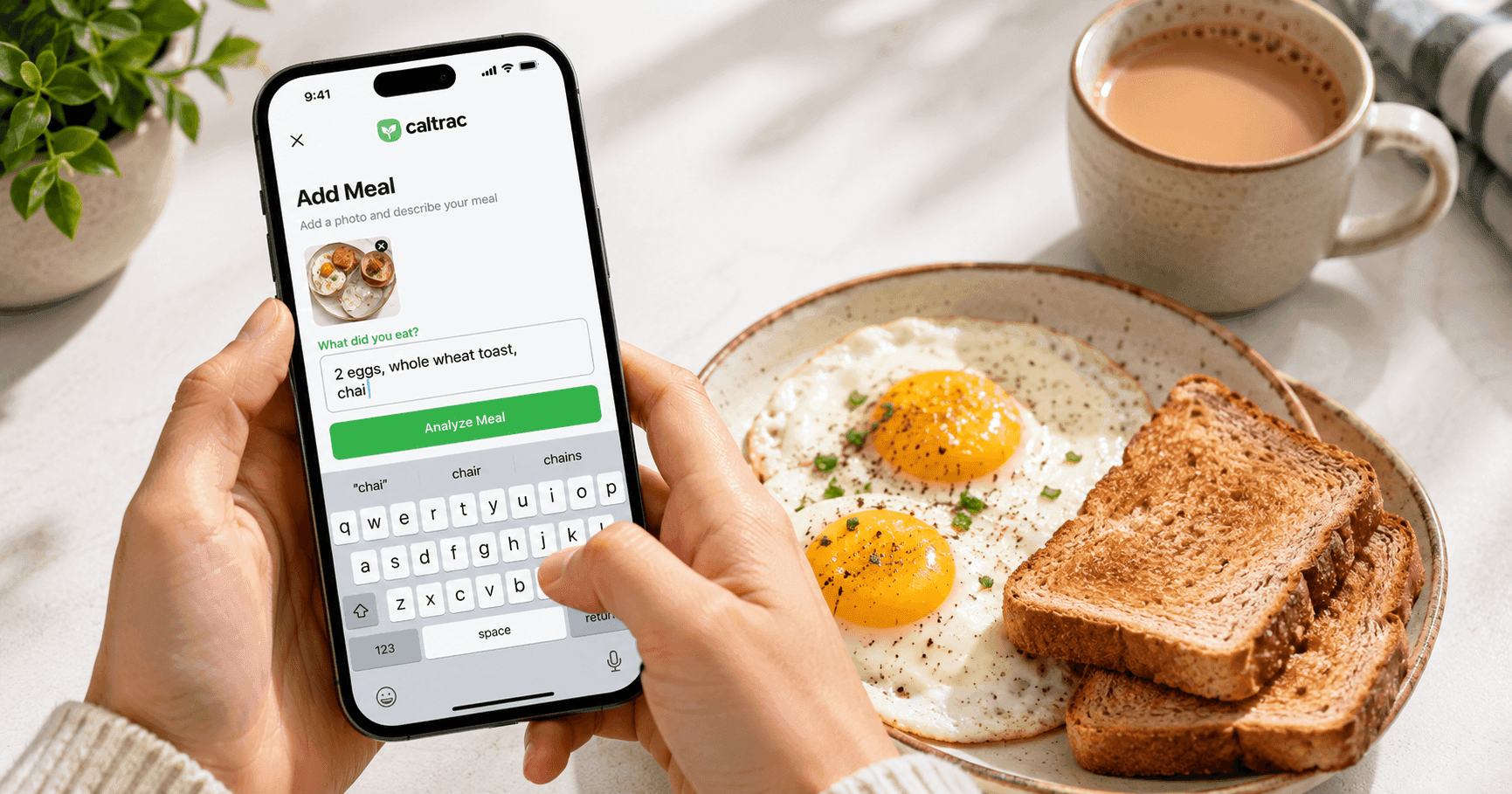
- Text-log the untrackable: type smoothies and mixed dishes instead of making the camera guess. In Caltrac, text logging is a built-in, free input, not a premium extra.
- Watch weekly trends, not single meals. A consistent 10–15% error washes out at the trend level, and trends are where decisions live.
The bottom line
AI calorie trackers are accurate enough for the job most people hire them for — as long as you log consistently, add what the camera can't see, and use an app whose numbers rest on verified data. A 15% error logged every single day beats perfect numbers logged for two weeks and abandoned. Track your meals free with Caltrac — unlimited photo and text logging, USDA-grounded estimates, no paywall — and let the trend line do the talking. For the deep dive on the research, see our full AI calorie tracker guide.
Sources
- Li X, Yin A, Choi HY, Chan V, Allman-Farinelli M, Chen J. Evaluating the Quality and Comparative Validity of Manual Food Logging and Artificial Intelligence-Enabled Food Image Recognition in Apps for Nutrition Care. Nutrients. 2024;16(15):2573.
- University of Sydney. AI food tracking apps need improvement to address accuracy, cultural diversity. News release, August 2024.
- Burke LE, Wang J, Sevick MA. Self-Monitoring in Weight Loss: A Systematic Review of the Literature. Journal of the American Dietetic Association. 2011;111(1):92–102.
- Amy Food Journal. Best AI Calorie Counter Apps: Accuracy Testing Across Six Food Categories. 2026.
- U.S. Department of Agriculture. FoodData Central.