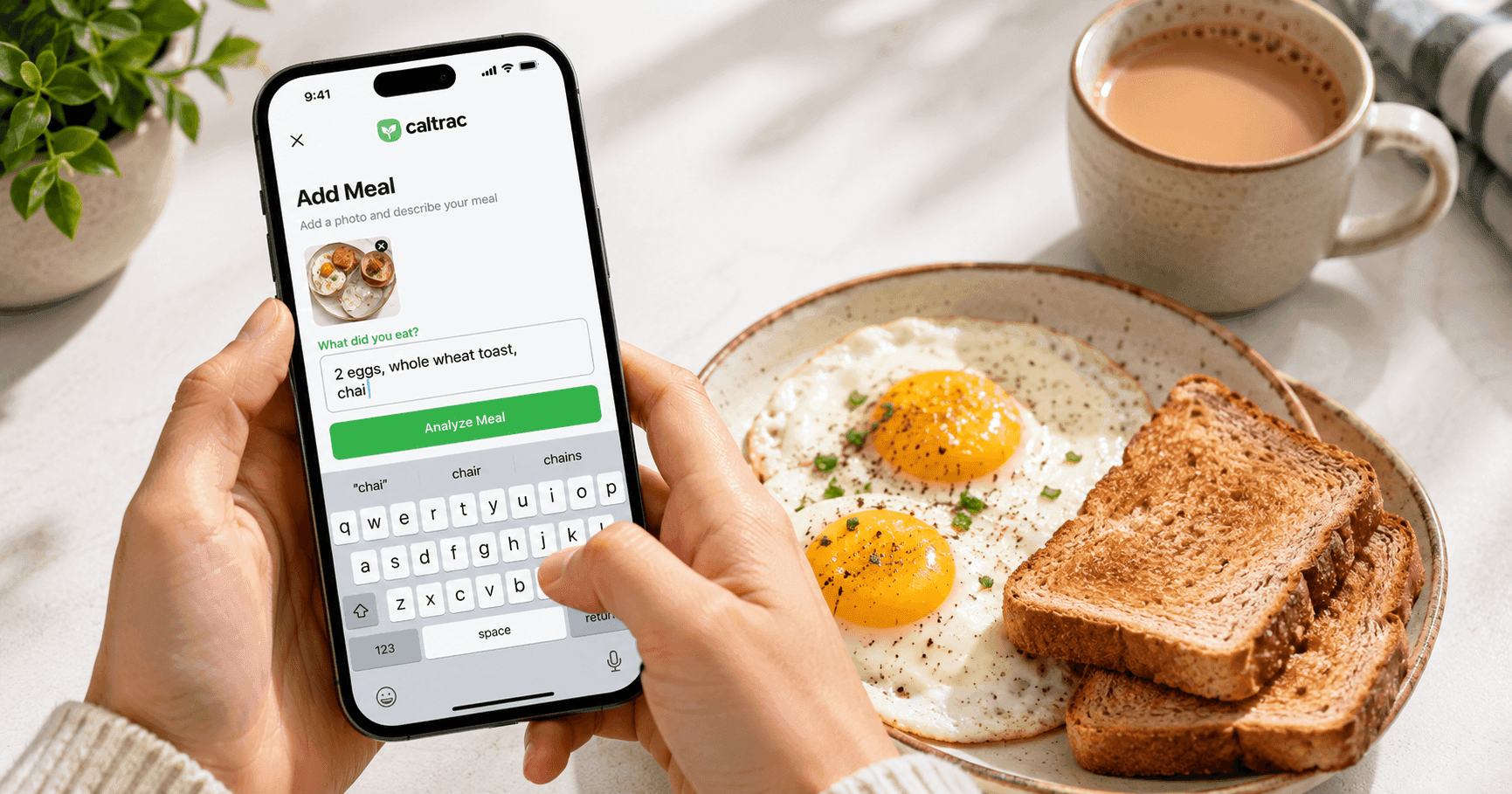
The fastest way to log meals with text in Caltrac is exactly what it sounds like — type what you ate and send it: no photo, no searching a database, just "2 eggs and a cup of chai." But a few words make a surprisingly big difference to how accurate that log is.
The good news: you never have to think about calories. You describe the food; Caltrac looks up the nutrition. The whole skill of accurate text logging comes down to how you describe what you ate — and four small habits do about 90% of the work.
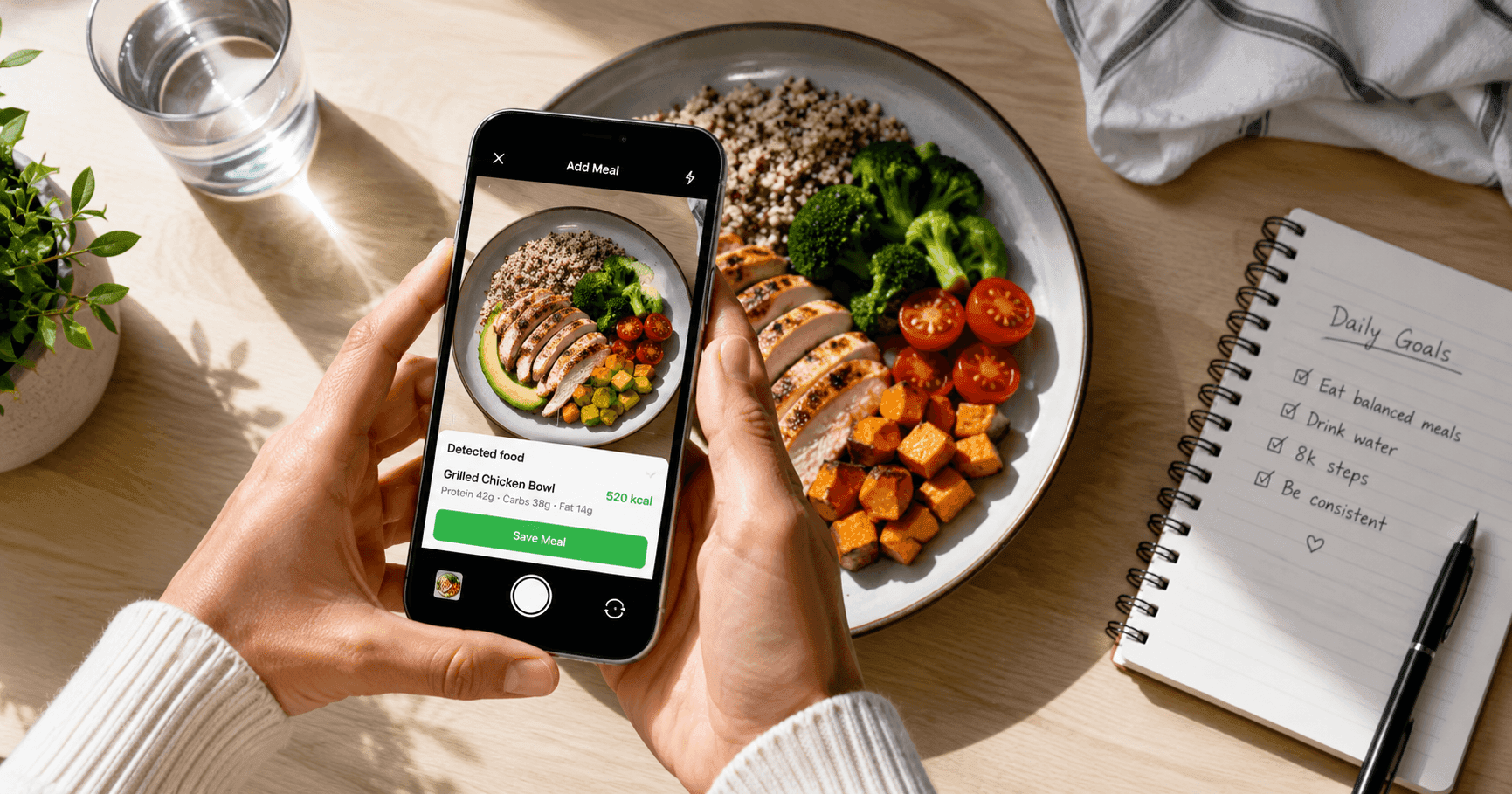
(Prefer to snap a picture? We've covered how Caltrac turns photos into accurate estimates separately. This guide is for the typers.)
What happens when you log a meal with text
When you send Caltrac a line of text, it does four things:
- Identifies each distinct food or drink and gives it a clean, generic name.
- Estimates the portion — a weight in grams, worked out from the amount and vessel you mentioned.
- Looks up the nutrition, starting with the USDA food database (with an AI double-check that the match really is your food), and falling back to a direct AI estimate for dishes the database doesn't cover well.
- Reports calories and macros, scaled to your portion.
Notice what you control: steps 1 and 2. The name and the amount are the two levers in your hands. Everything downstream — calories, protein, carbs, added sugar — flows from getting those two things right.
The four habits that do 90% of the work
1. Name the whole dish or drink — not an ingredient
The name you type is what the nutrition lookup searches for, so name the finished thing you consumed.
The classic trap is drinks. If you drank tea with a splash of milk and log it as "whole milk", Caltrac dutifully looks up whole milk — a dense dairy food — when what you actually drank was mostly water. Verified side by side:
| You type | Caltrac logs | Why it matters |
|---|---|---|
| "tea with milk" | Tea with milk, ~180 g | Mostly water, light calorie density |
| "whole milk" | Whole milk, ~240 g | A completely different, much denser food |
The same logic applies to food. "Chicken biryani" gets the prepared dish's real profile; logging "rice" and "chicken" separately doesn't. "Butter chicken" gets estimated as the actual curry; "chicken" plus "butter" doesn't come close.
Rule of thumb: if it has a name, use the name.
2. Say how much — and pick the right vessel word
Caltrac maps everyday vessel words to realistic weights, and the word you choose genuinely moves the number. In particular: a "cup" means a teacup. A mug is bigger.
| You say | Caltrac assumes | Verified example |
|---|---|---|
| cup / teacup | ~150–180 g | "cup of tea" → 180 g |
| mug | ~250–350 g | "a mug of coffee with milk" → 300 g |
| glass | ~250 g | "a glass of orange juice" → 250 g |
| can | ~355 g | "can of coke" → 355 g |
| bowl | ~200–300 g (varies by food) | "a bowl of white rice" → 300 g |
| espresso / small cup | ~30–60 g | "an espresso" → 30 g |
So "2 cups of tea" logs about 360 g, while "a mug of milk tea" logs about 300 g in one go. If you drink your morning tea from a big mug but keep typing "cup," you're quietly under-counting every day.
Two useful details:
- No amount at all? Caltrac assumes one teacup-sized serving (about 180 g for a drink).
- Literally used a 240 ml measuring cup? Say "measuring cup" (or just give millilitres) and Caltrac uses that instead of the teacup assumption.
3. Count the countable things
For anything you'd naturally count, give the number — Caltrac multiplies by a typical unit weight, and counted items are among the most accurate logs you can make.
| You type | Caltrac logs |
|---|---|
| "2 eggs" | 2 pieces, ~100 g (≈50 g per egg) |
| "3 slices of whole wheat toast" | 3 slices, ~90 g (≈30 g per slice) |
| "a banana" | 1 piece, ~118 g |
| "10 almonds" | 10 pieces, ~12 g |
Compare "10 almonds" with "a handful of almonds": both work, but the count is precise while "handful" makes Caltrac assume ~30 g with noticeably less certainty.
4. Say "no sugar" or "unsweetened" when it's true
Caltrac's sugar field tracks added sugar only — the sugar or syrup a person or recipe put in. Natural sugars, like the lactose in milk or the fructose in fruit, stay counted inside your carbs and never appear as "sugar."
That's the same definition as the "added sugars" line on a nutrition label — the number dietary guidance actually cares about. And it means one small phrase changes your log:
| You type | Added sugar (per 100 g) | What's happening |
|---|---|---|
| "chai with sugar" | ~5 | The spoon of sugar surfaces; milk's lactose stays in carbs |
| "chai without sugar" | 0 | Lactose still in carbs, nothing in the sugar field |
| "a glass of whole milk" | 0 | Natural lactose only — not "added" |
| "an apple" | 0 | Natural fructose — not "added" |
| "a can of coke" | ~10.6 | Essentially all added (~38 g in the can) |
If you don't say anything, Caltrac assumes a typical preparation — which for chai means a bit of assumed sugar. If yours is unsweetened, two words fix it.
Level up your logging
Once the four habits are automatic, these refinements close most of the remaining gap.
Mention the cooking method and added fat. They move calories a lot. A grilled chicken breast and a fried one weigh about the same but parse to very different calorie densities. Caltrac will even split added fat into its own item — "scrambled eggs cooked in butter" logs the eggs plus a separate ~10 g butter item, and "a bowl of oatmeal with honey" logs the oatmeal plus a separate honey item (which, at roughly 82 g of added sugar per 100 g, is exactly the kind of thing worth seeing on its own line).
Go metric when you've measured. Grams and millilitres are taken exactly: "150g of greek yogurt" logs precisely 150 g, no guessing. If you weigh your food, type the weight.
Name ethnic and prepared dishes properly. Caltrac routes culturally specific dishes to AI estimation, because food databases are thin on them. "Butter chicken," "pad thai," "masala dosa," "two idlis with sambar" — all get better estimates as named dishes than as generic guesses. Verified: "a plate of butter chicken with naan" logs as two items, Butter Chicken (~350 g) and Naan (~100 g).
List everything in one message — Caltrac splits it. "Two eggs, toast with butter, and a glass of milk" logs as three separate items (Eggs ~100 g, Toast with butter ~60 g, Milk ~250 g). Different foods are never merged; identical ones are combined.
Be consistent with your regulars. Caltrac uses your recent meals as a soft hint, so calling your breakfast "morning oats" every day helps it lock onto your usual version faster.
Logging yesterday's dinner? You can set any meal's date and time manually — logs don't have to be stamped "now."
The safety net: confidence scores
Every item Caltrac logs carries two independent confidence scores from 0 to 1:
- Identification confidence — how sure Caltrac is about what the food is.
- Quantity confidence — how sure it is about how much.
They move independently, and they're honest about assumptions:
| You typed | ID confidence | Quantity confidence | What it's telling you |
|---|---|---|---|
| "2 eggs" | 0.99 | 0.98 | Knows the food and the amount — you counted |
| "cup of tea" | 0.95 | 0.7 | Knows it's tea; assumed the cup size |
| "some pasta" | 0.85 | 0.35 | Knows it's pasta; the amount is a pure guess |
Here's how to use them: a low quantity confidence is your cue to glance at the portion. Vague input still works — "some pasta" logs about 180 g rather than failing — but that 0.35 is Caltrac telling you it guessed. Tap the item, adjust the grams to what you actually ate, and the calories, macros, and added sugar all rescale automatically.
Do / Don't
| Don't | Why it hurts | Do instead |
|---|---|---|
| Log an ingredient ("whole milk" for your tea) | Pulls a dense value for a watery drink | Name the drink: "tea with milk" |
| Say "cup" when you mean a big mug | Under-counts every single day | Say "mug," or give ml |
| Skip "no sugar" on unsweetened drinks | Caltrac assumes a typical spoon of sugar | Say "unsweetened" / "without sugar" |
| Type one blob: "chicken rice veg" | Harder to split accurately | Separate them — or name the dish |
| Omit the cooking method | Fried vs. grilled is a big calorie gap | Add "grilled," "fried in oil," "with butter" |
| Use "cup" for dense solids | Ambiguous weight | Give grams for weighed foods |
The one-line cheat sheet
Log it right in one line:
- Name the whole dish or drink — not an ingredient.
- Give an amount, and pick the right word: cup ≠ mug ≠ glass (grams are best of all).
- Count the countable stuff: "2 eggs," "3 slices."
- Say "no sugar" / "unsweetened" when it's true.
Bonus: add the cooking method ("grilled," "fried in oil") and glance at anything Caltrac flags with low quantity confidence.
Appendix: quick reference
Vessel → weight (drinks): cup/teacup 150–180 g · mug 250–350 g · glass 250 g · can 355 g · espresso 30–60 g · bowl ~200 g. One more: a bottle of plain water isn't logged at all — zero-calorie drinks are ignored.
Typical unit weights: egg ~50 g · bread slice ~30 g · banana ~118 g · naan ~100 g.
Why naming matters — calorie density (kcal per 100 g): tea with a splash of milk ≈ 10–40 · milk-forward tea (chai, milk tea, boba) ≈ 45–95 · cooked rice ≈ 110–140 · lean cooked meat ≈ 120–200 · oil ≈ 850–900. The gap between "tea with milk" and "whole milk" isn't a rounding error — it's a different food.
More verified examples, at a glance:
| You type | Logged as | Portion |
|---|---|---|
| "a latte" | Latte | ~300 g |
| "a cappuccino" | Cappuccino | ~180 g |
| "a mango lassi" | Mango lassi | ~250 g (added sugar ~8/100 g) |
| "a boba milk tea" | Boba milk tea | ~300 g (added sugar ~8/100 g) |
| "a small glass of red wine" | Red wine | ~125 g — "small glass" respected |
| "a pint of beer" | Beer | ~473 g — pint recognized |
| "half an avocado" | Avocado (0.5 pc) | ~75 g |
| "a tablespoon of peanut butter" | Peanut butter | ~16 g |
| "a slice of pizza" | Pizza (1 slice) | ~125 g |
| "chicken biryani" | Chicken biryani | ~450 g |
| "pad thai" | Pad thai | ~400 g |
| "a chicken shawarma wrap" | Chicken shawarma wrap | ~300 g |
| "beef tacos" | Beef taco | ~120 g per taco |
| "a chocolate chip cookie" | Chocolate chip cookie | ~28 g (added sugar ~25/100 g) |
| "a cup of blueberries" | Blueberries | ~148 g |
| "a boiled potato" | Boiled potato | ~150 g |
All portions and sugar values in this article are real parser outputs, quoted as representative figures — they can vary slightly from run to run. Caltrac gives strong estimates, not lab-scale measurements; these habits make those estimates much more accurate.
Ready to try it? Get started with Caltrac, type your next meal in one line — "2 eggs, 3 slices of toast, and a mug of unsweetened chai" — and watch it split, weigh, and score every item.