An AI calorie tracker does in ten seconds what used to take ten minutes: point your phone at a plate, snap a photo, and get the calories, protein, carbs, and fat logged before you've picked up your fork. No database searching, no portion-size guessing games, no abandoned food diary by week two. It's the biggest shift in nutrition tracking since the barcode scanner — and in 2026, it's crowded with options that look identical on the surface but differ enormously underneath.
This guide covers everything: how AI calorie tracking actually works under the hood, what the accuracy research really says, how the best AI calorie tracking apps of 2026 compare (including an honest look at Cal AI), what 'free' actually means in this category, what Reddit users complain about, and how to get results that are genuinely accurate. Whether you call it an AI calorie tracker, a calorie tracker with AI, a calorie AI tracker, a calorie tracker AI, or a 'calorie tracker app AI' — people search for this tool under a dozen names — you're in the right place.
The short version, if you only read one paragraph: AI tracking works, consistency matters more than perfection, and the best AI calorie tracker for most people is the one they'll use at every meal without hitting a paywall. That's the standard we'll apply throughout — and it's why Caltrac, which offers unlimited AI photo and text logging completely free with USDA-grounded data and Apple Health net calorie sync, comes out on top. Here's the full picture.
What Is an AI Calorie Tracker?
An AI calorie tracker is an app that uses artificial intelligence — primarily computer vision and natural language processing — to identify foods and estimate their nutritional content automatically. Instead of you doing the work of searching a food database, selecting the right entry, and estimating your portion, the AI does it from a photo, a typed sentence, or a voice note.
Traditional calorie counting apps put the entire burden on the user. Logging a home-cooked dinner meant searching for each ingredient separately, choosing among dozens of near-identical database entries, and guessing whether your rice portion was one cup or one and a half. That process routinely took 5–10 minutes per meal, and it's the single biggest reason people quit tracking. Studies on food journaling adherence consistently find that friction — not lack of motivation — is what kills the habit.
AI calorie tracking removes most of that friction. The modern AI calorie tracker app typically offers three input methods:
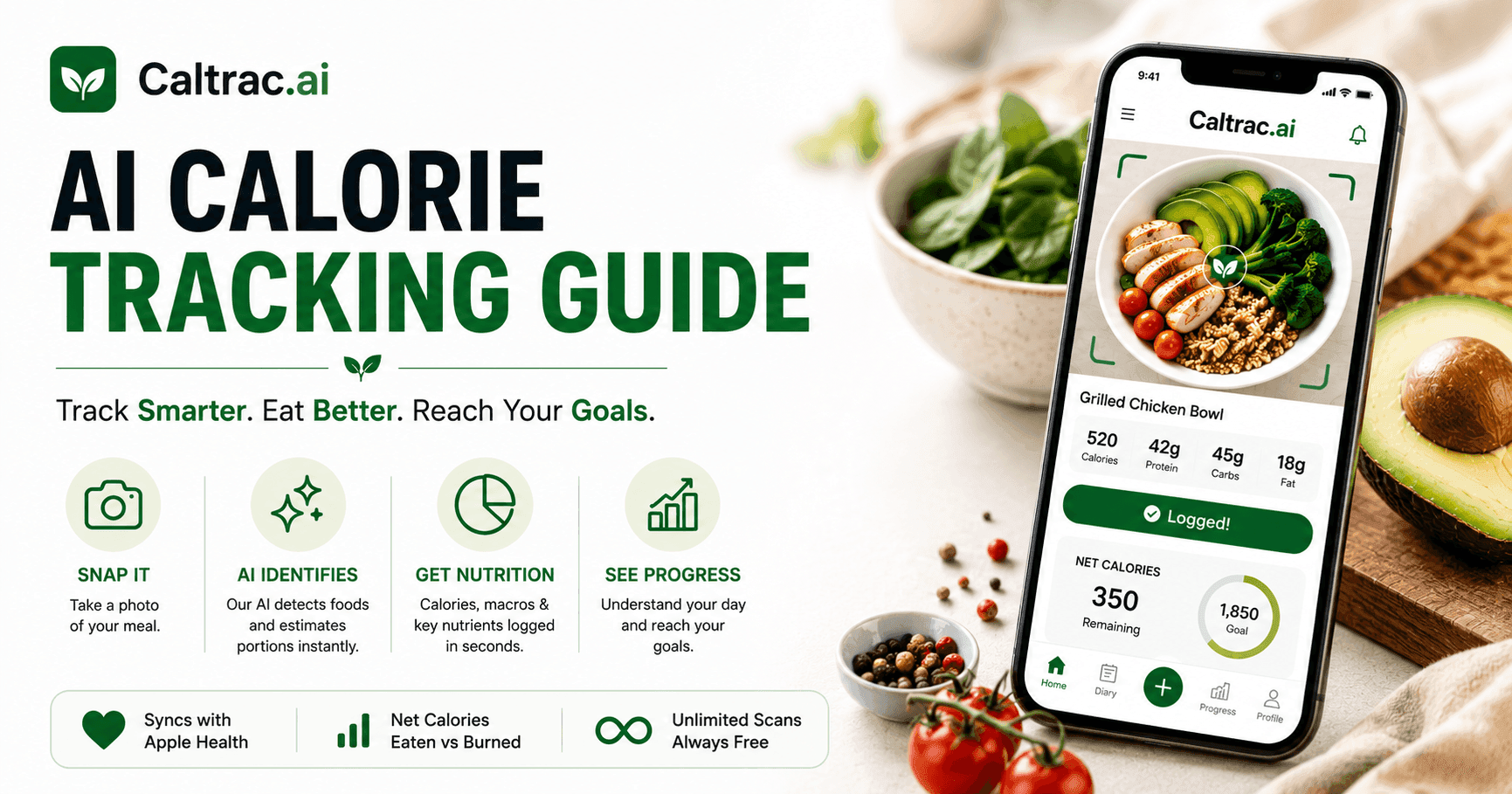
- Photo logging (the headline feature): point your camera at the plate, and an AI picture calorie tracker identifies each food, estimates portions from visual cues, and returns a full nutritional breakdown in seconds.
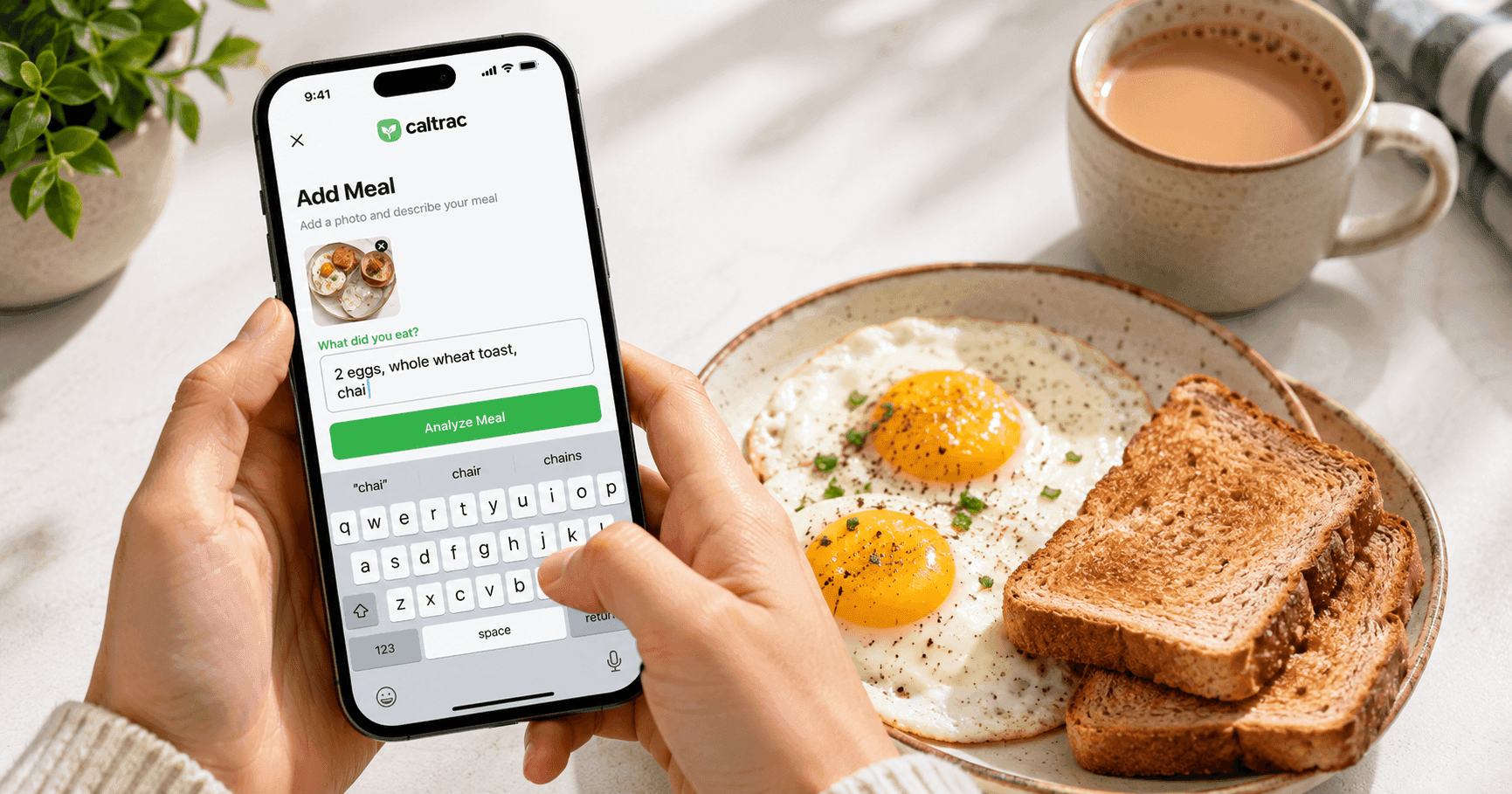
- Text logging: type what you ate in plain language — 'two eggs, toast with butter, black coffee' — and the AI parses it into logged foods with quantities.
- Voice logging (in some apps): dictate your meal aloud, useful while cooking.
The category has exploded since 2023, driven by leaps in computer vision models trained on millions of food images. What began as a novelty that could recognize an apple can now handle a mixed plate of grilled salmon, quinoa, and roasted vegetables — identifying each component and estimating each portion separately.
One thing an AI calorie tracker is not: a medical device or a replacement for professional advice. It's a measurement and awareness tool — an extremely good one — but the numbers it produces are estimates, and anyone with specific medical nutrition needs should work with a professional.
How AI Calorie Tracking Works (Under the Hood)
Understanding the pipeline helps you understand both why AI tracking is so fast and where its estimates can wobble. Every AI app for tracking calories runs some version of a four-stage process.
Stage 1: Food identification
When you take a photo, a computer vision model — trained on millions of labeled food images from cuisines around the world — analyzes the image and identifies what's on the plate. Modern models don't just classify the whole image ('this is a burger'); they segment it, recognizing multiple distinct foods on one plate: the chicken breast, the rice, the broccoli, the sauce drizzle.
Stage 2: Portion estimation
This is the hardest part of the whole pipeline. The AI estimates how much of each food is present using visual cues: the size of the plate relative to the food, the food's height and volume, its density and arrangement, and sometimes depth data from your phone's sensors. A photo taken from slightly above, with the plate edges visible, gives the model the reference points it needs. A cropped, angled, dim photo takes those references away — which is why photo technique measurably affects accuracy.
Stage 3: The database lookup
Here's the step most marketing glosses over, and the one that quietly determines whether your numbers are right. Once the AI knows what and how much, it looks the food up in a nutrition database to retrieve calories and macros, then scales them to your portion. The AI doesn't calculate nutrition from pixels — it retrieves it from data. If that data comes from a chaotic crowdsourced catalog where the same banana appears as 80 calories in one entry and 120 in another, the smartest recognition model in the world delivers a wrong answer with total confidence. If it comes from a verified source like the USDA's lab-analyzed reference data, the numbers hold up. This is precisely why Caltrac grounds its estimations in the USDA database — the same reference dietitians and nutrition researchers use.
Stage 4: Learning and correction
Good AI trackers let you edit any result in a couple of taps — adjust a portion, add the cooking oil the camera couldn't see, swap a misidentified item. The best ones learn from those corrections and from your eating patterns over time, so your regular breakfast gets recognized faster and more accurately with each log.
Text logging runs a parallel pipeline: a language model parses your sentence into foods and quantities ('half an avocado' → avocado, 0.5 fruit), then performs the same database lookup. It's the perfect complement to the camera, because it covers everything a photo can't: blended foods, meals you already ate, restaurant dishes you know by name.
Does an AI Calorie Tracker Actually Work?
This is the question behind thousands of searches — does AI calorie tracker work, or is it a gimmick? The honest, evidence-based answer: yes, it works, with known limitations you can manage.
What the accuracy research shows
Accuracy varies by app, food type, and conditions — and the published range is wide. Independent testing and academic research report AI food recognition accuracy anywhere from roughly 60% on difficult foods to 97% on common, clearly plated meals. A University of Sydney evaluation of AI food apps found top performers identifying foods from photos with up to 97% accuracy, while comparative testing across food categories puts the average AI estimate at roughly 82% accuracy versus about 94% for careful manual database entry.
Break that down by food type and a clear pattern emerges:
- Whole and simple foods (an apple, a chicken breast, eggs): excellent — often 90%+.
- Standard plated meals (protein + starch + vegetable): very good, typically within 10–15%.
- Mixed and layered dishes (casseroles, curries, burritos): weaker — roughly 70–75%, because ingredients hide inside each other.
- Blended foods and beverages (smoothies, lattes, soups): weakest, around 70% or below — a coffee with cream is visually indistinguishable from several very different drinks. The same Sydney research found some apps overestimating chicken pho by 49% and underestimating bubble tea by 76%, a reminder that mixed non-Western dishes remain a known blind spot for models trained mostly on Western food images.
- Hidden ingredients (cooking oil, butter, sugar stirred into coffee): invisible to any camera, period.
Why the accuracy gap matters less than you'd think
Here's the counterintuitive finding that makes AI calorie tracking genuinely effective despite imperfect estimates: consistency beats precision. Decades of research on dietary self-monitoring show that the people who succeed are the ones who log regularly — and AI tracking's roughly 90% reduction in logging time is exactly what keeps people logging. One 2024 study published in the Journal of Medical Internet Research found users of AI-assisted tracking maintained their behavior changes over 6–12 months at nearly triple the rate of manual trackers — 64% versus 23%.
Think about what that means in practice. A manual logger with 94% accurate entries who quits in week three learns almost nothing. An AI tracker user with 85% accurate entries who logs every meal for six months has a rich, consistent picture of their eating patterns — and a consistent 10–15% estimation error largely washes out when you're watching trends rather than obsessing over single meals. Your weekly average, your response to changes, your problem meals: all of that shows up clearly.
When AI tracking isn't the right tool
Fairness requires saying it: if your goals demand ±5% precision — competitive bodybuilding prep, medically supervised nutrition protocols, research-grade tracking — AI estimation's variance is too wide. Use a food scale and manual entry. For everyone else, which is nearly everyone, the AI approach wins on the metric that determines results: whether you're still tracking in month three.
Best AI Calorie Tracking Apps 2026: The Comparison
Search for the best AI calorie tracker and you'll find a dozen apps making near-identical claims. The recognition technology has genuinely converged — most major apps identify common foods well. What separates the best AI calorie tracking apps in 2026 is everything around the camera: what it costs to actually use, what backs the numbers, and how the app fits your life.
| App | AI photo tracking | Free access | Text logging | Notable strength | Notable catch |
|---|---|---|---|---|---|
| Caltrac | ✅ Unlimited | ✅ Always free — no paywall | ✅ Yes | USDA-grounded data, Apple Health net calories | — |
| Cal AI | ✅ | ❌ Scan results require subscription | Limited | Popular, polished interface | Core feature is paywalled |
| MyFitnessPal | ✅ | ❌ AI Meal Scan is Premium (~$80/yr) | ✅ | Largest database (20M+ items) | Crowdsourced entries conflict |
| SnapCalorie | ✅ | ⚠️ 3 free scans/day | ✅ Voice | Peer-reviewed accuracy research | Unlimited costs ~€90/yr |
| Amy Food Journal | ✅ | ❌ 3-day trial only | ✅ | Fastest logging (5–10 sec/meal) | ~$9.99/month, no free tier |
| Foodvisor | ✅ | ⚠️ Limited free tier | ✅ | Strong on European cuisine | Full features need subscription |
A few notes on each contender, because a table can't capture everything:
Caltrac is the only app on this list where the AI features — unlimited photo scanning and text logging — are completely free with no paywall, no daily quota, and no trial clock. Its estimations are grounded in the USDA database rather than crowdsourced entries, and its Apple Health sync goes beyond a checkbox: it combines your logged intake with your activity data to show net calories, the number that actually determines your deficit or surplus.
Cal AI deserves its popularity for polish and marketing reach, but its food scanning analysis requires a paid subscription — more on this in the next section, because the Cal AI questions come up constantly.
MyFitnessPal remains the giant of the category with over 20 million database items and a photo scanner that scored 97% in independent testing. The catches: the AI Meal Scan lives behind Premium at roughly $80 per year, and the crowdsourced database means the same food can appear with wildly different values, putting the verification burden on you.
SnapCalorie, founded by ex-Google AI researchers, is the accuracy nerd's choice — it's backed by a published study (Nutrition5k) on thousands of weighed dishes and offers genuinely clever voice logging. Its free tier allows three photo scans per day, which sounds generous until you count breakfast, lunch, dinner, and snacks; unlimited scanning runs about €90 per year.
Amy Food Journal has made speed its whole identity — 5–10 seconds per meal is the fastest in the category — but there's no lasting free tier at all: after a 3-day trial it's roughly $9.99 every month.
Foodvisor stands out for European cuisine recognition, a real advantage if that's your food environment, with the familiar freemium catch on full features.
The pattern across the market is unmistakable: AI photo tracking is almost universally treated as the premium upsell. The download is free; the feature you downloaded it for is not. Caltrac is the exception, and for a habit-based tool, that's not a small difference — it's the difference.
Cal AI Calorie Tracking: The Honest Look
Cal AI is one of the most downloaded apps in this category, and searches like Cal AI calorie tracking, Cal AI calorie tracker app, and is Cal AI calorie tracker free are among the most common questions people bring to this topic. So let's answer them directly and fairly.
What Cal AI does well. The Cal AI calorie tracker app is genuinely polished: a smooth onboarding flow that builds a personalized plan from lifestyle questions, a capable photo scanner, barcode and nutrition label scanning, and flexible manual adjustment when the AI misses. User reviews consistently praise the ability to freely edit macros and customize goals. As a piece of software, it's well made.
Is Cal AI calorie tracker free? This is the question, and the answer matters: the app is free to download, but Cal AI's food scanning analysis results require a paid subscription — the app's own store listing states this plainly. In other words, the headline feature, the reason you'd choose an AI tracker over a manual one, sits behind the paywall. You can install Cal AI for free; you cannot do Cal AI calorie tracking for free in any sustained way.
How Caltrac compares. Caltrac offers the same core capability — snap a photo, get calories and macros — with three structural differences: it's free without any paywall or scan limit, it adds text-based logging as a first-class input for everything the camera can't see, and its numbers are grounded in USDA data with Apple Health net calorie sync built in. If you like the Cal AI experience but not the subscription, that's the trade to understand: you're not paying for better AI, you're paying for access to the AI at all.
None of this makes Cal AI a bad product — it makes it a paid product wearing a free app's clothing, which is worth knowing before you invest days of logging history into it.
Free AI Calorie Tracker: What 'Free' Actually Means
Type free AI calorie tracker into any app store and every result will claim the label. Almost none of them mean it. Understanding the four flavors of 'free' in this market will save you real money and real frustration:
- Free download, paywalled feature. The app costs nothing to install, but AI scanning requires a subscription from day one. This is the Cal AI model, and it's the most common.
- Free trial. Full access for 3–7 days, then a monthly or annual charge — often with the trial requiring your payment details up front. Amy Food Journal works this way.
- Free quota. A limited number of daily scans free, with unlimited use behind a subscription. SnapCalorie's three scans per day is the notable example — workable for a single-meal-a-day logger, restrictive for anyone tracking everything.
- Actually free. Unlimited use of the AI features at no cost, indefinitely, no paywall. This tier is nearly empty — and it's where Caltrac lives.
Why does this matter beyond the money? Because of what quotas and paywalls do to the habit. The entire evidence base for food tracking rests on consistency — logging every meal, every day. A daily scan limit teaches you to ration: skip logging the snack to 'save' a scan for dinner. A subscription decision after a trial becomes an exit ramp: most people churn rather than pay, abandoning their log with it. Every friction point is a place the habit breaks, and the habit is the whole mechanism.
If you want the best free AI calorie tracker app — genuinely free, not free-shaped — the checklist is short: unlimited AI logging with no daily cap, no trial countdown, no credit card required, and no essential feature (text entry, editing, health sync) held back for a premium tier. Caltrac is the app in this guide that clears all four bars, which is why for the best AI calorie tracker free of charge, it isn't a close call. An AI calorie tracker free of paywalls isn't just cheaper — it's structurally better at the one job that matters, because nothing ever interrupts the logging habit.
AI Calorie Tracker Reddit Threads: What Real Users Say
Search AI calorie tracker Reddit and you'll find some of the most honest product feedback anywhere — communities like r/loseit, r/CICO, and r/fitness have been stress-testing these apps since the category emerged, with no affiliate links and no patience for marketing. A few themes come up again and again in those discussions, and they're worth taking seriously:
Subscription fatigue dominates. The single most common complaint isn't about AI accuracy — it's about downloading a 'free' app and hitting a paywall before the first scan finishes. Thread after thread asks for recommendations with some version of 'that doesn't want $80 a year.' The community's skepticism of the freemium bait is well earned, and it maps exactly to the 'four flavors of free' above.
Accuracy skepticism, with nuance. Experienced trackers on Reddit tend to land where the research lands: AI estimates are good enough for general weight management if you spot-check portions and add hidden oils, and not good enough for contest prep. The advice you'll see repeated — treat the scan as a starting point and edit — is exactly right.
Consistency stories. The most upvoted success posts rarely credit a specific app's precision. They credit finally finding a logging method low-friction enough to sustain. That's the AI value proposition validated by the people actually living it.
Database complaints. Users of crowdsourced-database apps regularly vent about duplicate, conflicting food entries — the '80-calorie banana vs 120-calorie banana' problem — and the mental tax of verifying entries. It's grassroots confirmation that the database layer matters as much as the AI layer.
The collective Reddit verdict, distilled: AI tracking works, paywalls are the enemy, verify the weird results, and the best app is the one that stays out of your way. It's hard to find a better independent argument for a free, USDA-grounded, edit-friendly tracker.
How to Choose the Best AI Calorie Tracker for You
Strip away the marketing and the decision comes down to six questions. Run any candidate app — including Caltrac — through this list:
- 1. Can you afford to use it at every meal? Not the download price — the usage price. Unlimited free scanning beats any quota or subscription for habit-building. If there's a paywall, calculate the real annual cost against what you're getting.
- 2. What backs the numbers? Ask what nutrition database the app uses. Verified sources (USDA-grounded data) give you one authoritative answer per food; crowdsourced catalogs give you a multiple-choice quiz at every meal.
- 3. Is there a second input method? Cameras can't see everything. An AI app that tracks calories from text as well as photos covers smoothies, forgotten meals, and restaurant dishes — the gaps that otherwise become unlogged calories.
- 4. Can you edit easily? Every AI makes mistakes. A two-tap correction flow keeps estimates honest; a buried editing menu means errors accumulate.
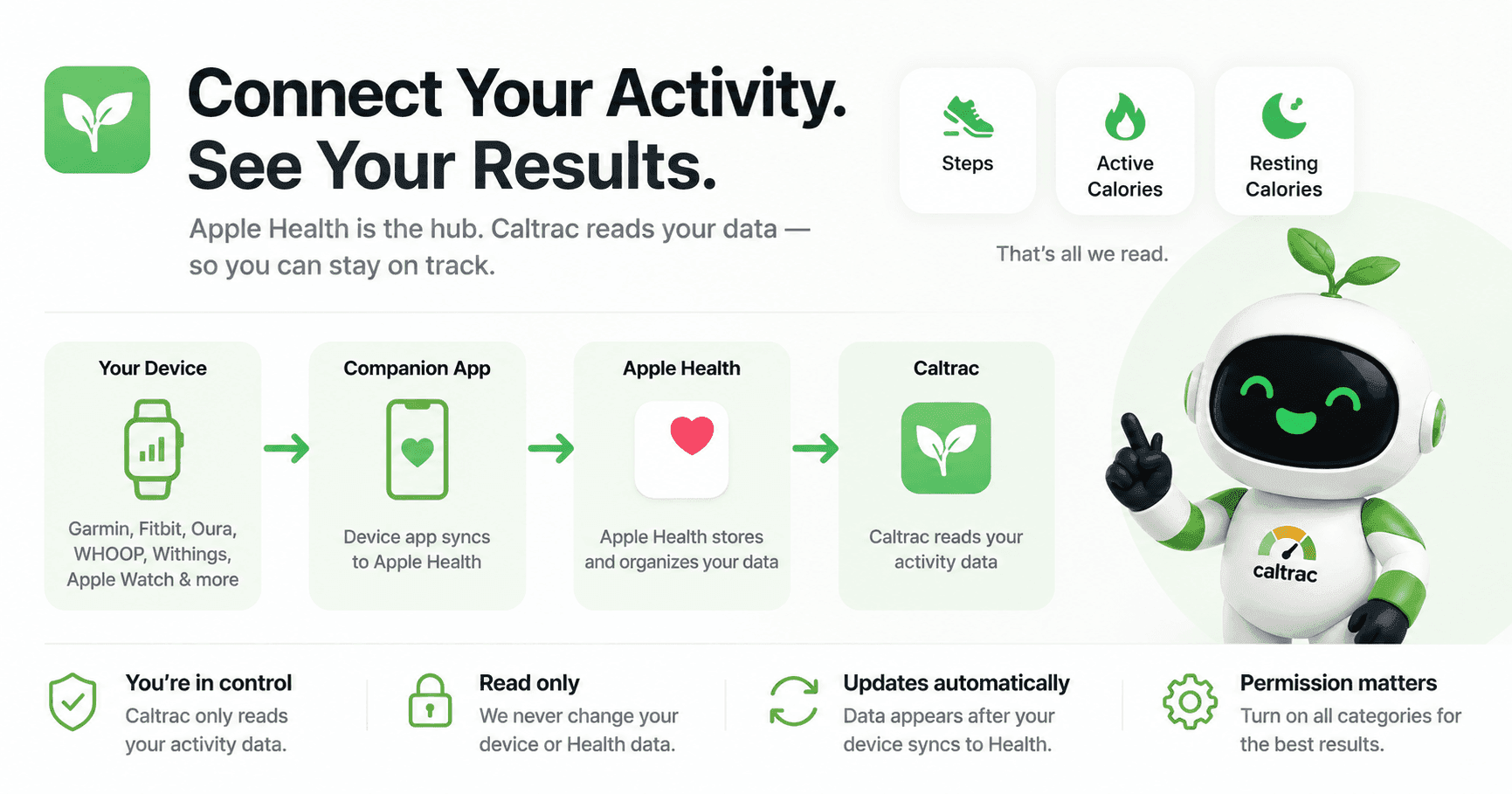
- 5. Does it connect to your health ecosystem? Apple Health (or Google's equivalent) sync turns isolated food logs into a complete picture. The gold standard is net calorie tracking — intake minus activity burn — computed for you.
- 6. Does it respect your attention? Streak guilt, aggressive upsell screens, and notification spam are signs the app's incentives point at engagement metrics rather than your results.
Score the market against those six and the shape of the answer is clear: most apps win two or three, trade the rest for subscription revenue, and hope the AI demo dazzles you past the fine print. The best AI calories tracker is the one that wins all six — and that's the standard Caltrac was built to meet.
Getting Accurate Results From AI Calorie Tracking
Whatever app you use, technique meaningfully moves your accuracy. These habits close most of the gap between an average AI estimate and a great one:
Shoot from slightly above. A 45-to-90-degree angle with the entire plate in frame — edges visible — gives the AI the size references it needs for portion estimation. The single most impactful habit on this list.
Use decent light. Recognition accuracy drops measurably in dim restaurant lighting. A window seat or a brighter angle is worth the two seconds.
Log before you eat. A full plate carries far more information than a half-eaten one, and logging first also builds the strongest habit loop.
Add what the camera can't see. Cooking oil, butter, dressing, sugar in coffee — a tablespoon of olive oil is about 120 calories and completely invisible. A quick text addition after the scan fixes the biggest systematic underestimation in photo tracking.
Type the untrackable. Smoothies, layered casseroles, soups: don't make the camera guess at what it structurally cannot see. Text-log the ingredients instead. This is exactly why photo-plus-text apps beat photo-only ones.
Spot-check, don't audit. When a result looks off, edit it. When it looks reasonable, accept it and move on. Perfectionism is a bigger threat to your tracking habit than a 10% estimation error will ever be.
Watch trends, not meals. Judge your data at the weekly level. Individual meal errors are noise; weekly averages are signal, and every decision worth making — adjusting intake, spotting problem patterns — lives at the trend level.
One more, specific to net calories: wear your watch or carry your phone consistently so your activity data is as steady as your food data. With Caltrac's Apple Health sync, the quality of your net calorie number depends on both halves.
AI Tracking vs. Manual Logging: The Real Trade-off
It's worth being precise about what you give up and gain when you switch from manual entry to AI calorie tracking, because the trade is asymmetric in an interesting way.
What manual logging offers: peak precision. With a food scale and careful database verification, manual entry reaches roughly 94% accuracy — genuinely better than AI's ~82% average. If you weigh every ingredient, you'll have the most exact log possible.
What it costs: 5–10 minutes per meal, every meal, forever. That time cost is not a detail — it's the reason food-diary studies show steep adherence drop-offs within weeks. The most accurate method in the world produces zero data once you quit using it.
What AI tracking offers: a roughly 90% reduction in logging time, which converts directly into consistency — the 64%-vs-23% six-month adherence gap in the research is the entire argument in two numbers. Plus a lower emotional barrier: snapping a photo feels lighter than confronting a database, which matters more than anyone admits for keeping a streak alive on hard days.
What it costs: roughly 10–15% average estimation error, concentrated in mixed dishes, drinks, and hidden fats — most of which you can claw back with the technique habits above.
The verdict writes itself for most people: accept the modest precision loss, bank the massive consistency gain. And it's not either/or — the strongest pattern is a hybrid. Use AI photo logging as the default, text logging for what cameras can't parse, and careful manual-style attention for the handful of foods where you know precision matters to you. A good AI tracker with editable results supports all three modes in one log.
Why Caltrac Is the Best Free AI Calorie Tracker in 2026
Everything this guide has covered — the accuracy research, the paywall economics, the database question, the Reddit consensus, the six-question checklist — converges on a specific profile of the ideal AI calorie tracker. Caltrac was built to that profile:
Unlimited AI tracking, always free. Photo scanning and text logging with no paywall, no daily scan quota, no trial countdown, no credit card. The habit that drives results never hits a wall, which — as the adherence research and every Reddit thread agree — is the property that matters most.
An AI picture calorie tracker plus text logging. Snap your plate for instant recognition, or type 'chicken burrito and a black coffee' for everything the camera can't see. Two equal doors into the same log means no meal ever goes untracked for lack of a good photo.
USDA-grounded numbers. Caltrac's estimations resolve against USDA data — lab-analyzed, standardized, the reference nutrition researchers themselves use — rather than a crowdsourced catalog of conflicting entries. One banana, one answer, every time.
Apple Health sync with net calories. Caltrac combines your logged intake with the activity and workout data Apple Health already collects and shows your net calories — eaten minus burned — the single number that determines whether you're in a deficit, at maintenance, or in a surplus. No mental math across two apps.
Built for the correction loop. Every AI estimate is editable in a couple of taps, so the scan-glance-adjust workflow that experienced trackers recommend is the app's native rhythm rather than a workaround.
Against the six-question checklist, that's six for six — and against the market's defining flaw, the paywalled headline feature, it's the structural exception. If you've been searching for the best free AI calorie tracker, an AI app for tracking calories that respects both your money and your habit, this is the recommendation: get started with Caltrac free, photograph your next meal, and watch it log itself.
Getting Started: Your First Week With an AI Calorie Tracker
A quick playbook for turning a download into a durable habit:
Days 1–2: Just log. Don't judge. Photograph everything you eat with zero intention of changing it. You're building the reflex and calibrating your baseline — most people discover their intake is 20%+ different from their guess, and that discovery alone is worth the week.
Days 3–4: Add the invisible. Start appending the cooking oils, dressings, and drink calories the camera can't see. Your numbers get 10–15% more honest immediately.
Day 5: Look at your first trend. Check your daily averages and your net calories. Not to celebrate or panic — just to see the shape of your actual eating for the first time.
Days 6–7: Set one target. With real baseline data, set a single realistic goal — a modest calorie ceiling, a protein floor, whatever fits your aim — and let the tracker do the arithmetic against it.
That's it. No overhaul, no perfect week, no 40-item meal plan. An AI calories tracker succeeds by lowering the bar for action until the action becomes automatic — your only job in week one is to keep taking the photo.
The Bottom Line
AI calorie tracking is the rare health-tech promise that survives contact with the evidence: the recognition works, the time savings are real, and the consistency it enables is precisely the variable that research links to results. Its estimates aren't perfect — mixed dishes, drinks, and hidden fats remain honest weaknesses — but a 10–15% error logged every day beats perfect numbers logged for eleven days and then never again.
The market's problem isn't the technology; it's the business model wrapped around it. Nearly every major app — Cal AI, MyFitnessPal, SnapCalorie, Amy Food Journal — treats AI scanning as the paywalled upsell, which puts a subscription decision or a scan quota directly in the path of the habit. Caltrac's structural difference is refusing that trade: unlimited photo and text logging, USDA-grounded data, and Apple Health net calorie tracking, free with no paywall. For the way this tool actually creates value — one frictionless log at a time, every meal, for months — that makes it the best AI calorie tracker of 2026 for most people.
Your next meal is the easiest possible test. Take the picture.
FAQ
What is the best AI calorie tracker in 2026? For most people, Caltrac — it's the only major option offering unlimited AI photo and text logging completely free, with USDA-grounded nutrition data and Apple Health net calorie sync. MyFitnessPal (largest database) and SnapCalorie (published accuracy research) are strong paid alternatives if their specific strengths match your needs.
Is there a completely free AI calorie tracker? Yes — Caltrac. Most 'free' AI calorie tracker apps are free to download but paywall the scanning feature, limit you to a daily scan quota, or expire after a short trial. Caltrac's AI logging is unlimited and free with no paywall.
Does an AI calorie tracker actually work? Yes, within honest limits. Research puts AI accuracy at roughly 82% on average — up to 97% on common foods, weaker on mixed dishes and drinks. Because AI logging takes seconds, users stick with it at nearly triple the rate of manual tracking, and that consistency is what drives real-world results.
Is Cal AI calorie tracker free? The Cal AI app is free to download, but its food scanning analysis results require a paid subscription — the core AI feature is behind the paywall. If you want the same capability without a subscription, Caltrac offers unlimited free scanning.
How accurate is AI calorie tracking from a photo? Typically within 10–15% for standard plated meals, better for simple whole foods, worse for smoothies, casseroles, and anything with hidden ingredients like cooking oil. Good photo technique — overhead angle, full plate in frame, decent light — and quick manual additions for oils close most of the gap.
Can AI track calories without a photo? Yes. The better AI calorie tracker apps, Caltrac included, accept plain-text entries — type 'two eggs and toast with butter' and the AI parses and logs it. Text logging is the right tool for blended foods, restaurant meals, and anything you forgot to photograph.
What's the best AI calorie tracker for weight loss specifically? The one you'll use at every meal — adherence predicts weight-loss success far better than app choice. That said, net calorie tracking (intake minus activity, which Caltrac computes via Apple Health) is the most directly useful feature for managing a deficit, and a free app removes the most common quitting point.
Do AI calorie trackers work for home-cooked and non-Western food? They're improving but imperfect. Research has documented larger errors on mixed non-Western dishes — one study found pho overestimated by 49%. For complex home cooking, use text logging for the ingredient list or edit the photo estimate; for standard plated meals, the AI handles most cuisines well.
Is an AI calorie tracker worth it compared to manual logging? If you've ever abandoned a food log out of tedium, yes. Manual entry is ~12 points more accurate on paper, but AI tracking's speed produces the consistency that manual logging famously fails to sustain — and hybrid use (AI by default, manual precision where it counts) gets you most of both.
What do Reddit users say about AI calorie trackers? The recurring themes in AI calorie tracker Reddit threads: the technology is genuinely useful, subscription paywalls on 'free' apps are the top frustration, estimates should be spot-checked rather than blindly trusted, and low-friction logging is what actually produced people's success stories.