


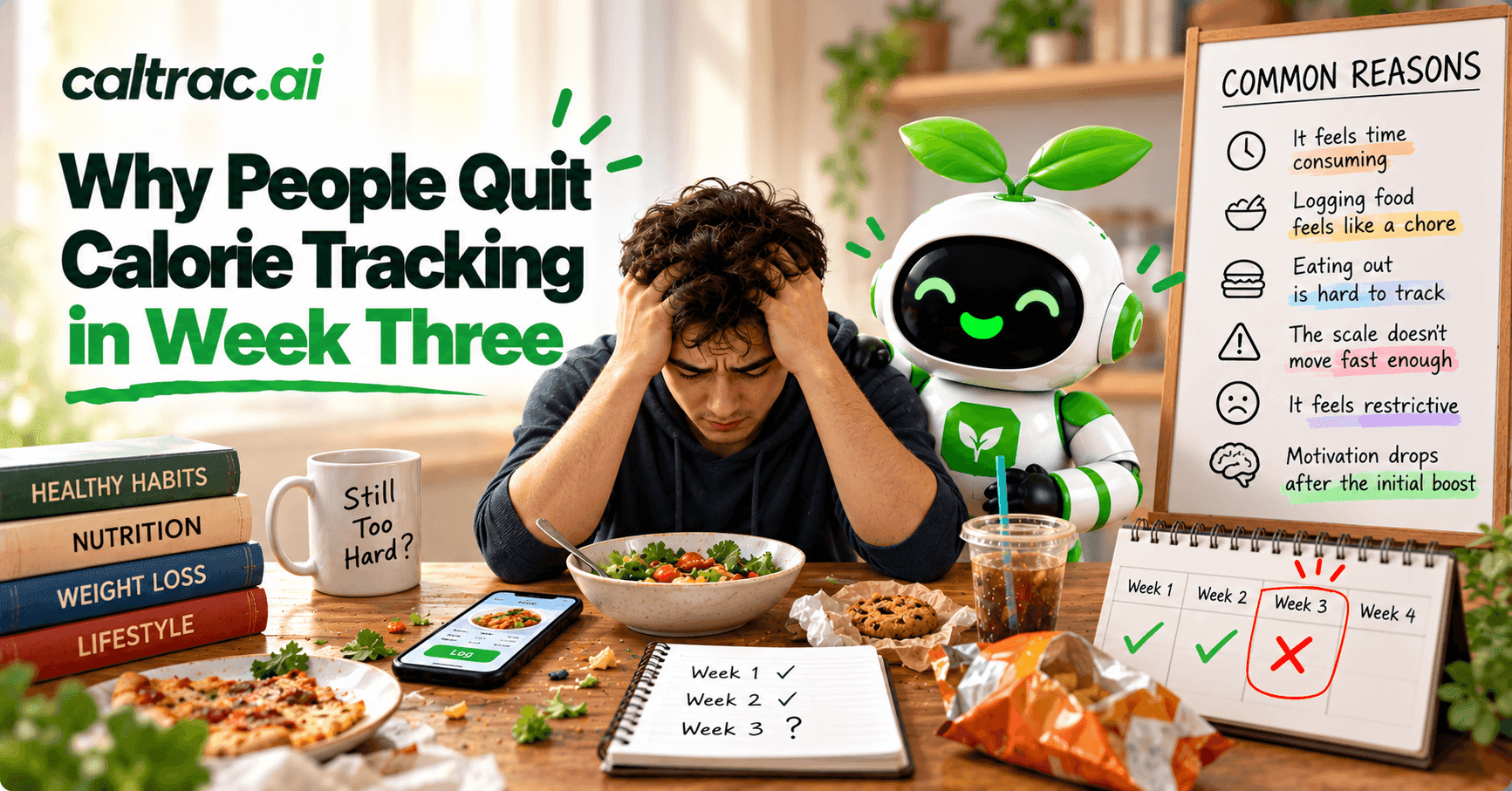
Almost everyone who starts logging their food stops. Not because it does not work: self-monitoring is the single most consistent predictor of weight loss in the research, and the people who keep doing it lose two to three times as much as the people who do not. They stop because logging is effortful, because a missed day feels like failure, and because week three is where enthusiasm runs out and habit has not yet taken over.
This article is about that gap. It covers what the studies say about when people quit and why, how much logging actually matters, and the specific habits that separate the quarter of people who keep going from the three quarters who do not.
The Evidence That Tracking Works
A systematic review of 22 studies found a consistent association between self-monitoring and weight loss across diet, exercise and weight tracking [1]. The size of the effect is what makes the drop-off so costly. In a 12-week trial using a commercial app, only 25% of participants were "consistent trackers," logging six or more days a week for most weeks. Those consistent trackers lost 2.4 kg more at three months, and 48% of them reached a clinically meaningful 5% weight loss compared with 13% of inconsistent trackers; by six months the gap was 54% versus 15% [2]. In a six-month online programme, people who logged in 2.7 times a day lost 10% or more of their weight; those logging in 1.7 times a day did not [3].
The direction of cause is debated, since motivated people both track more and lose more. But the pattern is the same in every dataset: logging frequency tracks weight loss almost linearly, and in one trial the correlation between tracking days and weight change was 0.63 [4].
When People Quit
The decline is fast and front-loaded. In the online programme above, participants spent 23 minutes a day on self-monitoring in month one and 14.6 minutes by month six, and by the end only 65% were recording anything at all [3]. In a primary-care trial of a popular calorie-counting app, logins "decreased sharply after the first month," and the app produced no more weight loss than usual care over six months [5]. In a 12-week app trial, diet tracking fell to a median of two to five days a week depending on how it was introduced, and the authors noted that dietary self-monitoring "declines quickly" [6].
At population scale the numbers are starker. Of 189,770 people who downloaded a free photo-based food diary app, 2.58% used it actively, defined as ten or more photos and at least a week of use [7]. In a 52-week study of nearly 800,000 users of an intermittent fasting app, 16.7% were still active at 13 weeks, 6.9% at 26 weeks and 2.1% at a year [8]. Week three is not a cliff for everyone, but for most people it is the week the slide becomes visible.
Why People Quit
Researchers at the University of Washington surveyed 141 food journalers, two-thirds of them lapsed, and analysed 5,526 forum posts from users of MyFitnessPal and similar apps. Of the 94 people who had quit, only 22 stopped because they had got what they needed [9]. The rest stopped for reasons that had nothing to do with the method working or not:
- Effort. Journaling was described as "too much effort," "time-consuming" and "tedious," in that order of frequency.
- Forgetting. The most common reason for a missed entry was simply forgetting, and a missed entry made the day's total wrong, which made the whole exercise feel pointless. One lapsed user's summary: once the habit is broken, it is hard to start again.
- The hard foods. On a seven-point ease scale, packaged food scored 6.5 and fast food 6.3, because they have labels. Home-cooked meals scored 4.6, restaurant meals 3.6 and food at parties 2.9. People quit at the dinner party, not at the supermarket.
- Not knowing what is in it. More than 75 respondents cited not knowing ingredients or portion sizes as a barrier, alongside unreliable database entries.
The same study notes that the design of most apps compounds the problem: a red number for going over budget and a blank day for forgetting both read as judgement, and judgement is what people avoid [9].
The Problem Tracking Is Trying to Solve
There is a reason to push through the effort, and it is that memory is a terrible food log. In a classic study of people who insisted they could not lose weight despite eating very little, actual intake was 47% higher than they reported and physical activity 51% lower [10]. In a large study using biomarkers, men under-reported their energy intake by 12 to 14% on detailed recalls and 31 to 36% on questionnaires; women by 16 to 20% and 34 to 38% [11]. Nobody was lying. Human estimation is biased in one direction, and the bias is large enough to erase a 500-calorie deficit.
Logging exists to replace that estimate with a measurement. It only works if it happens.
Seven Habits That Make It Stick
1. Make it the smallest possible action
The 2015 CHI study's central finding was that burden kills journaling [9]. A later trial made the point from the other side: when participants were asked to tick off a short list of "red zone" foods instead of logging everything, they tracked on 97% of days versus 49% for detailed logging, and lost the same weight [12]. The lesson is not that detail is bad. It is that the version you will do beats the version you will not. Photographing a plate takes three seconds; image-assisted methods have been shown to reduce under-reporting compared with traditional recall [13]. Start with the photo. Add detail later if you want it.
2. Decide in advance what a missed day means
Habit research is clear that one missed repetition does not break a forming habit: in a study tracking 96 people for 84 days, "missing one opportunity to perform the behaviour did not materially affect the habit formation process" [14]. What breaks it is treating the miss as the end. Decide now: a missed meal gets a rough estimate, a missed day gets skipped, and tomorrow starts clean. The forum users who quit after one blank day were following a rule nobody had actually set [9].
3. Expect it to take about ten weeks, not three
The same habit study found that time to reach automaticity ranged from 18 to 254 days, with the average plateau at 66 days [14] [15]. Three weeks is not enough for logging to feel automatic for most people. It is exactly long enough for novelty to wear off. If you know the uncomfortable middle lasts until roughly week ten, week three stops feeling like evidence that you are not a tracking person.
4. Log the hard meals first, not last
Packaged food is easy to log and matters least; restaurant and party meals are hard to log and matter most, because that is where the calories hide [9]. Flip the default. On a restaurant night, log before you order, or photograph the plate when it arrives. An estimate made at the table is worth far more than a precise entry for the apple you had at your desk.
5. Weigh yourself daily and read the weekly average
Daily weighing is associated with more weight loss and no psychological harm across 17 studies [16], and in one six-month trial daily weighers lost 6.1 kg more than those who weighed less often [17]. The catch is that daily weight is noisy: it rises on weekends and falls through the week in a predictable rhythm [18] [19], and a single Monday number has ended many diets. Weigh every morning, judge the seven-day average, and let Monday be Monday.
6. Track flexibly, not rigidly
In a study of 54,517 people, flexible dietary control, meaning general guidelines with room for exceptions, was associated with lower body weight and a higher chance of successful weight loss, while rigid all-or-nothing control was associated with higher weight and more binge eating [20]. Two further studies found the same pattern: rigid dieting travelled with overeating and mood problems, flexible dieting did not [21] [22]. A tracking habit built on "I will log most meals most days" survives a holiday. One built on "every gram, every day" does not survive the first birthday party.
7. Have a reason to look at the number
Logging without reviewing is data entry. Two things turn it into feedback. The first is a target: a daily calorie figure and a protein figure to log against, so each entry means something. Caltrac's calorie calculator and macro calculator give you both in under a minute. The second is recalibration: weight loss slows as you shrink because a smaller body burns less [23], so re-run the calculator every 5 kg. A plateau with a stale target feels like failure; the same plateau with a recalculated target is a prompt.
When Week Three Arrives
Here is what the research says to do when logging starts to feel like a chore, which it will:
- Shrink the task. Photos only, or a short red-zone list, for a week [12].
- Keep the hard meals. If you log one thing, log dinner out.
- Do not fill in the gap. Yesterday's blank stays blank. Today gets logged [14].
- Check the weekly weight trend, not the daily weight [18].
- Give it to week ten before deciding whether tracking is for you [15].
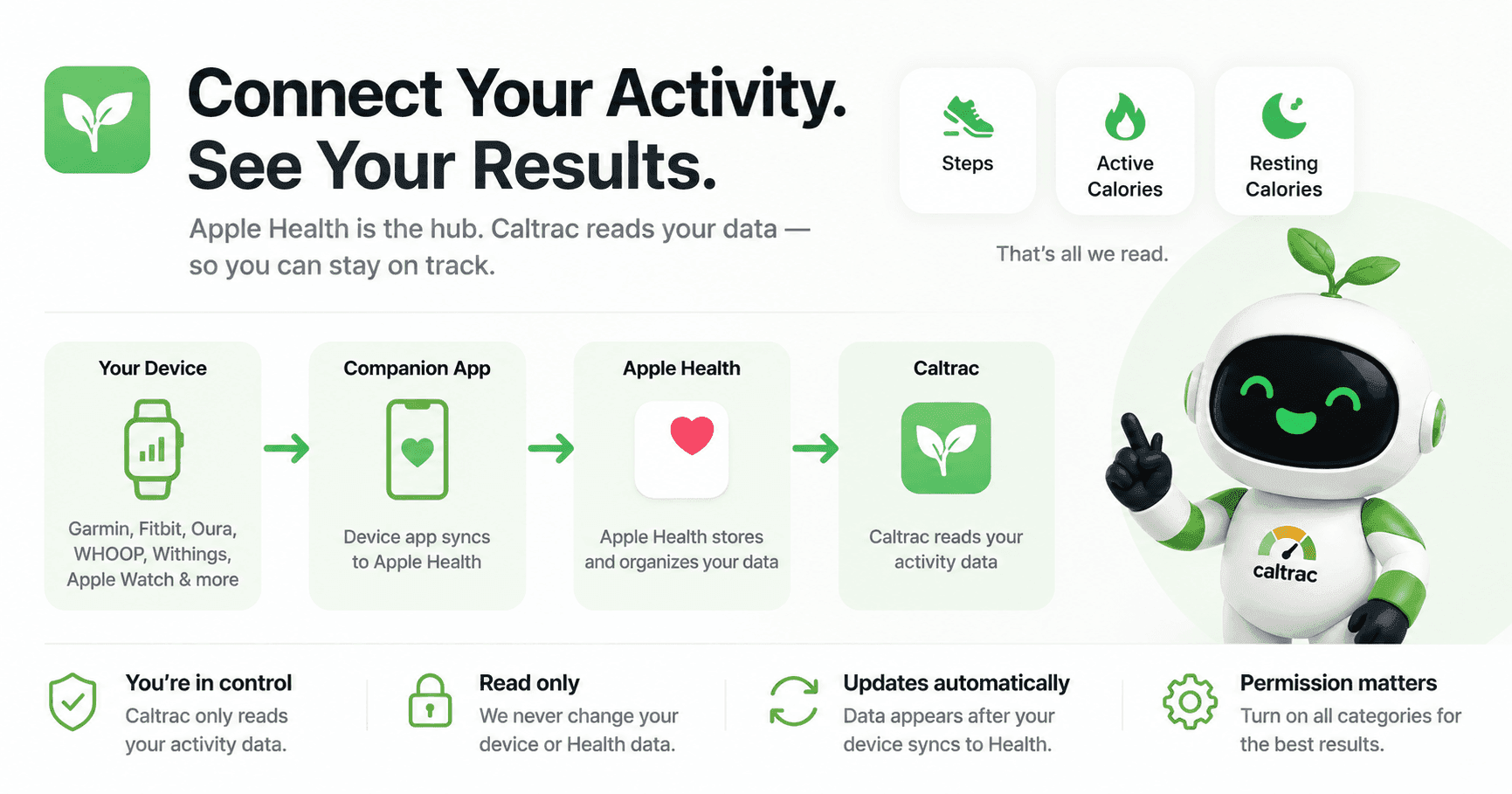
That is where tracking earns its keep, and where the design of the tool matters. Snap a photo of your plate or type "dal, rice, 1 tsp oil" and track it automatically with Caltrac. The three-second photo removes the effort that makes people quit, the estimate replaces the memory that fails them, and your Apple Health-powered net calorie count shows how the day fits without a red number for being human. Make the habit small; let the app do the rest.
Frequently Asked Questions
Why do people stop tracking calories? Mainly effort, forgetting, and the difficulty of logging home-cooked, restaurant and party meals. In a survey of lapsed journalers, only 22 of 94 had stopped because they had achieved their goal [9].
How long does it take for calorie tracking to become a habit? Habit research puts automaticity at an average of about 66 days, with a range of 18 to 254 [14] [15]. Roughly ten weeks is a realistic expectation.
Does calorie tracking actually work? Consistent trackers lost 2.4 kg more over three months and were three to four times as likely to reach a 5% weight loss in a commercial app trial [2]. The effect depends on doing it.
Is it okay to miss a day of logging? Yes. Missing a single opportunity did not materially affect habit formation in the research [14]. Resume the next day without back-filling.
Is photo food logging accurate? Image-assisted methods reduce under-reporting compared with memory-based recall [13]. In one small trial a photo app did not improve tracking frequency over a calorie app, so the photo helps accuracy more than consistency [4]; the habits above address consistency.
Should I weigh myself every day while tracking? Yes. Daily weighing is linked to greater weight loss without psychological harm [16] [17]. Read the weekly average, since weight rises on weekends and falls through the week [18].
References
- Burke LE, Wang J, Sevick MA. Self-monitoring in weight loss: a systematic review of the literature. Journal of the American Dietetic Association. 2011;111(1):92-102. pubmed.ncbi.nlm.nih.gov
- Patel ML, Brooks TL, Bennett GG. Consistent self-monitoring in a commercial app-based intervention for weight loss. Journal of Behavioral Medicine. 2020;43(3):391-401. pubmed.ncbi.nlm.nih.gov
- Harvey J, Krukowski R, Priest J, West D. Log Often, Lose More: Electronic Dietary Self-Monitoring for Weight Loss. Obesity. 2019;27(3):380-384. pubmed.ncbi.nlm.nih.gov
- Dunn CG, Turner-McGrievy GM, Wilcox S, Hutto B. Dietary Self-Monitoring Through Calorie Tracking but Not Through a Digital Photography App Is Associated with Significant Weight Loss: The 2SMART Pilot Study. Journal of the Academy of Nutrition and Dietetics. 2019;119(9):1525-1532. pubmed.ncbi.nlm.nih.gov
- Laing BY, et al. Effectiveness of a smartphone application for weight loss compared with usual care in overweight primary care patients: a randomized, controlled trial. Annals of Internal Medicine. 2014;161(10 Suppl):S5-S12. pubmed.ncbi.nlm.nih.gov
- Patel ML, Hopkins CM, Brooks TL, Bennett GG. Comparing Self-Monitoring Strategies for Weight Loss in a Smartphone App: Randomized Controlled Trial. JMIR mHealth and uHealth. 2019;7(2):e12209. pubmed.ncbi.nlm.nih.gov
- Helander E, Kaipainen K, Korhonen I, Wansink B. Factors related to sustained use of a free mobile app for dietary self-monitoring with photography and peer feedback. Journal of Medical Internet Research. 2014;16(4):e109. pubmed.ncbi.nlm.nih.gov
- Torres L, et al. Retention, Fasting Patterns, and Weight Loss With an Intermittent Fasting App: Large-Scale, 52-Week Observational Study. JMIR mHealth and uHealth. 2022;10(10):e35896. pubmed.ncbi.nlm.nih.gov
- Cordeiro F, et al. Barriers and Negative Nudges: Exploring Challenges in Food Journaling. Proceedings of the SIGCHI Conference on Human Factors in Computing Systems (CHI 2015). 2015:1159-1162. pmc.ncbi.nlm.nih.gov
- Lichtman SW, et al. Discrepancy between self-reported and actual caloric intake and exercise in obese subjects. New England Journal of Medicine. 1992;327(27):1893-1898. pubmed.ncbi.nlm.nih.gov
- Subar AF, et al. Using intake biomarkers to evaluate the extent of dietary misreporting in a large sample of adults: the OPEN study. American Journal of Epidemiology. 2003;158(1):1-13. pubmed.ncbi.nlm.nih.gov
- Patel ML, et al. Detailed Versus Simplified Dietary Self-monitoring in a Digital Weight Loss Intervention. JMIR Formative Research. 2022;6(12):e42191. pubmed.ncbi.nlm.nih.gov
- Boushey CJ, Spoden M, Zhu FM, Delp EJ, Kerr DA. New mobile methods for dietary assessment: review of image-assisted and image-based dietary assessment methods. Proceedings of the Nutrition Society. 2017;76(3):283-294. pubmed.ncbi.nlm.nih.gov
- Lally P, van Jaarsveld CHM, Potts HWW, Wardle J. How are habits formed: Modelling habit formation in the real world. European Journal of Social Psychology. 2010;40(6):998-1009. doi.org
- Gardner B, Lally P, Wardle J. Making health habitual: the psychology of 'habit-formation' and general practice. British Journal of General Practice. 2012;62(605):664-666. pubmed.ncbi.nlm.nih.gov
- Zheng Y, et al. Self-weighing in weight management: a systematic literature review. Obesity. 2015;23(2):256-265. pubmed.ncbi.nlm.nih.gov
- Steinberg DM, Bennett GG, Askew S, Tate DF. Weighing every day matters: daily weighing improves weight loss and adoption of weight control behaviors. Journal of the Academy of Nutrition and Dietetics. 2015;115(4):511-518. pubmed.ncbi.nlm.nih.gov
- Orsama AL, et al. Weight rhythms: weight increases during weekends and decreases during weekdays. Obesity Facts. 2014;7(1):36-47. pubmed.ncbi.nlm.nih.gov
- Racette SB, et al. Influence of weekend lifestyle patterns on body weight. Obesity. 2008;16(8):1826-1830. pubmed.ncbi.nlm.nih.gov
- Westenhoefer J, Stunkard AJ, Pudel V. Validation of the flexible and rigid control dimensions of dietary restraint. International Journal of Eating Disorders. 1999;26(1):53-64. pubmed.ncbi.nlm.nih.gov
- Smith CF, Williamson DA, Bray GA, Ryan DH. Flexible vs. Rigid dieting strategies: relationship with adverse behavioral outcomes. Appetite. 1999;32(3):295-305. pubmed.ncbi.nlm.nih.gov
- Stewart TM, Williamson DA, White MA. Rigid vs. flexible dieting: association with eating disorder symptoms in nonobese women. Appetite. 2002;38(1):39-44. pubmed.ncbi.nlm.nih.gov
- Hall KD, et al. Quantification of the effect of energy imbalance on bodyweight. Lancet. 2011;378(9793):826-837. pubmed.ncbi.nlm.nih.gov