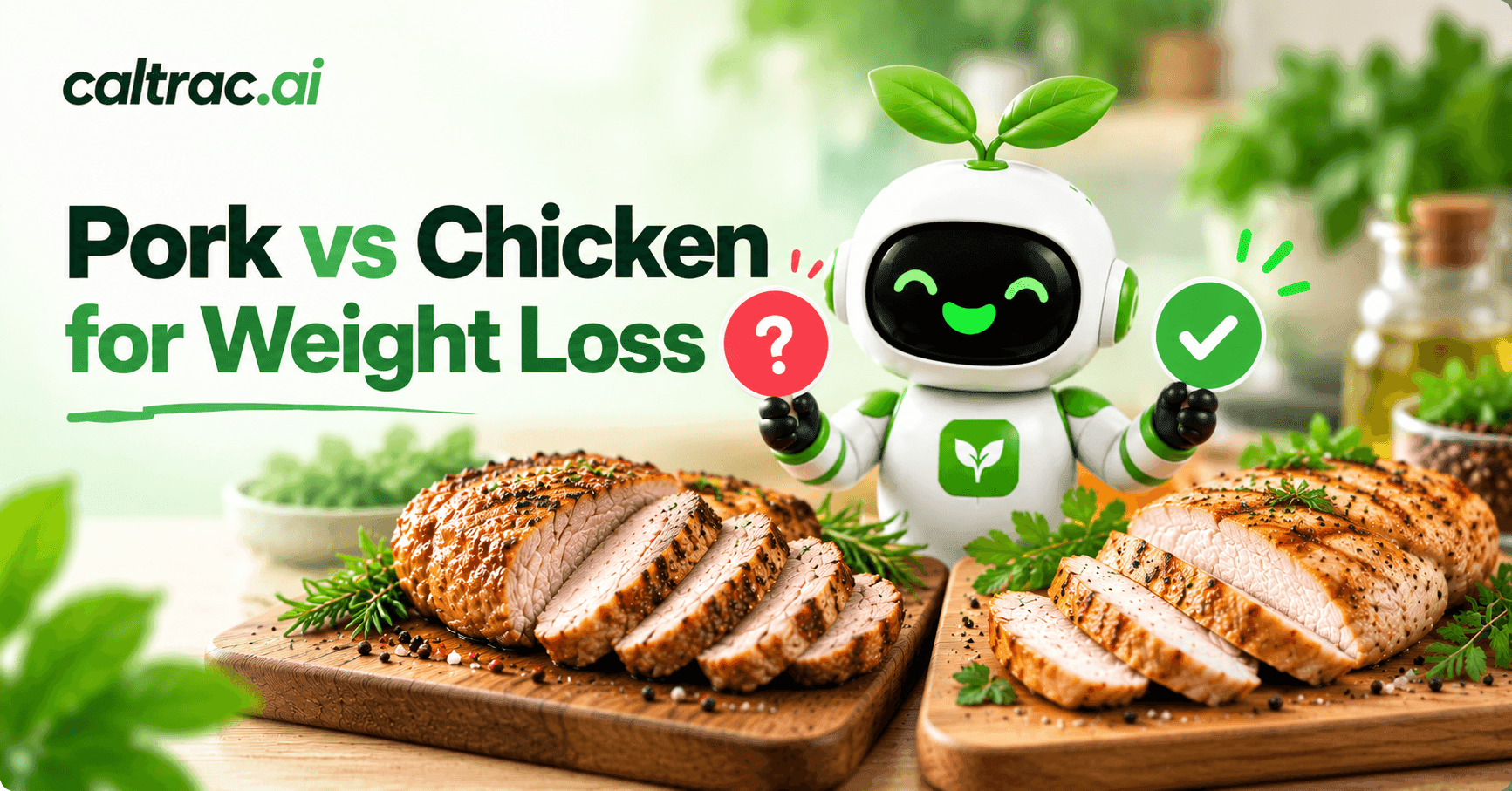
Chicken breast is the default protein of every diet plan ever written. Pork rarely makes the list. Yet when you line the two up with USDA data, pork tenderloin has fewer calories per 100 g than skinless chicken breast, and a lean pork loin chop is leaner than a skinless chicken thigh. Chicken breast still holds the protein record, and the two are tied on protein per calorie. For weight loss, the real difference is not the animal. It is skin, cut, and how the meat was cooked.
This article compares pork and chicken cut by cut, looks at the trial that fed overweight adults both meats to see which worked better, and ends with a simple rule for choosing between them.
Quick Answer: Pork vs Chicken for Weight Loss
- Lowest calories: Pork tenderloin, 143 kcal per 100 g cooked, versus 165 kcal for skinless chicken breast [1] [7].
- Most protein: Skinless chicken breast, 31 g per 100 g, with lean pork loin chop close behind at 30 g [7] [2].
- Protein per calorie: A tie. Chicken breast gives 18.8 g per 100 kcal; pork tenderloin and pork loin chop give 18.3 and 18.5 g.
- Saturated fat: Nearly identical on lean cuts, 1.0 g for chicken breast and 1.2 g for pork tenderloin per 100 g.
- Micronutrients: Pork wins on thiamin, zinc, selenium, B12, riboflavin, and potassium. Chicken wins on niacin.
- What the trial showed: Overweight adults who ate up to 1 kg a week of lean pork, chicken, or beef lost body fat the same way on all three [15].
Pork vs Chicken Nutrition: Lean Cuts Compared
All values are per 100 g cooked, from USDA FoodData Central. Protein per 100 calories shows how much protein you get for the calories you spend, which is the number that matters in a deficit.
| Cut (100 g cooked) | Calories | Protein | Fat | Saturated fat | Protein per 100 kcal | Source |
|---|---|---|---|---|---|---|
| Pork tenderloin, roasted | 143 kcal | 26.2 g | 3.5 g | 1.2 g | 18.3 g | [1] |
| Chicken drumstick, skinless, roasted | 155 kcal | 24.2 g | 5.7 g | 1.5 g | 15.6 g | [11] |
| Pork center loin chop, lean, pan-broiled | 162 kcal | 30.0 g | 4.7 g | 1.7 g | 18.5 g | [2] |
| Chicken breast, skinless, roasted | 165 kcal | 31.0 g | 3.6 g | 1.0 g | 18.8 g | [7] |
| Chicken thigh, skinless, roasted | 179 kcal | 24.8 g | 8.2 g | 2.3 g | 13.9 g | [9] |
| Chicken breast, with skin, roasted | 197 kcal | 29.8 g | 7.8 g | 2.2 g | 15.1 g | [8] |
Two things jump out. First, chicken breast and lean pork are interchangeable as diet foods. A 150 g portion of skinless chicken breast is about 248 calories for 47 g of protein; the same portion of pork tenderloin is about 215 calories for 39 g; a pork loin chop is 243 calories for 45 g. Pick the one you will actually enjoy eating for twelve weeks.
Second, the moment you move to dark meat, chicken loses its halo. Skinless chicken thigh has more calories, more fat, and twice the saturated fat of a lean pork chop, with 5 g less protein [9] [2]. "Chicken" is not automatically the leaner choice.
Where the Calories Hide: Skin, Fat, and Batter
| Cut (100 g cooked) | Calories | Protein | Fat | Saturated fat | Protein per 100 kcal | Source |
|---|---|---|---|---|---|---|
| Chicken thigh, with skin, roasted | 232 kcal | 23.3 g | 14.7 g | 4.1 g | 10.0 g | [10] |
| Chicken wing, with skin, roasted | 254 kcal | 23.8 g | 16.9 g | 5.0 g | 9.4 g | [12] |
| Chicken breast, batter-fried | 260 kcal | 24.8 g | 13.2 g | 3.5 g | 9.5 g | [14] |
| Pork shoulder (Boston butt), roasted | 269 kcal | 23.1 g | 18.9 g | 7.0 g | 8.6 g | [5] |
| Ground pork, regular, cooked | 297 kcal | 25.7 g | 20.8 g | 7.7 g | 8.7 g | [4] |
| Bacon, pan-fried | 468 kcal | 33.9 g | 35.1 g | 12.0 g | 7.2 g | [6] |
Chicken skin roughly doubles the fat of whichever cut it is on: it adds 32 calories per 100 g to breast and 53 to thigh [7] [8] [9] [10]. Batter-frying a chicken breast takes it from 165 to 260 calories and cuts the protein, because part of what you are eating is now flour and oil [14]. Wings with skin land in the same range as a fatty pork shoulder.
On the pork side, the trap is the fatty cuts. Shoulder, belly, ribs, regular ground pork, and anything cured sit at roughly double the calories of tenderloin for less protein. Bacon is in a category of its own, at 468 calories and 1,680 mg of sodium per 100 g [6]. Most of pork's reputation as a fattening meat comes from these cuts, not from the loin.
Ground Pork vs Ground Chicken
Ground chicken sounds like the safe choice, but USDA's figure for cooked ground chicken is 189 calories and 23.3 g of protein per 100 g, because it is usually made from a mix of dark meat and skin [13]. Extra-lean 96/4 ground pork is 187 calories with 30.6 g of protein, so it is the better buy if you can find it [3]. Regular unlabeled ground pork, at 297 calories, is the worst of the three [4]. As always, the lean percentage on the label beats the name of the animal.
What Happens When People Actually Eat Them
Researchers at the University of South Australia tested this directly. In a nine-month randomised crossover trial, 49 overweight or obese adults ate up to 1 kg per week of pork, chicken, or beef for three months each, in an otherwise unrestricted diet, with body composition measured by DXA scan. There was no difference in BMI, waist or hip circumference, or body fat between the three meats, and no difference in calorie or nutrient intake either [15].
The same group's earlier six-month trial of 164 overweight adults found that adding up to 1 kg of lean fresh pork a week, mostly in place of beef and chicken, produced significant reductions in weight, BMI, waist circumference, and fat mass compared with controls, with no loss of lean mass [16]. The crossover trial then showed that chicken would have done the same job.
The practical reading is simple. Lean meat helps with fat loss because of its protein, and pork and chicken deliver that protein equally well.
Why Lean Meat Helps You Lose Fat
Whether it is pork loin or chicken breast on the plate, the mechanism is the same.
Protein is the most filling macronutrient. It increases satiety more than carbohydrate or fat and helps people eat less when food is unrestricted [19]. A major 2015 review concluded that diets providing 1.2 to 1.6 g of protein per kg of body weight per day, with about 25 to 30 g per meal, improve appetite control, body weight, and fat loss [17]. A 100 g serving of either meat clears that per-meal target.
Protein costs calories to digest. Diet-induced thermogenesis is higher for protein than for carbohydrate or fat, so a higher-protein diet nudges daily energy expenditure up [18].
Protein protects muscle in a deficit. Higher-protein energy-restricted diets produce more fat loss and better lean mass preservation than lower-protein diets at the same calorie intake [17]. Both meats supply about 2.2 to 2.6 g of leucine per 100 g cooked [1] [7], the amino acid that triggers muscle protein synthesis.
Pork vs Chicken: Vitamins and Minerals
This is where the two meats genuinely part ways, and it is the strongest argument for not eating chicken breast seven days a week. Values are per 100 g cooked, with percent of the FDA Daily Value [21].
| Nutrient (per 100 g) | Pork tenderloin [1] | Chicken breast, skinless [7] | Winner |
|---|---|---|---|
| Thiamin (B1) | 0.95 mg (79% DV) | 0.07 mg (6% DV) | Pork |
| Niacin (B3) | 7.4 mg (46% DV) | 13.7 mg (86% DV) | Chicken |
| Riboflavin (B2) | 0.39 mg (30% DV) | 0.11 mg (9% DV) | Pork |
| Vitamin B6 | 0.74 mg (43% DV) | 0.60 mg (35% DV) | Pork, narrowly |
| Vitamin B12 | 0.57 mcg (24% DV) | 0.34 mcg (14% DV) | Pork |
| Zinc | 2.4 mg (22% DV) | 1.0 mg (9% DV) | Pork |
| Selenium | 38 mcg (69% DV) | 28 mcg (50% DV) | Pork |
| Iron | 1.2 mg (6% DV) | 1.0 mg (6% DV) | Tie |
| Potassium | 421 mg (9% DV) | 256 mg (5% DV) | Pork |
| Phosphorus | 267 mg (21% DV) | 228 mg (18% DV) | Pork, narrowly |
Pork tenderloin is the more nutrient-dense of the two by a clear margin. The thiamin gap is the headline: one serving of pork covers most of the day's requirement, chicken contributes almost none. Pork also delivers more than twice the zinc and B12. Chicken's one decisive win is niacin. Neither is a strong iron source compared with beef.
Chicken breast has slightly more unsaturated fat as a share of its total: about 22% of its fat is polyunsaturated versus 14% in pork tenderloin [7] [1]. On cuts this lean, the absolute difference is a fraction of a gram.
The Red Meat Question
Pork is red meat, whatever the old "other white meat" slogan said. The World Health Organization defines red meat as all mammalian muscle meat, including pork, and classifies it as Group 2A, "probably carcinogenic to humans," based on limited evidence. Processed meat such as bacon, ham, and sausage is Group 1, "carcinogenic to humans." Poultry was not part of that evaluation [20].
For someone choosing between fresh pork loin and chicken breast for weight loss, this is the one argument that leans toward chicken, and it is about long-term health rather than calories. The sensible middle ground is the one the evidence supports: eat fresh lean pork freely, keep cured and processed pork occasional, and rotate in poultry and fish.
The Verdict: Pick by Cut and Skin, Not by Animal
If you want one rule: skinless chicken breast and lean pork loin are equals for weight loss. Choose the one you will keep eating, and avoid the skin, the fatty cuts, and the batter on either.
Best chicken for weight loss: skinless breast, skinless drumstick, skinless thigh in moderation, and ground chicken breast if labeled.
Best pork for weight loss: tenderloin, boneless loin chops, center loin roast, sirloin roast, and 96/4 ground pork.
Save for occasions: chicken wings, skin-on thighs, fried chicken, pork belly, pork shoulder, spare ribs, regular ground pork, bacon, ham, and sausage.
Choose pork when you want more B vitamins, zinc, and selenium for the same calories, or simply when you are bored of chicken. Choose chicken when you want the absolute highest protein per 100 g or prefer to keep red meat intake low. Alternating the two gives you the best of both nutrient profiles.
Cooking Tips That Keep Either Lean
- Remove the skin before cooking chicken, or at least before eating. It is where most of the fat sits.
- Trim visible fat from pork chops. The difference between "lean only" and "lean and fat" is fat you can see.
- Roast, grill, air-fry, or pan-sear with a spray of oil. Each tablespoon of oil adds about 120 calories, and batter adds more.
- Do not overcook pork. Loin cooked to 63°C (145°F) and rested stays juicy without added fat; overcooked pork is what drives people to sauce.
- Portion by cooked weight. A 100 to 150 g portion of either lean meat gives 25 to 47 g of protein for 145 to 250 calories.
Tracking Pork and Chicken Without Guesswork
The same 150 g of chicken can be 248 calories or 390 depending on skin and cooking method. The same 150 g of pork can be 215 or 450 depending on the cut. Raw versus cooked weight shifts the numbers by another 25 to 30%. Logging "chicken" or "pork chop" from memory is how a careful diet drifts over budget.
That is where tracking earns its keep. Snap a photo of your grilled chicken or type "150 g pork tenderloin" and track it automatically with Caltrac. You will see the calories, protein, and saturated fat logged in seconds, and your Apple Health-powered net calorie count will show exactly how it fits your day. Enjoy the meal; let the app watch the numbers.
Frequently Asked Questions
Is pork or chicken better for weight loss? They are equal when you compare lean cuts. Pork tenderloin has fewer calories (143 vs 165 per 100 g), chicken breast has more protein (31 vs 26 g), and protein per calorie is a tie. A randomised crossover trial found no difference in body fat changes between pork, chicken, and beef [15].
Is pork tenderloin leaner than chicken breast? Yes, slightly. Pork tenderloin has 143 calories and 3.5 g of fat per 100 g cooked; skinless chicken breast has 165 calories and 3.6 g of fat [1] [7]. Chicken breast has more protein.
Which has more protein, pork or chicken? Skinless chicken breast, at 31 g per 100 g. Lean pork loin chop is close at 30 g, and pork tenderloin has 26 g [7] [2] [1].
Is pork a white meat? No. The WHO classifies pork as red meat along with beef and lamb [20]. The "other white meat" line was an advertising campaign.
Is chicken thigh or pork chop better for weight loss? A lean pork chop. Per 100 g, skinless chicken thigh has 179 calories, 8.2 g of fat, and 24.8 g of protein; a lean pork center loin chop has 162 calories, 4.7 g of fat, and 30 g of protein [9] [2].
Is ground chicken healthier than ground pork? Only if the pork is regular grind. Cooked ground chicken has 189 calories and 23 g of protein per 100 g; 96/4 ground pork has 187 calories and 31 g of protein; regular ground pork has 297 calories [13] [3] [4].
References
- USDA FoodData Central. Pork, fresh, loin, tenderloin, separable lean only, cooked, roasted. SR Legacy, FDC ID 168250. fdc.nal.usda.gov
- USDA FoodData Central. Pork, fresh, loin, center loin (chops), boneless, separable lean only, cooked, pan-broiled. SR Legacy, FDC ID 168285. fdc.nal.usda.gov
- USDA FoodData Central. Pork, ground, 96% lean / 4% fat, cooked, crumbles. SR Legacy, FDC ID 169193. fdc.nal.usda.gov
- USDA FoodData Central. Pork, fresh, ground, cooked. SR Legacy, FDC ID 167903. fdc.nal.usda.gov
- USDA FoodData Central. Pork, fresh, shoulder, blade, boston (roasts), separable lean and fat, cooked, roasted. SR Legacy, FDC ID 168259. fdc.nal.usda.gov
- USDA FoodData Central. Pork, cured, bacon, pre-sliced, cooked, pan-fried. SR Legacy, FDC ID 168322. fdc.nal.usda.gov
- USDA FoodData Central. Chicken, broilers or fryers, breast, meat only, cooked, roasted. SR Legacy, FDC ID 171477. fdc.nal.usda.gov
- USDA FoodData Central. Chicken, broilers or fryers, breast, meat and skin, cooked, roasted. SR Legacy, FDC ID 171075. fdc.nal.usda.gov
- USDA FoodData Central. Chicken, broilers or fryers, thigh, meat only, cooked, roasted. SR Legacy, FDC ID 172388. fdc.nal.usda.gov
- USDA FoodData Central. Chicken, broilers or fryers, thigh, meat and skin, cooked, roasted. SR Legacy, FDC ID 173625. fdc.nal.usda.gov
- USDA FoodData Central. Chicken, broilers or fryers, dark meat, drumstick, meat only, cooked, roasted. SR Legacy, FDC ID 172376. fdc.nal.usda.gov
- USDA FoodData Central. Chicken, broilers or fryers, wing, meat and skin, cooked, roasted. SR Legacy, FDC ID 173630. fdc.nal.usda.gov
- USDA FoodData Central. Chicken, ground, crumbles, cooked, pan-browned. SR Legacy, FDC ID 171117. fdc.nal.usda.gov
- USDA FoodData Central. Chicken, broilers or fryers, breast, meat and skin, cooked, fried, batter. SR Legacy, FDC ID 171475. fdc.nal.usda.gov
- Murphy KJ, Parker B, Dyer KA, et al. A comparison of regular consumption of fresh lean pork, beef and chicken on body composition: a randomized cross-over trial. Nutrients. 2014;6(2):682-696. PubMed 24534884
- Murphy KJ, Thomson RL, Coates AM, Buckley JD, Howe PR. Effects of eating fresh lean pork on cardiometabolic health parameters. Nutrients. 2012;4(7):711-723. PubMed 22852059
- Leidy HJ, Clifton PM, Astrup A, et al. The role of protein in weight loss and maintenance. American Journal of Clinical Nutrition. 2015;101(6):1320S-1329S. PubMed 25926512
- Westerterp KR. Diet induced thermogenesis. Nutrition & Metabolism. 2004;1:5. PubMed 15507147
- Paddon-Jones D, Westman E, Mattes RD, Wolfe RR, Astrup A, Westerterp-Plantenga M. Protein, weight management, and satiety. American Journal of Clinical Nutrition. 2008;87(5):1558S-1561S. PubMed 18469287
- World Health Organization. Cancer: Carcinogenicity of the consumption of red meat and processed meat (Q&A). who.int
- US Food and Drug Administration. Daily Value on the Nutrition and Supplement Facts Labels. fda.gov