Ask a vegetarian in India how they hit their protein target and soya chunks will come up within a minute. The numbers explain why. 100 g of dry soya chunks contains about 345 calories and 52 g of protein [1], which is more protein per gram than chicken breast, paneer, eggs, or any dal. They are cheap, shelf-stable, and soak up whatever gravy you put them in.
This guide covers the full nutrition profile of soya chunks, how their protein quality stacks up against animal sources, what the research says about the common soy worries, and the one tracking mistake that trips up almost everyone who logs them. Every figure is referenced, and the full source list is at the end.
What Are Soya Chunks?
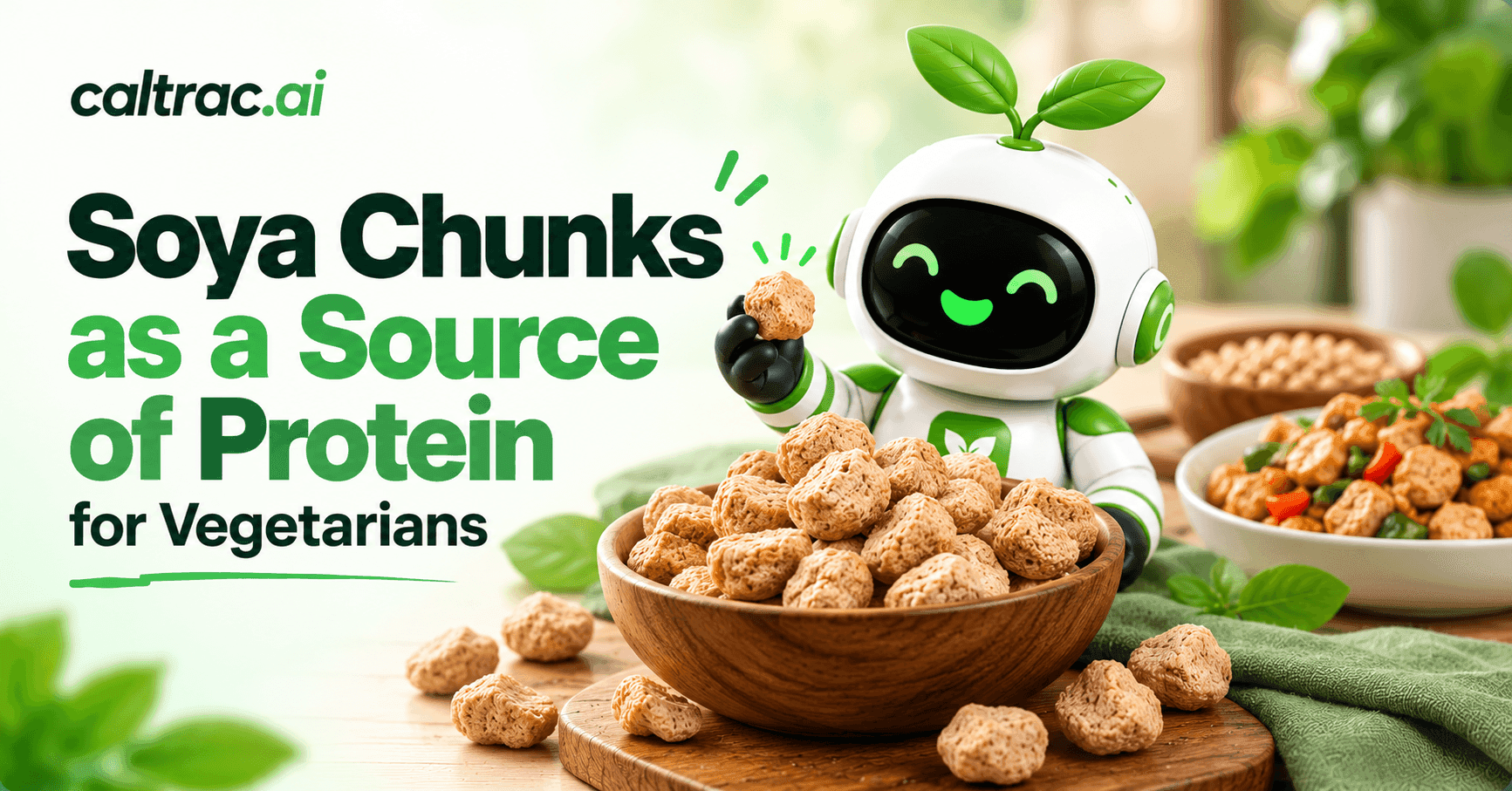
Soya chunks, also sold as soya nuggets, soy chunks, or textured vegetable protein (TVP), are made from defatted soy flour. After soybean oil is pressed out, the remaining high-protein flour is cooked under pressure and pushed through an extruder, which gives it a fibrous, meat-like texture [21]. The result is dried into chunks, mini chunks, or granules. The ingredient list on most packs is a single line: defatted soy [1].
Because the oil has been removed, soya chunks are almost fat-free and extremely concentrated in protein. That is the whole story of their nutrition profile.
Soya Chunks Nutrition Facts (Dry)
The figures below are the pack label values for Nutrela, India's most widely sold brand [1], shown alongside the USDA FoodData Central entry for defatted soy flour, the ingredient they are made from [3]. The two line up closely on protein, carbs, and fat, which is a useful sanity check.
| Nutrient (per 100 g dry) | Nutrela pack label | USDA defatted soy flour |
|---|---|---|
| Calories | 345 kcal | 327 kcal |
| Protein | 52 g | 51.5 g |
| Total fat | 0.5 g | 1.2 g |
| Carbohydrate | 33 g | 33.9 g |
| Dietary fiber | 13 g | 17.5 g |
| Sugars (natural) | 7 g | 16.4 g |
| Calcium | 350 mg | 241 mg |
| Iron | 20 mg | 9.2 mg |
Sources: Nutrela label [1] and Open Food Facts record for the same brand (354 kcal, 53.2 g protein, 7.2 g sugars) [2]; USDA SR Legacy 174275 [3].
Three things to notice:
- Over half the dry weight is protein. At 52 g per 100 g, soya chunks are in the same league as protein powder, which typically runs 70 to 80 g per 100 g.
- Fat is close to zero. Almost all of soy's natural fat is removed in processing, so the calories come from protein and carbohydrate in roughly equal measure.
- The carbs include fiber and natural soy sugars. About 13 to 17 g of the carbohydrate is fiber. The remaining sugars are mostly sucrose and soy oligosaccharides, the same compounds that make beans gassy.
Soya chunks nutrition by serving
Nobody eats 100 g of dry chunks in one sitting. Here is what realistic portions look like, based on the label values [1]:
| Serving | Dry weight | Approx. cooked weight | Calories | Protein | Carbs | Fiber | Fat |
|---|---|---|---|---|---|---|---|
| Small (pack serving) | 25 g | 75 g | 86 kcal | 13 g | 8 g | 3 g | 0.1 g |
| Standard | 50 g | 150 g | 173 kcal | 26 g | 17 g | 7 g | 0.3 g |
| Large | 75 g | 225 g | 259 kcal | 39 g | 25 g | 10 g | 0.4 g |
| Per 100 g cooked (plain) | 33 g | 100 g | 115 kcal | 17 g | 11 g | 4 g | 0.2 g |
Cooked weights assume the chunks end up at about three times their dry weight. The original textured-protein patents describe rehydrated chunks weighing two to three times the dry material, with a 3:1 water-to-chunk soak preferred [21]. Squeeze harder and the cooked weight drops; soak longer and it rises. The protein does not change either way.
Vitamins and Minerals in Soya Chunks
Using the USDA defatted soy flour entry as the conservative reference [3], a standard 50 g dry serving provides:
| Mineral or vitamin | Per 50 g dry | % Daily Value |
|---|---|---|
| Folate | 152 mcg | 38% |
| Magnesium | 145 mg | 35% |
| Phosphorus | 337 mg | 27% |
| Iron | 4.6 mg | 26% |
| Potassium | 1,190 mg | 25% |
| Zinc | 1.2 mg | 11% |
| Calcium | 120 mg | 9% |
Percent Daily Values use the FDA reference values for adults [10]. Nutrela's own label lists higher calcium and iron (350 mg and 20 mg per 100 g) [1], so your box may read differently.
Either way, the iron is non-heme. Iron absorption from vegetarian diets is estimated at 5 to 12%, versus 14 to 18% from mixed diets, and ascorbic acid (vitamin C) is one of the best-established enhancers of non-heme iron absorption [16]. Pairing soya chunks with tomatoes, lemon, or capsicum is a simple way to use that.
Soya chunks contain no vitamin C, no vitamin B12, and no vitamin D [3]. Vegetarians still need to cover B12 from dairy, fortified foods, or a supplement.
Why Soya Chunks Are a Standout Protein for Vegetarians
1. Highest protein density of any common vegetarian food
The fairest way to compare protein sources is protein per 100 calories, because it shows how much protein you get for the calorie budget you spend. Soya chunks beat every vegetarian staple by a wide margin and sit closer to chicken breast than to dal.
| Food (per 100 g) | Calories | Protein | Protein per 100 kcal | Source |
|---|---|---|---|---|
| Chicken breast, roasted | 165 kcal | 31 g | 18.8 g | [4] |
| Soya chunks, dry | 345 kcal | 52 g | 15.1 g | [1] |
| Tofu, firm | 144 kcal | 17 g | 12.0 g | [5] |
| Eggs, whole | 143 kcal | 12.6 g | 8.8 g | [6] |
| Lentils (dal), cooked | 116 kcal | 9 g | 7.8 g | [7] |
| Paneer (Amul Malai) | 323 kcal | 20 g | 6.2 g | [9] |
| Chickpeas, cooked | 164 kcal | 8.9 g | 5.4 g | [8] |
To get the 26 g of protein in 50 g of soya chunks from dal, you would need to eat nearly 300 g of cooked dal, at about 335 calories. From paneer, you would need 130 g, at about 420 calories. Soya chunks deliver it for 173.
2. It is a complete protein
Soy is one of very few plant proteins that supplies all nine essential amino acids in meaningful amounts [3]. Quality scores back this up. A 2022 review in Frontiers in Nutrition pooled the published protein-quality studies on soy and found a mean DIAAS of 84.5 and a mean PDCAAS of 85.6, with most individual results above 75, the FAO threshold for a "high quality" protein claim [11]. Soy protein concentrate, the closest category to soya chunks, ranked second-highest of all soy products, just behind soymilk [11]. Soy scores a little below egg and whey, but well above wheat, rice, and most legumes.
3. Rich in lysine, the amino acid cereal-based diets lack
Diets built on rice, wheat, and millet are chronically short of lysine, the first limiting amino acid in cereal grains [12]. Soy is unusually rich in it: USDA data shows 3.13 g of lysine per 100 g of defatted soy flour [3], so a 50 g serving of soya chunks adds roughly 1.6 g. Soy's own weak spot is methionine (0.63 g per 100 g), which grains happen to have plenty of. Soya chunks with rice or roti is not just a convenient meal; the two proteins fill each other's gaps, which is exactly the complementary-protein effect nutrition researchers have described for decades [12].
4. Enough leucine to trigger muscle building
Leucine is the amino acid that switches on muscle protein synthesis after a meal. The International Society of Sports Nutrition recommends that each protein dose contain 0.7 to 3 g of leucine, within a 20 to 40 g serving of high-quality protein [13]. A 50 g dry serving of soya chunks provides about 1.9 g of leucine (based on 3.83 g per 100 g of defatted soy flour [3]), squarely inside that range, and a soya chunk curry with rice or a glass of milk pushes it toward the top. A 2018 meta-analysis of nine resistance-training trials with 266 participants found no difference in strength or lean mass gains between soy protein and animal protein supplements [14].
5. Supports healthy cholesterol
Soy protein has one of the longest-standing heart-health records of any food. A 2019 meta-analysis of the 46 trials the US FDA itself identified found that a median 25 g of soy protein per day lowered LDL cholesterol by 4.76 mg/dL, roughly 3 to 4%, compared with non-soy protein [15]. The effect is modest, but it stacks with the fact that soya chunks displace higher-saturated-fat proteins like paneer and red meat from the plate.
6. High fiber with almost no fat
Few protein sources also deliver fiber. A 50 g serving of soya chunks provides 7 to 9 g of fiber alongside its 26 g of protein, with less than half a gram of fat [1] [3]. That combination is rare, and it is why soya chunks work so well in a fat-loss phase: they are filling, protein-dense, and leave most of your calorie budget for everything else.
Soya Chunks vs Chicken for Protein
This is the comparison most people actually want. Gram for gram dry, soya chunks have more protein than chicken breast. Cooked, it is closer: 100 g of soaked soya chunks has about 17 g of protein versus 31 g in 100 g of roasted chicken breast [4], because the chunks are two-thirds water once rehydrated.
Where chicken wins: slightly higher protein quality, more leucine per serving, heme iron, and vitamin B12.
Where soya chunks win: fiber, folate, magnesium, zero cholesterol, far lower cost, and no refrigeration. For a vegetarian, the comparison is academic anyway. The practical takeaway is that soya chunks are the closest thing to chicken breast that a vegetarian diet offers.
Common Soy Myths, Checked Against the Research
Does soy lower testosterone or raise estrogen in men? No. A 2021 meta-analysis in Reproductive Toxicology pooled 41 clinical studies, with testosterone measured in 1,753 men, and found no significant effect of soy protein or isoflavones on total testosterone, free testosterone, estradiol, or estrone, regardless of dose or study duration [17].
Does soy cause breast cancer? The American Cancer Society's position is that soy foods are healthy and safe, and that human studies show either no effect on breast cancer risk or a possible reduction. The concern came from rodent studies using isoflavone doses far beyond food intake. The ACS does not recommend soy supplements, which can contain far higher isoflavone levels than food [18]. The caution applies to supplements, not to soya chunks.
Is soy bad for the thyroid? A 2019 systematic review and meta-analysis of randomized trials found no significant change in free T3 or free T4 with soy, and only a very modest rise in TSH of unclear clinical significance [19]. An earlier review of 14 trials in healthy adults reached the same conclusion for people with normal thyroid function and adequate iodine [20]. If you take levothyroxine, soy may reduce its absorption and raise the dose you need, so take the medication on an empty stomach and eat soy foods a few hours later. The same review concludes that hypothyroid adults do not need to avoid soy, but should make sure their iodine intake is adequate [20].
Are soya chunks "too processed"? They are processed in the sense that the oil is removed and the flour is extruded with heat and pressure [21]. But the ingredient list is a single item with no additives, sodium, or added oil [1], and the processing is what makes the protein so concentrated. It is a different category from packaged snacks.
How Much Soya Chunks Per Day?
For most adults, 25 to 50 g dry per day (roughly 13 to 26 g of protein) is a sensible everyday amount, and up to 100 g dry is fine on heavy training days or when it is your main protein source. The clinical trials behind soy's cholesterol and hormone findings used a median of 25 g of soy protein per day, often for months, without adverse effects [15] [17].
Two reasons not to overdo it:
- Gas and bloating. The oligosaccharides in soy ferment in the gut. Increasing gradually helps, as does rinsing the soaked chunks before cooking.
- Variety. Soya chunks are missing B12, vitamin C, and healthy fats. They work best as one of several protein sources alongside dairy, legumes, nuts, and eggs if you eat them.
People with kidney disease who have been told to limit protein, and anyone with a soy allergy, should treat soya chunks like any other high-protein food and follow their doctor's advice.
How to Cook Soya Chunks So They Actually Taste Good
The beany smell that puts people off comes from the soaking water. Fix it with three steps:
- Soak the dry chunks in hot water with a pinch of salt for 10 to 15 minutes until soft and doubled in size.
- Squeeze out the water firmly. This is the step most people skip, and it is why their chunks taste spongy.
- Rinse in fresh water once and squeeze again. The chunks are now neutral and ready to absorb flavor.
From there, they go anywhere meat would:
- Soya chunk curry or masala: simmered in an onion-tomato gravy, the classic.
- Soya pulao or biryani: chunks cooked with rice and whole spices.
- Soya chilli or 65: marinated, pan-fried, and tossed in sauce.
- Soya bhurji: granules crumbled and cooked like scrambled eggs.
- Soya keema: granules in place of minced meat for keema, stuffed parathas, or tacos.
- Grilled or air-fried: marinated in yogurt and spices, then roasted like tikka.
- Salad topper: boiled, squeezed, and tossed with cucumber, onion, lemon, and chaat masala.
The Tracking Mistake Everyone Makes With Soya Chunks
The pack label says 52 g of protein per 100 g. That is per 100 g dry. After soaking, those same chunks weigh roughly 250 to 300 g [21]. If you weigh a cooked portion and log it against the dry label, you will record up to three times the protein and calories you actually ate. If you log the dry weight but pick a "cooked soya chunks" database entry, you will under-count by the same margin.
That is where tracking earns its keep. Snap a photo of your soya chunk curry or type "50 g soya chunks" and track it automatically with Caltrac. You will see the protein, calories, and fiber logged in seconds, and your Apple Health-powered net calorie count will show exactly how it fits your day. Get your protein in; let the app watch the numbers.
Frequently Asked Questions
How much protein is in 100 g of soya chunks? About 52 g of protein per 100 g of dry soya chunks [1]. The same 100 g weighs roughly 300 g after soaking, so cooked soya chunks contain about 17 g of protein per 100 g.
How much protein is in 50 g of soya chunks? About 26 g of protein, with 173 calories, 17 g of carbs, 7 g of fiber, and almost no fat. This is a typical single serving.
Are soya chunks good for weight loss? Yes, in the sense that they are one of the most filling foods per calorie available: high protein, high fiber, nearly zero fat. The calories still count, and the gravy they are cooked in usually adds more than the chunks do.
Are soya chunks good for building muscle? Yes. Soy is a complete protein, and a meta-analysis of resistance-training trials found it supports muscle and strength gains as well as animal protein [14]. A 50 g dry serving provides 26 g of protein and about 1.9 g of leucine.
Can I eat soya chunks every day? Yes. One to two servings a day is well within the amounts studied safely in clinical trials [15]. Rotate in other protein sources for B12, healthy fats, and variety.
Do soya chunks have more protein than chicken? Per 100 g dry, yes (52 g vs 31 g). Per 100 g cooked, chicken breast has more (31 g vs about 17 g), because soaked chunks are mostly water [4]. Per calorie, chicken breast is slightly ahead, but soya chunks beat every other vegetarian protein.
Are soya chunks safe for men? Yes. The largest meta-analysis to date, covering 41 studies and more than 1,700 men, found no effect of soy on testosterone or estrogen levels [17].
References
- Nutrela Soya Granules, pack nutritional facts per 100 g (Energy 345 kcal, Protein 52 g, Fat 0.5 g, Carbohydrates 33 g, Dietary fibre 13 g, Calcium 350 mg, Iron 20 mg; Ingredients: Defatted soy), as reproduced in a retailer listing. thedesifood.com
- Open Food Facts. Nutrela Soya Mini Chunks, barcode 8906032018919 (354 kcal, 53.19 g protein, 33.5 g carbohydrate, 7.18 g sugars, 0.82 g fat per 100 g). world.openfoodfacts.org
- USDA FoodData Central. Soy flour, defatted. SR Legacy, FDC ID 174275. fdc.nal.usda.gov
- USDA FoodData Central. Chicken, broilers or fryers, breast, meat only, cooked, roasted. SR Legacy, FDC ID 171477. fdc.nal.usda.gov
- USDA FoodData Central. Tofu, raw, firm, prepared with calcium sulfate. SR Legacy, FDC ID 172475. fdc.nal.usda.gov
- USDA FoodData Central. Egg, whole, raw, fresh. SR Legacy, FDC ID 171287. fdc.nal.usda.gov
- USDA FoodData Central. Lentils, mature seeds, cooked, boiled, without salt. SR Legacy, FDC ID 172421. fdc.nal.usda.gov
- USDA FoodData Central. Chickpeas (garbanzo beans, bengal gram), mature seeds, cooked, boiled, without salt. SR Legacy, FDC ID 173757. fdc.nal.usda.gov
- Amul. Amul Malai Paneer, nutritional information per 100 g (Energy 323 kcal, Protein 20 g, Total fat 25 g, Carbohydrate 4.5 g). amul.com
- US Food and Drug Administration. Daily Value on the Nutrition and Supplement Facts Labels. fda.gov
- van den Berg LA, Mes JJ, Mensink M, Wanders AJ. Protein quality of soy and the effect of processing: A quantitative review. Frontiers in Nutrition. 2022;9:1004754. frontiersin.org
- Young VR, Pellett PL. Plant proteins in relation to human protein and amino acid nutrition. American Journal of Clinical Nutrition. 1994;59(5 Suppl):1203S-1212S. PubMed 8172124
- Jäger R, Kerksick CM, Campbell BI, et al. International Society of Sports Nutrition Position Stand: protein and exercise. Journal of the International Society of Sports Nutrition. 2017;14:20. PubMed 28642676
- Messina M, Lynch H, Dickinson JM, Reed KE. No difference between the effects of supplementing with soy protein versus animal protein on gains in muscle mass and strength in response to resistance exercise. International Journal of Sport Nutrition and Exercise Metabolism. 2018;28(6):674-685. PubMed 29722584
- Blanco Mejia S, Messina M, Li SS, et al. A meta-analysis of 46 studies identified by the FDA demonstrates that soy protein decreases circulating LDL and total cholesterol concentrations in adults. Journal of Nutrition. 2019;149(6):968-981. PubMed 31006811
- Hurrell R, Egli I. Iron bioavailability and dietary reference values. American Journal of Clinical Nutrition. 2010;91(5):1461S-1467S. PubMed 20200263
- Reed KE, Camargo J, Hamilton-Reeves J, Kurzer M, Messina M. Neither soy nor isoflavone intake affects male reproductive hormones: An expanded and updated meta-analysis of clinical studies. Reproductive Toxicology. 2021;100:60-67. PubMed 33383165
- American Cancer Society. Soy and Cancer Risk: Our Expert's Advice. cancer.org
- Otun J, Sahebkar A, Östlundh L, Atkin SL, Sathyapalan T. Systematic review and meta-analysis on the effect of soy on thyroid function. Scientific Reports. 2019;9:3964. PubMed 30850697
- Messina M, Redmond G. Effects of soy protein and soybean isoflavones on thyroid function in healthy adults and hypothyroid patients: a review of the relevant literature. Thyroid. 2006;16(3):249-258. PubMed 16571087
- US Patent 4,057,656. High-protein quick cooking meat-like food made from plant protein materials. Granted 8 November 1977. patents.google.com