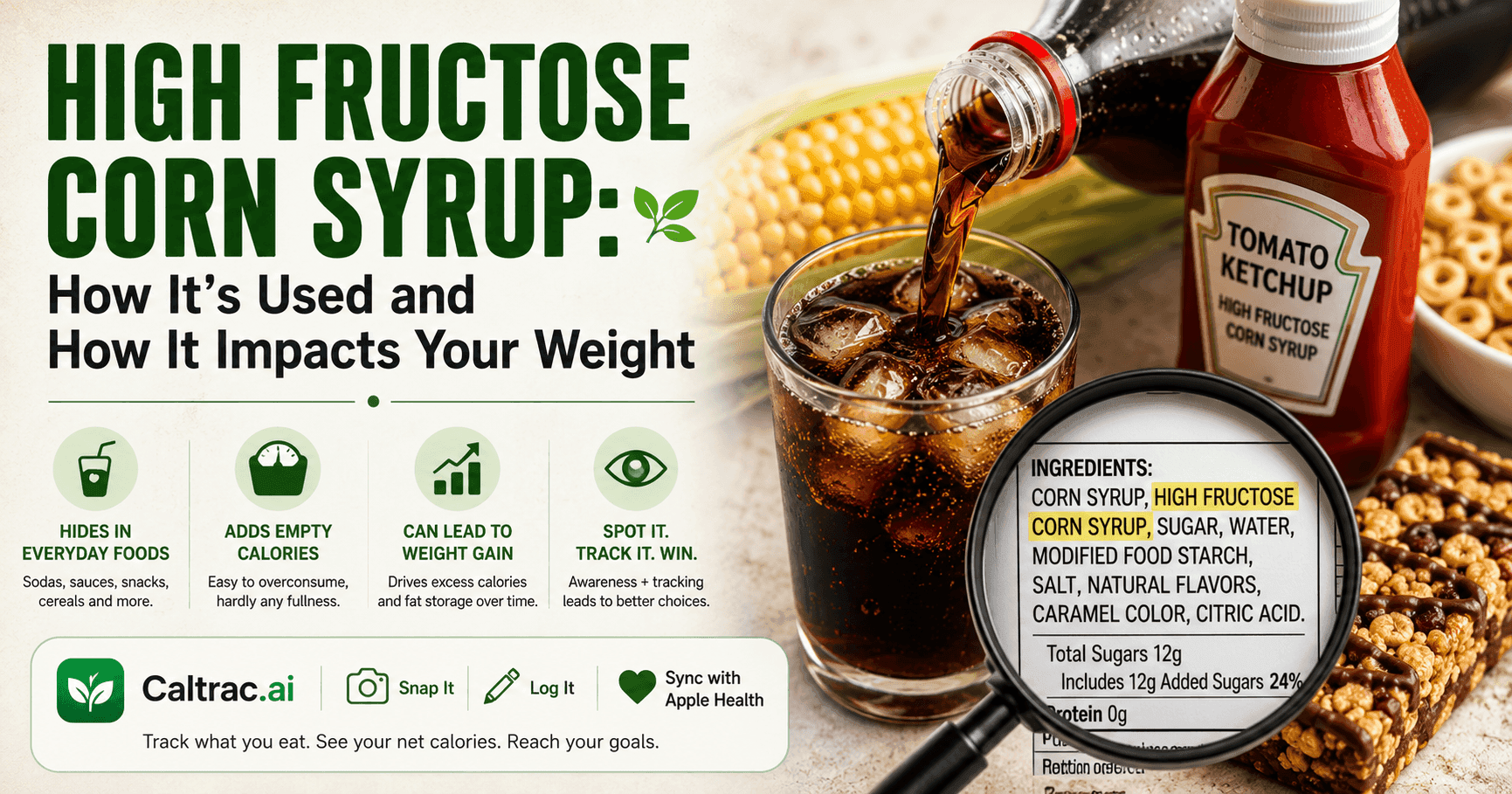
High fructose corn syrup (HFCS) might be the most argued-about ingredient in the modern food supply. It sweetens your soda, hides in your ketchup, and shows up in foods you'd never think of as sugary. The quick verdict: HFCS isn't a unique poison — metabolically it behaves much like regular sugar — but it's a cheap, invisible way for extra calories to flood your diet, and those quiet, easy-to-overconsume calories are exactly how it impacts your weight. Here's what HFCS actually is, where it hides, and how to keep it from working against your goals.
What is high fructose corn syrup?
HFCS is a liquid sweetener made from corn. Manufacturers break corn starch down into glucose, then convert part of that glucose into fructose — the sweeter of the two sugars. The result is a syrup that's roughly half glucose and half fructose, which makes it chemically very similar to table sugar (sucrose), just in liquid form.
Two versions dominate the food supply:
- HFCS-55 (about 55% fructose) — the standard sweetener in sodas and sweetened beverages.
- HFCS-42 (about 42% fructose) — common in baked goods, cereals, sauces, and processed foods.
Food companies love it for practical reasons: it's cheaper than sugar, blends easily into liquids, keeps products moist, extends shelf life, and delivers consistent sweetness at industrial scale. That's why it spread so far, so fast.
How HFCS is used: where it hides in your food
Sweetened drinks are the obvious source — a single 12 oz (355 ml) can of regular soda carries around 35–40g of it. But the reason HFCS matters for your weight isn't just soda; it's how quietly it appears in foods that don't taste like dessert:
- Condiments and sauces: ketchup, BBQ sauce, salad dressings, pasta sauces
- Breads and baked goods: sandwich bread, buns, muffins, crackers
- Breakfast foods: many cereals, flavored yogurts, granola and cereal bars
- Snacks and frozen foods: frozen dinners, snack cakes, some canned fruits and juices
Individually, each source might add only a few grams. Across a normal day of eating, they stack — and because none of them feels like eating sugar, most people dramatically underestimate their intake.
How high fructose corn syrup impacts your weight
Here's the part that matters most, and it's less mysterious than the headlines suggest. HFCS affects your weight through three well-understood routes:
1. It adds calories without adding fullness
HFCS is pure sugar calories — about 4 calories per gram — with zero fiber, zero protein, and almost no effect on satiety. Liquid sources are the worst offenders: research consistently shows that calories you drink don't register with your appetite the way calories you chew do. Drink a 150-calorie soda with lunch and you won't eat 150 calories less; you'll just eat lunch plus the soda. Over weeks, that's the exact recipe for a calorie surplus.
2. It makes overeating effortless
Sweetness drives palatability, and palatability drives intake. Foods engineered with HFCS are easy to eat quickly and hard to stop eating — which is precisely why it's in so many of them. You don't gain weight because fructose breaks the laws of physics; you gain weight because sweetened products make eating more the path of least resistance.
3. In excess, fructose has its own downsides
Unlike glucose, fructose is processed mostly by the liver. In large, chronic amounts — the kind delivered by daily sugary drinks — high fructose intake is associated with increased liver fat and worsening metabolic markers. This isn't unique to HFCS (table sugar delivers nearly identical fructose loads), but it's one more reason heavy, habitual intake works against both your weight and your health.
Is HFCS worse than regular sugar?
Honestly: not meaningfully. Table sugar is 50% fructose; HFCS is 42–55%. Controlled studies comparing the two find they have very similar effects on weight, appetite, and metabolism. The problem was never that HFCS is uniquely evil — it's that HFCS made added sugar cheap and ubiquitous, pushing total intake far beyond the roughly 25g (women) to 36g (men) of added sugar per day that the American Heart Association suggests as a ceiling. Whether the label says "sugar," "corn syrup," or "HFCS," your body mostly sees the same thing: fast, easy calories.
How to cut back without overhauling your life
You don't need to fear every gram — you need visibility. A few high-leverage moves:
- Start with drinks. Swapping sweetened beverages for water, sparkling water, or diet versions is usually the single biggest cut available.
- Read labels on "non-sweet" foods. Sauces, dressings, and breads are where HFCS surprises people.
- Watch serving sizes. A "serving" of BBQ sauce is 2 tablespoons; most people use double.
- Track what you actually eat. Hidden sugar is only hidden until you log it.
That last one is where most people's estimates fall apart — and where tracking pays off. Log your meals with a quick photo or a line of text and track it automatically with Caltrac: you'll see your real calorie and carb totals, and with Apple Health sync your net calories update as you move. HFCS thrives on invisibility; a free, no-paywall food log takes that advantage away.
Bottom line
High fructose corn syrup is used everywhere because it's cheap and versatile — and it impacts your weight mainly by sliding easy, unfilling calories into drinks and processed foods you don't think of as sweet. It's not uniquely worse than sugar, but it makes overconsuming sugar effortless. Cut the sweetened drinks, check labels on sauces and snacks, and log what you eat so the hidden calories stop being hidden.
FAQ
Does high fructose corn syrup cause weight gain by itself? No single ingredient causes weight gain on its own — a sustained calorie surplus does. HFCS contributes by adding calories that don't fill you up, especially in drinks, making a surplus much easier to reach without noticing.
Is HFCS worse than table sugar? Metabolically they're near twins — both are roughly half glucose, half fructose. The practical difference is availability: HFCS made added sugar cheap enough to appear in thousands of products, driving total intake up.
What foods have the most high fructose corn syrup? Regular sodas and sweetened beverages top the list by far, followed by condiments (ketchup, BBQ sauce), baked goods, sweetened cereals, flavored yogurts, and snack bars. Checking the ingredient list is the only reliable way to know.
Do I have to avoid HFCS completely to lose weight? No. Weight loss comes down to your overall calorie balance, not perfection with one ingredient. Cutting the biggest sources — usually sugary drinks — and tracking your intake so nothing hides is far more effective than trying to eliminate every trace.
Can AI track my HFCS consumption? AI can't measure HFCS as a specific molecule — no camera can see what kind of sweetener is in your soda. What it can do is track the calories, carbs, and sugars of everything that contains it, which is what actually matters for your weight. Snap a photo of your meal or type in a packaged item, and a free AI tracker like Caltrac logs the totals in seconds — so the sugary drinks and sauces where HFCS hides show up in your daily numbers instead of slipping past unnoticed