



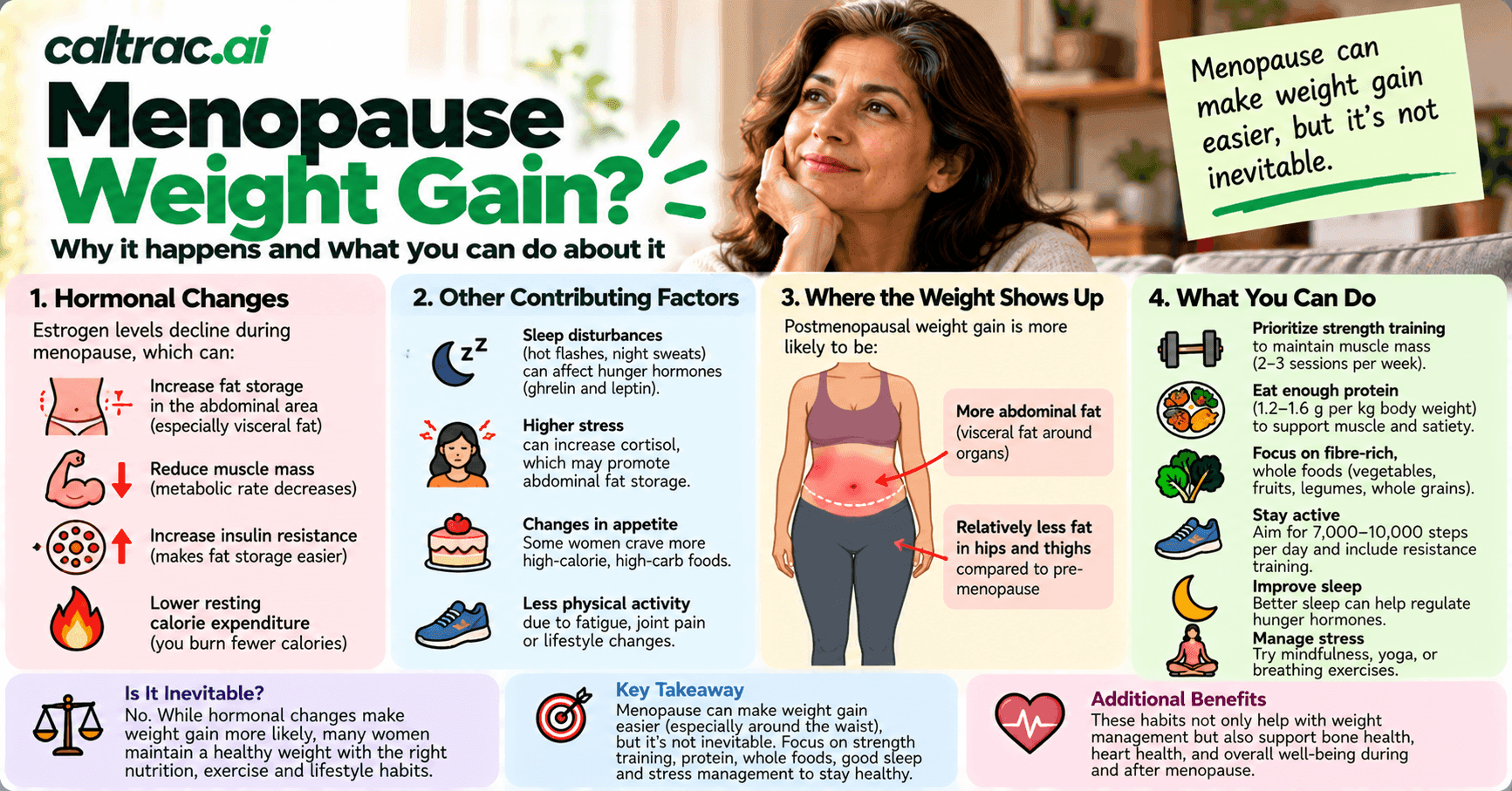
Women gain weight around menopause, and most of what they are told about it is half right. Menopause itself does not add the kilos; age does, at roughly the same rate before and after. What menopause does is move them. The hormonal shift sends fat to the abdomen, takes it from muscle, and nudges energy expenditure down at exactly the moment most women's activity also falls. The result feels like a metabolism that broke, and the fix is not a special diet but a specific set of adjustments to protein, strength training, sleep and calorie targets. This article covers what the research actually shows and what to do about it.
This is general nutrition information, not medical advice; decisions about hormone therapy belong with your doctor.
What Changes, and What Does Not
Weight gain is age, not menopause. A review of the evidence concluded that mid-life weight gain is not attributable to menopause itself; women gain weight through their forties and fifties whether or not they are in the transition [1]. In the Study of Women's Health Across the Nation, which tracked 1,246 women through the transition, total weight rose in a straight line across the menopausal years with no acceleration at the final period [2].
Body composition is menopause. The same study found that at the onset of the transition, the rate of fat gain doubled and lean mass began to fall, and both continued until about two years after the final menstrual period before levelling off [2]. The hormonal change increases total and abdominal fat, and oestrogen therapy ameliorated the shift in trials [1]. Over four years in another cohort, only women who became postmenopausal gained visceral fat, the deep abdominal fat tied to metabolic disease [3]. That shift from muscle to abdominal fat is why clothes stop fitting even when the scale barely moves, and why the transition raises cardiovascular risk [4].
Energy expenditure falls a little, and activity falls more. Sleeping energy expenditure declined over four years in all mid-life women studied, more steeply in those who went through menopause, and fat oxidation fell by about a third [3]. Physical activity also dropped, starting about two years before the final period [3]. Several hundred fewer calories burned a day, from a slower resting rate and less movement, with no change in eating, is a kilo or two a year.
The mechanisms beyond oestrogen, including gut hormones, sleep disruption and the microbiome, are still poorly understood [5], but the practical picture is clear enough to act on.
What Works
Recalculate your calories. The target that maintained your weight at 40 does not at 52. Run the BMR calculator for your current age and weight, then the calorie calculator with an honest activity level, and expect the maintenance number to be 100 to 300 kcal lower than you remember. Weight loss still follows a 500 to 750 kcal daily deficit [6]; it is the starting line that moved.
Raise protein to 1.2 to 1.6 g per kilogram. Lean mass is falling and protein is the only nutrient that slows it. Higher-protein diets in that range preserve muscle during weight loss and improve fullness [7]. For a 70 kg woman that is 85 to 110 g a day, or 30 to 35 g at each of three meals, which is roughly double what many mid-life women eat. Whey protein helps only when paired with training: in postmenopausal women, whey plus resistance exercise improved lower-limb lean mass and strength, while whey alone did nothing measurable [8].
Lift, and lift enough. Resistance training is the direct answer to lean mass loss and abdominal fat gain, but the dose matters more after menopause. In a 20-week controlled trial, a low-volume programme increased fat-free mass in premenopausal women but not postmenopausal ones, and the authors suggest postmenopausal women need more than six to eight sets per muscle group per week to see the same result [9]. Two or three full-body sessions a week, with three to four sets of a push, a pull, a squat and a hinge, meets that.
Protect sleep. Hot flashes and night sweats fragment sleep, and short sleep is independently linked to weight gain: in 68,183 nurses followed for 16 years, women sleeping five hours or less gained 1.14 kg more than those sleeping seven, with a 15% higher risk of obesity [10]. Sleep is covered in detail in our sleep and weight loss article; the short version is a fixed wake time, a cool dark room and no alcohol in the evening.
Eat fibre at every meal. In a six-month calorie-restricted trial, fibre intake predicted both weight lost and adherence better than any other dietary factor [11]. Thirty grams a day from vegetables, pulses, oats and fruit also addresses the constipation and bloating that often arrive with the transition.
Ask about hormone therapy, as a medical question. Menopausal hormone therapy is prescribed for symptoms, not weight, but its metabolic effects are relevant: a meta-analysis of 107 trials found it reduced abdominal fat by 6.8%, improved insulin resistance by 12.9% and lowered new-onset diabetes by 30% in women without diabetes [12]. Whether it suits you depends on your history and is a conversation for your doctor, not an article [13].
The Order of Operations
Most women try to fix mid-life weight by eating less of the same food. That is the one approach that makes the composition problem worse, because a plain calorie cut without protein and lifting loses muscle alongside fat. The order that works is:
- Strength training first, two or three sessions a week at adequate volume [9].
- Protein second, 1.2 to 1.6 g/kg spread across the day [7] [8].
- Then the deficit, a moderate 300 to 500 kcal below a recalculated maintenance, built from fibre-rich food [6] [11].
- Sleep and symptoms alongside, including the medical conversation about hormone therapy if symptoms are disrupting sleep [10] [13].
One more connection worth knowing: in the SWAN cohort, women with higher body fat reported more hot flashes, with 27% higher odds per standard deviation of fat [14]. That is an association, not proof that losing fat reduces flashes, but it is one more reason the composition change is worth taking seriously.
What Not to Expect
The scale will move slowly. A 300 to 500 kcal deficit is a quarter to half a kilo a week, and if you are lifting properly some of the fat lost is replaced by muscle, so the waist shrinks faster than the weight. Measure the waist. Expect the first month to show more change in how clothes fit than in the number. And expect the plateau that comes with any diet, which is covered in our plateau article; it is arithmetic, not menopause.
That is where tracking earns its keep. Protein is the number mid-life women most often miss, and it is invisible without logging. Snap a photo of the plate or type "150 g Greek yogurt, 30 g almonds" and track it automatically with Caltrac. You will see protein and fibre against the targets that matter now, and your Apple Health-powered net calorie count sets the deficit against a maintenance figure that reflects your current age, not the one you remember. Lift, eat the protein, and let the app show you whether you did.
Frequently Asked Questions
Does menopause cause weight gain? Not directly. Weight rises with age at the same rate through the transition [2] [1]. Menopause changes where weight goes: fat gain doubles, lean mass falls, and fat moves to the abdomen [2] [3].
Why is belly fat worse after menopause? Falling oestrogen redirects fat storage to the abdomen; only women who became postmenopausal gained visceral fat over four years in one cohort [3], and oestrogen therapy reduced abdominal fat by about 7% in trials [12].
Does metabolism slow down at menopause? Modestly. Sleeping energy expenditure fell over four years, more in women who went through menopause, with fat oxidation down about a third, and physical activity also dropped [3]. The combined effect is a few hundred calories a day.
How much protein should a woman over 50 eat? About 1.2 to 1.6 g per kilogram of body weight, 85 to 110 g a day for 70 kg, which preserves muscle during weight loss [7]. Whey helps only when combined with resistance training [8].
What exercise is best for menopause weight gain? Resistance training at sufficient volume: more than six to eight sets per muscle group per week, since low-volume programmes did not build lean mass in postmenopausal women [9].
Does HRT help with weight loss? It is not a weight-loss treatment, but a meta-analysis found hormone therapy reduced abdominal fat by 6.8% and improved insulin resistance [12]. Whether it is appropriate is a medical decision [13].
References
- Davis SR, et al. Understanding weight gain at menopause. Climacteric. 2012;15(5):419-429. pubmed.ncbi.nlm.nih.gov
- Greendale GA, et al. Changes in body composition and weight during the menopause transition. JCI Insight. 2019;4(5):e124865. pubmed.ncbi.nlm.nih.gov
- Lovejoy JC, Champagne CM, de Jonge L, Xie H, Smith SR. Increased visceral fat and decreased energy expenditure during the menopausal transition. International Journal of Obesity. 2008;32(6):949-958. pubmed.ncbi.nlm.nih.gov
- Kodoth V, Scaccia S, Aggarwal B. Adverse Changes in Body Composition During the Menopausal Transition and Relation to Cardiovascular Risk: A Contemporary Review. Women's Health Reports. 2022;3(1):573-581. pubmed.ncbi.nlm.nih.gov
- Fenton A. Weight, Shape, and Body Composition Changes at Menopause. Journal of Mid-life Health. 2021;12(3):187-192. pubmed.ncbi.nlm.nih.gov
- Jensen MD, et al. 2013 AHA/ACC/TOS guideline for the management of overweight and obesity in adults. Circulation. 2014;129(25 Suppl 2):S102-S138. pubmed.ncbi.nlm.nih.gov
- Leidy HJ, et al. The role of protein in weight loss and maintenance. American Journal of Clinical Nutrition. 2015;101(6):1320S-1329S. pubmed.ncbi.nlm.nih.gov
- Kuo YY, Chang HY, Huang YC, Liu CW. Effect of Whey Protein Supplementation in Postmenopausal Women: A Systematic Review and Meta-Analysis. Nutrients. 2022;14(19):4210. pubmed.ncbi.nlm.nih.gov
- Isenmann E, et al. Resistance training alters body composition in middle-aged women depending on menopause: a 20-week control trial. BMC Women's Health. 2023;23:526. pubmed.ncbi.nlm.nih.gov
- Patel SR, Malhotra A, White DP, Gottlieb DJ, Hu FB. Association between reduced sleep and weight gain in women. American Journal of Epidemiology. 2006;164(10):947-954. pubmed.ncbi.nlm.nih.gov
- Miketinas DC, et al. Fiber Intake Predicts Weight Loss and Dietary Adherence in Adults Consuming Calorie-Restricted Diets: The POUNDS Lost Study. Journal of Nutrition. 2019;149(10):1742-1748. pubmed.ncbi.nlm.nih.gov
- Salpeter SR, et al. Meta-analysis: effect of hormone-replacement therapy on components of the metabolic syndrome in postmenopausal women. Diabetes, Obesity and Metabolism. 2006;8(5):538-554. pubmed.ncbi.nlm.nih.gov
- Knight MG, et al. Weight regulation in menopause. Menopause. 2021;28(8):960-965. pubmed.ncbi.nlm.nih.gov
- Thurston RC, et al. Adiposity and reporting of vasomotor symptoms among midlife women: the Study of Women's Health Across the Nation. American Journal of Epidemiology. 2008;167(1):78-85. pubmed.ncbi.nlm.nih.gov