


Meal prep works for one unglamorous reason: it moves the decision about what to eat from the moment you are hungry to a moment when you are not. The research on home cooking and planning is consistent, the trial evidence on portion control is strong, and the practical barrier is always the same, which is that nobody wants to eat the same chicken and rice five days running. This guide gives you the evidence, two complete weeks at 1,500 and 1,800 calories built from USDA data with macros, and a system for cooking it in two sessions.
Why Meal Prep Works
Planners weigh less. Among 40,554 French adults, people who planned their meals had better diet quality and more food variety, and women who planned had 21% lower odds of obesity, men 19% [1]. The study is cross-sectional, so it cannot prove planning causes the difference, but the direction matches everything else.
Home cooks eat less. In a US national sample, adults who cooked dinner at home six to seven times a week ate about 2,160 kcal a day against 2,300 for those who cooked once or less, with less fat and 16 g less sugar [2]. Frequent home cooking also raised diet-quality scores substantially and cost less, about $273 a month per person against $330 for infrequent cooks [3].
Portion control is the mechanism. In an eight-week trial of two 1,365 kcal diets, women given portion-controlled entrées lost 5.6 kg against 3.6 kg for women preparing their own meals at the same calorie target [4]. A year-long trial found pre-portioned foods produced faster early loss, though the groups converged by twelve months at about 4.5 kg [5]. Meal prep is portion control you do yourself.
It removes the logging problem. The most common reasons people stop tracking food are effort and not knowing what is in a dish [6]. A prepped meal is weighed once, logged once, and eaten five times.
The Design Rules
Every meal below follows four rules drawn from the research:
- 25 to 35 g of protein per meal, totalling 1.2 to 1.6 g per kilogram of body weight, the range that preserves muscle and controls appetite in a deficit [7] [8].
- Fibre at every meal. Fibre intake was the strongest predictor of weight loss and adherence in a six-month trial [9].
- Calories set by the target. 1,500 kcal is a 500 to 750 kcal deficit for someone maintaining at 2,000 to 2,250; 1,800 for someone at 2,300 to 2,550 [10]. Find yours with the calorie calculator and scale the portions.
- Measured fat. One teaspoon of oil is 40 kcal [11]; it is counted, not poured.
The 1,500 Calorie Week
Five weekdays, repeating. Weekend meals follow the same template with different proteins. All values from USDA FoodData Central; vegetables and spices counted at a flat 40 kcal per portion.
| Meal | Food | Calories | Protein | Fibre |
|---|---|---|---|---|
| Breakfast | 50 g oats [12], 150 g nonfat Greek yogurt [13], 100 g banana [14] | 360 | 22 g | 8 g |
| Lunch | 120 g chicken breast [15], 150 g cooked lentils [16], 150 g roast vegetables, 1 tsp olive oil [11] | 452 | 51 g | 12 g |
| Snack | 2 hard-boiled eggs [17], 1 apple (180 g) [18] | 249 | 13 g | 4 g |
| Dinner | 150 g firm tofu [19] or 120 g chicken, 150 g sweet potato [20], 150 g broccoli [21], 1 tsp oil | 442 | 33 g | 9 g |
| Total | 1,503 | 119 g | 33 g |
For a 75 kg person, 119 g of protein is 1.59 g/kg. The fibre total exceeds the 25 g women's target and approaches the 38 g men's target.
The 1,800 Calorie Week
Same template, larger carbohydrate and fat portions, one extra snack.
| Meal | Food | Calories | Protein | Fibre |
|---|---|---|---|---|
| Breakfast | 60 g oats, 200 g nonfat Greek yogurt, 100 g banana, 15 g almonds [22] | 511 | 30 g | 10 g |
| Lunch | 150 g chicken breast, 150 g cooked brown rice [23], 150 g roast vegetables, 1 tsp oil | 512 | 52 g | 6 g |
| Snack | 150 g cottage cheese [24], 1 apple | 215 | 16 g | 4 g |
| Dinner | 150 g salmon [25], 200 g sweet potato, 150 g broccoli, 1 tsp oil | 580 | 39 g | 11 g |
| Evening | 2 slices whole-wheat bread (60 g) [26] with 15 g peanut butter [27] | 241 | 11 g | 5 g |
| Total | 2,059 | 148 g | 36 g |
That lands about 260 kcal above 1,800 as written, because the salmon and almonds are calorie-dense; drop the evening snack on three of the five days, or swap salmon for chicken, and the week averages 1,800. The point of showing the arithmetic is that you can see exactly which lever to pull.
Swaps That Keep the Template
Boredom kills meal prep faster than hunger does. Each slot has interchangeable options with similar macros:
- Protein, 120 to 150 g cooked: chicken breast, turkey breast, lean beef mince, white fish, salmon, tofu, 200 g cooked kidney beans (254 kcal, 17 g protein) [28], 50 g dry soya chunks, 3 eggs, 200 g Greek yogurt. Rotate two per week.
- Carbohydrate, 150 g cooked: rice (195 kcal per 150 g) [29], brown rice, quinoa, sweet potato, potato, 2 rotis, 60 g dry pasta.
- Vegetables, 150 g or more: anything. Roast a tray of mixed vegetables once; it covers five lunches.
- Flavour, free: spice pastes, lemon, vinegar, chilli, herbs, garlic, mustard, soy sauce in moderation. The oil is the only flavouring that costs calories.
Change the spice profile, not the structure: the same chicken, rice and vegetables becomes Indian, Mexican, Mediterranean or Thai with a different jar.
The Two-Session System
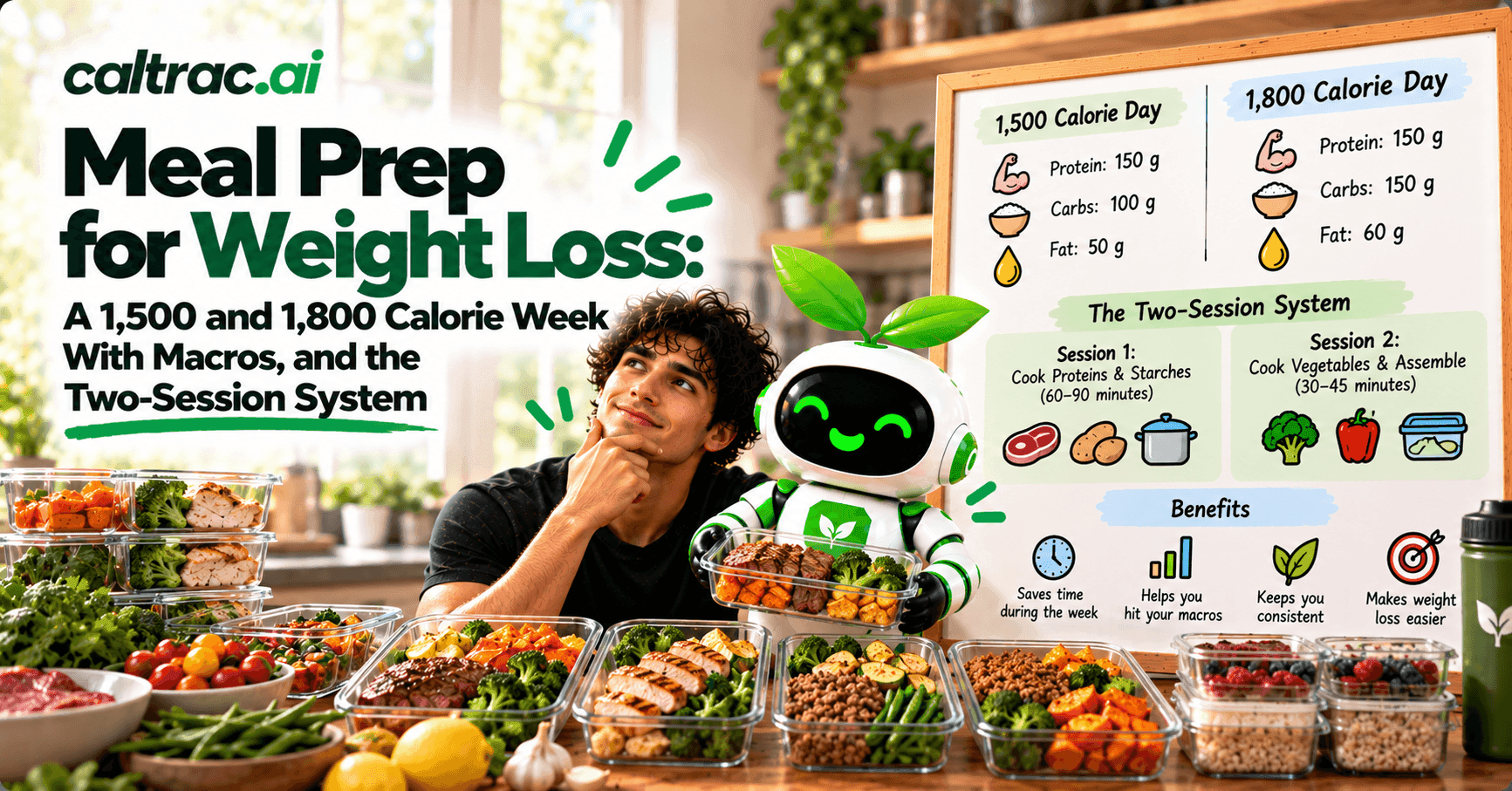
Session one, 90 minutes on Sunday. Roast two trays of vegetables. Cook 750 g of chicken breast or the week's protein. Cook 750 g of rice or sweet potato. Boil ten eggs. Portion into ten containers, five lunches and five dinners, and weigh as you go so the first container is logged and the other nine are copies.
Session two, 20 minutes on Wednesday. Cook the second protein and refresh anything that will not last. This is the step people skip, and it is why their Thursday lunch is a sandwich from a shop.
Food safety. The FDA storage chart gives cooked meat, poultry and mixed dishes three to four days in a refrigerator at 4°C or below, and two to six months in a freezer at −18°C [30]. A Sunday cook therefore covers Monday to Wednesday or Thursday safely; freeze Thursday and Friday's portions on Sunday and move them to the fridge on Wednesday. Cooked food left out for more than two hours, or one hour above 32°C, should be discarded [31].
Where It Goes Wrong, and the Fix
Eating the prepped meal and then something else. The meals above are built to 1,500 or 1,800 kcal in total. If you are hungry after them, the fix is to add protein and vegetables to the meals, not a snack outside them; 119 g of protein a day should hold most people, and if it does not, the deficit may be too large for your maintenance [10].
Under-portioning the protein and over-portioning the rice. Weigh the protein first. It is the expensive ingredient and the one people skimp.
Pouring the oil. One teaspoon is 40 kcal; one tablespoon is 120 [11]. A week of unmeasured tablespoons is a kilo of fat not lost.
Prepping a diet you dislike. The weight-loss benefit of meal prep is adherence [1] [4]; a prepped meal you throw away has no benefit at all. Cook food you want to eat.
Set your own target first with the calorie calculator, and your protein with the macro calculator; then scale the portions above to match.
That is where tracking earns its keep. Weigh and log the first container, snap a photo of it, and track it automatically with Caltrac; the other four are the same meal, logged in seconds. You will see the week's protein, fibre and calories against your targets before Monday starts, and your Apple Health-powered net calorie count shows how each day actually lands. Cook once; let the app log the week.
Frequently Asked Questions
Does meal prep help with weight loss? Yes. Meal planners had 19 to 21% lower odds of obesity in a 40,000-person study [1], frequent home cooks ate about 140 fewer calories a day [2], and portion-controlled meals produced 2 kg more loss in eight weeks at the same calorie target [4].
How many calories should my meal prep be? Your maintenance minus 500 to 750 kcal [10]. For most adults that is 1,400 to 1,900 kcal; the calorie calculator gives your figure.
How long does meal prep last in the fridge? Three to four days for cooked meat, poultry and mixed dishes at 4°C or below; two to six months frozen [30].
How much protein should each meal have? About 25 to 35 g, totalling 1.2 to 1.6 g per kilogram of body weight a day [7] [8].
Can I meal prep for a week at once? Cook on Sunday for Monday to Wednesday, freeze Thursday and Friday's portions, and move them to the fridge mid-week to stay inside the FDA's three-to-four-day window [30].
Is meal prep cheaper? Usually. Frequent home cooks spent about $57 less per person per month on food than infrequent cooks while eating better [3].
References
- Ducrot P, et al. Meal planning is associated with food variety, diet quality and body weight status in a large sample of French adults. International Journal of Behavioral Nutrition and Physical Activity. 2017;14:12. pubmed.ncbi.nlm.nih.gov
- Wolfson JA, Bleich SN. Is cooking at home associated with better diet quality or weight-loss intention? Public Health Nutrition. 2015;18(8):1397-1406. pubmed.ncbi.nlm.nih.gov
- Tiwari A, Aggarwal A, Tang W, Drewnowski A. Cooking at Home: A Strategy to Comply With U.S. Dietary Guidelines at No Extra Cost. American Journal of Preventive Medicine. 2017;52(5):616-624. pubmed.ncbi.nlm.nih.gov
- Hannum SM, et al. Use of portion-controlled entrees enhances weight loss in women. Obesity Research. 2004;12(3):538-546. pubmed.ncbi.nlm.nih.gov
- Rolls BJ, Roe LS, James BL, Sanchez CE. Does the incorporation of portion-control strategies in a behavioral program improve weight loss in a 1-year randomized controlled trial? International Journal of Obesity. 2017;41(3):434-442. pubmed.ncbi.nlm.nih.gov
- Cordeiro F, et al. Barriers and Negative Nudges: Exploring Challenges in Food Journaling. Proceedings of the SIGCHI Conference on Human Factors in Computing Systems. 2015:1159-1162. pmc.ncbi.nlm.nih.gov
- Leidy HJ, et al. The role of protein in weight loss and maintenance. American Journal of Clinical Nutrition. 2015;101(6):1320S-1329S. pubmed.ncbi.nlm.nih.gov
- Schoenfeld BJ, Aragon AA. How much protein can the body use in a single meal for muscle-building? Implications for daily protein distribution. Journal of the International Society of Sports Nutrition. 2018;15:10. pubmed.ncbi.nlm.nih.gov
- Miketinas DC, et al. Fiber Intake Predicts Weight Loss and Dietary Adherence in Adults Consuming Calorie-Restricted Diets: The POUNDS Lost Study. Journal of Nutrition. 2019;149(10):1742-1748. pubmed.ncbi.nlm.nih.gov
- Jensen MD, et al. 2013 AHA/ACC/TOS guideline for the management of overweight and obesity in adults. Circulation. 2014;129(25 Suppl 2):S102-S138. pubmed.ncbi.nlm.nih.gov
- USDA FoodData Central. Oil, olive: 884 kcal per 100 g (1 tsp about 4.5 g, 40 kcal). SR Legacy 171413. fdc.nal.usda.gov
- USDA FoodData Central. Cereals, oats, dry: 379 kcal, 13.2 g protein, 10.1 g fibre per 100 g. SR Legacy 173904. fdc.nal.usda.gov
- USDA FoodData Central. Yogurt, Greek, nonfat, plain: 54 kcal, 9.5 g protein per 100 g. SR Legacy 171312. fdc.nal.usda.gov
- USDA FoodData Central. Bananas, raw: 89 kcal per 100 g. SR Legacy 173944. fdc.nal.usda.gov
- USDA FoodData Central. Chicken breast, roasted: 165 kcal, 31 g protein per 100 g. SR Legacy 171477. fdc.nal.usda.gov
- USDA FoodData Central. Lentils, cooked: 116 kcal, 9 g protein, 7.9 g fibre per 100 g. SR Legacy 172421. fdc.nal.usda.gov
- USDA FoodData Central. Egg, whole, hard-boiled: 155 kcal, 12.6 g protein per 100 g. SR Legacy 173424. fdc.nal.usda.gov
- USDA FoodData Central. Apples, raw, with skin: 52 kcal per 100 g. SR Legacy 171688. fdc.nal.usda.gov
- USDA FoodData Central. Tofu, firm: 144 kcal, 17.3 g protein per 100 g. SR Legacy 172475. fdc.nal.usda.gov
- USDA FoodData Central. Sweet potato, baked: 90 kcal, 3.3 g fibre per 100 g. SR Legacy 170134. fdc.nal.usda.gov
- USDA FoodData Central. Broccoli, raw: 34 kcal per 100 g. SR Legacy 170379. fdc.nal.usda.gov
- USDA FoodData Central. Nuts, almonds: 579 kcal, 21.2 g protein per 100 g. SR Legacy 170567. fdc.nal.usda.gov
- USDA FoodData Central. Rice, brown, cooked: 123 kcal, 1.6 g fibre per 100 g. SR Legacy 169704. fdc.nal.usda.gov
- USDA FoodData Central. Cheese, cottage, 2%: 81 kcal, 10.4 g protein per 100 g. SR Legacy 172182. fdc.nal.usda.gov
- USDA FoodData Central. Salmon, Atlantic, farmed, cooked: 206 kcal, 22.1 g protein per 100 g. SR Legacy 175168. fdc.nal.usda.gov
- USDA FoodData Central. Bread, whole-wheat: 252 kcal, 12.4 g protein per 100 g. SR Legacy 172688. fdc.nal.usda.gov
- USDA FoodData Central. Peanut butter, smooth: 598 kcal, 22.2 g protein per 100 g. SR Legacy 172470. fdc.nal.usda.gov
- USDA FoodData Central. Beans, kidney, cooked: 127 kcal, 8.7 g protein per 100 g. SR Legacy 173740. fdc.nal.usda.gov
- USDA FoodData Central. Rice, white, long-grain, cooked: 130 kcal per 100 g. SR Legacy 168878. fdc.nal.usda.gov
- US Food and Drug Administration. Refrigerator and Freezer Storage Chart (cooked meat and poultry dishes: 3 to 4 days refrigerated, 2 to 6 months frozen). fda.gov
- US Food and Drug Administration. Are You Storing Food Safely? (two-hour rule; refrigerator at or below 4°C). fda.gov