


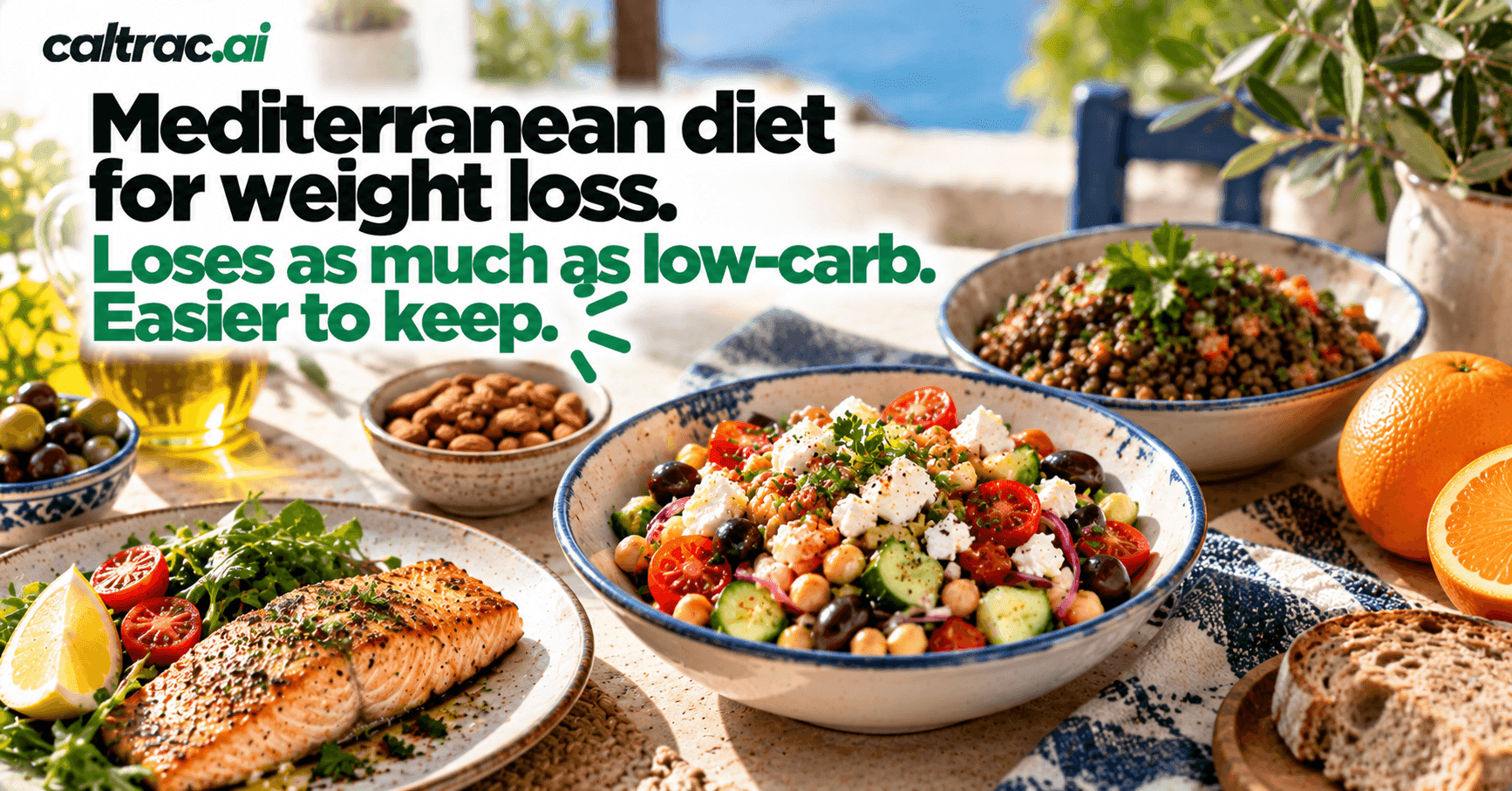
The Mediterranean diet is the most studied eating pattern in the world, and the single most important thing to know about it for weight loss is that the famous trial, the one that cut heart attacks and strokes by about 30%, was not a weight-loss trial and did not restrict calories. The weight-loss evidence is separate, it is good, and it is more modest: a Mediterranean pattern loses about as much weight as any other sensible diet, a little more than low-fat, and it is easier to stay on. Combined with a calorie deficit it did better than usual care in the largest trial to test it. This article separates the heart evidence from the weight evidence, then shows what a Mediterranean week looks like at a deficit, from USDA data.
What the Diet Is
Olive oil as the main fat; vegetables, fruit, legumes, nuts and whole grains daily; fish and seafood often; poultry, eggs and dairy, mostly yogurt and cheese, in moderation; red meat and sweets rarely; wine, if at all, with meals. It is a pattern rather than a prescription, which is why it survives contact with real life better than diets built on rules.
The Heart Evidence
PREDIMED randomised 7,447 Spanish adults at high cardiovascular risk to a Mediterranean diet with extra-virgin olive oil, the same diet with nuts, or advice to reduce fat, with no calorie restriction in any arm. Over a median of 4.8 years, major cardiovascular events fell by 31% in the olive-oil group and 28% in the nut group relative to control [1]. The paper was retracted and republished in 2018 after randomisation irregularities at some sites were corrected, and the results held. An umbrella review of 29 meta-analyses found robust evidence that the pattern reduces overall mortality, cardiovascular disease, coronary heart disease, heart attack, cancer incidence, neurodegenerative disease and diabetes [2].
The mechanism most relevant here is fat quality: replacing saturated fat with unsaturated fat cut cardiovascular events by 17% in a Cochrane review of 15 trials [3], and olive oil, nuts and fish are exactly that replacement.
None of this is about weight. PREDIMED reported no weight-loss result and did not set out to produce one [1].
The Weight Evidence
Head to head with other diets. The DIRECT trial followed 322 adults for two years on low-fat, Mediterranean or low-carbohydrate diets. Weight loss was 2.9 kg, 4.4 kg and 4.7 kg respectively, with the Mediterranean and low-carbohydrate arms statistically ahead of low-fat and not different from each other; adherence was high at 85% at two years, and among the 36 participants with diabetes, glucose and insulin improved more on the Mediterranean diet [4]. The broader literature agrees that the macronutrient split matters little at equal calories: in a two-year trial of four diets, weight loss was the same whatever the carbohydrate, fat and protein mix [5], and in a year-long trial of low-fat against low-carbohydrate, both lost about 5 to 6 kg [6].
Meta-analysis. Across 16 randomised trials in 3,436 people, the Mediterranean diet produced 1.75 kg more weight loss than comparison diets, rising to 3.88 kg when it was combined with energy restriction and 4.01 kg when combined with physical activity; no trial reported weight gain [7]. In trials lasting a year or more, Mediterranean diets lost 4.1 to 10.1 kg against 2.9 to 5.0 kg for low-fat diets, and performed similarly to low-carbohydrate diets [8].
With a deficit, the largest trial. PREDIMED-Plus added calorie restriction and exercise to the Mediterranean pattern in 626 overweight adults with metabolic syndrome. At one year the intervention group had lost 3.2 kg against 0.7 kg for controls on an unrestricted Mediterranean diet, with a third of them losing 5% or more of body weight against 12% of controls, and better waist, glucose, triglycerides and HDL [9].
The pattern across all of it: the Mediterranean diet does not melt fat on its own; the calorie-unrestricted PREDIMED arms were not weight-loss arms. Combined with a deficit, it loses weight at least as well as any alternative, and the adherence figures suggest people keep eating it, which over two years is what decides the result.
Why It Is Easy to Stay On
Three features explain the adherence. Fat is not restricted, so food tastes like food; olive oil, nuts and cheese are in. Fibre is high, because legumes, vegetables, fruit and whole grains are daily; fibre intake predicted weight loss and adherence better than any other factor in a six-month trial [10]. And protein is adequate, from fish, legumes, yogurt, eggs and poultry, in the 1.2 to 1.6 g per kilogram range that preserves muscle and controls appetite in a deficit [11]. The only thing the diet asks you to give up often is red meat and sweets, which most people were going to limit anyway.
A Mediterranean Day at 1,600 Calories
From USDA data, the pattern at a deficit for someone maintaining at 2,100 to 2,300 kcal [12]:
| Meal | Food | Calories | Protein | Fibre |
|---|---|---|---|---|
| Breakfast | 200 g nonfat Greek yogurt, 20 g walnuts, 1 orange (150 g) [13] [14] [15] | 308 | 23 g | 5 g |
| Lunch | 150 g chickpeas, 100 g tomato, 100 g cucumber, 50 g spinach, 30 g feta, 1 tbsp olive oil, lemon, 1 slice whole-wheat bread [16] [17] [18] [19] [20] [21] [22] | 565 | 23 g | 16 g |
| Snack | 1 apple (150 g), 20 g almonds [23] [24] | 194 | 4 g | 6 g |
| Dinner | 120 g grilled salmon, 150 g cooked lentils, 150 g roast vegetables (counted at 40 kcal), 1 tsp olive oil [25] [26] [21] | 501 | 40 g | 15 g |
| Total | 1,568 | 91 g | 42 g |
That day is 42 g of fibre, 91 g of protein and about 3 tablespoons of olive oil and nuts. Swap the salmon for 150 g of cod (162 kcal, 29 g protein) [27] or 120 g of chicken breast (198 kcal, 37 g) [28], the chickpeas for hummus on the bread [29], the lentils for 150 g of whole-wheat pasta with tomato and garlic [30], and the week fills itself.
Two notes on the things people worry about. Olive oil is 119 kcal a tablespoon [21], and the PREDIMED olive-oil arm used about four tablespoons a day with no weight gain, but it was not trying to lose weight either. At a deficit, two to three tablespoons a day is the budget, measured. Wine is 125 kcal a glass [31]; it is permitted in the pattern, it is not required, and at a deficit it competes with food for calories.
How to Start
- Swap the fat first. Olive oil in place of butter and ghee, nuts in place of biscuits. This is the change with the heart evidence behind it [3] [1].
- Put a legume on the plate daily. Chickpeas, lentils, beans or hummus; 150 g is 10 to 12 g of fibre [16] [26].
- Fish twice a week and poultry or eggs on other days; red meat to once a week or less.
- Vegetables at two meals, fruit as the snack. The volume is what makes a 1,600 kcal day feel like enough.
- Set the deficit. The pattern alone maintains weight; the deficit loses it [9]. Find yours in the calorie calculator and the protein target in the macro calculator.
That is where tracking earns its keep. The Mediterranean diet's two calorie-dense pillars, olive oil and nuts, are the two foods people most under-count. Snap a photo of the salad or type "chickpea salad, 1 tbsp olive oil, 30 g feta" and track it automatically with Caltrac. You will see the oil and nuts counted against the day, and your Apple Health-powered net calorie count shows whether the pattern is running at a deficit or at maintenance. Eat Mediterranean; let the app set the dose.
Frequently Asked Questions
Is the Mediterranean diet good for weight loss? Yes, with a calorie deficit. It lost 4.4 kg over two years against 2.9 kg for low-fat in a head-to-head trial [4], 1.75 kg more than comparison diets across 16 trials, and 3.9 kg more when calorie-restricted [7]. Without restriction it maintains weight rather than losing it [1].
How much weight can you lose on the Mediterranean diet? In trials of a year or more, 4 to 10 kg [8]; with calorie restriction and exercise, 3.2 kg in the first year against 0.7 kg for controls in PREDIMED-Plus [9].
Can you eat olive oil and still lose weight? Yes, measured. A tablespoon is 119 kcal [21]; two to three a day fits a 1,600 kcal plan when it replaces butter and ghee rather than adding to them.
Is the Mediterranean diet better than low-carb? Similar for weight: 4.4 kg against 4.7 kg at two years, not statistically different [4]. The Mediterranean pattern has stronger evidence for heart outcomes [1] [2].
Can Indians follow a Mediterranean diet? The pattern translates directly: dal and chana are the legumes, mustard or olive oil the fat, fish or paneer the protein, roti the whole grain, and vegetables at two meals. The change is less ghee, less sugar and more pulses, not different cuisine.
Does the Mediterranean diet include wine? It permits a glass with meals; it does not require it. At 125 kcal a glass [31], wine competes with food in a deficit.
References
- Estruch R, et al. Primary Prevention of Cardiovascular Disease with a Mediterranean Diet Supplemented with Extra-Virgin Olive Oil or Nuts. New England Journal of Medicine. 2018;378(25):e34. pubmed.ncbi.nlm.nih.gov
- Dinu M, Pagliai G, Casini A, Sofi F. Mediterranean diet and multiple health outcomes: an umbrella review of meta-analyses of observational studies and randomised trials. European Journal of Clinical Nutrition. 2018;72(1):30-43. pubmed.ncbi.nlm.nih.gov
- Hooper L, et al. Reduction in saturated fat intake for cardiovascular disease. Cochrane Database of Systematic Reviews. 2020;5:CD011737. pubmed.ncbi.nlm.nih.gov
- Shai I, et al. Weight loss with a low-carbohydrate, Mediterranean, or low-fat diet. New England Journal of Medicine. 2008;359(3):229-241. pubmed.ncbi.nlm.nih.gov
- Sacks FM, et al. Comparison of weight-loss diets with different compositions of fat, protein, and carbohydrates. New England Journal of Medicine. 2009;360(9):859-873. pubmed.ncbi.nlm.nih.gov
- Gardner CD, et al. Effect of Low-Fat vs Low-Carbohydrate Diet on 12-Month Weight Loss in Overweight Adults and the Association With Genotype Pattern or Insulin Secretion: The DIETFITS Randomized Clinical Trial. JAMA. 2018;319(7):667-679. pubmed.ncbi.nlm.nih.gov
- Esposito K, Kastorini CM, Panagiotakos DB, Giugliano D. Mediterranean diet and weight loss: meta-analysis of randomized controlled trials. Metabolic Syndrome and Related Disorders. 2011;9(1):1-12. pubmed.ncbi.nlm.nih.gov
- Mancini JG, Filion KB, Atallah R, Eisenberg MJ. Systematic Review of the Mediterranean Diet for Long-Term Weight Loss. American Journal of Medicine. 2016;129(4):407-415.e4. pubmed.ncbi.nlm.nih.gov
- Salas-Salvadó J, et al. Effect of a Lifestyle Intervention Program With Energy-Restricted Mediterranean Diet and Exercise on Weight Loss and Cardiovascular Risk Factors: One-Year Results of the PREDIMED-Plus Trial. Diabetes Care. 2019;42(5):777-788. pubmed.ncbi.nlm.nih.gov
- Miketinas DC, et al. Fiber Intake Predicts Weight Loss and Dietary Adherence in Adults Consuming Calorie-Restricted Diets: The POUNDS Lost Study. Journal of Nutrition. 2019;149(10):1742-1748. pubmed.ncbi.nlm.nih.gov
- Leidy HJ, et al. The role of protein in weight loss and maintenance. American Journal of Clinical Nutrition. 2015;101(6):1320S-1329S. pubmed.ncbi.nlm.nih.gov
- Jensen MD, et al. 2013 AHA/ACC/TOS guideline for the management of overweight and obesity in adults. Circulation. 2014;129(25 Suppl 2):S102-S138. pubmed.ncbi.nlm.nih.gov
- USDA FoodData Central. Yogurt, Greek, nonfat, plain: 54 kcal, 9.5 g protein per 100 g. SR Legacy 171312. fdc.nal.usda.gov
- USDA FoodData Central. Nuts, walnuts, English: 654 kcal, 15.2 g protein per 100 g. SR Legacy 170187. fdc.nal.usda.gov
- USDA FoodData Central. Oranges, raw: 46 kcal, 2.4 g fibre per 100 g. SR Legacy 169918. fdc.nal.usda.gov
- USDA FoodData Central. Chickpeas, cooked: 164 kcal, 8.9 g protein, 7.6 g fibre per 100 g. SR Legacy 173757. fdc.nal.usda.gov
- USDA FoodData Central. Tomatoes, red, ripe, raw: 18 kcal per 100 g. SR Legacy 170457. fdc.nal.usda.gov
- USDA FoodData Central. Cucumber, with peel, raw: 15 kcal per 100 g. SR Legacy 168409. fdc.nal.usda.gov
- USDA FoodData Central. Spinach, raw: 23 kcal, 2.9 g protein per 100 g. SR Legacy 168462. fdc.nal.usda.gov
- USDA FoodData Central. Cheese, feta: 264 kcal, 14.2 g protein per 100 g. SR Legacy 173420. fdc.nal.usda.gov
- USDA FoodData Central. Oil, olive: 884 kcal per 100 g; 1 tablespoon 13.5 g, 119 kcal. SR Legacy 171413. fdc.nal.usda.gov
- USDA FoodData Central. Bread, whole-wheat: 252 kcal, 12.4 g protein, 6 g fibre per 100 g; 1 slice about 30 g. SR Legacy 172688. fdc.nal.usda.gov
- USDA FoodData Central. Apples, raw, with skin: 52 kcal, 2.4 g fibre per 100 g. SR Legacy 171688. fdc.nal.usda.gov
- USDA FoodData Central. Nuts, almonds: 579 kcal, 21.2 g protein, 12.5 g fibre per 100 g. SR Legacy 170567. fdc.nal.usda.gov
- USDA FoodData Central. Salmon, Atlantic, farmed, cooked: 206 kcal, 22.1 g protein per 100 g. SR Legacy 175168. fdc.nal.usda.gov
- USDA FoodData Central. Lentils, cooked: 116 kcal, 9 g protein, 7.9 g fibre per 100 g. SR Legacy 172421. fdc.nal.usda.gov
- USDA FoodData Central, FNDDS. Fish, cod, grilled: 108 kcal, 19.4 g protein per 100 g. FDC ID 2706242. fdc.nal.usda.gov
- USDA FoodData Central. Chicken breast, meat only, roasted: 165 kcal, 31 g protein per 100 g. SR Legacy 171477. fdc.nal.usda.gov
- USDA FoodData Central. Hummus, commercial: 237 kcal, 7.8 g protein, 5.5 g fibre per 100 g. SR Legacy 174289. fdc.nal.usda.gov
- USDA FoodData Central. Pasta, cooked, enriched: 158 kcal, 5.8 g protein per 100 g. SR Legacy 169737. fdc.nal.usda.gov
- USDA FoodData Central. Wine, table, red: 85 kcal per 100 g; 1 glass about 150 ml, 125 kcal. SR Legacy 173190. fdc.nal.usda.gov