
Today, an AI calorie tracking app can estimate the calories in your lunch from a single photo in about two seconds. Point your phone at a plate, and software identifies the food, guesses the portion, and fills in the macros. It feels effortless — almost magical. But that convenience is the payoff of more than 130 years of science, data, and engineering. The journey from burning food in a lab furnace to snapping a picture of your dinner is a genuinely fascinating one. Here's how calorie tracking became automatic.
Before apps: how we learned to count calories
Long before smartphones, the calorie had to be turned into a practical, measurable unit. In the 1890s, American chemist Wilbur Atwater built a respiration calorimeter — a sealed, room-sized chamber that measured the heat a person produced while resting or exercising inside it, sometimes for days at a time. He also burned food samples in a bomb calorimeter to measure their energy content, analyzing thousands of foods in the process.
Out of that work came the Atwater system: the now-familiar estimates of roughly 4 calories per gram of protein, 4 per gram of carbohydrate, and 9 per gram of fat. Those numbers still sit underneath every nutrition label and every calorie app on the planet.
Turning that science into a weight-loss tool came a little later. In 1918, physician Lulu Hunt Peters published a wildly popular book that reframed calorie counting as an everyday dieting method for the general public. For the next several decades, "tracking" meant a pencil, a notebook, and a printed table of food values.
The first digital calorie trackers
The notebook era lasted a surprisingly long time. The big shift came in 2005, when Mike Lee built MyFitnessPal — reportedly to lose weight before his wedding — and later launched it with his brother Albert. Its breakthrough wasn't artificial intelligence; it was a massive, crowdsourced food database that finally put nutrition numbers for millions of items in your pocket.
When MyFitnessPal arrived on the iPhone App Store in 2009, it took off, eventually growing to tens of millions of users. Under Armour acquired it in 2015 for around $475 million, and it later sold to a private equity firm for $345 million in 2020. For years, it was the default way people counted calories.
But every database-driven app shared one stubborn problem: manual logging. You still had to search for each food, choose the right entry, and eyeball your portion size. That friction is why so many people download a calorie tracker on Monday and quietly abandon it by Wednesday. Solving that friction is exactly what AI was eventually built to do.
When AI learned to "see" food
The first attempts to automate logging came from the research world. Around 2014, scientists began applying convolutional neural networks (CNNs) — the deep-learning models behind modern image recognition — to photos of food.
Then in 2015, a team at Google led by researcher Kevin Murphy demonstrated a project called Im2Calories. It could look at an ordinary phone photo, identify the items on a plate, and even attempt to estimate portion size and volume, then map that to a calorie figure. The team also released a food-image dataset to help train future systems.
It was a genuine milestone — but it was a research prototype, not a shipping product. Real-world accuracy was hard: lighting, angles, mixed dishes, and hidden ingredients all threw the models off. For most of the 2010s, photo-based tracking stayed a "coming soon" promise. In 2023, SnapCalorie, built by a co-founder of Google Lens, became one of the first serious consumer attempts to make it work.
The AI calorie tracking app goes mainstream
The real tipping point arrived with large multimodal AI models — the same generation of AI that can read, reason, and interpret images. These models made food recognition dramatically more capable than the earlier lab systems.
In May 2024, two high-school students, Zach Yadegari and Henry Langmack, launched Cal AI. The concept was simple: snap a photo, get calories and macros. Under the hood, they combined image models from companies like OpenAI and Anthropic with retrieval over open food datasets, and claimed accuracy around 90% for many foods. It went viral on TikTok and grew to millions of downloads in under two years.
In a sign of how fast the category matured, MyFitnessPal — the original database king — acquired Cal AI, with the deal closing in late 2025 and announced in early 2026. That single move tells the whole story: the company that made manual logging mainstream bought the company built to eliminate it.
A quick timeline
| Era | Milestone |
|---|---|
| 1890s | Wilbur Atwater builds the respiration calorimeter and defines the Atwater system (4/4/9) |
| 1918 | Lulu Hunt Peters popularizes calorie counting for weight loss |
| 2005 | MyFitnessPal launches with a crowdsourced food database |
| 2014–2015 | CNNs and Google's Im2Calories bring AI food recognition into the lab |
| 2023 | SnapCalorie ships one of the first serious photo-calorie apps |
| 2024 | Cal AI makes photo-based AI logging go viral |
| 2025–2026 | MyFitnessPal acquires Cal AI; AI logging becomes the norm |
How an AI calorie tracker app actually works today
A modern AI app that tracks calories usually chains together a few steps behind that single tap:
- Recognition — the model identifies what foods are in the image.
- Segmentation — it separates each item on the plate (the rice from the chicken from the sauce).
- Portion estimation — it judges how much of each food is there, using visual cues and reference points.
- Database lookup — it maps each item to nutrition data for calories and macros.
- Reasoning — modern language models help handle messy, real-world descriptions and mixed dishes.
The result is a log entry that used to take a minute of typing, produced almost instantly.
What AI still gets wrong
As good as these tools have become, it's worth being honest about the limits. AI is an estimate, not a lab measurement.
- Portion size is the hardest part — a photo can't always tell a small serving from a large one without a size reference.
- Hidden ingredients like cooking oils, butter, and sugary sauces can add real calories the camera never sees.
- Mixed and homemade dishes are tougher than a plain chicken breast or a labeled package.
The practical takeaway: an AI estimate is a fast, useful starting point, especially when you review and adjust it. Consistency matters more than perfect precision for weight loss.
The future of AI calorie tracking
The trajectory is clear. As multimodal models keep improving, expect better portion estimation, tighter integration with wearables and health data, and more personalized coaching built on top of your logs. The search interest in the best AI calorie tracking apps 2026 reflects a category that's shifted from novelty to expectation — snapping a photo is quickly becoming the default, not the gimmick.
Where this leaves you
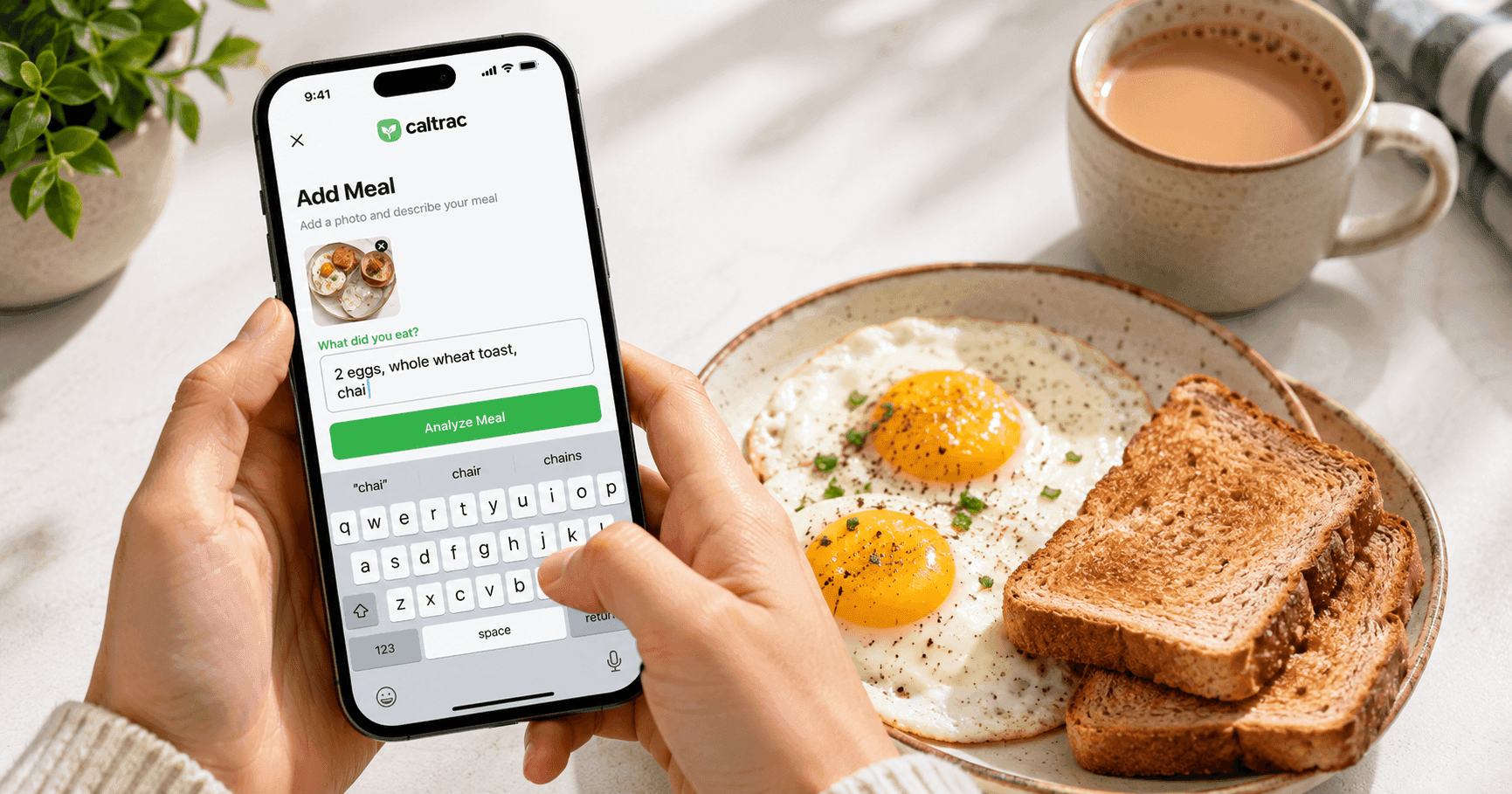
The whole point of this 130-year story is to make one thing easier: knowing what you actually eat. You no longer need a calorimeter, a notebook, or a minute of typing per meal. Instead of guessing, you can track it automatically with Caltrac — snap or describe your meal and get instant calories and macros, so the awareness that used to take real effort now takes seconds.
FAQ
What is an AI calorie tracking app? It's an app that uses artificial intelligence — usually image recognition and language models — to estimate the calories and macros in your food, often from a single photo, instead of making you search a database and log everything by hand.
Are AI calorie tracker apps accurate? They're good estimates, not lab measurements. Modern apps often claim around 90% accuracy for common foods, but portion size and hidden ingredients like oils and sauces can throw the numbers off. Reviewing and adjusting the AI's guess makes tracking far more reliable.
What was the first AI calorie tracking app? Early research like Google's 2015 Im2Calories project pioneered photo-based calorie estimation, but it was a lab prototype. Consumer apps like SnapCalorie (2023) and the viral Cal AI (2024) were among the first to make photo-based AI logging mainstream.
Is there a free AI calorie tracker app?\nMany AI calorie apps use a freemium model — free basic tracking with a paid subscription for advanced features. If you're comparing a free AI calorie tracker app, check what's included at no cost versus what's locked behind a subscription before you commit. You can get started with Caltrac and put its AI photo logging to the test on your own meals to see how automatic tracking fits your routine.